Webhooks de entrada para o Pumble
Com os webhooks de entrada, você pode postar mensagens facilmente de outros aplicativos no Pumble. Ao criar um webhook de entrada, você recebe um URL exclusivo pelo qual pode enviar uma carga JSON com o texto da mensagem.
Criando um webhook de entrada #
Para criar um novo webhook de entrada:
- Clique no nome do seu espaço de trabalho no canto superior esquerdo
- Acesse as Configurações do espaço de trabalho
- Selecione Configurações gerais no menu suspenso
- Clique na seção Webhooks de entrada na barra lateral
- Clique no botão Novo Webhook no canto superior direito
- Escolha o canal onde seu webhook postará mensagens
- Clique no botão Adicionar Webhooks de entrada para concluir o processo
Quando você cria seu webhook, o editor é aberto automaticamente. Lá você poderá personalizar seu nome, alterar o canal, adicionar uma etiqueta descritiva, personalizar o ícone, e o mais importante, copiar ou gerar seu URL exclusivo.
O limite de taxa para webhooks recebidos no Pumble é de um segundo por webhook.
O número máximo de caracteres em um webhook é 10000.
Usando webhook de entrada para enviar uma mensagem #
Para enviar uma mensagem usando os webhooks de entrada que você acabou de criar, basta fazer uma solicitação HTTP POST para o URL exclusivo que você copiou do editor de webhooks.
A carga útil da solicitação deve conter a propriedade texto e esse texto será enviado para um canal especificado. Os tipos de conteúdo atualmente suportados são:
application/jsonapplication/x-www-form-urlencoded
Aqui está um exemplo de solicitação curl para postagem em um canal usando um webhook de entrada com o tipo de conteúdo application/x-www-form-urlencoded:
curl -X POST \ --location "https://api.pumble.com/workspaces/WORKSPACE-ID/incomingWebhooks/postMessage/WEBHOOK-CODE" \ --data-urlencode "payload={ \"text\": \"This is posted to general and comes from a bot named MyNewWebhook.\" }"Aqui está um exemplo de solicitação JSON curl para postar em um canal usando um webhook de entrada:
curl -X POST \ --location
  "https://api.pumble.com/workspaces/WORKSPACE-ID/incomingWebhooks/postMessage/WEBHOOK-CODE" \
  -H "Content-Type: application/json" \
-d '{"text":"This is posted to general and comes from a bot named MyNewWebhook."}'Você pode usar formatação rich text para mensagens webhook. Aqui estão alguns exemplos de payload:
Menção do usuário:
{
   "text": "User mention: <<@{{userId}}>>, channel mention: <<#{{channelId}}>>, user group mention: <<&{{userGroupId}}>> and @here @channel"
}Anexo:
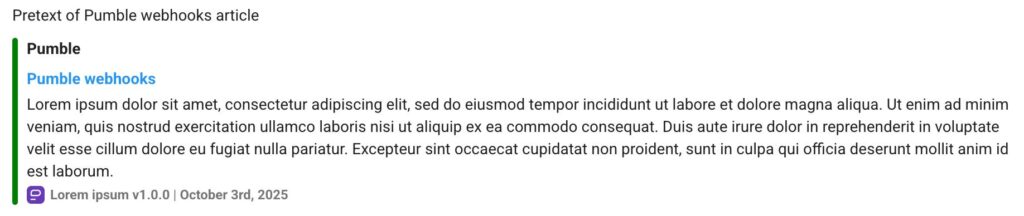
{
   "attachments": [
       {
           "pretext": "Pretext of Pumble webhooks article",
           "title": "Pumble webhooks",
           "title_link": "https://pumble.com/help/integrations/add-pumble-apps/incoming-webhooks-for-pumble",
           "text": "Lorem ipsum dolor sit amet, consectetur adipiscing elit, sed do eiusmod tempor incididunt ut labore et dolore magna aliqua. Ut enim ad minim veniam, quis nostrud exercitation ullamco laboris nisi ut aliquip ex ea commodo consequat. Duis aute irure dolor in reprehenderit in voluptate velit esse cillum dolore eu fugiat nulla pariatur. Excepteur sint occaecat cupidatat non proident, sunt in culpa qui officia deserunt mollit anim id est laborum.",
           "author_name": "Pumble",
           "author_link": "https://pumble.com",
           "footer": "Lorem ipsum v1.0.0",
           "footer_icon": "https://files.pumble.com/avatars/default/pumble-logo",
           "color": "green", // or hex RGB
           "ts": 1759479334
       }
   ]
}
Este exemplo de anexo enviará uma mensagem parecida com esta:
Hiperlinks:
{
    "text": "[Markdown Hyperlink](https:\/\/pumble.com) | <a href=\"https:\/\/pumble.com\">Html hyperlink<\/a> | <https:>"
}Emojis:
{
   "text": "Emojis :raised_hands: :heart:"
}
Bloco de código:
{
   "text": "`Inline code` and ```Code block\n hello \nEnd of code block```"
}
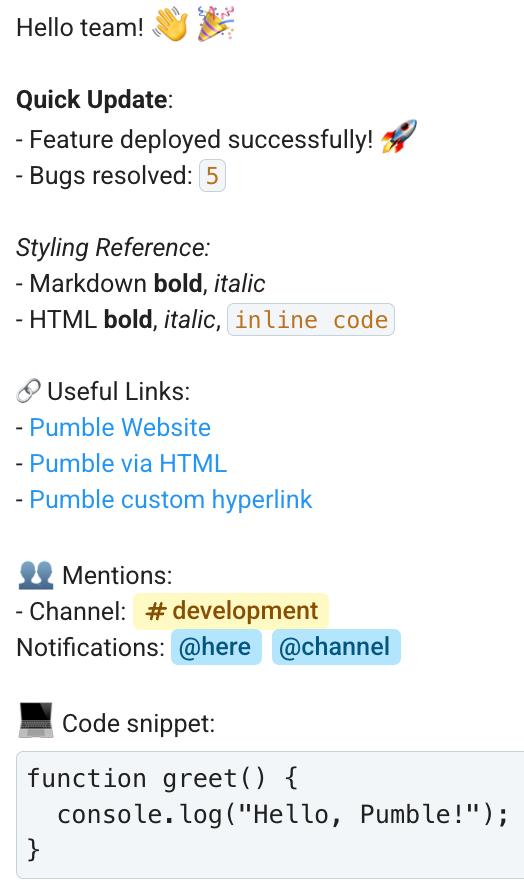
Aqui está um exemplo de mensagem que incorpora diferentes tipos de formatação de rich text:
{
    "text": "Hello team! :wave: :tada:\n\n**Quick Update**:\n- Feature deployed successfully! :rocket:\n- Bugs resolved: `5`\n\n*Styling Reference:*\n- Markdown **bold**, *italic*\n- HTML <b>bold<\/b>, <i>italic<\/i>, <code>inline code<\/code>\n\n\ud83d\udd17 Useful Links:\n- [Pumble Website](https:\/\/pumble.com)\n- <a href=\"https:\/\/pumble.com\">Pumble via HTML<\/a>\n- <https:> \n\n:busts_in_silhouette: Mentions:\n- Channel: <<#{{68e3a383ce5f2c8d95ff46a6}}>> \nNotifications: @here @channel \n\n:computer: Code snippet:```function greet() {\n  console.log(\"Hello, Pumble!\");\n}```"
}
Esta mensagem do webhook ficaria assim:
Processar os erros #
Se tudo estiver configurado corretamente, você receberá um status HTTP 200 indicando que seu webhook de entrada foi bem-sucedido. Isso nem sempre acontece, e essa ação pode falhar por diversos motivos.
Utilize a tabela a seguir para solucionar erros comuns de webhook.
| Código de erro | Mensagem de erro | Causa |
|---|---|---|
400440 | O canal está arquivado. | O canal onde o webhook está enviando mensagens foi arquivado. |
400700 | O webhook de entrada está desativado. | The webhook was disabled by the Workspace Admin. |
400702 | Incoming webhook is deleted. | O webhook foi excluído pelo administrador do espaço de trabalho. |
400703 | Formato de carga útil inválido. | A carga útil da solicitação não está em um dos formatos compatíveis. |
403200 | Você não pode realizar esta operação. | Você não tem permissão para postar no canal especificado. |
404100 | Não encontrado. | O URL exclusivo não foi encontrado e provavelmente foi regenerado por um administrador do espaço de trabalho. |