Mis à jour le 13 mars 2026

Puisque nous consacrons environ un tiers de notre vie au travail, il serait agréable de passer ce temps de manière épanouissante et impliquée, n'est-ce pas ?
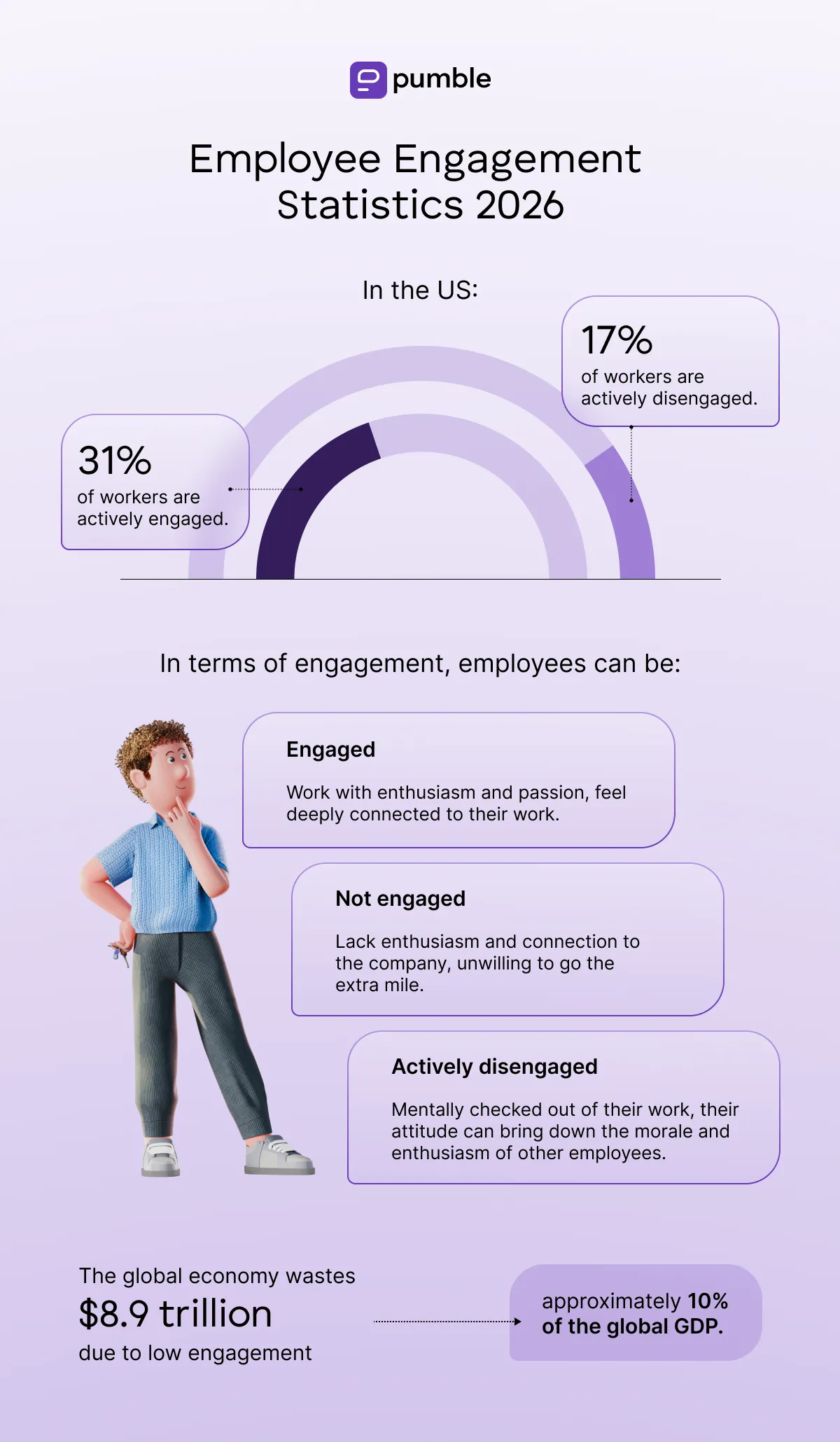
Malheureusement, selon l'indicateur mondial de Gallup, le taux d'engagement des employés aux États-Unis a chuté à 31 %, et à seulement 21 % au niveau mondial.
Mais la situation est-elle aussi sombre que ces chiffres le laissent entendre ?
Nous vous présentons les dernières statistiques sur l'engagement des employés, notamment des données sur :
- Les tendances émergentes en matière d'engagement des employés,
- Le coût du désengagement des employés, et
- Les facteurs qui influencent positivement et négativement l'engagement des employés.
Plongeons dans le vif du sujet.

- Aux États-Unis, 31 % de la population est engagée, contre seulement 21 % des employés à l'échelle mondiale.
- L'économie mondiale perd plus de 8 000 milliards de dollars par an en raison du désengagement des employés.
- Des employés engagés constituent un atout précieux, contribuant à réduire l'absentéisme, les incidents de sécurité et le taux de rotation du personnel.
- Les managers peuvent jouer un rôle déterminant, car ils influencent le niveau d'engagement jusqu'à 70 %.
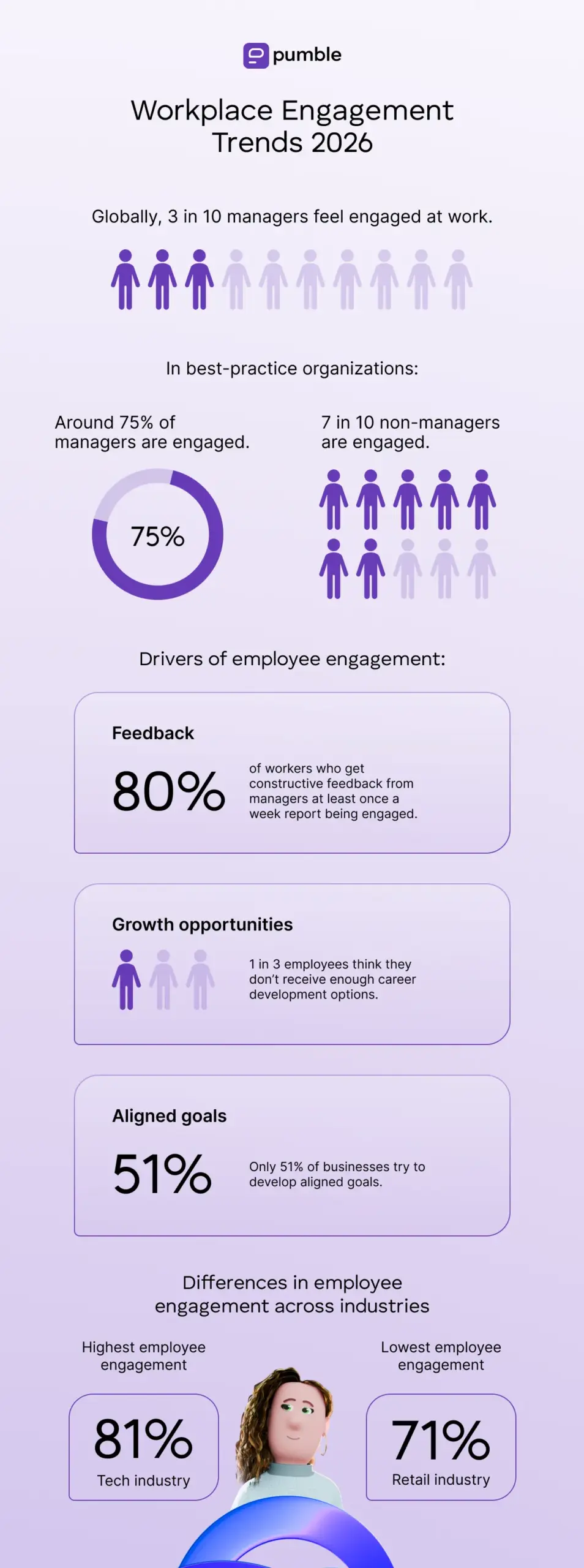
- Le secteur technologique affiche le taux d'engagement le plus élevé (81 %), tandis que les employés du commerce sont les plus désengagés au monde (71 %).
- Les plus jeunes actifs (16-18 ans) sont également les plus désengagés (64 %).
- En matière d'engagement, les employés en mode hybride (77 %) surpassent à la fois les télétravailleurs (76 %) et les employés travaillant sur site (72 %).
Qu'est-ce que l'engagement des salariés ?
L'engagement des employés est un concept qui décrit l'enthousiasme et l'engagement que les travailleurs ressentent à l'égard de leur organisation. Le terme fait également référence aux émotions des employés envers leur entreprise, qui les aident à aligner leurs contributions sur les objectifs de l'organisation.
En général, les employés qui s'investissent dans leur travail adhèrent plus facilement à la culture d'entreprise et obtiennent de meilleurs résultats.
Une étude Gallup sur l'engagement des employés à long terme révèle de nombreux avantages, notamment :
- Un bien-être accru des employés (de 70 %),
- Une rentabilité organisationnelle en hausse (de 23 %),
- Une participation plus active des employés aux initiatives de l'entreprise (de 22 %) et
- Une productivité accrue (de 14 %).
Bien sûr, les choses ne sont pas toujours aussi tranchées et nous reconnaissons 3 niveaux d'engagement :
- Engagé — Employés investis dans leur travail qui ressentent un lien fort avec leur entreprise.
- Désengagé — Employés peu enthousiastes qui font le strict nécessaire, mais qui peuvent se mettre en retrait face à des tâches plus exigeantes.
- Activement désengagé — Employés mécontents et pleins de ressentiment qui propagent leur négativité aux autres.
Alors, que se passe-t-il lorsque les employés ne sont pas engagés, ou pire encore, lorsqu'ils sont activement désengagés ?
Voici ce que révèlent les dernières statistiques sur l'engagement des employés.
L'engagement des employés est en baisse
Selon des données récentes de Gallup, après des années de déclin progressif et de stagnation, l'engagement des employés aux États-Unis a atteint son niveau le plus bas depuis 2020.
En 2024, les tendances en matière d'engagement des employés aux États-Unis ont montré que :
- 31% des travailleurs étaient activement engagés, tandis que
- 17% des travailleurs étaient activement désengagés.
Ces chiffres sont restés inchangés tout au long de l'année 2025.
Cependant, l'étude de HR.com sur la productivité et l'engagement laisse place à l'espoir. Le rapport indique que la plupart des employés sont modérément engagés, avec un score de 7 sur une échelle de 10. Cela dit, pour l'employé moyen, le risque de tomber en dessous de 6 et de basculer dans le désengagement est élevé.
Le coût élevé du désengagement des employés
Quel est le coût du désengagement des employés pour l'économie mondiale ?
En 2025, le rapport State of the Global Workforce de Gallup estimait que le désengagement coûte 438 milliards de dollars à l'économie mondiale.
D'autres rapports avancent des chiffres encore plus élevés. Le « People Element Employee Engagement Report de 2025 » note que l'économie mondiale perd 8,9 billions de dollars en raison du faible engagement — ce qui équivaut à près de 10 % du PIB mondial. Un chiffre similaire apparaît dans le Global Employee Engagement Index d'Effectory, soulignant que les pertes annuelles s'élèvent à 8,8 billions de dollars.
Que signifient ces pertes pour les entreprises et les demandeurs d'emploi ?
Dans l'aperçu de Forbes sur les perspectives d'emploi pour 2026, quelques dures vérités occupent le devant de la scène :
- Premièrement, le marché du travail semble en perte de vitesse, malgré une économie florissante aux États-Unis.
- Deuxièmement, les entreprises seront probablement très sélectives dans leurs décisions d'embauche tout au long de l'année 2026.
Compte tenu de ces circonstances, le « job hugging » — le fait de rester chez son employeur actuel en raison de l'incertitude économique — pourrait devenir un phénomène encore plus répandu dans les prochaines années.
Ces données semblent décourageantes, mais cela ne signifie pas que les organisations doivent réduire leurs dépenses à l'excès pour compenser ces revers. Au contraire, c'est une raison de plus pour investir dans des stratégies d'engagement des employés à long terme.
Les entreprises s'appuient sur des méthodes éprouvées pour mesurer l'engagement de leurs employés
Selon HR.com, 61 % des organisations mesurent régulièrement l'engagement de leurs employés, les méthodes les plus courantes étant :
- Les enquêtes (79 %),
- Les données sur le roulement du personnel et la fidélisation (61 %) et
- Les entretiens de suivi et de départ (59 %).
Malheureusement, seulement 18 % des entreprises qui suivent l'engagement affirment que la majorité de leurs effectifs (plus de 80 %) sont très engagés.
Les différences entre employés désengagés et engagés sont frappantes
Une étude de McKinsey sur l'engagement des employés met en lumière six archétypes de travailleurs, classés selon leur niveau d'engagement et de satisfaction :
- Les employés performants : excellent en matière de performance, de bien-être et d'équilibre entre vie professionnelle et vie personnelle. Ils représentent 4,5 % des effectifs.
- Les employés engagés : accomplissent leurs tâches avec fiabilité, aident souvent leurs collègues et boostent la motivation de l'équipe. Ils constituent 40 % des effectifs.
- Les slashers : moyennement engagés, ils occupent simultanément deux emplois ou plus et représentent 5 % des effectifs.
- Les employés légèrement désengagés : ils font état de faibles niveaux de performance, de satisfaction et d'engagement. Ils représentent 33,5 % des effectifs.
- Les perturbateurs : employés peu performants, profondément insatisfaits de leur travail et dont l'attitude a un impact négatif sur leurs collègues. Ils représentent 12 % des effectifs.
- Les démissionnaires : très démotivés et peu enthousiastes à l'égard de tous les aspects de leur travail. Ils représentent 10 % des effectifs.
S'appuyant sur ces différences, Gallup a constaté que les employés engagés, tels que les « employés performants » et les « employés dévoués », réduisent :
- L'absentéisme de 78 %,
- Les incidents de sécurité de 63 % et
- Le taux de rotation du personnel dans les entreprises à fort taux de rotation de 21 %.
Au sein d'équipes engagées, les managers doivent d'abord tirer profit de ces avantages.
🎓 Astuce Pro de Pumble
Cette ressource présente plusieurs stratégies d'engagement des employés que vous pouvez essayer, y compris un modèle d'enquête pratique sur l'engagement des employés :
L'engagement des managers est en baisse
Le rapport « État des lieux de la main-d'œuvre mondiale » de 2025 a révélé que l'engagement des managers est en déclin. C'est un mauvais signe, car l'édition 2024 indiquait que les managers peuvent influencer l'engagement des employés jusqu'à 70 %. Ils jouent donc un rôle essentiel dans la performance des employés et le bien-être .
Une explication plausible de cette baisse est que les managers sont plus susceptibles d'éprouver des émotions négatives que leurs collègues occupant des fonctions non managériales. Bien qu'ils ressentent des niveaux similaires de stress, de colère et de solitude, l'écart se creuse en ce qui concerne la tristesse et l'inquiétude.
| Expérimenté au quotidien % | ||
|---|---|---|
| Émotion | Managers | Autres employés |
| Stress | 41 | 40 |
| Inquiétude | 39 | 36 |
| Tristesse | 24 | 21 |
| Solitude | 21 | 20 |
| Colère | 21 | 19 |
Compte tenu de cette pression, les managers sont plus susceptibles de chercher un nouveau travail que les non-managers.
Il est intéressant de noter que les collaborateurs individuels font état d'une amélioration de leur bien-être, tandis que les managers plus âgés, ainsi que les femmes managers, enregistrent respectivement une baisse de 5 % et 7 %.
Ces données soulignent la nécessité pour les entreprises de mieux valoriser et soutenir leurs managers, car ils sont en première ligne pour accompagner et responsabiliser leurs équipes.
Dans les organisations aux pratiques exemplaires, le soutien au personnel d'encadrement peut comprendre les éléments suivants :
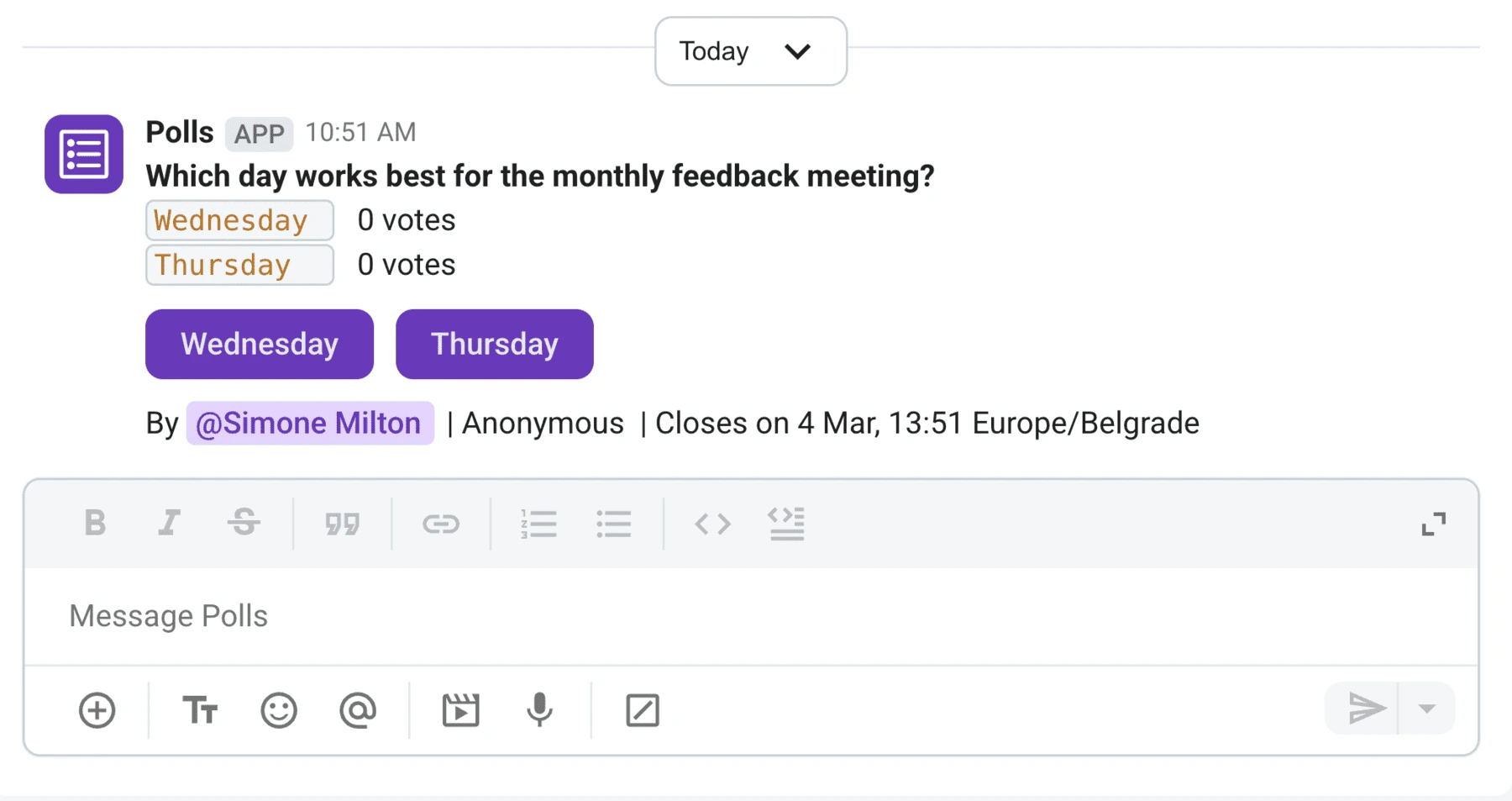
- L'utilisation de sondages dans les applis de communication d'équipe pour déterminer quelles sont les ressources les plus nécessaires,
- La reconnaissance constante des contributions,
- La formation continue et l'investissement dans les opportunités de développement professionnel,
- La rationalisation des procédures RH et
- Les enquêtes annuelles ou semestrielles sur l'engagement des employés centrées sur des sujets spécifiques (par exemple, les reconnaissances et les récompenses, le bien-être des employés, la dynamique de l'équipe, etc.)
Lorsque de telles mesures sont mises en place, les résultats ne tardent pas à suivre. Les entreprises les plus performantes se distinguent par un taux d'engagement élevé, ¾ des managers et 7 employés sur 10 sont activement impliqués.
Boostez votre équipe avec Pumble
Lorsque les managers sont engagés, leurs équipes le sont aussi
La méta-analyse Q12 de Gallup a mis en lumière les données sur l'engagement des managers, notant que seuls 3 managers sur 10 se sentent engagés au travail dans le monde — une triste réalité, puisque le même rapport a révélé que les managers engagés dirigent également des équipes engagées.
En élargissant son enquête sur l'engagement des employés au niveau national, Gallup a produit des données plus spécifiques.
À savoir, dans les pays où les managers font état de niveaux plus élevés d'engagement des employés, les non-managers suivent généralement le mouvement.
Voici la comparaison.
| L'engagement des managers et celui des non-managers (%) | ||
|---|---|---|
| Pays | Managers | Non-managers |
| Le Lesotho, | 49 | 44 |
| Le Costa Rica | 42 | 36 |
| Les États-Unis | 37 | 32 |
| L'Argentine, | 30 | 30 |
| L'Islande, | 27 | 23 |
| Le Canada | 22 | 20 |
| L'Allemagne | 17 | 12 |
| Le Royaume-Uni | 11 | 10 |
| La France | 8 | 8 |
Même dans les pays où l'engagement des employés est faible, les managers obtiennent des scores supérieurs à ceux des autres employés.
Le feedback fait toute la différence
Le rapport Gallup 2024 a également révélé que 80 % des employés qui reçoivent un feedback constructif de leurs managers au moins une fois par semaine sont engagés.
Les conclusions de People Element pour 2025 confirment qu'outre le feedback, d'autres facteurs clés de l'engagement des employés incluent :
- Opportunités de développement — Les employés sont plus enclins à adhérer aux objectifs de l'entreprise lorsqu'ils perçoivent des perspectives d'évolution de carrière ou de perfectionnement.
- Reconnaissance — Se sentir soutenu et reconnu pour un travail valorisant accroît naturellement l'engagement et la satisfaction au travail.
- Confiance envers le leadership — La confiance envers les managers et la direction repose sur une attention sincère et une communication transparente.
Pour garantir un impact positif du feedback sur la performance des employés, les managers devraient :
- Organiser des réunions régulières pour établir des boucles de feedback continu,
- Prioriser la sécurité psychologique, et
- Réaffirmer (et clarifier) les objectifs à long terme.
🎓Astuce Pro de Pumble
Tirer le meilleur parti du feedback est un processus continu. Voici quelques ressources qui peuvent aider votre équipe à récolter les fruits d'un feedback constructif :
Des conversations qui comptent avec Pumble
Des parcours de carrière peu clairs réduisent l'engagement des salariés
People Element a approfondi l'analyse du rôle que jouent les opportunités de croissance dans l'engagement des salariés, révélant qu'un travailleur sur trois estime ne pas bénéficier de suffisamment de possibilités d'avancement.
Des chiffres plus précis indiquent que :
- 65 % des employés jugent équitables les procédures actuelles pour les nouveaux postes vacants, alors que
- 46 % ne croient pas qu'ils obtiendront une promotion.
En réalité, de nombreux travailleurs considèrent que les employeurs sont responsables des obstacles à l'évolution de carrière. Voici les barrières les plus courantes rencontrées par les employés, selon le rapport ADP Research PAW 2025.
| Barriers to career advancement | % |
|---|---|
| Manque d'opportunités | 19 |
| Manque de désir | 13 |
| Manque de temps | 12 |
| Motivation | 10 |
| Manque de support | 8 |
| Manque de confiance | 8 |
| Manque d'expérience | 8 |
| Manque de visibilité | 6 |
| Manque de compétences | 6 |
| Peur | 5 |
| Manque d'éducation | 5 |
À mesure que les conditions économiques et technologiques évoluent, les organisations devront créer des initiatives pour requalifier leur main-d'œuvre et remodeler les emplois. Avec l'implémentation à grande échelle de l'intelligence artificielle (IA) au sein de la population active mondiale, nous pourrions assister à un essor de l'engagement envers la montée en compétences en IA dans les années à venir.
Cela pourrait impliquer de prioriser la mobilité interne des talent, ce qui encourage l'avancement de carrière au sein de l'organisation. Les employés pourraient même souhaiter passer de leur poste actuel à une nouvelle fonction où ils devraient tout recommencer. Pour que cela réussisse, il est nécessaire de cultiver une culture d'apprentissage continu.
La définition d'objectifs stimule l'engagement
L'analyse de HR.com révèle que 72 % des employés se fixent des objectifs professionnels et personnels pour accroître leur engagement.
Lorsque les équipes s'efforcent constamment et proactivement d'atteindre de nouveaux objectifs, elles favorisent :
- La productivité,
- La fidélisation,
- La sécurité,
- L’engagement et
- Le bien-être.
Bien entendu, ces avantages ne se concrétisent que si les objectifs sont régulièrement réévalués et définis.
🎓 Astuce Pro de Pumble
Aligner votre équipe sur les objectifs de l'entreprise demande un certain effort. Ce guide en trois étapes peut vous aider à démarrer :
Le secteur des technologies est en tête pour ce qui est de l'engagement des salariés
En 2024, le rapport mondial de WorkL sur les lieux de travail a mis en évidence des disparités en matière d'engagement des employés selon les secteurs d'activité.
Le secteur technologique occupe la première place avec 78 %, soit 5 % de plus que la moyenne mondiale. Ce constat s'est confirmé en 2025, le dernier rapport de WorkL indiquant que le secteur technologique atteignait 81 %. L'analyse a également souligné le Royaume-Uni comme un exemple positif de secteur technologique florissant, avec un taux d'engagement de 85 %.
Autre fait intéressant concernant le secteur technologique. Outre son taux d'engagement des employés le plus élevé, il présente également le taux de départ le plus faible. Autrement dit, ses employés sont les moins susceptibles de quitter leur emploi actuel pour une nouvelle opportunité. Cependant, compte tenu des progrès rapides réalisés dans les domaines de l'IA, de la robotique et de la cybersécurité – mentionnés dans le rapport « Tendances technologiques 2026 » de Deloitte – il est difficile de déterminer dans quelle mesure ce faible taux de rotation est dû à une fidélisation par crainte de l'inaction.
Les secteurs du commerce de détail et de la défense ont les employés les plus désengagés
En 2024, le secteur de la Défense occupait la dernière place, avec un taux d'engagement des employés de 68 %.
La situation dans le secteur du commerce de détail n'était guère meilleure, son taux d'engagement chutant à 69 %. Le désengagement des employés était particulièrement répandu en Nouvelle-Zélande, au Royaume-Uni et au Canada.
Les employés étaient particulièrement mécontents :
- Du manque de personnel,
- D'une direction irrespectueuse,
- D'une rémunération insuffisante et
- Des horaires de travail.
En 2025, une légère amélioration semble s'être amorcée, l'engagement atteignant 71 % dans le secteur du commerce de détail. Malgré cette hausse, les employés du commerce restent le groupe le plus désengagé de la population active mondiale, signe de leur insatisfaction persistante concernant :
- La protection des travailleurs,
- Les changements économiques, et
- La culture d'entreprise.
Les écarts entre les sexes et les handicaps persistent
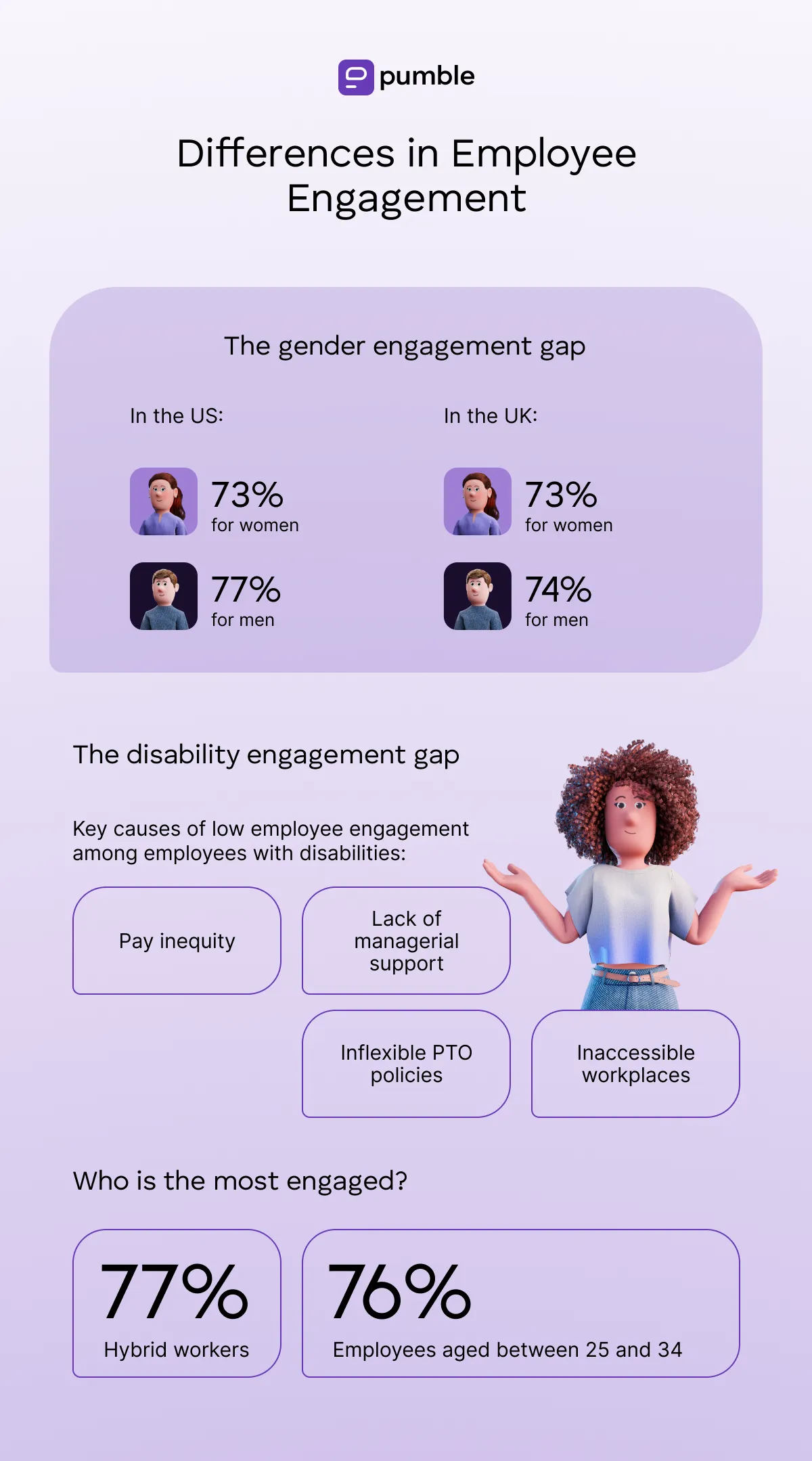
Les données de WorkL sur l'engagement des employés pour 2024 ont révélé une légère différence entre les hommes et les femmes. Le déséquilibre le plus marqué se trouvait aux États-Unis, où le score d'engagement était de 73% pour les femmes contre 77% pour les hommes.
De plus, les femmes étaient plus susceptibles de quitter leur emploi, avec un risque de départ de 25%, tandis que ce score tombait à 20% chez les hommes.
Les chiffres de 2025 montrent que l'écart entre les sexes se réduit, du moins dans certains pays, ce qui est prometteur. Au Royaume-Uni, par exemple, les hommes ont obtenu un score de 74%, et les femmes ne sont pas loin derrière avec 73%.
Cependant, en 2024, c'est au Royaume-Uni que l'écart lié au handicap était le plus prononcé. Les travailleurs en situation de handicap y affichaient un score d'engagement de 68%, soit le taux le plus bas au monde. Ils ont indiqué que l'un des principaux facteurs de leur mécontentement était le manque de sensibilisation au handicap dans l'environnement de travail.
À l'inverse, les États-Unis se sont distingués comme une exception positive en 2025. Alors que le taux d'engagement global y était de 76%, il grimpait à 77% pour les employés en situation de handicap.
Au Royaume-Uni, le mécontentement des employés s'est accentué en ce qui concerne la satisfaction salariale. Sur ce point précis, le taux d'engagement des personnes handicapées est tombé à 63%, contre 66% pour les autres travailleurs.
Éliminer l'écart d'engagement et de satisfaction salariale nécessitera de s'attaquer aux causes principales du faible engagement des employés, notamment :
- L'iniquité salariale,
- Le manque de soutien managérial,
- Des politiques de congés payés rigides, et
- L'inaccessibilité des lieux de travail.
Les jeunes employés sont les moins engagés
Actuellement, cinq générations cohabitent au travail, et les différences générationnelles compliquent la tâche des entreprises pour maintenir un engagement constant.
En conséquence, l'engagement est au plus bas (64 %) chez les plus jeunes employés (âgés de 16 à 18 ans). WorkL note que leur désengagement provient souvent de :
- Obstacles professionnels rencontrés lors de leurs premiers emplois,
- Salaires insufficient et horaires de travail instables,
- Manque d'opportunités de développement de carrière.
Une hausse de l'engagement se produit chez les travailleurs âgés de 25 à 34 ans, atteignant un sommet de 76 %. L'engagement reste constant même pour les travailleurs de plus de 65 ans, avec un pic à 75 %.
Pour clarifier ces statistiques, WorkL a conclu que les jeunes travailleurs et les employés plus âgés partagent les mêmes valeurs.
Plus précisément, ils valorisent tous deux :
- Une rémunération plus élevée,
- Un équilibre entre vie professionnelle et vie privée,
- Un leadership fort, et
- La flexibilité.
Mais leurs priorités diffèrent, car les jeunes travailleurs accordent de l'importance à :
- L'acquisition de nouvelles compétences,
- Le développement de leur carrière,
- L'utilisation d'outils modernes, et
- Un environnement de travail positif et inclusif.
Les employés de plus de 55 ans se préoccupent d'autres aspects, tels que :
- L’indépendance,
- La confiance envers leur expertise et leur expérience, et
- La stabilité et la sécurité de l'emploi.
🎓 Astuce Pro de Pumble
Pour découvrir comment créer des liens entre vos employés de différentes générations, consultez l'article de blog suivant :

La rémunération reste un point d'amélioration essentiel
Les recherches de WorkL sur l'engagement des employés ont révélé qu'à l'échelle mondiale, les employés aimeraient travailler moins d'heures avec une meilleure rémunération.
Le nombre d'employés recherchant un travail flexible — qu'il soit hybride ou entièrement à distance — ha doublé entre 2019 et 2024. De plus, 24% des employés qui souhaiteraient plus de flexibilité mentionnent également vouloir un salaire plus élevé.
Rien d'étonnant, lorsque les employés estiment être rémunérés équitablement, leur niveau d'engagement s'améliore.
Regardons le graphique.
| Pays | Engagement des salariés (%) parmi les personnes estimant être payées équitablement |
|---|---|
| Les Philippines | 79 |
| Les Émirats arabes unis | 74 |
| Les États-Unis | 71 |
| Mondial | 70 |
| Le Canada | 69 |
| L'Australie | 69 |
| Le Royaume-Uni | 68 |
L'analyse 2025 de WorkL confirme que la rémunération équitable est un élément essentiel de l'engagement des employés. Ces derniers recherchent de plus en plus des emplois où leurs compétences, leur expérience et leur expertise seront véritablement valorisées.
L'engagement des employés est au plus haut chez les travailleurs hybrides
La flexibilité est un thème central du rapport 2025 de WorkL. En plus d'un désir de souplesse dans les horaires d'embauche et de départ, de nombreux salariés ont exprimé leur intérêt pour la semaine de 4 jours.
Les données soulignent également la volonté des employés de mieux contrôler où et quand ils travaillent. En d'autres termes, le modèle hybride est perçu comme un moyen efficace d'éliminer les trajets inutiles et d'établir des frontières plus claires entre vie professionnelle et vie privée.
Les chiffres confirment ce sentiment, les travailleurs hybrides affichent le taux d'engagement le plus élevé (77 %), suivis de près par les travailleurs en distanciel complet (76 %). Pour les employés sur site à temps plein, l'engagement chute à 72 %.
Ce recul pourrait être un effet secondaire des pressions croissantes pour le retour au bureau, phénomène surnommé « hybrid creep ». Des trajets plus longs, des horaires rigides et le suivi de l'assiduité peuvent tous avoir des effets néfastes sur l'engagement des collaborateurs.
🎓 Astuce Pro de Pumble
La communication hybride représente un défi pour de nombreuses entreprises, car elle implique la gestion d'équipes travaillant à la fois sur site et à distance. Pour vous aider à trouver le juste équilibre au sein de votre équipe, consultez la ressource suivante :
La confiance dans les dirigeants continue de stimuler l'engagement des salariés
Les données de People Element pour 2024 indiquent que la confiance envers le leadership s'érode, avec seulement :
- 23% des salariés déclarent faire confiance à leur direction,
- 2 salariés sur 3 estiment que la direction communique une vision claire de l'avenir et
- 63% des salariés estiment qu'ils reçoivent une communication suffisante de la part de la direction.
Cette même année, dans son réexamen de l'engagement des employés, CultureAmp a rapporté que dans les organisations où les employés ont confiance en leurs dirigeants, l'engagement suit une trajectoire ascendante.
Pourtant, seulement 37% des entreprises ont demandé l'avis de leur personnel concernant la confiance dans le leadership en 2024, contre 54% en 2019. Ce déclin pourrait indiquer une tendance négative, où les entreprises évitent délibérément cette question pour éviter des réponses indésirables ou pourraient ne pas vouloir allouer de ressources pour traiter le problème.
Selon People Element, voici les principaux leviers mondiaux de l'engagement des employés en 2025, particulièrement en ce qui concerne la confiance envers la direction.
| Confiance envers le leadership |
|---|
| « Je suis tenu informé des sujets qui me touchent. » |
| « La direction communique une vision claire de l'avenir. » |
| « La communication de la haute direction est suffisante. » |
Les indicateurs ci-dessus mettent en évidence d'éventuels cas d'amélioration. Notamment, les participants à l'enquête People Element ont attribué une note à la communication du leadership inférieure à celle de 2023. Ces résultats montrent que le personnel attend des dirigeants et de la haute direction qu'ils incarnent les « 3 C » (Caractère, Compétence et Communication).
Créez un lien de confiance avec votre équipe sur Pumble
Le respect au travail atteint un nouveau seuil
Les données de Gallup sur le respect au travail montrent que 4 travailleurs sur 10 aux États-Unis estiment être traités avec respect dans le cadre de leur emploi. En 2024, seuls 37 % des employés ont déclaré être traités avec respect au travail, soit le chiffre le plus bas depuis 2022.
Pourquoi est-ce important ? D'une part, les employés engagés sont cinq fois plus susceptibles de se sentir respectés au travail que leurs collègues désengagés. D'autre part, le manque de respect engendre non seulement des relations plus fragiles entre collègues, mais il accroît également les risques de harcèlement ou de discrimination.
Les marchés locaux de l'emploi influencent l'engagement des salariés
L'état du marché local de l'emploi est un autre facteur qui impacte l'engagement au travail — lorsque les opportunités d'emploi se font rares, le niveau de désengagement augmente.
À l'inverse, quand le marché de l'emploi s'améliore, les taux d'engagement des salariés progressent également. C'est tout à fait logique, il est naturel de ressentir de l'insatisfaction lorsque l'on ne parvient pas à trouver un meilleur poste.
Examinons quelques données régionales issues du rapport « State of the Global Workplace ».
| Classement régional | Engagement des employés (%) |
|---|---|
| États-Unis et Canada | 31 |
| Amérique latine et Caraïbes | 31 |
| Asie du Sud | 26 |
| Eurasie post-soviétique | 26 |
| Asie du Sud-Est | 26 |
| Australie et Nouvelle-Zélande | 23 |
| Afrique subsaharienne | 19 |
| Asie de l'Est | 18 |
| Moyen-Orient et Afrique du Nord | 14 |
| Europe | 13 |
Notez qu'une augmentation de l'engagement des employés ne se produit pas automatiquement lorsque les conditions économiques s'améliorent. Pour cela, des changements politiques et socio-économiques doivent également avoir lieu.
Les équipes jouent un rôle essentiel dans l'engagement des employés
Les données montrent qu'il ne suffit pas de former des équipes en espérant une amélioration de l'engagement des employés.
En 2025, le rapport PAW Engagement d'ADP Research a conclu que les équipes performantes génèrent des employés très engagés. Plus précisément, 55 % des répondants travaillant dans des équipes performantes se disent engagés au travail, contre seulement 10 % des employés faisant partie d'équipes moyennes.
Alors, quelle est la proportion d'employés travaillant dans des équipes exceptionnelles si l'on examine les données par pays ?
| Pays | % des employés travaillant dans des équipes exceptionnelles |
|---|---|
| L'Égypte, | 39 |
| L'Înde | 33 |
| Le Nigéria, | 29 |
| L’Arabie saoudite, | 28 |
| L'Afrique du Sud | 27 |
| Le Brésil, | 25 |
| Les États-Unis | 24 |
| La Chine, | 24 |
| Le Singapour | 23 |
| Le Royaume-Uni | 20 |
Globalement, le constat est le suivant, seulement 1 employé sur 5 estime faire partie de la meilleure équipe avec laquelle il ait jamais travaillé au cours de sa carrière.
Créez une équipe ultra-engagée avec Pumble by CAKE.com
D'après les statistiques sur l'engagement des employés que nous avons évoquées, il est probable qu'environ un quart seulement de vos effectifs soit activement engagé. Cet engagement chute drastiquement dans un climat de peur et d'incertitude.
Il est donc essentiel de s'attaquer aux difficultés dès leur apparition.
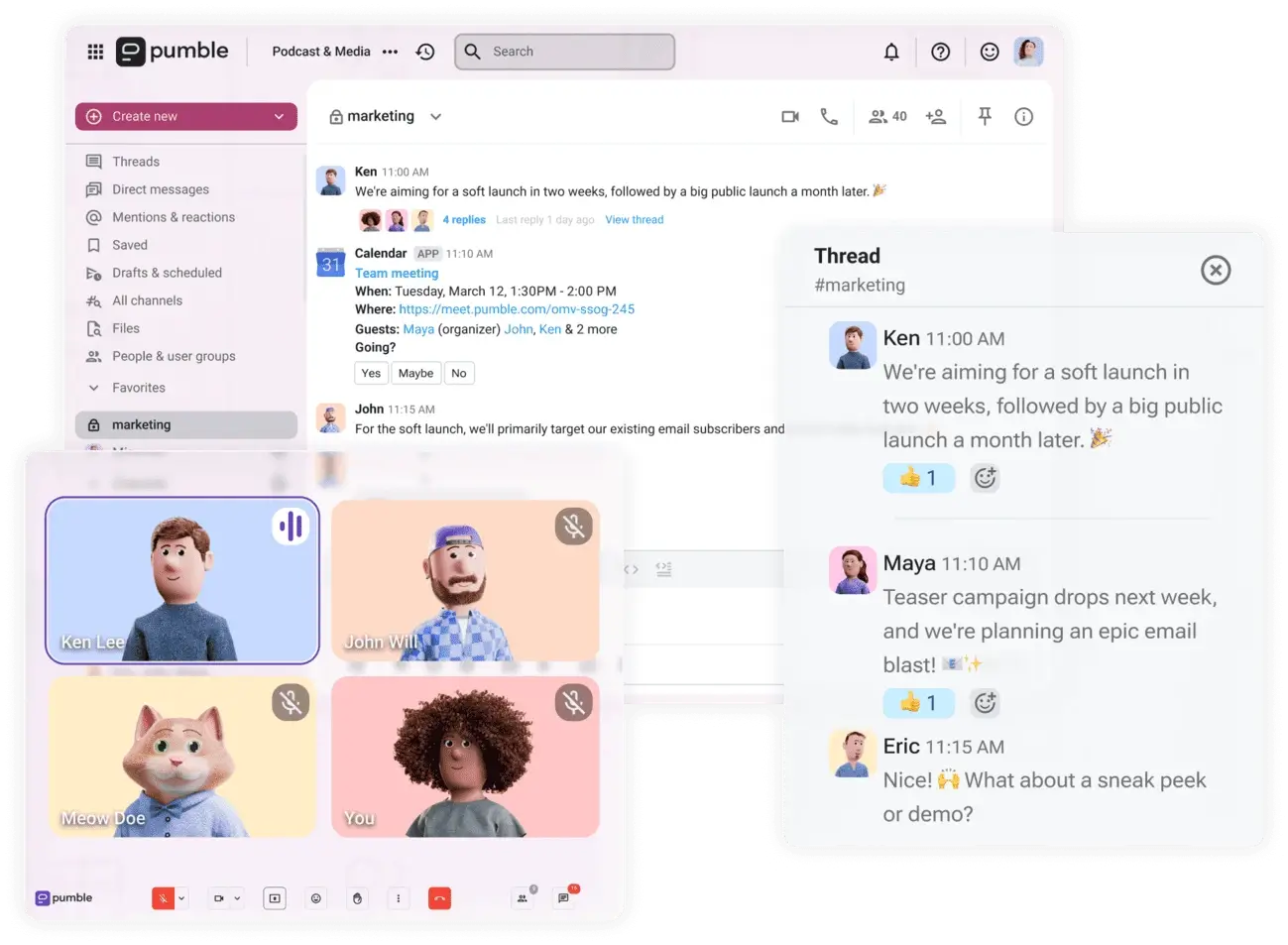
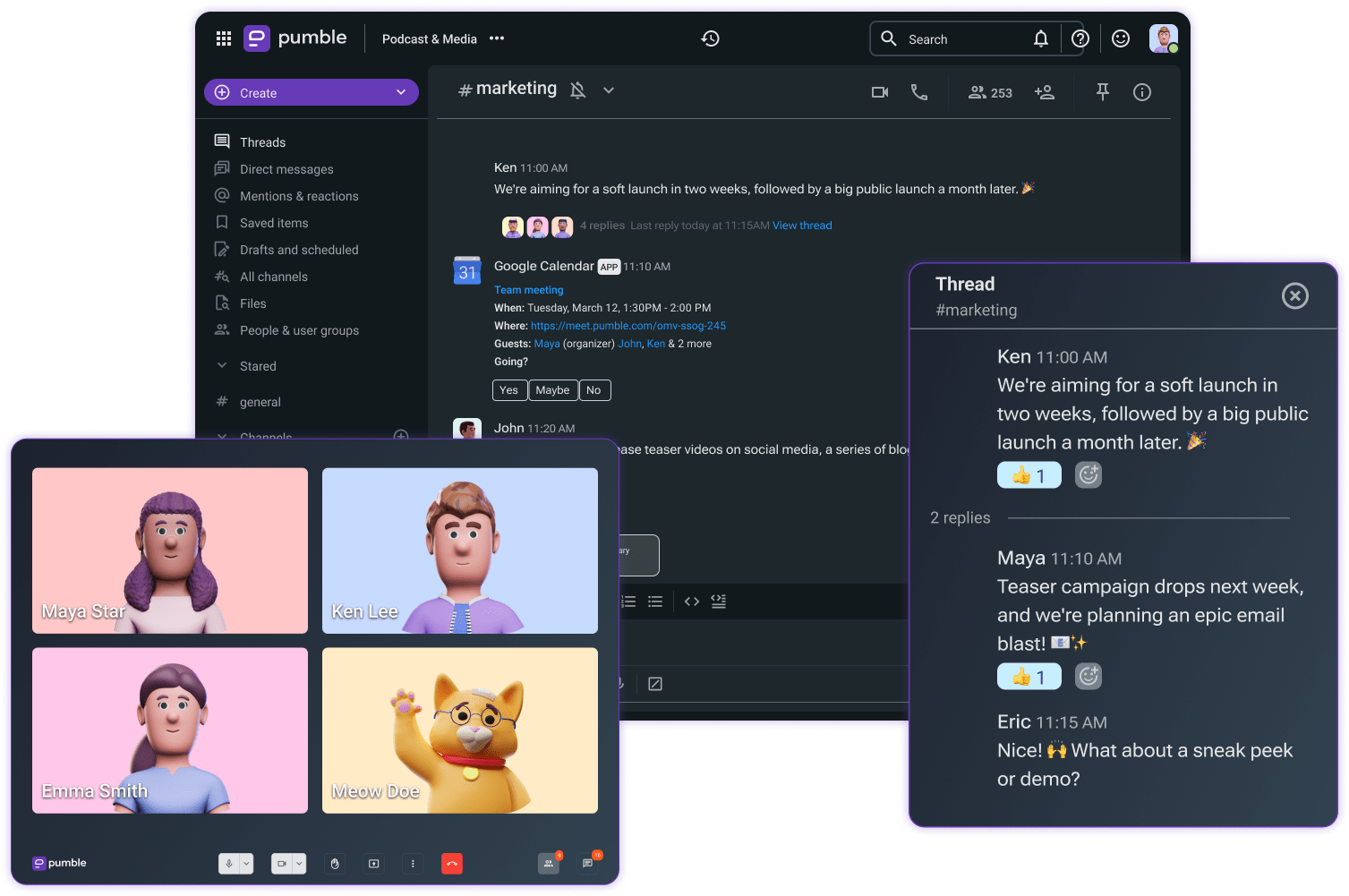
Des applications comme Pumble par CAKE.com simplifient la communication au travail, avec des messages directs en temps réel et des fils de discussion permettant à chacun d'avoir des échanges transparents.
Maintenez le dialogue grâce aux fonctionnalités de visioconférence et communiquez avec vos collègues de manière plus humaine et empathique.
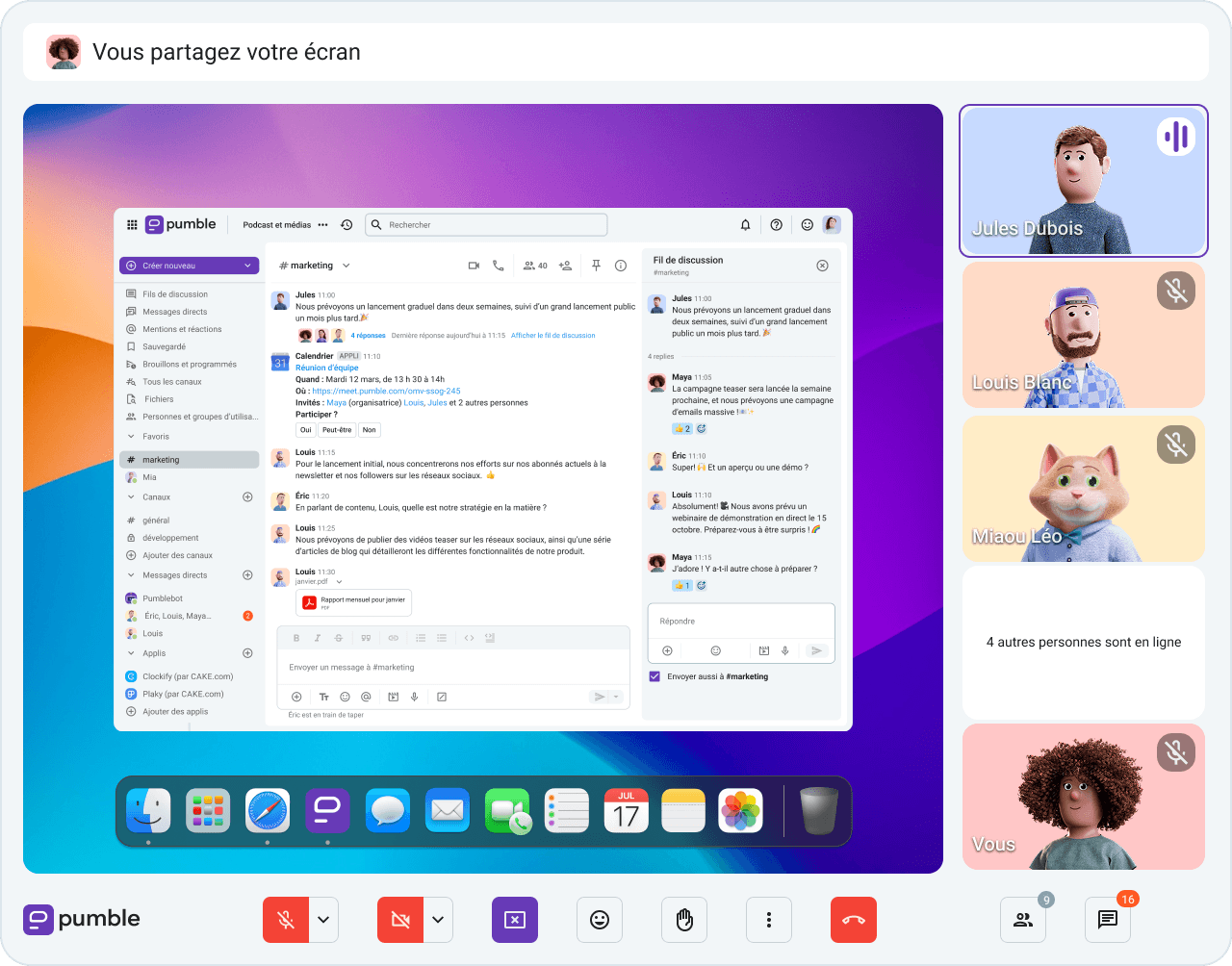
Tirez pleinement parti desfonctionnalités de communication et de collaboration de Pumble et assurez-vous que l'engagement des employés ne devienne jamais un obstacle.
Gardez votre équipe connectée, quel que soit l'endroit où elle travaille.
Références :
- ADP Research. (2025). People at work: A global workforce view 2025. https://www.adpresearch.com/wp-content/uploads/2025/03/PAW2025-Final.pdf
- Comfort, P. (2019). Does character matter? The three C’s of leadership. Business.com. https://www.business.com/articles/the-three-cs-of-leadership/
- Deloitte. (2025). Tech trends 2025. Deloitte Insights. https://www.deloitte.com/us/en/insights/topics/technology-management/tech-trends.html
- Effectory. (2025). Global employee engagement index. https://go.effectory.com/hubfs/EN-Downloads/Effectory_Global_Employee_Engagement_Index_2025.pdf?hsLang=en
- Gallup. (2024). Gallup Q12® meta-analysis. https://www.gallup.com/workplace/321725/gallup-q12-meta-analysis-report.aspx
- Gallup. (2024). Global indicator: Employee engagement. https://www.gallup.com/394373/indicator-employee-engagement.aspx
- Gallup. (2025). How to improve employee engagement in the workplace. https://www.gallup.com/workplace/285674/improve-employee-engagement-workplace.aspx
- Gallup. (2025). State of the global workplace report. https://www.gallup.com/workplace/349484/state-of-the-global-workplace.aspx
- Harter, J. (2023). A great manager’s most important habit. Gallup. https://www.gallup.com/workplace/505370/great-manager-important-habit.aspx
- Harter, J. (2025). US employee engagement sinks to 10-year low. Gallup. https://www.gallup.com/workplace/654911/employee-engagement-sinks-year-low.aspx
- Harter, J. (2026). US employee engagement declines from 2020 peak. Gallup. https://www.gallup.com/workplace/701486/employee-engagement-declines-2020-peak.aspx
- HR.com. (2025). HR.com’s state of employee productivity and engagement 2025. https://www.hr.com/en/resources/free_research_white_papers/hrcoms-state-of-employee-productivity-and-engageme_mbrlgjgk.html
- Kwai, I., & Jamieson, T. (2024). Inside the four-day workweek experiment. The New York Times. https://www.nytimes.com/2024/12/08/business/four-day-work-week-uk.html
- Lichtenberg, N. (2026). “Hybrid creep” is the latest trick bosses are using to get workers back in the office. Fortune. https://fortune.com/2026/01/13/what-is-hybrid-creep-remote-work-return-to-office/
- McKinsey & Company. (2024). Engage your workforce. https://www.mckinsey.com/quarterly/the-five-fifty/five-fifty-engage-your-workforce
- Pendell, R. (2025). Respect at work returns to a record low. Gallup. https://www.gallup.com/workplace/655040/respect-work-returns-record-low.aspx
- People Element. (2025). Employee engagement report. https://peopleelement.com/2025-employee-engagement-report-trends-takeaways/
- Purdue University. (2023). Generational differences in the workplace. Purdue Global. https://www.purdueglobal.edu/education-partnerships/generational-workforce-differences-infographic/
- Robinson, B. (2025). “Job hugging”: 75% of workers staying put through 2027, study shows. Forbes. https://www.forbes.com/sites/bryanrobinson/2025/10/25/job-hugging-75-of-workers-staying-put-through-2027-study-shows/
- Sherman, E. (2025). Jobs prospects for 2026 are looking grim, even with a growing economy. Forbes. https://www.forbes.com/sites/eriksherman/2025/12/31/jobs-prospects-for-2026-are-looking-grim-even-with-a-growing-economy/
- WorkL. (2024). Global workplace report 2024. https://workl.com/global-workplace-report-2024-powered-by-workl/
- WorkL. (2025). Global workplace report 2025. https://www.flipsnack.com/workl/global-workplace-report-2025