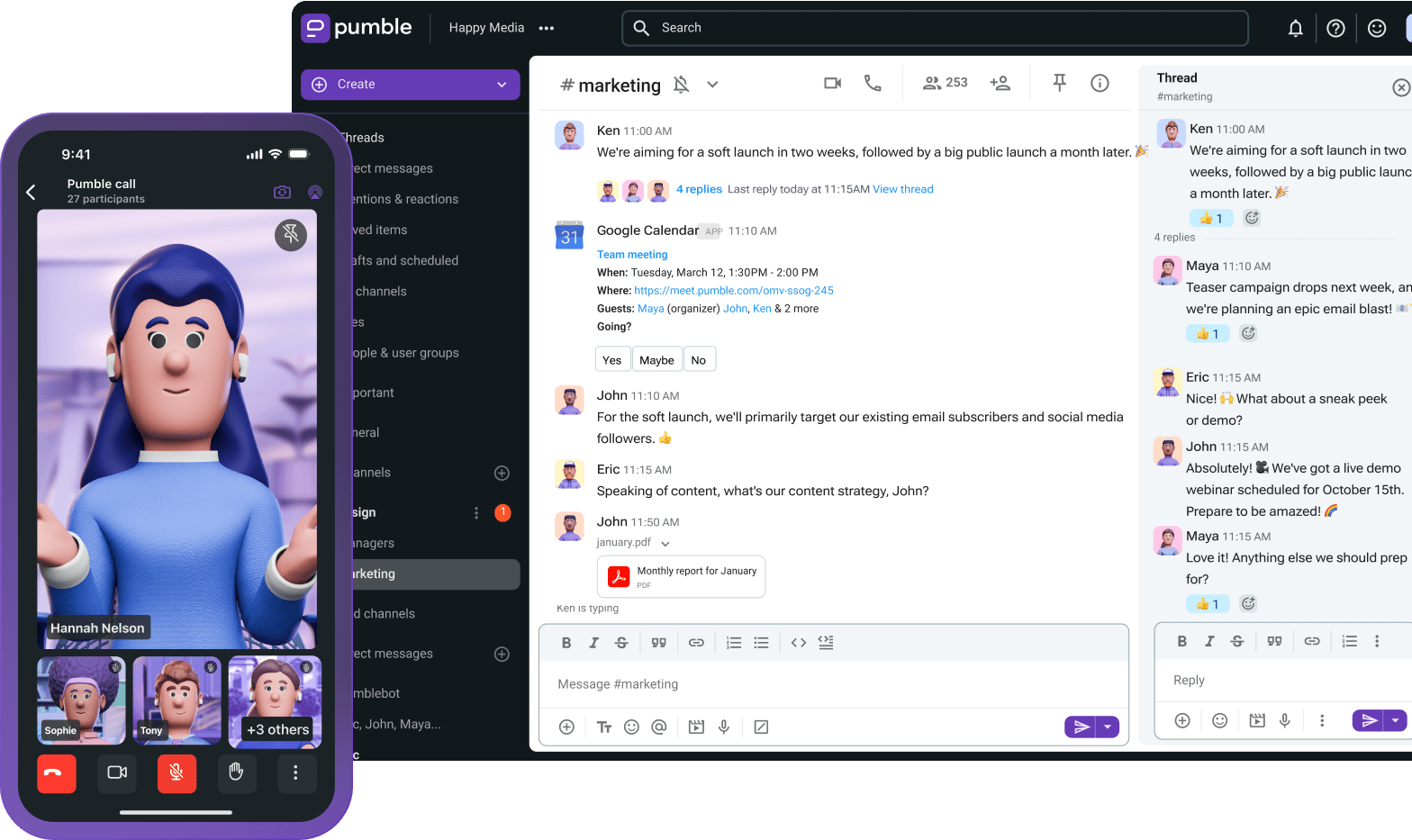
Mis à jour : 16 janvier 2025

Il est temps de l'admettre : notre façon de collaborer a changé.
Un véritable virage s'est opéré lors de la transition entre le travail au bureau et la collaboration à distance via des outils en ligne.
Pourtant, nous devons reconnaître l'importance de la collaboration d'équipe et des valeurs fondamentales qui en sont le socle, à savoir :
- La transparence,
- Le contexte, et
- La sécurité.
Heureusement, certaines équipes ont déjà percé les secrets d'une collaboration réussie.
Ainsi, nous n'aurons pas à lutter pour intégrer ces valeurs clés dans nos stratégies de collaboration.
Il nous suffit de noter ce qui a fonctionné pour les autres et de trouver des outils capables de briser les silos de travail tout en encourageant la collaboration plurifonctionnelle.

Secret n° 1 : Maintenir la continuité contextuelle
Saviez-vous que le nombre d'entreprises offrant de la flexibilité au travail a bondi de 14 % entre 2023 et 2024 ?
À ce jour, près des deux tiers des employeurs ont adopté le travail hybride ou entièrement à distance.
Si la plupart des employés ont accueilli ce changement avec satisfaction, cette transition a également forcé de nombreuses équipes à distance à faire face aux conséquences de choix d'outils de collaboration peu judicieux de la part de leur direction.
L'un des obstacles à la collaboration qui en résulte est la lutte contre la perte d'informations causée par des outils imposant des limites arbitraires sur les données et l'historique des messages, comme la tristement célèbre limite de 90 jours imposée par certains outils de communication.
Bien entendu, ces limites visent généralement les utilisateurs gratuits et peuvent être ignorées par les entreprises plus stables financièrement. Cependant, les ramifications opérationnelles de telles restrictions peuvent étouffer la croissance de petites entreprises prometteuses, car le contexte entourant les décisions passées finit par se perdre.
Alors, quel est le secret pour surmonter cet obstacle et maintenir la continuité contextuelle ?
Eh bien, voyons ce que disent les équipes qui ont trouvé la solution.
Améliorer la collaboration d'équipe avec Pumble
La solution ? L'historique de messages illimité de Pumble
Selon Maryam Nazir, directrice financière de TELOS, une société de conseil et de centres d'appels, assurer la continuité du contexte repose sur l'accès à l'intégralité de l'historique des messages de son équipe :

« L'historique des messages illimité et le partage de documents sont essentiels pour nous, car les fichiers de connaissances produits évoluent peu et les partager quotidiennement serait ingérable. »
Les équipes performantes comme TELOS doivent pouvoir se remémorer le raisonnement et le contexte des décisions passées. C'est pourquoi cette entreprise a choisi Pumble de CAKE.com comme principal outil de communication interne, offrant à ses utilisateurs un accès illimité et gratuit à leur historique de messages.
Passer à Pumble a permis à de nombreux dirigeants de surmonter leur crainte de perdre des données, comme peut en témoigner Ryan Vandendyck, fondateur du studio de développement de jeux indépendants Eden Industries.

« Je ne suis plus paranoïaque à l'idée de perdre l'historique de mes messages. Désormais, si j'ai discuté de quelque chose avec mon directeur artistique il y a 6 mois, je sais que je peux simplement le retrouver. Cela m'a libéré d'un grand stress concernant l'oubli ou la perte d'accès aux décisions et aux plans que nous avons pris. »
En d'autres termes, Pumble donne les pleins pouvoirs à ses utilisateurs en leur offrant un accès illimité à leurs propres messages, leur permettant de :
- Comprendre le contexte derrière les décisions passées,
- Résoudre les conflits en s'appuyant sur des preuves concrètes, et
- Intégrer efficacement les nouvelles recrues en les invitant dans des canaux contenant toutes les informations et documentations pertinentes.

Secret n° 2 : Instaurer la sécurité psychologique au sein des équipes
En fin de compte, il est impossible d'avoir une dynamique de collaboration positive sans établir au préalable un climat de sécurité psychologique.
Mais cela devrait être assez simple. Après tout, instaurer la sécurité psychologique dans différents types d'équipes consiste avant tout à créer un environnement où chacun sent que ses pensées et opinions seront prises en compte plutôt qu'ignorées. Facile, non ?
Peut-être pas. Mais et s'il existait un moyen de favoriser le travail d'équipe et la collaboration en choisissant simplement le bon outil de communication ?
Tout repose sur le choix d'une application conçue pour encourager l'engagement spontané grâce à :
- Des réactions émojis, pour les messages et annonces qui ne nécessitent pas de réponse textuelle,
- Des canaux publics, où l'information est partagée de manière transparente plutôt que d'être restreinte, et
- Des messages modifiables, ce qui permet de réduire l'anxiété que les employés peuvent ressentir lorsqu'ils partagent un feedback.
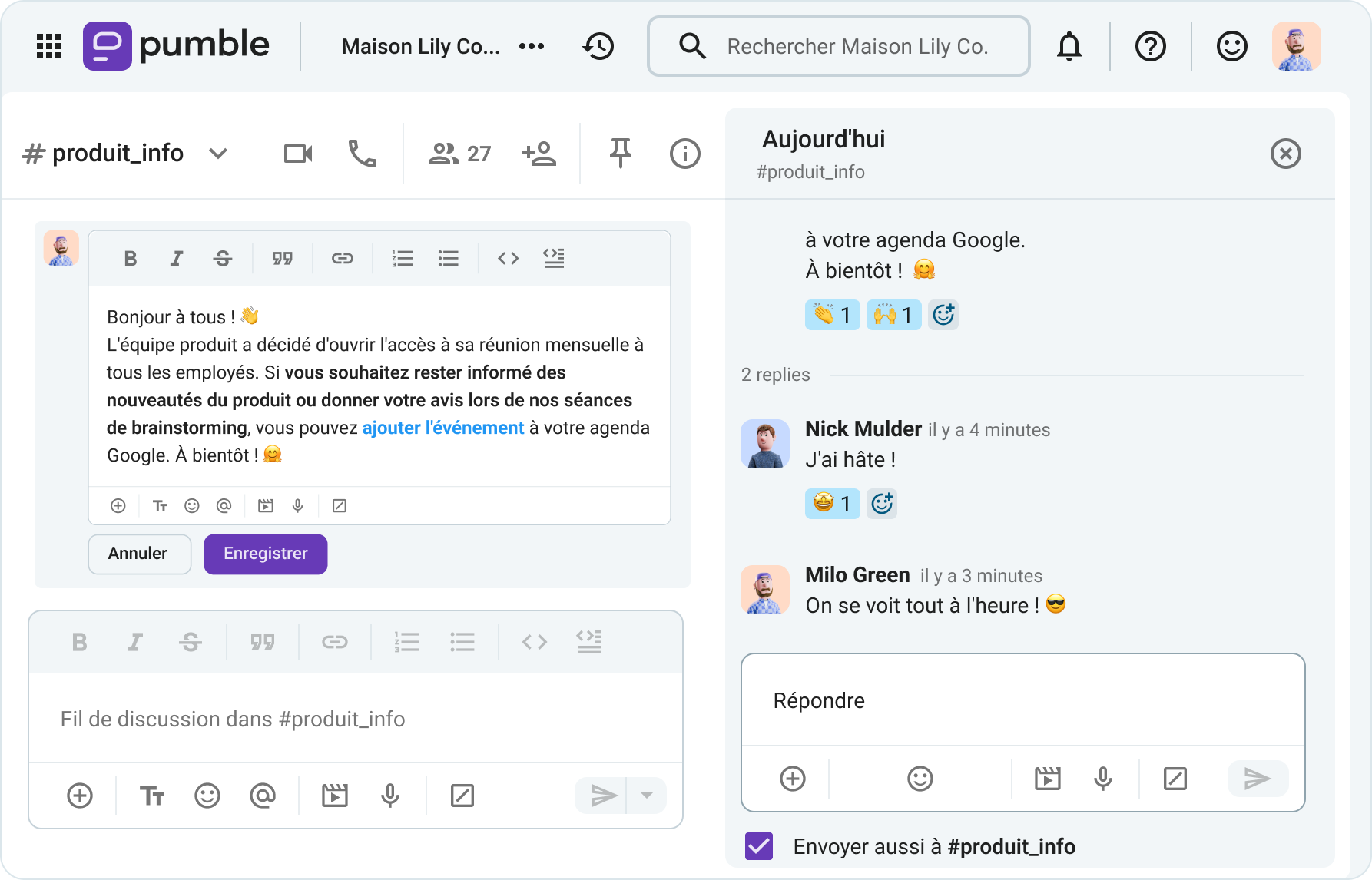
Cela étant dit, voyons comment des équipes concrètes peuvent tirer parti de ces fonctionnalités pour instaurer une sécurité psychologique.
🎓 ASTUCE PRO DE PUMBLE
Les canaux publics sont un excellent moyen de briser le travail en silo et d'instaurer une meilleure dynamique collaborative. Pour découvrir les autres fonctionnalités de Pumble qui boostent le travail d'équipe, consultez ce guide :
Transformez Pumble en votre QG numérique
La solution ? Les fonctionnalités de messagerie personnalisables de Pumble
L'utilisation d'une application de communication d'équipe avec une interface conviviale et de fonctionnalités de messagerie personnalisables peut faire toute la différence lorsque vous essayez d'instaurer une sécurité psychologique au sein des équipes.
Si votre équipe semble hésitante à participer aux discussions dans les canaux publics, encourager l'utilisation de réactions émojis pourrait l'inciter à contribuer plus ouvertement aux conversations par la suite.
Comme nous l'a confié Justin Quek, directeur de Mustard, un studio de marketing de contenu basé à Singapour, son équipe utilise les émojis Pumble de plusieurs manières :

« Le bouton de réaction permet de dire ce que vous voulez sans avoir à taper de réponse. Et, avec un peu de créativité, la fonction de statut peut s'avérer très amusante et utile (par exemple, nous l'utilisons pour nous prévenir quand nous partons déjeuner 🍔). »
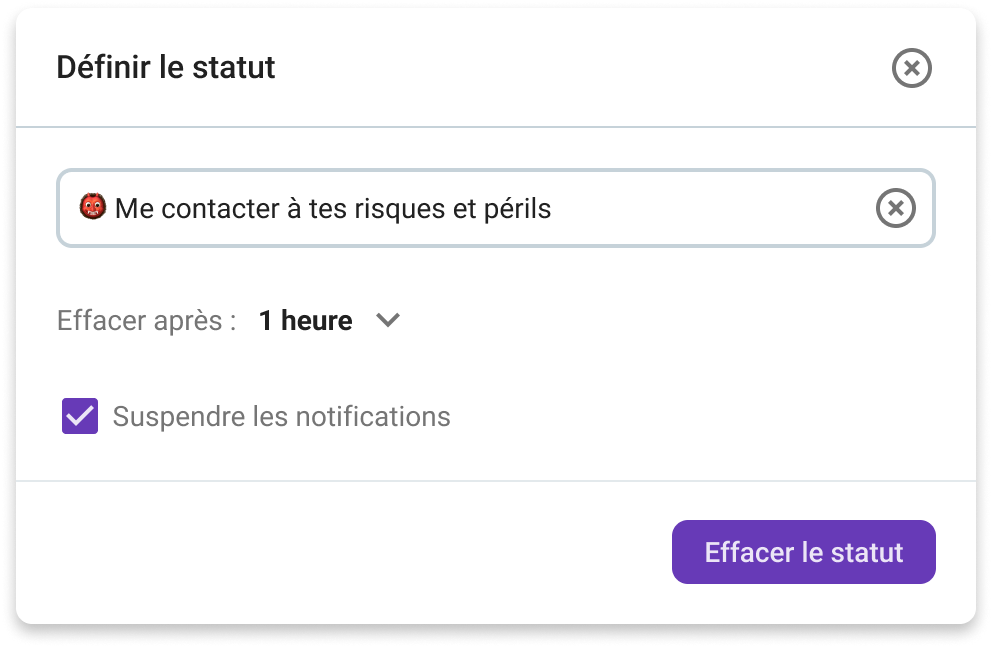
L'utilisation de réactions émojis et de statuts personnalisés, comme celui illustré ci-dessus, réduira la formalité perçue de votre espace de travail numérique, ce qui peut aider vos employés à devenir plus expressifs au fil du temps.
De plus, la possibilité de modifier ou de supprimer leurs messages même après l'envoi devrait leur apporter la sécurité supplémentaire dont ils ont besoin, car ils ne craindront plus de faire des fautes de frappe ou de mal s'exprimer.
Puisque la participation est l'un des éléments les plus importants de la collaboration selon le consultant en organisation Glenn Parker, aider vos employés à devenir plus communicatifs devrait se traduire par un meilleur travail en équipe et une collaboration accrue de manière générale.

Secret n° 3 : Structurer votre espace de travail numérique
La saturation de notifications peut sérieusement freiner la dynamique de collaboration au sein de votre équipe, et entraîner une baisse de ses performances.
Bien sûr, décourager la communication pour réduire le nombre de notifications ne résoudra pas ce problème.
En effet, une communication efficace est essentielle à la réussite d'une collaboration d'équipe.
Alors, comment rendre votre espace de travail numérique plus serein et plus productif ?
Gérer les notifications sur Pumble
La solution ? Définir des règles de base pour votre espace de travail Pumble
Pour vous assurer que les membres de votre équipe ne perdent pas de temps à répondre aux notifications, la meilleure solution est de structurer votre espace de travail virtuel.
En effet, Pumble permet de créer un nombre illimité de canaux publics et privés, ce qui peut vite devenir chaotique pour les utilisateurs participant à de nombreuses discussions.
Heureusement, les utilisateurs peuvent toujours ajuster leurs paramètres de notification :
- Désactiver les notifications pour les canaux, les personnes et les discussions de groupe,
- Activer ou désactiver les notifications de fils de discussion, ou
- Créer un calendrier de notifications pour les recevoir en dehors des heures de travail.
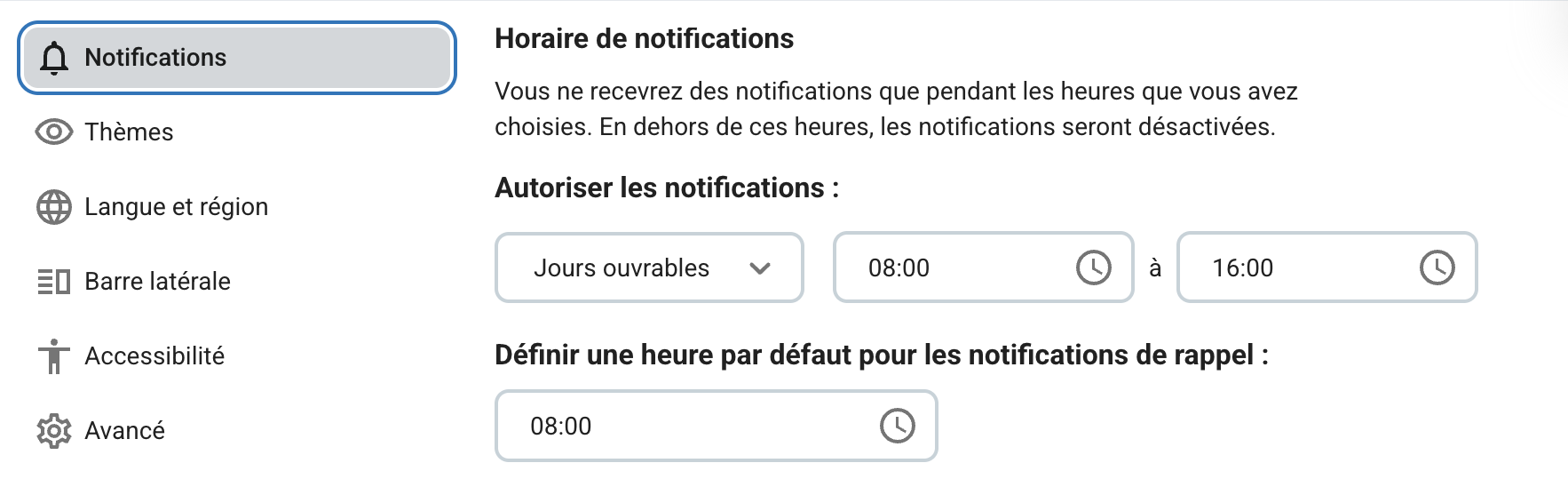
Outre le fait d'informer votre équipe de ces fonctionnalités, vous pouvez également optimiser l'organisation de votre espace de travail numérique en :
- Respectant des conventions de nommage strictes lors de la création de nouveaux canaux, telles que #équipe_[nom], #projet_[nom] ou encore #[département]_[sujet] (par exemple, #livrables_marketing),
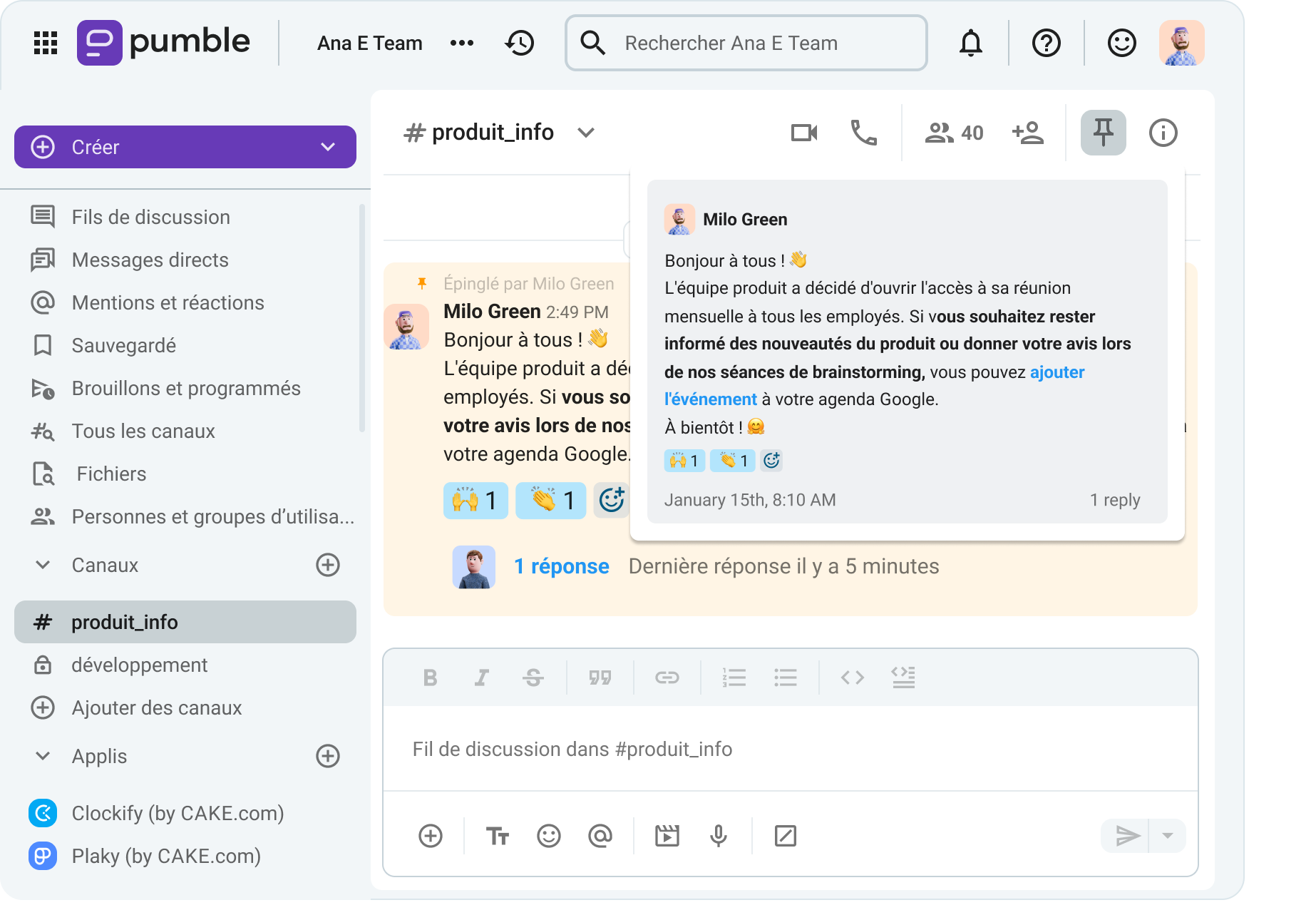
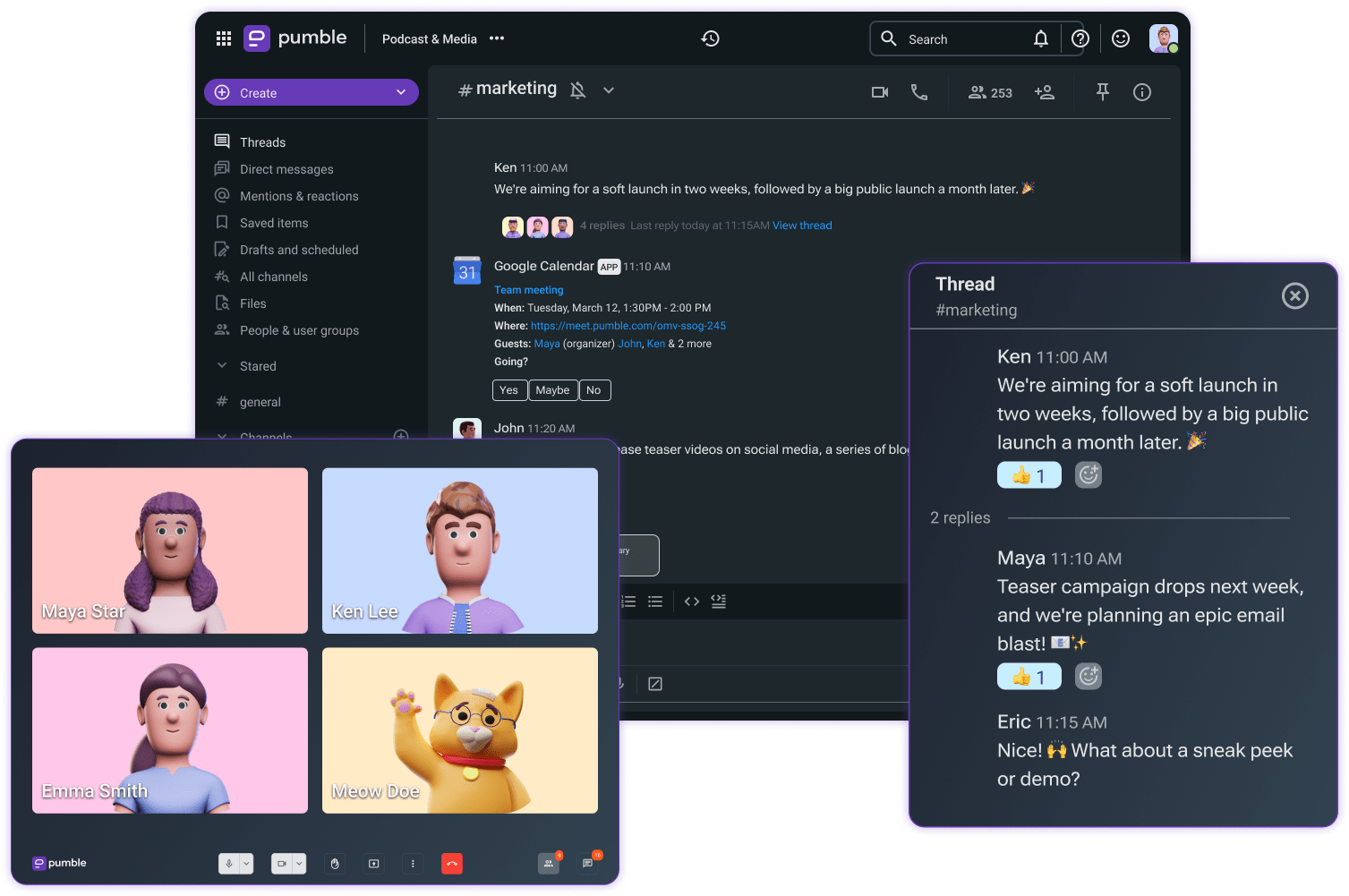
- Tirant pleinement parti des fils de discussion de Pumble, qui vous permettent d'organiser vos conversations par sujet (une fonctionnalité très appréciée de l'équipe de l'agence de marketing digital Nerd Evolution),
- Attirant l'attention sur les annonces importantes via les mentions de canaux, d'utilisateurs ou de groupes d'utilisateurs, et
- Épinglant les messages pour consultation ultérieure.
Secret n° 4 : Maîtriser la communication multimodale
L'un des secrets les mieux gardés d'une collaboration d'équipe réussie consiste à éviter les malentendus en privilégiant la clarté.
Cependant, inciter votre équipe à être plus concise à l'oral et à l'écrit n'est pas la seule façon de garantir une communication efficace.
En effet, la clarté peut également être renforcée par la communication multimodale.
Autrement dit, vous devriez fournir à votre équipe un outil qui ne la limite pas à un seul type de communication, mais lui permette d'utiliser plusieurs canaux de communication pour faire passer ses idées.
Voyons donc comment la communication multimodale peut vous aider à optimiser vos stratégies de collaboration d'équipe.
Pratiquer la clarté avec Pumble
La solution ? Aller au-delà des simples SMS sur Pumble
En tant qu'application de messagerie professionnelle, Pumble de CAKE.com possède de nombreuses fonctionnalités permettant à votre équipe de communiquer par écrit.
De plus, l'application intègre des fonctionnalités de visioconférence, incluant tout le nécessaire : messages et réactions emoji pendant les réunions, enregistrement des réunions et partage d'écran.
Il est ainsi facile de passer des SMS aux appels, comme nous l'a confié Bojana Vojnovic, ancienne directrice marketing et opérations chez Klever Cargo :

« Pumble nous a aidés pour la collaboration comme pour la communication. On résout les choses plus vite — par chat ou en lançant un appel rapide. Plus besoin d'organiser des réunions ou de suivre des listes interminables. C'est une des qualités de Pumble que j'adore : il offre une combinaison de tout ce dont on a besoin. »
Et, si vous souhaitez privilégier la communication asynchrone sans renoncer à la clarté des appels vidéo ou vocaux en direct, vous pouvez également essayer d'envoyer :
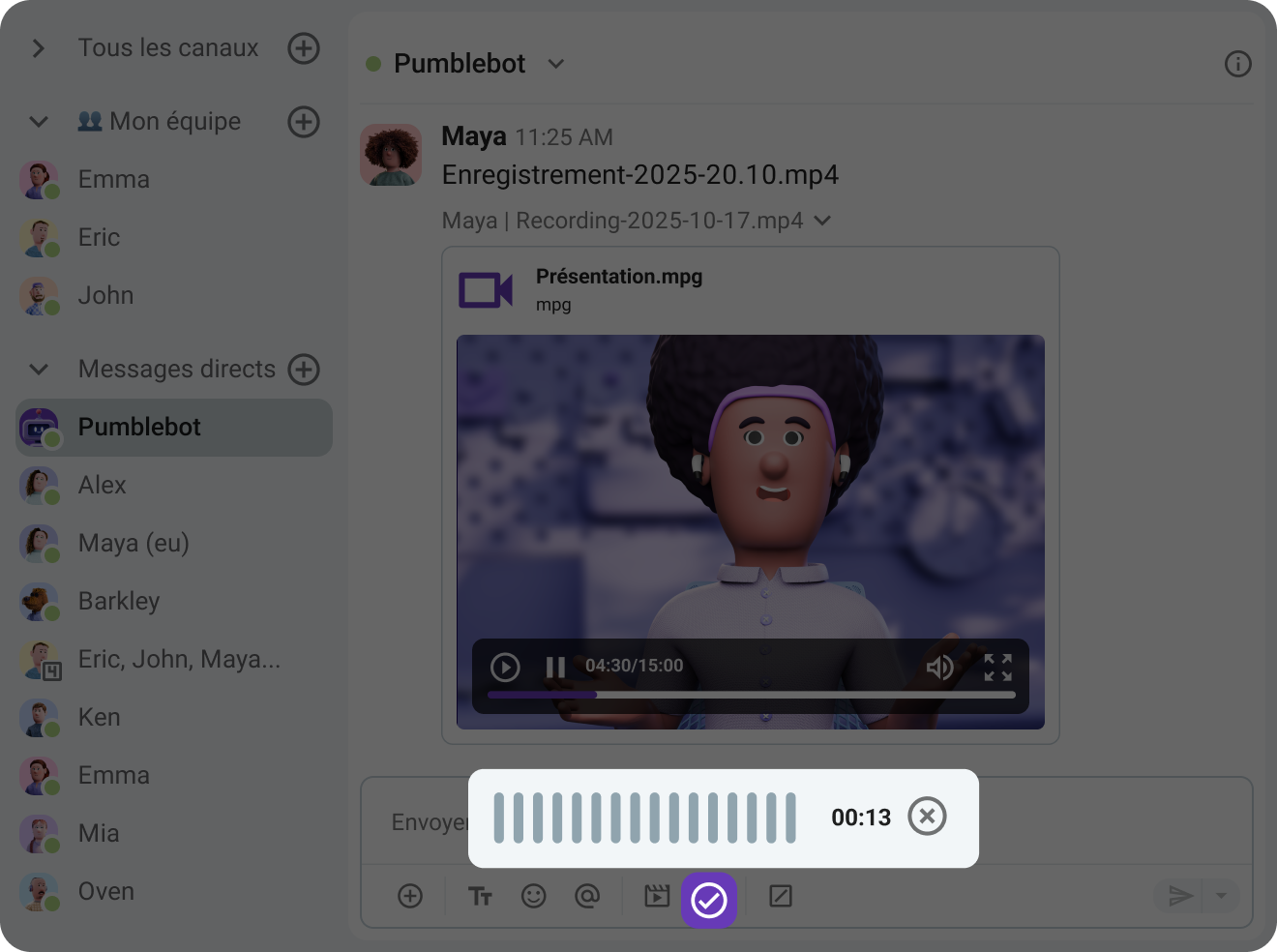
- Des messages vocaux, pour garantir que votre ton est bien transmis,
- Des messages vidéo, pour des démonstrations en direct, et même
- Des enregistrements d'écran, pour résoudre des problèmes techniques sans avoir à planifier de réunions.
🎓 ASTUCE PRO DE PUMBLE
Découvrez ici tous les avantages des messages vocaux et vidéo :
Secret n° 5 : Décloisonner les flux de travail grâce à l'accès invité
L'existence de silos de connaissances sonne souvent le glas de la collaboration interfonctionnelle, notamment avec les collaborateurs externes et les clients.
Lorsque les membres de l'équipe hésitent ou sont incapables de partager les informations relatives à un projet, il est souvent possible de résoudre le problème en clarifiant les rôles et en s'engageant à améliorer la communication.
Cependant, lorsque cette même réticence ou incapacité à communiquer se manifeste avec les parties prenantes externes, même les meilleures idées risquent de s'enliser dans un processus de développement interminable.
Alors, comment faire pour que votre équipe dispose des ressources nécessaires pour tenir les clients et les collaborateurs externes informés ?
Une fois de plus, Pumble propose une solution éprouvée.
🎓 ASTUCE PRO DE PUMBLE
Maintenir toutes les parties prenantes impliquées dans le processus de collaboration est le premier principe de collaboration, selon l'auteur David Straus. Pour découvrir les 4 autres, consultez cet article :
Collaborer avec les invité sur Pumble
La solution ? Exploiter au maximum les fonctionnalités d'accès invité de Pumble
Si vous souhaitez améliorer la productivité de votre équipe et la collaboration externe, vous devriez trouver des moyens d'intégrer vos collaborateurs externes.
Autrement dit, ils doivent se trouver dans les mêmes espaces (virtuels) que votre équipe.
Lorsque nous avons interrogé Michail Kollewijn sur la façon dont ses équipes chez Transcre8 et PublishMe utilisent Pumble, il nous a expliqué que c'est précisément pour cette raison qu'il trouvait la fonctionnalité d'accès invité de Pumble particulièrement utile.
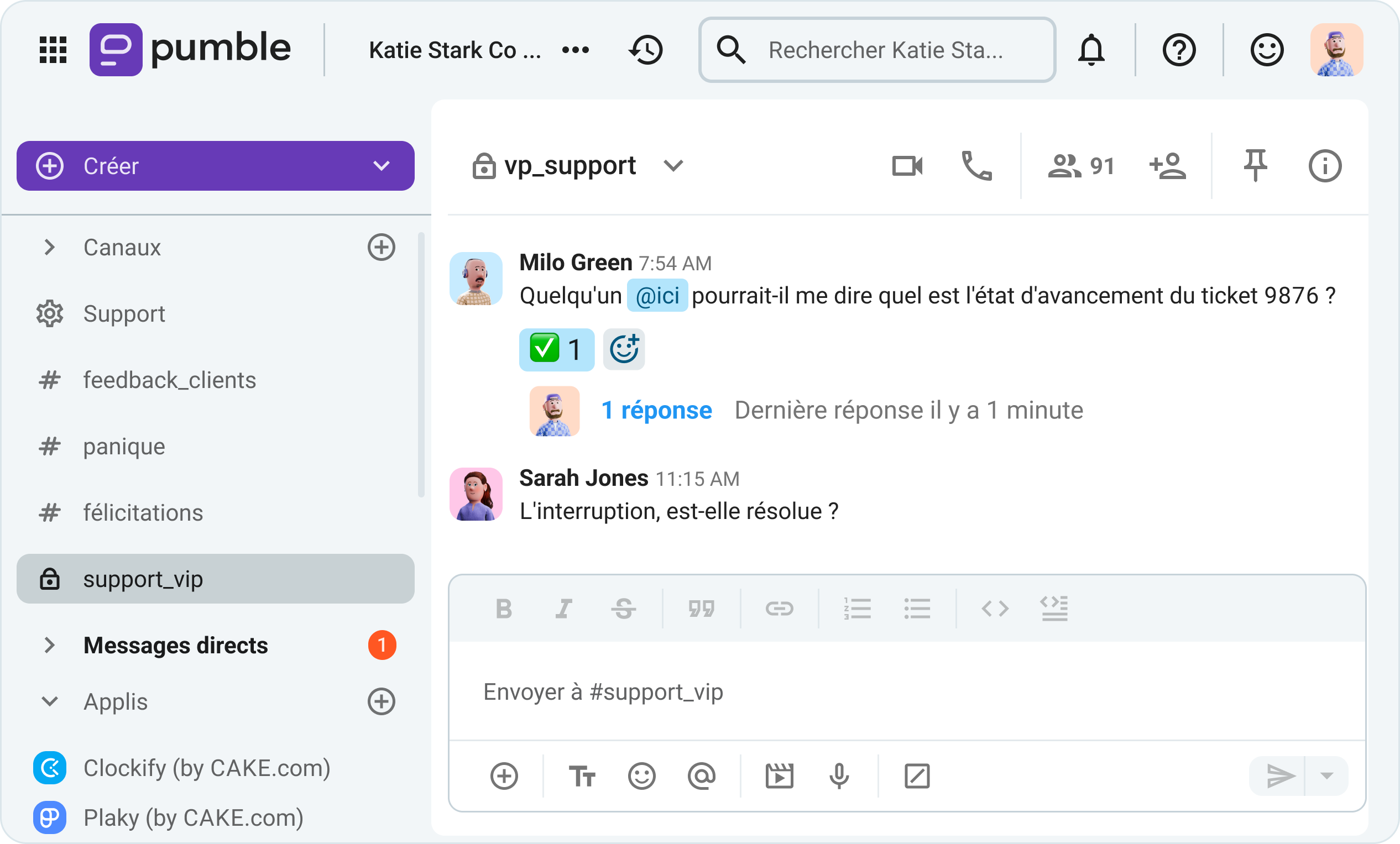
Après avoir négocié les contrats avec les auteurs avec lesquels ils collaborent, l'équipe de PublishMe leur donne des comptes d'accès invité et les intègre à son espace de travail Pumble.

« L'accès invité a été un petit plus bienvenu dans notre flux de travail, auquel nous ne nous attendions pas. Il permet d'inviter facilement un auteur ou un groupe d'auteurs à un canal de travail spécifique et d'établir une communication directe. »
En tant qu'utilisateurs invités, ces collaborateurs ont accès à un canal unique choisi par leur hôte (bien que les comptes invités multi-canaux soient également possibles). Cela permet aux auteurs de :
- Consulter les rapports de ventes mensuels,
- Négocier des contrats, et
- Envoyer des manuscrits (sans avoir à passer par email).
Ainsi, si votre équipe a également du mal à collaborer efficacement avec des clients, des freelances ou des contractuels, la fonctionnalité d'accès invité de Pumble pourrait être le moyen idéal de briser définitivement ces silos de travail.
Découvrez les secrets d'une collaboration d'équipe réussie avec Pumble by CAKE.com
Au niveau individuel comme collectif, la collaboration est une compétence qui demande du temps et des efforts pour se développer.
Les individus doivent être prêts à mettre leur ego de côté et à oublier les tensions interpersonnelles dans l'intérêt d'un objectif commun.
En fin de compte, les bons leaders doivent être capables de guider leur équipe à travers ces différentes étapes du développement de groupe.
Cependant, il existe des moyens de rendre ce processus plus agréable pour toutes les personnes impliquées — et choisir la bonne application de communication pour votre équipe est une pièce maîtresse de ce puzzle.
Comme nous l'avons établi, les fonctionnalités uniques de Pumble et son design convivial vous aident à créer un siège social numérique qui décourage la formation de flux de travail cloisonnés.
Ce faisant, vous verrez les membres de votre équipe devenir plus communicatifs et ouverts à la collaboration plus vite que vous ne le pensez. Heureusement, l'historique illimité des messages de Pumble leur permettra de continuer à échanger sans craindre de perdre des données ou du contexte.
Alors, ne vous contentez pas d'applications qui n'ont pas été conçues dans une optique de collaboration.
Récupérez votre historique de messages et libérez tout le potentiel de votre équipe.
Créer un espace de travail gratuit sur Pumble dès aujourd'hui
Comment nous examinons cet article : Nos rédacteurs et éditeurs vérifient les articles et les mettent à jour lorsque de nouvelles informations sont disponibles, afin qu'ils soient toujours d'actualité.