 Updated: marzo 13, 2026

As we dedicate about a third of our lives to work, it’d be nice to spend that time satisfied and engaged, right?
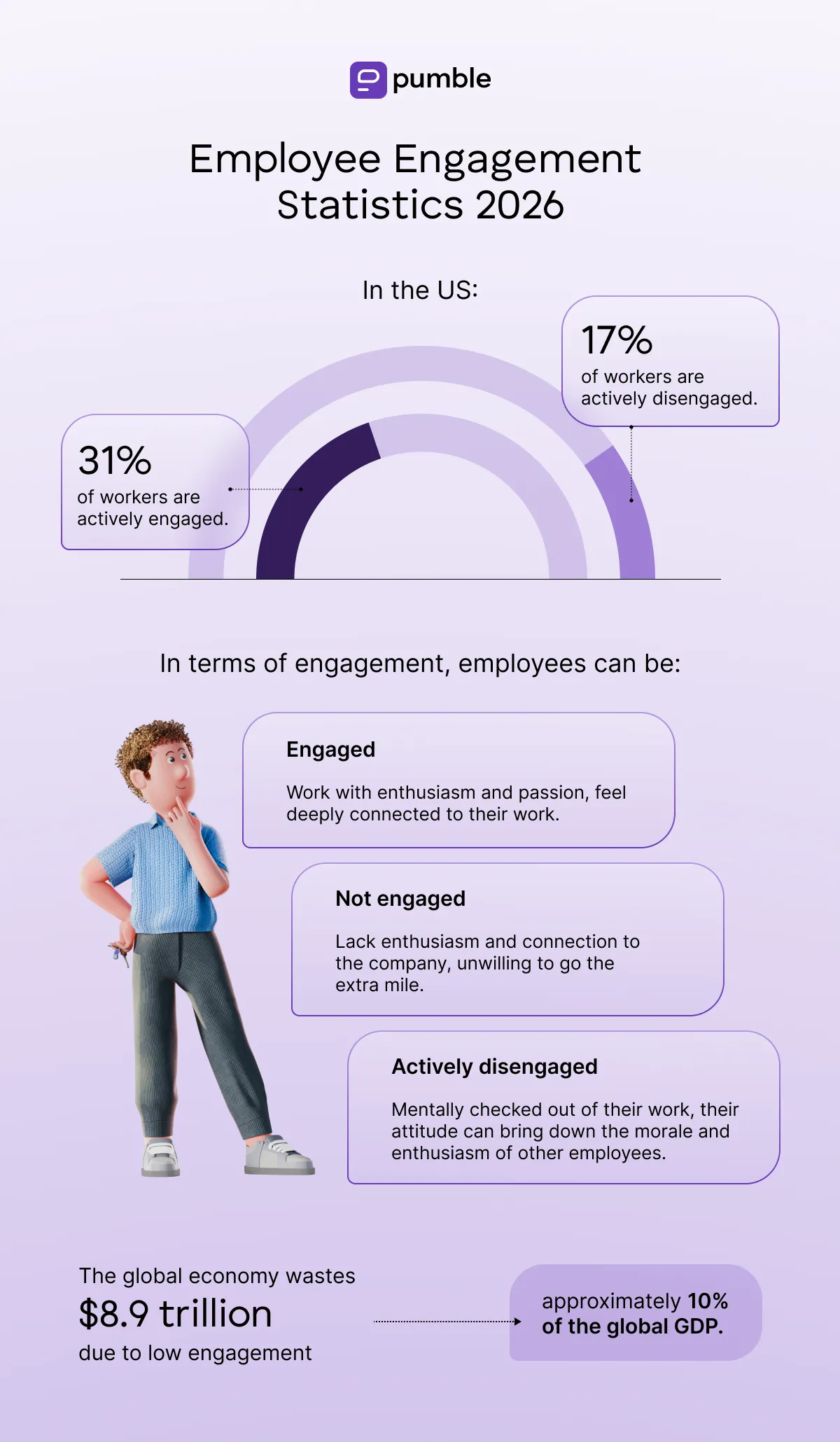
Unfortunately, according to Gallup’s Global Indicator, employee engagement in the United States is down to 31%, dropping to a mere 21% globally.
But, is the big picture as bleak as these numbers suggest?
We bring you the latest employee engagement statistics, including the data on:
- Emerging employee engagement trends,
- The cost of of employee disengagement, and
- Factors that positively and negatively affect employee engagement.
Empezamos.

- In the United States, 31% of the workforce is engaged, while just 21% of employees globally would say the same.
- The global economy loses out on over $8 trillion annually due to employee disengagement.
- Engaged employees are an enviable asset, helping to lower absenteeism, safety incidents, and turnover rates.
- Managers can help shift the tide, as they influence engagement levels by as much as 70%.
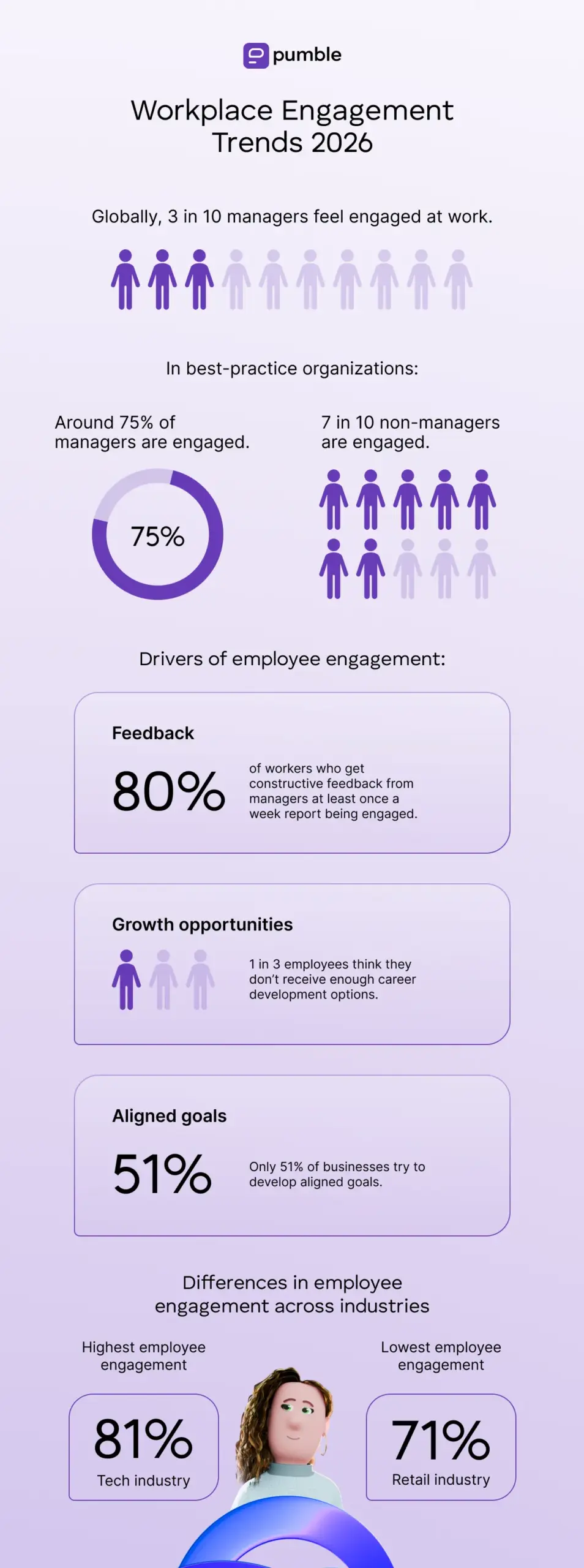
- The Tech sector boasts the most engaged employees (81%), while retail workers are the most disengaged group globally (71%).
- The youngest members of the workforce (16–18 year olds) are also the most disengaged (64%).
- When it comes to engagement, hybrid workers (77%) outperform both remote workers (76%) and on-site employees (72%).
¿Qué es el compromiso de los empleados?
El compromiso de los empleados es un concepto que describe el entusiasmo y compromiso que los trabajadores sienten sobre su organización. El término se refiere a las emociones de los empleados hacia su empresa, lo que les ayuda alinear sus contribuciones con los objetivos de la organización.
In general, employees who are engaged in their roles find it easier to embrace company culture and deliver positive results.
Long-term employee engagement research from Gallup reveals multiple benefits of engagement at work, including:
- Improved employee well-being (by 70%),
- Increased organizational profitability (by 23%),
- More involved employee participation in organizational initiatives (by 22%), and
- Higher productivity (by 14%).
Claro, las cosas no son siempre tan claras, y reconocemos los 3 niveles de compromiso de los empleados:
- Engaged — Employees who are committed to their jobs and feel a strong connection to their workplace.
- Not engaged — Employees who aren’t enthusiastic about their jobs but do what is required, although they may step back from more demanding work.
- Actively disengaged — Unhappy employees with a resentful attitude who spread their negativity to others.
So, what happens when employees are not engaged or, worse yet, actively disengaged?
Here’s what the latest employee engagement statistics say.
Employee engagement is sinking lower
According to recent data from Gallup, after years of gradual dips and stagnation, employee engagement in the United States has reached its lowest point since 2020.
En 2024, las tendencias del compromiso de los empleados estadounidenses mostró que:
- El 31% de los trabajadores fueron activamente comprometidos, mientras que
- El 17% de los trabajadores fueron activamente desconectados.
These numbers stayed the same throughout 2025.
However, HR.com’s productivity and engagement research leaves room for hope. The reporting found that most employees are moderately engaged, scoring 7 on a 10-point scale. That being said, for the average employee, the risk of falling below 6 and dipping into disengagement is high.
The cost of employee disengagement is steep
How much does employee disengagement cost the global economy?
In 2025, Gallup’s State of the Global Workforce report estimated that disengagement drains $438 billion from the global economy.
Other reporting offers even higher figures. The People Element Employee Engagement Report from 2025 notes that the world economy loses $8.9 trillion due to low engagement — equivalent to nearly 10% of the global GDP. A similar number appears in Effectory’s Global Employee Engagement Index, highlighting that annual losses amount to $8.8 trillion.
What do these losses signal to businesses and job seekers?
In Forbes’s overview of job prospects for 2026, a few hard truths took center stage:
- First, the labor market seems to be in a slump, despite a flourishing economy in the United States.
- Second, companies will likely be highly selective in their hiring decisions throughout 2026.
Given these circumstances, job hugging — staying with your current employer due to economic uncertainty — may become an even more prevalent phenomenon in the next few years.
This data sounds disheartening, but it doesn’t mean organizations should pinch pennies to make up for setbacks. On the contrary, it’s all the more reason to invest in long-term employee engagement strategies.
Companies rely on tried-and-true methods to track engagement
HR.com found that 61% of organizations consistently measure employee engagement, with the most common methods being:
- Surveys (79%),
- Turnover and retention data (61%), and
- Stay and offboarding interviews (59%).
Unfortunately, only 18% of businesses that track engagement state that the majority of their workforce (over 80%) is highly engaged.
The differences between disengaged and engaged employees are stark
Insights on employee engagement from McKinsey highlight 6 worker archetypes based on their engagement and satisfaction:
- Thriving stars — Score high when it comes to performance, well-being, and maintaining healthy work-life boundaries. They make up 4.5% of the workforce.
- Committed workers — Perform their tasks reliably, often help coworkers, and boost team morale. They comprise 40% of the workforce.
- Double-dippers — Are mildly engaged, hold two or more jobs simultaneously, and account for 5% of the workforce.
- Mildly disengaged workers — Report low performance, satisfaction, and commitment levels. They comprise 33.5% of the workforce.
- Disruptors — Poor performers with deep job dissatisfaction whose attitudes negatively affect their coworkers. They make up 12% of the workforce.
- Quitters — Highly unmotivated and unenthusiastic about every aspect of their jobs. They make up 10% of the workforce.
Building on these differences, Gallup measured that engaged workers, such as “thriving stars” and “committed workers”, lower:
- Absenteeism by 78%,
- Safety incidents by 63%, and
- Turnover rates in high-turnover companies by 21%.
In engaged teams, reaping the above benefits starts with managers.
🎓 Consejo Pro de Pumble
This resource outlines several employee engagement strategies you can try, including a handy employee engagement survey template:
Engagement among managers is declining
The State of the Global Workforce report from 2025 found that manager engagement is on the decline. This is a bad sign, as the 2024 issue noted managers can cause variations in employee engagement of up to 70%. Thus, they play an integral part in employee performance and well-being.
A plausible explanation for this decrease is that managers are at a higher risk of experiencing negative emotions than their peers in non-managerial roles. Although they experience similar levels of stress, anger, and loneliness, the gap widens when it comes to sadness and worry.
| El % experimentado diariamente | ||
|---|---|---|
| Emoción | Gerentes | Otros empleados |
| Estrés | 41 | 40 |
| Preocupación | 39 | 36 |
| Tristeza | 24 | 21 |
| Soledad | 21 | 20 |
| Ira | 21 | 19 |
Given this pressure, managers are more prone to looking for a new job than employees in non-managerial positions.
Interestingly, individual contributors report an improvement in their well-being, while older managers, along with female managers, report a 5% and 7% drop, respectively.
This data underscores that companies need to do more to appreciate and support managers — since they’re on the frontlines of supporting and empowering their teams.
En las organizaciones de mejores prácticas, el apoyo al personal directivo puede incluir:
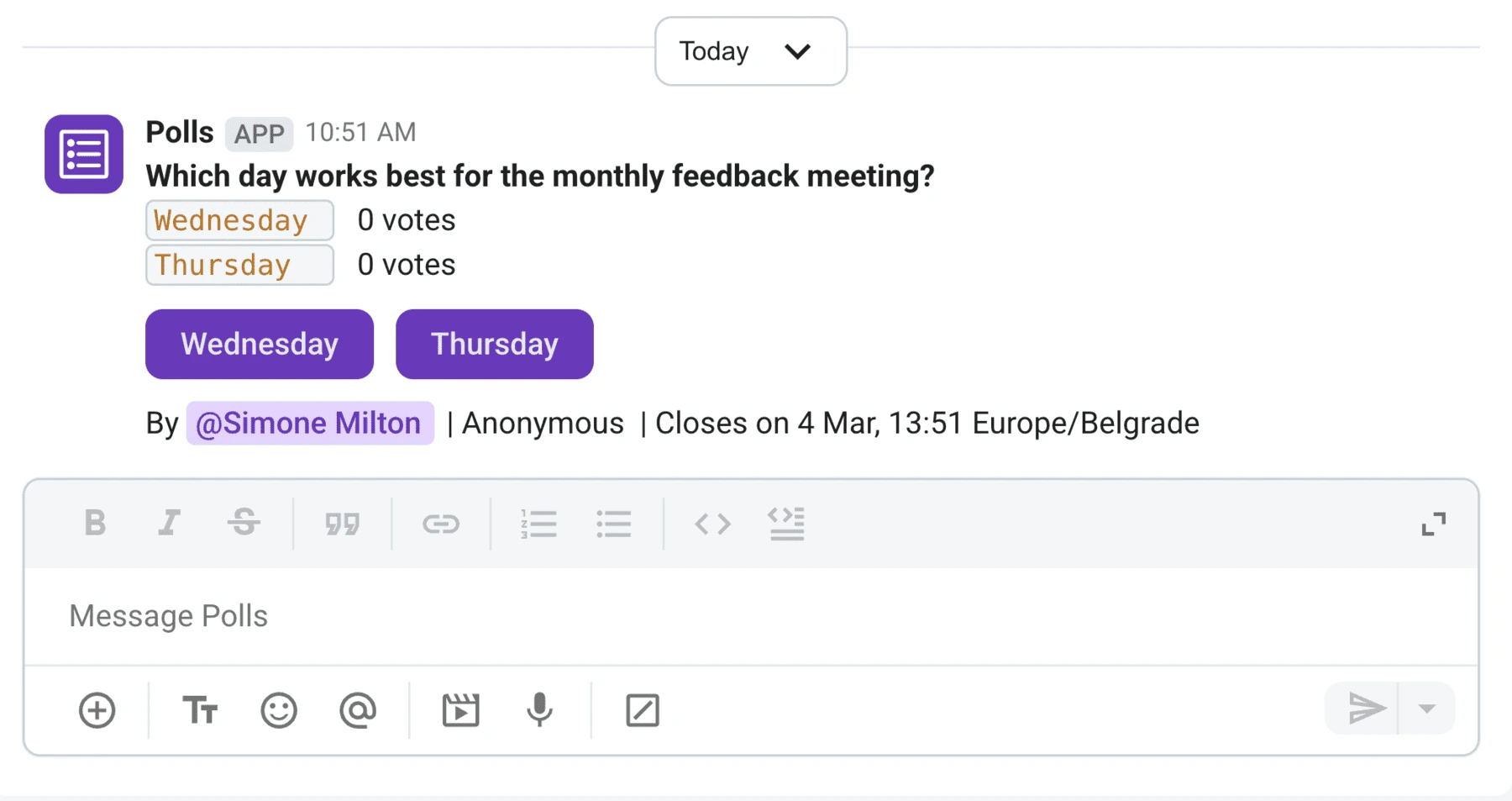
- Utilizar encuestas en aplicaciones de comunicación en equipo para determinar qué recursos son más necesarios,
- Reconocer constantemente las contribuciones,
- Educación continua e inversión en oportunidades de desarrollo profesional,
- Procedimientos de RRHH simplificados, y
- Encuestas de empleados anuales o semestrales centradas en temas específicos (por ejemplo, reconocimientos y premios, bienestar de los empleados, dinámica del equipo, etc.).
When such measures are implemented, rewards soon follow. Best-practice organizations stand out with ¾ of managers and 7 in 10 non-managers actively engaged.
Cuando los gerentes están comprometidos, sus equipos lo están también
The Q12 Meta-Analysis from Gallup highlighted management engagement data, noting that only 3 in 10 managers feel engaged at work globally — a sad reality, since the same report found that engaged managers also lead engaged teams.
Expanding its employee engagement survey to country level, Gallup produced more specific data.
Namely, in countries where managers report higher levels of employee engagement, non-managers usually follow suit.
Aquí está la comparación.
| El % del compromiso de los gerentes vs. no gerentes | ||
|---|---|---|
| País | Gerentes | No gerentes |
| Lesoto | 49 | 44 |
| Costa Rica | 42 | 36 |
| Estados Unidos | 37 | 32 |
| Argentina | 30 | 30 |
| Islandia | 27 | 23 |
| Canadá | 22 | 20 |
| Alemania | 17 | 12 |
| Reino Unido | 11 | 10 |
| Francia | 8 | 8 |
Even in countries with low employee engagement, managers still score higher than other employees.
Feedback makes a difference
Gallup’s 2024 report also found that 80% of workers who receive constructive feedback from managers at least once a week are engaged.
People Element’s findings from 2025 confirm that alongside feedback, other key drivers of employee engagement include:
- Growth opportunities — Employees are more likely to be in favor of company objectives when they see chances for career advancement or upskilling.
- Recognition — Feeling supported and recognized for meaningful work naturally increases employee engagement and workplace satisfaction.
- Confidence in leadership — Trust in managers and upper leadership is a result of genuine care and transparent communication.
To make sure feedback has a positive effect on employee performance, managers should:
- Host regular meetings to establish continuous feedback loops,
- Prioritize psychological safety, and
- Restate (and clarify) long-term goals.
🎓 Consejo Pro de Pumble
Aprovechar al máximo del feedback es un proceso continuo. Aquí están algunos recursos que pueden ayudar a tu equipo cosechar los beneficios del feedback constructivo:
Make conversations count in Pumble
Los caminos profesionales inciertos reducen el compromiso de los empleados
People Element further analyzed the role opportunity for growth plays in employee engagement, revealing that 1 in 3 workers feels they aren’t afforded sufficient career advancement opportunities.
More specific numbers show that:
- 65% of employees believe that existing procedures for new job openings are fair, while
- 46% don’t believe they will get a promotion.
In fact, many workers believe that employers are at fault for the barriers to career advancement. Below are the most common barriers employees face, according to the ADP Research PAW 2025 report.
| Barriers to career advancement | % |
|---|---|
| Lack of opportunity | 19 |
| Lack of desire | 13 |
| Lack of time | 12 |
| Self-motivation | 10 |
| Lack of support | 8 |
| Lack of confidence | 8 |
| Lack of experience | 8 |
| Lack of visibility with management | 6 |
| Lack of skill | 6 |
| Fear | 5 |
| Lack of education | 5 |
As economic and technological circumstances continue to evolve, organizations will have to create initiatives to reskill their workforce and reshape jobs. With the large-scale implementation of artificial intelligence (AI) across the global workforce, we could see an AI upskilling engagement boost in the coming years.
Esto podría implicar priorizar la movilidad interna de talento, lo que fomenta avances de la carrera dentro de la organización. Los empleados incluso podrían querer pasar de su posición actual a uno nuevo donde tendrían que empezar de cero. Para que esto sea un éxito, es necesario cultivar una cultura de aprendizaje continuo.
Goal setting fuels engagement
HR.com’s analysis reveals that 72% of employees set both professional and personal goals to increase their engagement.
When teams consistently and proactively strive toward new achievements, they drive:
- Productividad,
- Retención,
- Safety,
- Engagement, and
- Well-being.
Naturally, these benefits only occur if goals are frequently revisited and redefined.
🎓 Consejo Pro de Pumble
Alinear tu equipo con los objetivos de la empresa requiere algo de refuerzo. Esta guía de 3 pasos te ayudará a empezar:
El sector de la tecnología lidera la carga con los empleados comprometidos
In 2024, WorkL’s Global Workplace Report found differences in employee engagement across industries.
The Technology sector secured the top position with 78% — 5% higher than the global average. It was no different in 2025, as WorkL’s latest report noted the Tech sector climbed to 81%. The analysis further pointed out the United Kingdom as a positive example of a thriving Tech industry, with engagement reaching 85%.
Another interesting fact about the Tech sector is that besides the highest employee engagement rate, it also has the lowest flight risk rate — meaning its employees are the least likely to leave their current job for a new opportunity. But, given the rapid developments in AI, robotics, and cyber security — which were mentioned in Deloitte’s Tech Trends 2026 report — it’s tough to tell how much of the low turnover is due to job-hugging (fear-based retention).
Los sectores minorista y de defensa tienen los empleados más desconectados
The Defense sector was at the bottom in 2024, with an employee engagement score of 68%.
The situation in the Retail sector was hardly better – its engagement score falling to 69%. Notably, employee disengagement in this sector was rampant in New Zealand, the United Kingdom, and Canada.
Employees were particularly unhappy with:
- La falta del personal,
- La gestión irrespetuosa,
- La compensación insuficiente, y
- Las horas laborales.
As of 2025, there seems to have been some improvement, with engagement climbing to 71% in the Retail sector. Despite this increase, retail employees are the most disengaged group in the global workforce, signaling their continued dissatisfaction with:
- Worker protections,
- Cambios económicos, y
- Workplace culture.
Las brechas de género y discapacidad persisten
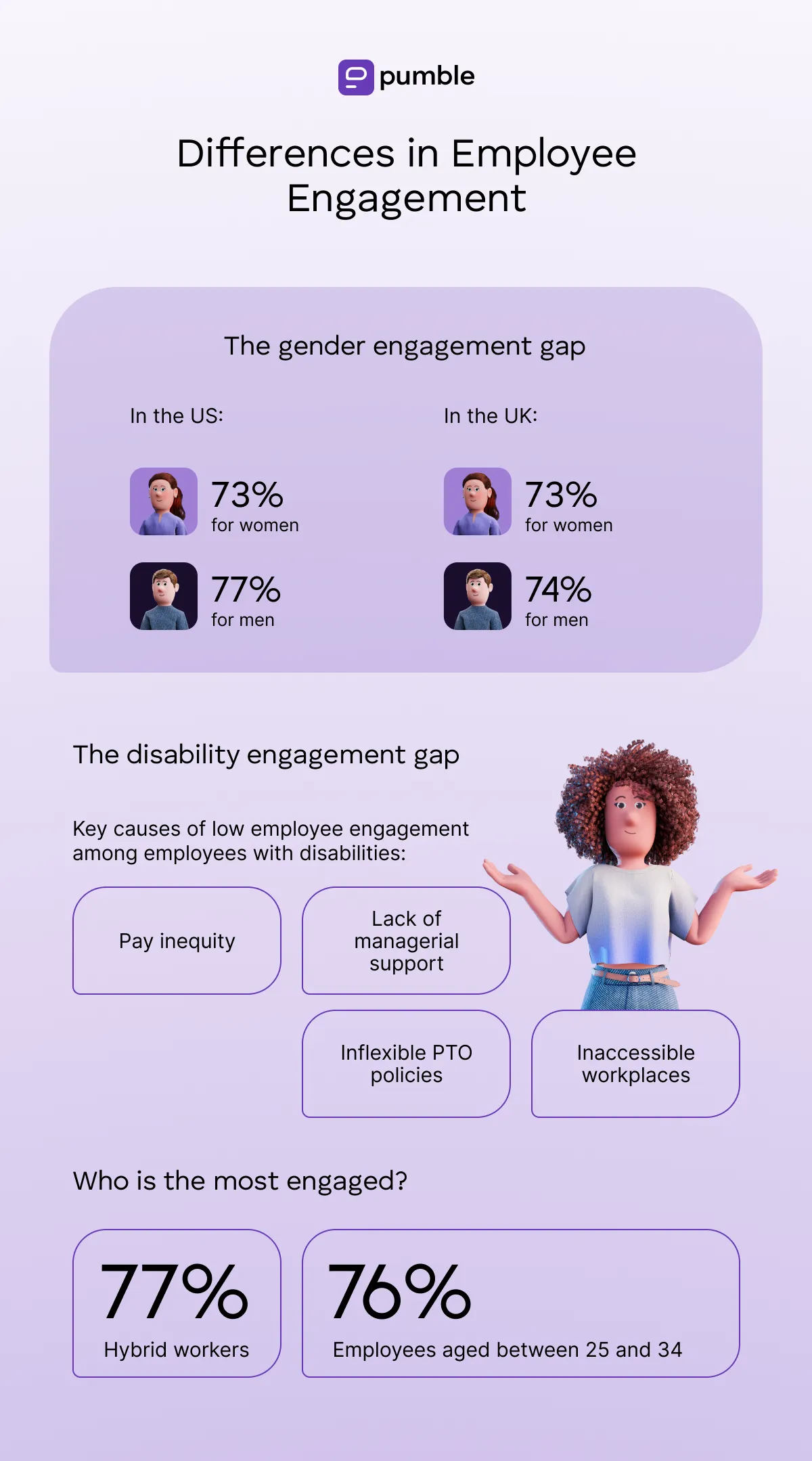
WorkL’s employee engagement data for 2024 pinpointed a slight difference between men and women. The greatest imbalance was in the US, where the engagement score was 73% for women and 77% for men.
Additionally, women were more likely to leave their jobs, with a flight risk score of 25%. For men, the score went down to 20%.
Figures from 2025 show that the gender gap is narrowing, at least in some countries, which is promising. In the United Kingdom, for example, men scored 74%, and women were not far behind at 73%.
But in 2024, the disability gap was most pronounced in the UK. Disabled workers had an employee engagement score of 68% — the lowest rating globally. They reported that one of the major contributors to their disgruntlement was insufficient disability awareness in the work environment.
On the other hand, the United States stood out as a positive exception in 2025. While the overall engagement rate in the United States was 76%, it went up to 77% for disabled employees.
In the United Kingdom, employee discontent deepened when connected to pay satisfaction. When focusing on pay, the engagement rate for people with disabilities dropped to 63%, while it was slightly higher for other workers, at 66%.
Eliminating the engagement and pay satisfaction gap will take addressing the key causes of low employee engagement, which include:
- Pay inequity,
- Poor managerial support,
- Inflexible PTO policies, and
- Inaccessible workplaces.
Younger employees are the least engaged
Currently, 5 generations are shaping the workplace, and generational differences make it harder for companies to keep employee engagement consistent.
As a result, engagement is lowest (64%) among younger employees (aged 16–18). WorkL notes that their disengagement often stems from:
- Career obstacles faced in their earliest jobs,
- Meager pay with unstable work hours, and
- Lack of career development opportunities.
An uptake in employee engagement happens with workers aged between 25–34, reaching a high of 76%. Engagement is consistent even for workers over 65, with a peak of 75%.
In an attempt to further clarify the above employee engagement statistics, WorkL concluded that both younger workers and older employees share the same values.
Namely, they both value:
- Higher compensation,
- Work-life balance,
- Strong leadership, and
- Flexibility.
But, they differ in priorities, as younger workers care about:
- Acquiring new skills,
- Developing their careers,
- Using modern tools, and
- Working in a positive and inclusive culture.
Employees over 55 are concerned with other aspects of work, such as:
- Independencia,
- Trust in their expertise and experience, and
- Job stability and security.
🎓 Consejo Pro de Pumble
To learn how to connect your intergenerational workforce, check out the following blog post:

La remuneración sigue siendo un punto clave de mejora
La investigación del compromiso de empleados del Workl reveló que globalmente, a los empleados les gustaría trabajar menos horas con un mejor salario.
The number of employees seeking flexible work — either hybrid or fully remote— doubled from 2019 to 2024. And, 24% of employees who’d like more flexibility also mentionedwanting a higher salary.
It’s no wonder — when employees feel that they are paid fairly, their engagement score improves.
Veamos la tabla.
| País | Employee engagement (%) among people who believe they’re paid fairly |
|---|---|
| Filipinas | 79 |
| Emiratos Árabes Unidos | 74 |
| Estados Unidos | 71 |
| Global | 70 |
| Canadá | 69 |
| Australia | 69 |
| Reino Unido | 68 |
WorkL’s 2025 analysis reaffirms that fair pay is an important component of employee engagement. Workers are increasingly looking for jobs where they feel their skills, experience, and expertise will be rewarded in a meaningful way.
Employee engagement is highest among hybrid workers
Flexibility is a theme present throughout most of WorkL’s 2025 report. Alongside a desire for more flexible clock-in and clock-out times, many employees were also interested in a 4-day workweek.
Another thing the data emphasized was employees’ wish for more control over where and when they worked. In other words, hybrid arrangements are seen as effective ways of eliminating unnecessary commuting and establishing clearer work-life boundaries.
The numbers confirm this sentiment, as hybrid workers report being the most engaged (77%), with fully remote workers following closely behind (76%). For full-time on-site employees, engagement drops to 72%.
This drop-off might be a side effect of increasing pressures to return to the office, which have been dubbed as hybrid creep. Longer commutes, inflexible work schedules, and attendance tracking can all have damaging effects on employee engagement.
🎓 Consejo Pro de Pumble
Hybrid communication poses a challenge for many companies, as it requires managing both on-site and remote staff. To ensure you strike this fine balance with your team, check out the following resource:
La confianza en el liderazgo sigue impulsando el compromiso de los empleados
People Element’s data from 2024 indicated that confidence and trust in leadership are waning, with only:
- El 23% de los empleados afirman que confían firmemente en su liderazgo,
- Dos de cada tres empleados cree que su liderazgo comunica una visión clara para el futuro, y
- El 63% de los empleados siente que recibe suficiente comunicación de su liderazgo.
That same year, in their reexamination of employee engagement, CultureAmp reported that in organizations where employees have confidence in their leaders, engagement takes an upward trajectory.
Sin embargo, solo el 37% de las empresas pidieron a sus empleados el feedback sobre la confianza en el liderazgo en 2024, en comparación con el 54% en 2019. Esta disminución podría indicar una tendencia negativa, donde las empresas saltan la pregunta deliberadamente para evitar respuestas no deseadas o puede que no estén dispuestos a asignar recursos para abordar el problema.
According to People Element, these were the most prominent global drivers of employee engagement in 2025, particularly about confidence in leadership.
| Trust and confidence in leadership |
|---|
| “I am kept informed about matters that affect me.” |
| “Leadership communicates a clear vision for the future.” |
| “There is sufficient communication from senior leadership.” |
The above indicators highlight possible improvement areas. Namely, participants in the People Element survey scored leadership communication lower than they did in 2023. These results show that staff expect leaders and upper management to exemplify the “3 Cs” (Character, Competence, and Communication).
Build trust with your team via Pumble
El respeto en el trabajo alcanza un nuevo mínimo
Gallup’s data on respect at work shows that 4 in every 10 workers in the United Statesfeelthey are treated with respect on the job. And, only 37% of employees agreed that they were treated respectfully at work in 2024, the lowest figure since 2022.
Why does this matter? For one, engaged employees are 5 times more likely to report feeling respected in the workplace than their disengaged peers. What’s more, not only does a lack of respect lead to weaker relationships among coworkers, but it also increases the chances of employees experiencing harassment or discrimination.
Los mercados laborales afectan el compromiso de los empleados
The state of the local job market is another factor that impacts work engagement — when there are fewer job opportunities, disengagement levels rise.
In contrast, when the job market improves, so do employee engagement rates. This makes sense, since it’s natural to feel unhappy when you can’t find a better job.
Let’s look at some regional data from the State of the Global Workplace report.
| Region ranking | Employee engagement (%) |
|---|---|
| United States and Canada | 31 |
| Latin America and the Caribbean | 31 |
| South Asia | 26 |
| Post-Soviet Euroasia | 26 |
| Southeast Asia | 26 |
| Australia and New Zealand | 23 |
| Sub-Saharan Africa | 19 |
| East Asia | 18 |
| Middle East and North Africa | 14 |
| Europe | 13 |
Note that an uptake in employee engagement doesn’t occur automatically when economic conditions improve. For this to happen, political and socio-economic changes must occur, too.
Teams are a big part of employee engagement
Data shows it’s not enough to simply form teams and hope they improve worker engagement.
In 2025, ADP Research’s PAW Engagement report concluded that high-performing teams yield highly engaged employees. Specifically, 55% respondents working on quality teams stated they are engaged at work, while only 10% of employees who are part of average teams said the same.
So, what’s the share of employees who work on exceptional teams when we zoom into country-specific data?
| País | % of employees working on outstanding teams |
|---|---|
| Egypt | 39 |
| India | 33 |
| Nigeria | 29 |
| Saudi Arabia | 28 |
| Sudáfrica | 27 |
| Brazil | 25 |
| Estados Unidos | 24 |
| China | 24 |
| Singapur | 23 |
| Reino Unido | 20 |
Globally, the numbers add up to this — only 1 in every 5 employees believes they’re part of the best team they’ve ever worked with in their careers.
Create a highly engaged workforce with Pumble by CAKE.com
Given the employee engagement statistics we discussed, it’s likely that only about a quarter of your workforce is actively engaged. And engagement plummets in an atmosphere of fear and uncertainty.
So, start with addressing challenges as soon as they arise.
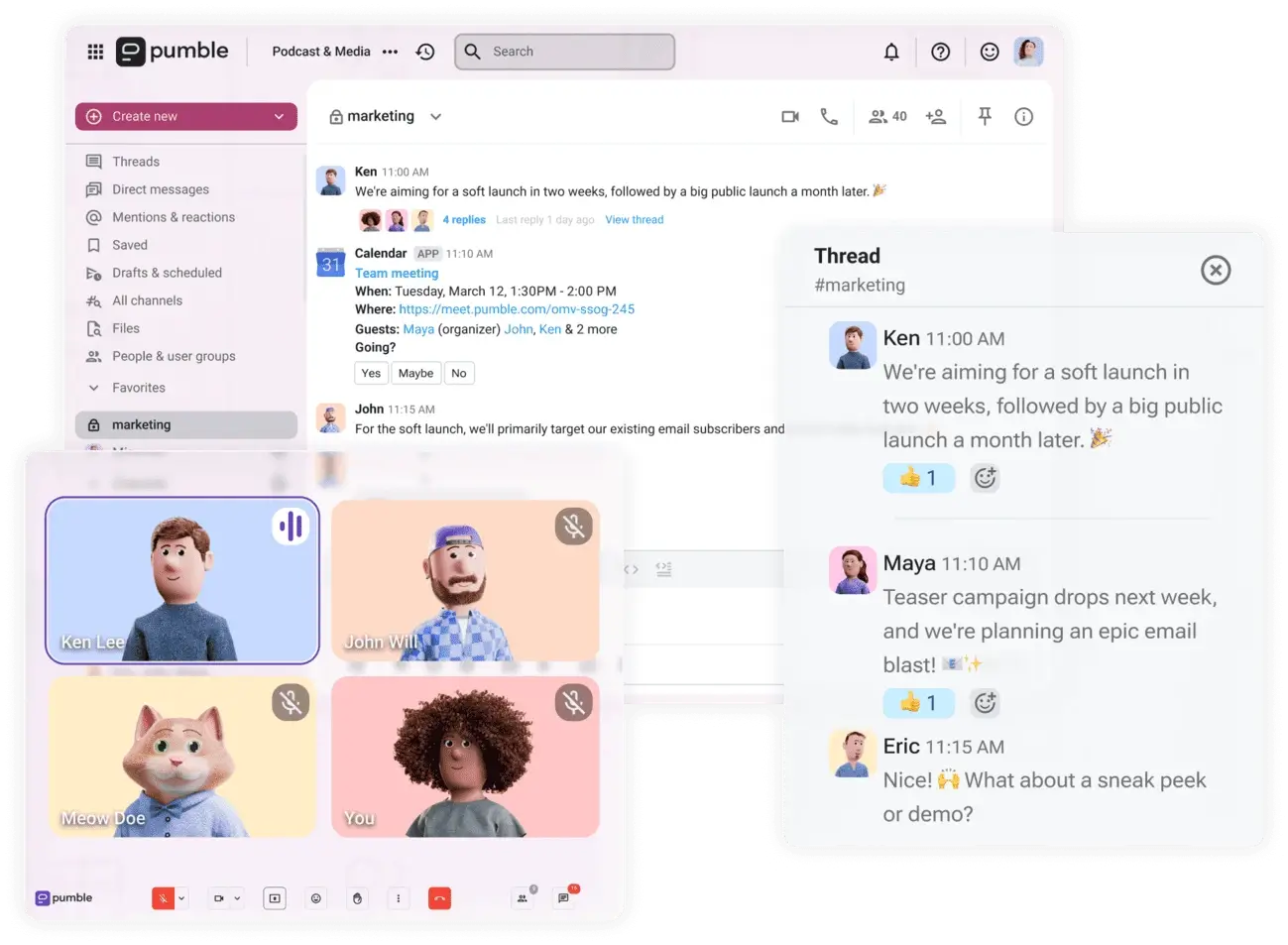
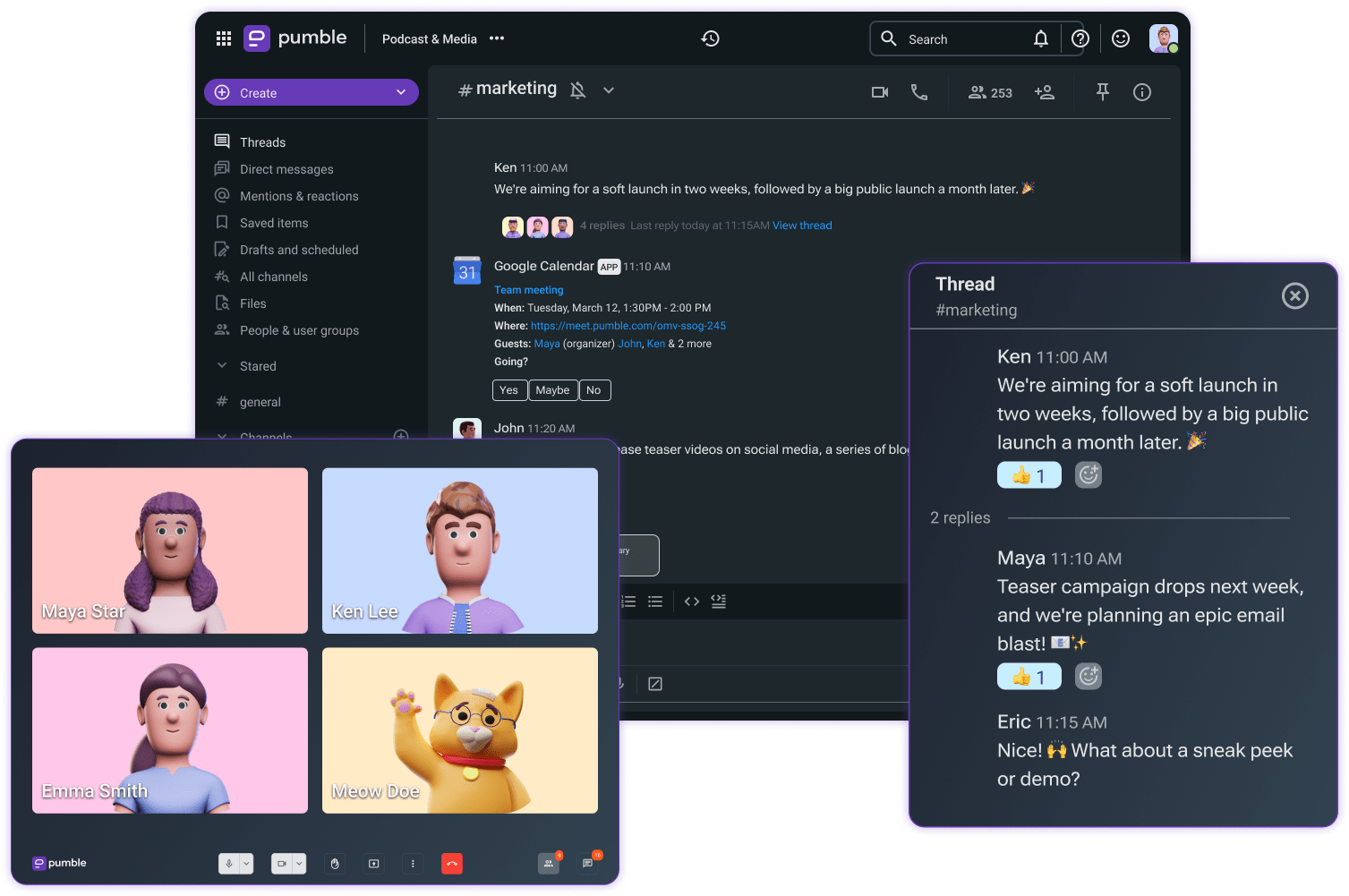
Apps like Pumble by CAKE.com streamline workplace communication, with real-time direct messages and threaded conversations allowing everyone to have transparent discussions.
Keep ongoing dialog alive with video conferencing features and connect with team members in a human and empathetic way.
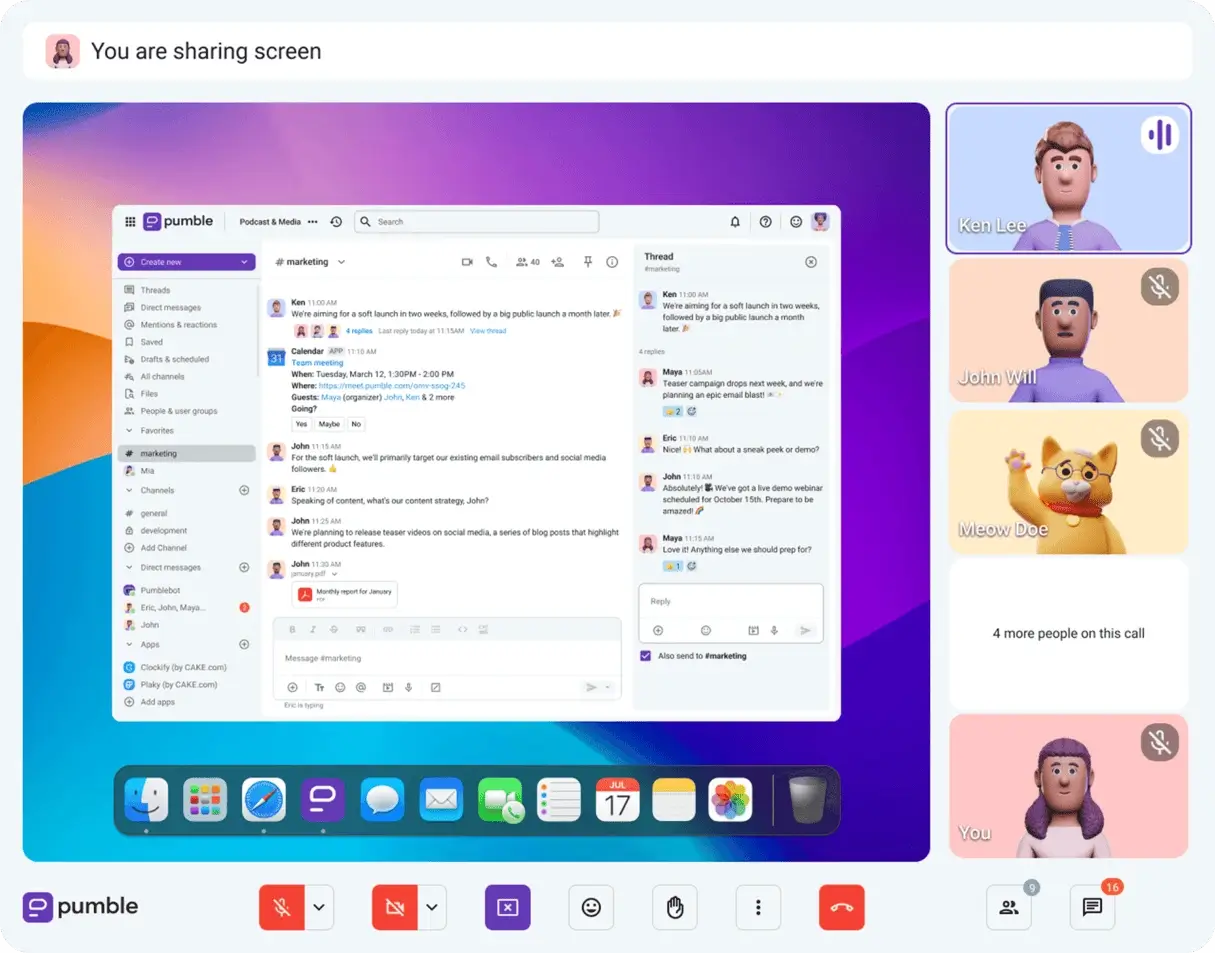
Aprovecha todo el alcance de Pumble de funciones de comunicación y colaboración y garantiza que el compromiso de los empleados nunca se convierte en un obstáculo.
Mantén a tu equipo conectado, sin importar dónde trabajes.
Referencias:
- ADP Research. (2025). People at work: A global workforce view 2025. https://www.adpresearch.com/wp-content/uploads/2025/03/PAW2025-Final.pdf
- Comfort, P. (2019). Does character matter? The three C’s of leadership. Business.com. https://www.business.com/articles/the-three-cs-of-leadership/
- Deloitte. (2025). Tech trends 2025. Deloitte Insights. https://www.deloitte.com/us/en/insights/topics/technology-management/tech-trends.html
- Effectory. (2025). Global employee engagement index. https://go.effectory.com/hubfs/EN-Downloads/Effectory_Global_Employee_Engagement_Index_2025.pdf?hsLang=en
- Gallup. (2024). Gallup Q12® meta-analysis. https://www.gallup.com/workplace/321725/gallup-q12-meta-analysis-report.aspx
- Gallup. (2024). Global indicator: Employee engagement. https://www.gallup.com/394373/indicator-employee-engagement.aspx
- Gallup. (2025). How to improve employee engagement in the workplace. https://www.gallup.com/workplace/285674/improve-employee-engagement-workplace.aspx
- Gallup. (2025). State of the global workplace report. https://www.gallup.com/workplace/349484/state-of-the-global-workplace.aspx
- Harter, J. (2023). A great manager’s most important habit. Gallup. https://www.gallup.com/workplace/505370/great-manager-important-habit.aspx
- Harter, J. (2025). US employee engagement sinks to 10-year low. Gallup. https://www.gallup.com/workplace/654911/employee-engagement-sinks-year-low.aspx
- Harter, J. (2026). US employee engagement declines from 2020 peak. Gallup. https://www.gallup.com/workplace/701486/employee-engagement-declines-2020-peak.aspx
- HR.com. (2025). HR.com’s state of employee productivity and engagement 2025. https://www.hr.com/en/resources/free_research_white_papers/hrcoms-state-of-employee-productivity-and-engageme_mbrlgjgk.html
- Kwai, I., & Jamieson, T. (2024). Inside the four-day workweek experiment. The New York Times. https://www.nytimes.com/2024/12/08/business/four-day-work-week-uk.html
- Lichtenberg, N. (2026). “Hybrid creep” is the latest trick bosses are using to get workers back in the office. Fortune. https://fortune.com/2026/01/13/what-is-hybrid-creep-remote-work-return-to-office/
- McKinsey & Company. (2024). Engage your workforce. https://www.mckinsey.com/quarterly/the-five-fifty/five-fifty-engage-your-workforce
- Pendell, R. (2025). Respect at work returns to a record low. Gallup. https://www.gallup.com/workplace/655040/respect-work-returns-record-low.aspx
- People Element. (2025). Employee engagement report. https://peopleelement.com/2025-employee-engagement-report-trends-takeaways/
- Purdue University. (2023). Generational differences in the workplace. Purdue Global. https://www.purdueglobal.edu/education-partnerships/generational-workforce-differences-infographic/
- Robinson, B. (2025). “Job hugging”: 75% of workers staying put through 2027, study shows. Forbes. https://www.forbes.com/sites/bryanrobinson/2025/10/25/job-hugging-75-of-workers-staying-put-through-2027-study-shows/
- Sherman, E. (2025). Jobs prospects for 2026 are looking grim, even with a growing economy. Forbes. https://www.forbes.com/sites/eriksherman/2025/12/31/jobs-prospects-for-2026-are-looking-grim-even-with-a-growing-economy/
- WorkL. (2024). Global workplace report 2024. https://workl.com/global-workplace-report-2024-powered-by-workl/
- WorkL. (2025). Global workplace report 2025. https://www.flipsnack.com/workl/global-workplace-report-2025
