 Updated: marzo 23, 2026
¿Sigues atrapado en reuniones innecesarias que podrían haber sido un email?
¿Hay algún avance a la vista?
Meeting statistics for 2026 show that the meeting culture has been constantly changing while employees express their opinion on meeting productivity and preferences.
En esta guía, te brindaremos todos los datos, cifras y estadísticas interesantes sobre las reuniones.
Sin más preámbulos, vamos a ver los detalles.

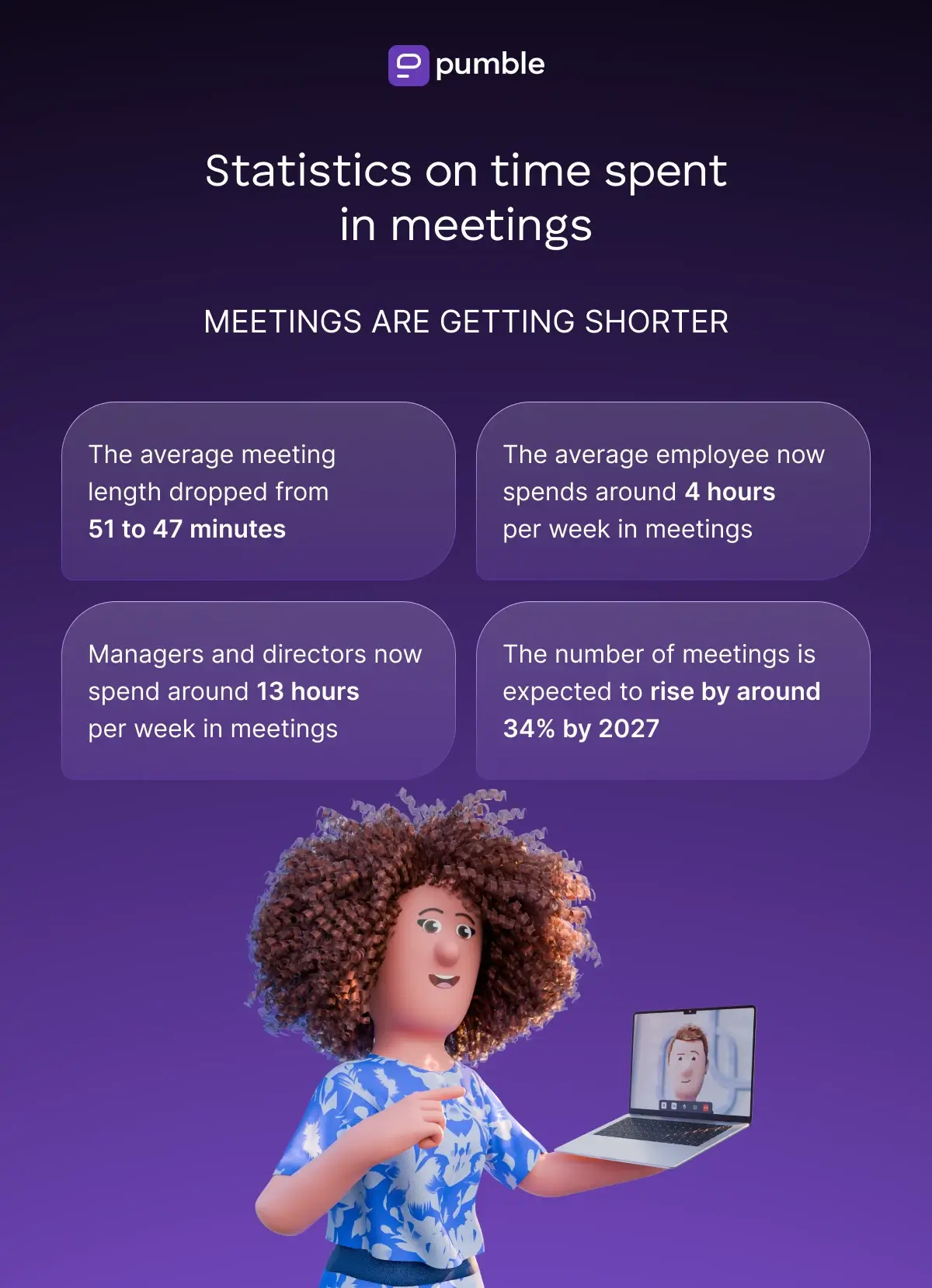
- Meetings are getting shorter. The average meeting length dropped from 51 to 47 minutes.
- The average employee now spends around 4 hours per week in meetings.
- Se estima que el número de reuniones seguirá aumentando alrededor de un 34% hasta 2027.
- El 70% de los empleados cree que su satisfacción laboral mejoraría si asistieran a menos reuniones.
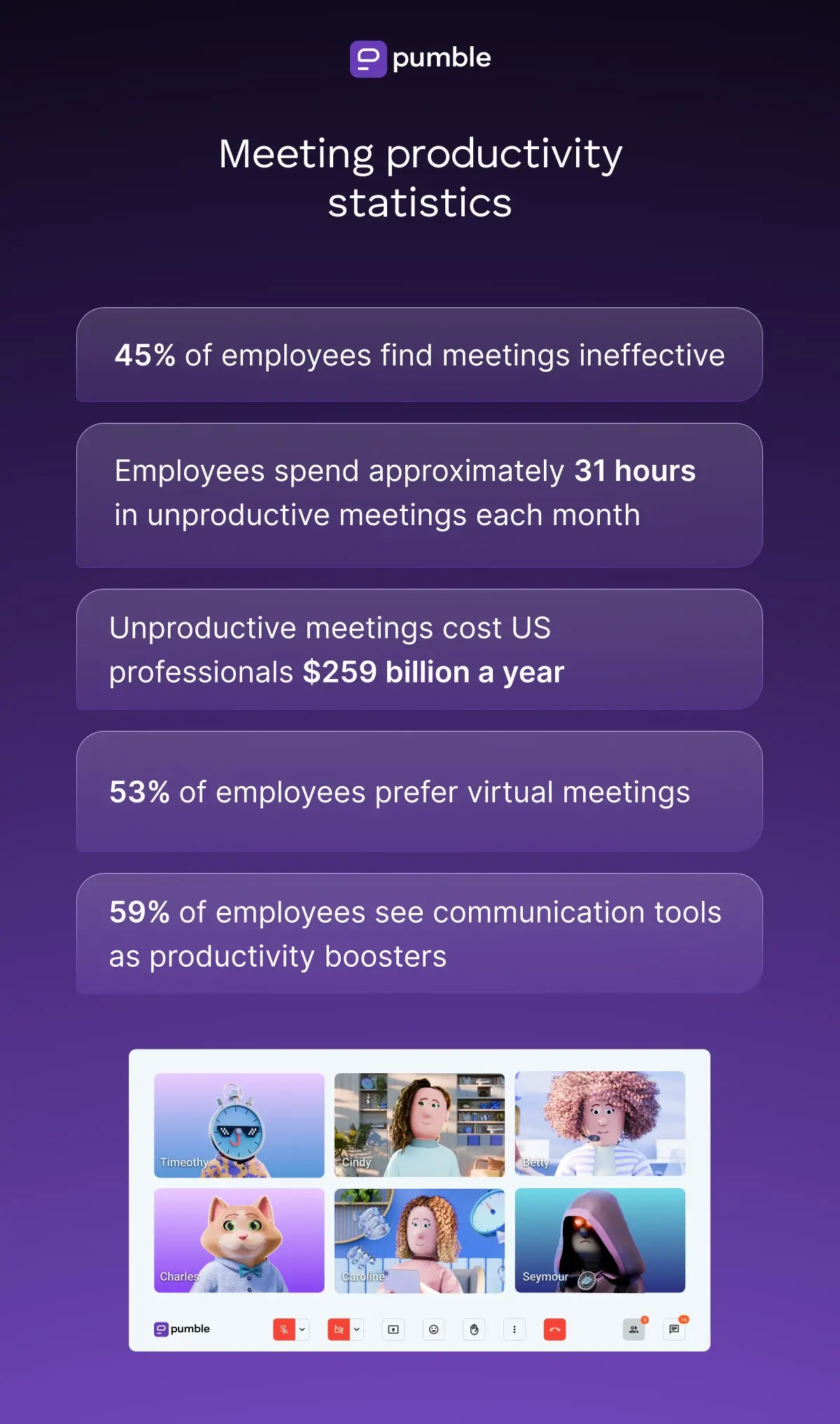
- Unproductive meetings cost US professionals $259 billion a year.
- Approximately, 71% of all meetings are unproductive.
- Around 72% of business leaders believe that implementing AI will significantly improve team productivity.
Estadísticas del tiempo dedicado a las reuniones
Las reuniones productivas pueden hacer que las horas pasen volando, mientras que las desorganizadas pueden parecer que se prolongan durante días. Para comprender mejor este concepto, examinemos algunos datos sobre la duración de las reuniones.
The biggest shift in meeting time happened after 2020
Una gran cantidad de investigaciones muestran que los profesionales asistieron a más reuniones en 2020 en comparación con antes de la pandemia.
En promedio, las reuniones fueron más breves y se centraron principalmente en:
- Mantener la conexión del equipo y
- Llamadas uno a uno.
The National Bureau of Economic Research (NBER) observed the impact of COVID-19 on collaboration and found that the nature of work has changed for the majority of knowledge workers — especially in terms of:
- Reuniones,
- Comunicación empresarial, y
- Horas de trabajo.
Es decir, hay un 12,9% más de reuniones por persona y un 13,5% más de asistentes por reunión.
However, other noticeable changes have occurred:
- La duración media de las reuniones ha disminuido un 20,1%.
- Las personas pasan un 11,5% menos de tiempo en reuniones después del confinamiento.
- Las jornadas laborales son un 8,2% más largas (o 48,5 minutos).
Meeting time is on a slow decline in 2026
A medida que el trabajo desde casa comenzó a convertirse en la nueva normalidad, el tiempo de reunión siguió aumentando.
Meetings continued to be on the larger side — more than 22% of meetings had at least 8 attendees. This is the maximum participant limit for optimum productivity, suggested by the research by Robert Sutton, a professor of organizational behavior at Stanford University.
According to a report by Fellow, managers spent over 50% of their week in meetings in 2023, on average — which was a 66% increase compared to the two previous years.
The same source reported in 2025 that this number was declining. Namely, managers and directors spent around 13 hours per week in meetings, while the C-suite executives had weekly meeting loads of around 11 hours, which made up 28.3% of their workweek.
According to Hubstaff’s “2026 Global Trends and Benchmarks Report”, this declining trend continues in 2026:
- Individual contributors spend around 4 hours per week in meetings, while
- Managers average close to 9 hours, or nearly a quarter of their work time.
Supernormal also reports that meetings are shorter in 2026. Namely, the average meeting length dropped from 51 to 47 minutes, but the volume stayed pretty consistent.
Still, in the 63rd International Meetings Statistics Report, the UIA (Union of International Organizations) estimated that the number of meetings will continue to rise by around 34% by 2027.
Estadísticas sobre la productividad de reuniones
Unnecessary meetings are seen as one of the critical distractions preventing professionals from finishing their work.
Sin embargo, las reuniones virtuales tienen el potencial de cambiar esta situación. Antes de discutir el impacto de las reuniones virtuales en la productividad, veamos qué porcentaje de reuniones son improductivas y cuánto tiempo se pierde en las reuniones.
¿Qué porcentaje de reuniones son reuniones improductivas?
Aunque las reuniones productivas afectan el desempeño de los empleados y la satisfacción laboral, algunas sesiones dejan mucho que desear.
Namely, Zippia reveals that:
- 65% of employees agree that frequent meetings stop them from focusing on and completing their tasks.
- 34% of workers report that unproductive meetings are the leading cause of revenue loss.
- 15% of all work hours are devoted to meetings, which makes roughly 71% of all meetings unproductive.
However, Calendly’s State of Meetings report for 2024 shows some conflicting views — 55% of respondents say meetings actually help them be more productive, while a decent portion of employees (45%) find meetings ineffective.
Similarly, LSE Generational Survey Report reveals that 35% of meetings are considered unproductive across all generations of employees.
Interestingly, the same report found that the general sentiment towards new ideas greatly impacts how meetings are perceived.
For example, meetings with attendees who accept new ideas were considered unproductive 23% of the time, while meetings with attendees who discouraged new ideas were deemed unproductive 66% of the time.
Zippia también informa que los empleados pasan aproximadamente 31 horas al mes en reuniones improductivas.
Para la mayoría de los empleados, esto se traduce en unas 8 reuniones por semana. Sin embargo, quienes ocupan puestos directivos y de liderazgo suelen asistir a más de 12 reuniones por semana.
¿Por qué las reuniones son improductivas?
Las reuniones mal organizadas pueden tener un impacto duradero en la satisfacción de los empleados y el éxito organizacional.
Zippia descubrió que:
- El 55% de los trabajadores ha realizado algún tipo de multitarea durante las reuniones,
- El 45% de los empleados encuestados se sienten abrumados por la cantidad de reuniones a las que asisten, y
- El 39% de los encuestados ha admitido haberse quedado dormido durante una reunión de trabajo.
Unproductive meetings decrease employee morale and engagement, which further leads to dissatisfaction with their jobs. What’s more, unnecessary meetings can overwhelm employees, decreasing their cognitive performance and draining their energy.
But, what are the main reasons we still attend so many unproductive meetings?
According to Atlassian’s research, meetings are increasingly considered unproductive due to the poor meeting culture. Employees cite following major causes of ineffective meetings:
- Individuals dominating the conversations, leaving no room for more voices and perspectives,
- Unclear next steps, so people don’t know what’s expected of them,
- Information repeating on multiple occasions and meeting attendees deeming the meeting pointless,
- Unnecessary meetings (could have been an email), and
- Missing clear agenda, so meetings lack focus.
Calendly had similar findings. They discovered that the top 3 reasons people find meetings unproductive include:
- Lack of follow-up notes and summaries,
- Critical attendees missing, delaying important decisions, and
- Lack of agenda or any pre-meeting read.
Las reuniones virtuales tienen un impacto más positivo en la productividad
Although the shift to remote work increased the general meeting time, it also caused higher productivity and engagement.
Si bien los empleadores tradicionalmente han vinculado el trabajo presencial y las reuniones en persona con la productividad máxima, las cifras sugieren que la fuerza laboral no comparte esta opinión.
According to Pumble’s Remote Work Statistics 2026, 69% of managers deem their teams more productive when working from home. This flexibility allows them to better manage their time and ensure that meetings don’t disrupt their workflow.
Another reason for improved productivity is improved employee training. In 2024, Owl Labs states that almost half (49%) of surveyed employees have received training on how to run inclusive and effective hybrid meetings.
Respondents in Buffer’s State of Remote Work report for 2023 also favor virtual meetings, particularly when the camera is on. Around 62% of surveyed remote workers stated keeping the camera on allowed them to gauge the nonverbal cues of other participants. Another 16% of respondents believe these meetings help them feel less isolated.
When managers and higher-ups know the best practices for leading virtual meetings, productivity and motivation follow suit. In 2026, in-house training should cover:
- Cómo preparar una agenda de reuniones práctica,
- Escucha activa, y
- Cómo mostrar empatía.
For midsize and large businesses, training on meeting role delegation should also be one of the top priorities. Depending on their objectives, some companies may benefit from tracking meeting costs and opting for asynchronous communication and collaboration.
Organiza reuniones efectivas en Pumble
Statistics on the cost of unproductive meetings
Las reuniones todavía suponen un coste enorme para las empresas y los equipos.
Unproductive meetings cost US professionals $259 billion a year, according to LSE. A large organization employing 2,500 people loses up to $9.6 million each year.
Another research, by Software Finder, reveals that productivity suffers greatly due to unproductive meetings. Employees consider 46% of their meeting time to be unproductive or unnecessary.
Status update meetings are deemed most wasteful by employees, followed by all-hands.
- Status update meetings — 53%,
- All-hands or town halls — 46%,
- Brainstorming sessions — 29%,
- Project kickoffs — 18%,
- 1-on-1s — 16%,
- Performance reviews — 15%, and
- Client calls — 12%.
This leads to severe consequences. It’s estimated that employees waste 146 hours in meetings every year, which amounts to roughly $6,280 in salary per employee.
Atlassian’s earlier estimates revealed that unnecessary meetings cost US businesses $37 billion in salary costs.
Needless to say, companies can save significant resources and better support their workforce by eliminating unnecessary meetings.
Cut back on unnecessary calls — Pumble
Hybrid meeting trends 2026: Statistics on the most common meeting formats
La pandemia y el trabajo remoto también afectaron los tipos más comunes de reuniones en el lugar de trabajo que realizan las organizaciones y los equipos.
As a result, one-on-one meetings became the most common, but group sessions persisted.
Let’s examine some data on the most common types of meetings in 2026.
Check-in meetings are the most common meeting formats
According to Supernormal, check-in or sync meetings and standups come up more often than other meeting formats (all-hands, 1:1, sprint/agile, interview) combined.
As expected, the name of the meeting suggests the meeting size. All-hands meetings and standups are more likely to host 10+ attendees. In fact, 45.4% of all standups have more than 10 attendees, while 1:1s almost never do.
The size of the meetings correlates with the level of disengagement employees experience, Calendly finds. Employees reported feeling less engaged in larger meetings such as all-hands gatherings, while smaller brainstorming meetings that require more active roles inspire higher engagement.
Virtual meetings remain most common
The majority of employees who worked from home during the pandemic reported they preferred hybrid meetings. More recent research by Zippia shows this trend is still very much alive in 2026, as 53% of employees favor virtual meetings.
Still, LiveCareer’s report shows a concerning fact. Namely, 45% of employees report feeling drained by virtual meetings often or always.
Yet, even despite the rise of hybrid creep, online and hybrid meetings remain more common, Owl Labs shows.
| Meeting frequency | Virtual meetings per week | In-person meetings per week |
|---|---|---|
| 0–1 meetings | 17% | 14% |
| 1–2 meetings | 38% | 35% |
| 3–4 meetings | 19% | 21% |
| 5–6 meetings | 12% | 13% |
| 7–8 meetings | 2% | 2% |
| 9–10 meetings | 4% | 5% |
| 11+ meetings | 8% | 10% |
Different time zones and last-minute meetings
Working across global teams has significantly reshaped when and how meetings happen.
Almost a third of meetings now involve participants in different time zones — a 35% increase since 2021. As a result, many calls are scheduled early in the morning or late at night to accommodate everyone.
Microsoft reports a 16% year-over-year rise in meetings held after 8 p.m. What’s more, the same report shows that around 29% of employees are still checking and responding to emails by 10 p.m. And, while some remote workers appreciate the calm of evening work, many hybrid employees experience added stress from late-night meetings.
Another major change is in how meetings are arranged. A growing number are being set up spontaneously. According to Microsoft’s 2025 data, 57% of meetings are impromptu and happen without a formal calendar invite, while roughly 10% of scheduled meetings are arranged just moments before they begin.
Although this flexibility can help teams address issues quickly, it can also lead to disorganized schedules and disrupt deep work.
Estadísticas sobre el uso de plataformas de conferencias para reuniones
According to Dialpad’s State of Video Conferencing report, companies started investing in video conferencing equipment more significantly during the 1990s. However, it wasn’t until 2020 that the use of video and audio technology for meetings became more widespread.
This could be explained by the pandemic and the global shift to remote work, when many people had to install these tools for the first time.
Six years later, we can see some changes, especially in how virtual conference platforms and AI technology are integrated into corporate meeting environments.
Statistics on the corporate perception of communication tools
Even though they’ve now been in use for at least 6 years, the jury is still out on how communication tools affect productivity.
Respondents in LiveCareer’s research are divided on this topic:
- 59% of employees see communication tools as productivity boosters.
- 20% of employees say these tools hamper their efficiency.
- 21% feel they have no impact.
It’s becoming increasingly clear that organizations need to invest more time and resources in training their employees on how to incorporate communication tools into their workflows to boost productivity. Or, for that matter, seek better fitted options for their specific team needs.

Estadísticas sobre cómo las organizaciones utilizan las plataformas de conferencias
When examining what tools companies most commonly use, LiveCareer has learned that communication platforms top the list, followed by time-tracking software.
Most used tools include:
- Communication platforms — 72%,
- Time-tracking software — 44%,
- Task management tools — 41%,
- AI-powered tools — 41%, and
- Professional development platforms — 19%.
However, the report notices a discrepancy between the tools employees are presented with and the tools they actually want to use.
Most employees wished their companies had better time trackers (52%) and task management tools (45%). At the same time, 38% of respondents seek more AI-powered tools and 25% of employees want more professional development platforms.
This is a valuable insight for organizations to better cater to their employees needs.
Need an award-winning time tracker, task management, and communication tool? You’re in luck. CAKE.com has everything your team needs to collaborate, for one affordable price.

Meeting fatigue data
Before the pandemic, professionals felt more comfortable in audio-only meetings. It seems like people’s preferences haven’t changed in this regard.
The global shift to video conferencing gave rise to the increase in fatigue in professionals spending long hours on camera.
Research from Stanford supports these claims. A study on the mental strain of video conferences concluded that attendees of virtual meetings experience higher cognitive loads than employees who attend meetings in person.
According to Forbes’ survey from 2023, Zoom fatigue has transformed into Meeting fatigue — physical and mental exhaustion caused by back-to-back video calls.
Almost 30% of surveyed workers viewed too many meetings as the main cause of meeting fatigue, while 47% of them considered meeting without a purpose as the main source of fatigue.
Although video conferencing isn’t a universal or the most comfortable solution for all organizations, it aids them in their daily operations as their needs evolve.
En los años siguientes, las videoconferencias se volverán naturales para la mayoría de los empleados en casi todas las industrias.
In fact, the Fortune Business Insights report states the video conferencing market share was $6.28 billion in 2021 and is expected to reach $14.58 billion by 2028.
Statistics on generational attitudes toward meetings
With such dramatic changes the meeting environment has experienced in recent years, it’s no surprise that different generation groups experience meetings very differently.
Older generations are more likely to be resistant to change in meeting landscape
Older generations are less likely to believe that attending more meetings could benefit them in any meaningful way — 37% of Boomers vs 16% of Millennials report feeling they’re already in too many meetings to Calendly.
Boomers are also more likely to intervene if someone is steering the conversation off course, compared to 44% of Gen Z and Millennials, and 55% of Gen X who care about keeping the agenda on track.
Note taking by hand is another meeting preference most commonly found with older generations:
- 63% of Boomers report handwriting their meeting notes, compared to
- 59% of Gen X, and
- 54% of Gen Z and Millennials.
Boomers are also least likely to be excited about using AI. Namely, 24% of Boomers reported being unenthusiastic about using AI, compared to 13% of Gen X, 5% of Millennials, and 3% of Gen Z.
Younger generations feel more drained by meetings
Although they spend the least amount of time on average in meetings, Gen Z suffers the greatest consequences, Software Finder reveals.
Namely, Gen Z spends “only” 5 hours per week in meetings (85% of Gen Z respondents). Millennials and Gen X typically attend 5 meetings per week, while Gen Z have 4 meetings scheduled.
At the same time, the vast majority of Gen Z respondents — 81% — say they feel meetings drain their energy.
Despite frequent meetings, Gen Z feel the loneliest
Gen Z experiences another paradox in their work life. Multiple studies have shown that, despite regular socializing, Gen Z are prone to feelings of loneliness and isolation at work.
Apparently, the meeting frequency has little to no effect on the sense of connectedness and belonging, at least for Gen Z.
Bupa’s Wellbeing Index 2025 highlights social isolation as one of the biggest problems in today’s workplace. According to their research, Gen Z experiences loneliness the most. Work circumstances are cited as the main reason 38% of Gen Z employees feel socially isolated.
Another survey, by Bingo Card Center, shows that, despite spending more time with coworkers than older generations, 60% of Gen Z workers express feeling lonely and wish they were closer to their colleagues.
Interesting virtual meeting statistics
Virtual remote meetings have brought entirely new sets of behaviors that were completely unimaginable in the in-office era.
Desde la apariencia de niños y mascotas hasta fondos y filtros divertidos, los entornos de trabajo virtuales han humanizado la forma en que abordamos las reuniones.
Profundizaremos en algunos datos curiosos sobre las reuniones virtuales para ver cuánto han cambiado la vida cotidiana de los trabajadores.
Employees have favorite meeting days
In 2024, when virtual meetings have become the default collaboration and decision-making modes for most employees, Fellow analyzed meeting preferences.
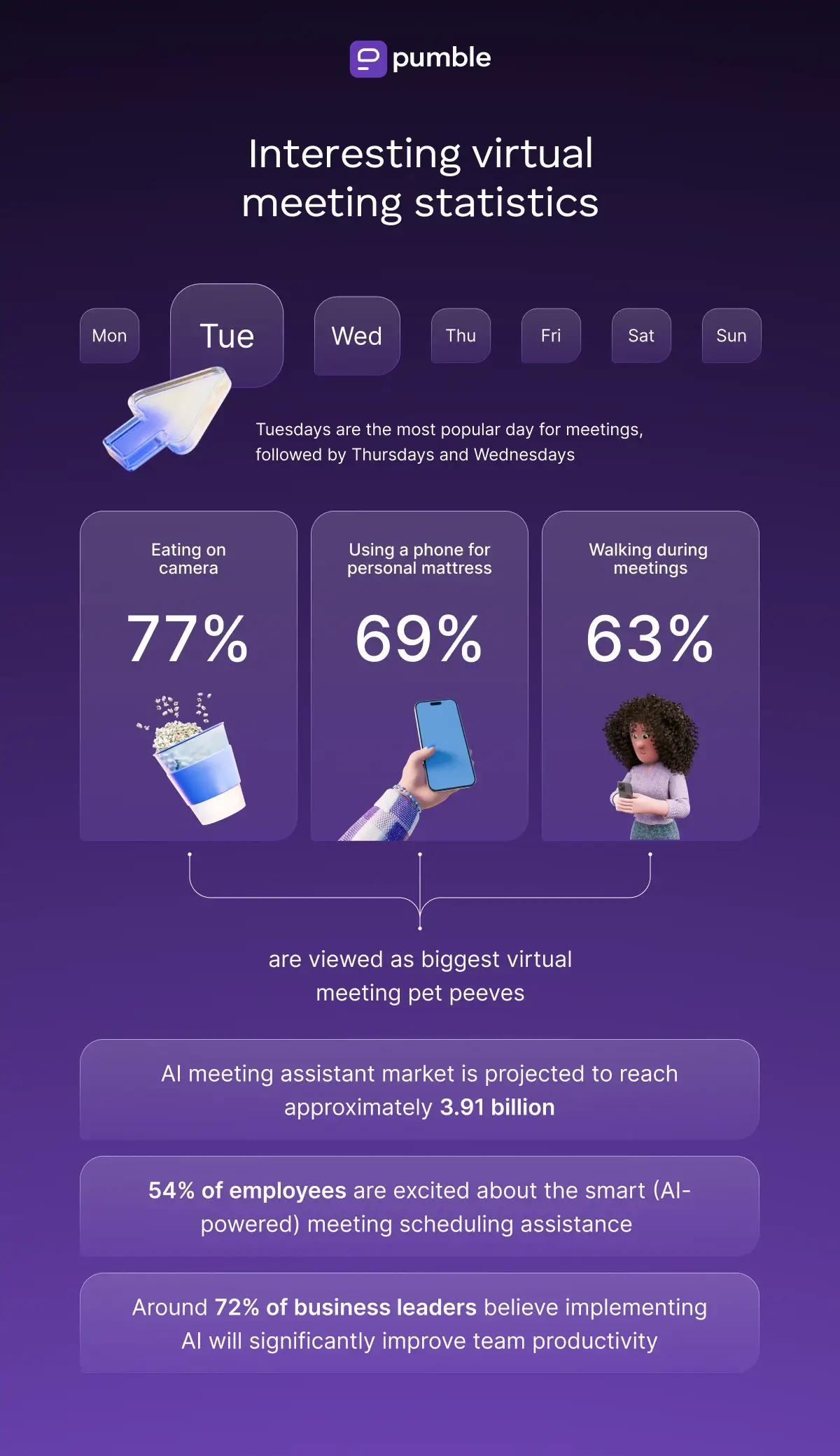
They’ve found that Tuesdays are the most popular day for meetings, followed by Thursdays and Wednesdays, leaving little to no room for deep work and execution on these days.
Supernormal had similar findings:
- Tuesday remains the most popular meeting day with 21.49% of weekly meetings happening on this day, followed by Thursday (21.27%).
- Wednesday follows closely with 20.81%.
- Monday is the second least favorite meeting day at 19.78%.
- Friday is the least popular, with 16.65% of weekly meetings being held on this day.
En general, los empleados prefieren que el comienzo y el final de la semana sean zonas libres de reuniones.
Employees cancel meetings regularly
Meeting overload is increasingly taking a toll on workplace culture. More than a quarter of employees (26%) report regularly cancelling at least one meeting each week, and this figure rises to 38% among managers.
When it comes to the types of meetings which get cancelled the most, Software Finder reveals that one-on-one meetings are often the first to be dropped, with 21% of employees observing that this trend is becoming more common within their organizations.
Employees refuse to participate in meetings
Software Finder highlights another notable issue — lack of participation. A striking 85% of employees admit they have remained silent in meetings despite having input to share, with 21% saying this happens frequently.
When asked about the reasons for these decisions, many attribute this to meetings feeling more like performances, where attendees focus on appearances rather than substantial discussions.
Make conversations count in Pumble
Eating on camera and using phones for personal use remain the biggest meeting pet peeves
When researching what behaviours are considered acceptable vs unacceptable during virtual meetings, Calendly discovered that, overall, eating on camera, using a phone for personal mattress, and walking during a meeting are viewed as the least appropriate behaviors.
Here’s a quick look of which behaviors employees find unacceptable during virtual meetings.
| Pet peeves | Percentage of employees who view it as inappropriate |
|---|---|
| Eating on camera | 77% |
| Using phone for personal use | 69% |
| Taking a walk when others are connected from their desks | 63% |
| Having camera off when the majority has camera on | 61% |
| Commuting or travelling | 46% |
| Sitting outdoors away from work station | 45% |
| Eating off camera, on mute | 32% |
On the other hand, using a phone for work purposes, multitasking, and eating off camera are generally seen as the most acceptable.
However, these pet peeves seem to differ across cultures. Workers in the United States tend to be slightly more tolerant of these behaviors compared to those in the United Kingdom. For example, 72% of US employees think eating off camera is acceptable, versus 64% in the UK.
Similarly, 68% of US workers are comfortable using a phone for work during in-person meetings, compared to 60% in the UK. Additionally, 76% US respondents believe it’s fine to step out to take an urgent call, while only 70% of UK respondents agree.
¿Cuál es el futuro de las reuniones en el lugar de trabajo?
In 2026, we’re seeing artificial intelligence (AI) rapidly reshaping the future of workplace meetings, transforming how teams collaborate and communicate.
It has been projected that by 2026, AI meeting assistants will have become a mainstream technology, with the global market projected to reach approximately $3.91 billion, reflecting the growing demand for automated collaboration tools.
This growth is closely tied to an “agentic shift,” where agentic AI workflows increasingly handle “work about work,” such as:
- Scheduling,
- Note-taking,
- Summarizing discussions, and
- Tracking action items.
This significantly reduces administrative work and lets organizations move from time-consuming meetings toward more productive and outcome-focused discussions.
As a result, meetings are becoming shorter, more purposeful, and better integrated into broader workflows.
Business leaders are also optimistic about these changes. Around 72% believe that implementing AI will significantly improve team productivity, according to Insight’s report on the possibilities of generative AI.
The optimism is supported by the rise of hybrid and remote work, which has promoted reliance on digital tools to maintain a healthy collaborative culture in global teams.
Employees are getting more enthusiastic about AI year-by-year. Calendly reveals that employee excitement about AI’s potential to make meeting scheduling easier grows every year:
In 2023, employees were mostly excited about:
- Smart scheduling assistance — 47%,
- Automated document summarization — 44%, and
- Time tracking management — 44%.
In 2024, Calendly discovered the following sentiment toward AI:
- 54% of employees reported being excited about the smart scheduling assistance,
- 44% said they were enthusiastic about the automated meeting follow-up, while
- 34% employees reported being excited about automated insights and time tracking.
While these AI-driven advancements may change how we conduct work meetings, it’s up to employers to ensure workers receive the proper introduction and training.
Haz que tus reuniones sean más productivas con Pumble by CAKE.com
At the end of the day, the numbers don’t lie. Meetings are still a necessary part of how teams get things done. But right now, they’re often bigger and less organized than they need to be.
Instead of moving things forward, too many meetings are eating up time, dragging things out, and leaving everyone feeling confused afterward.
The good news is, you don’t have to keep going down that road. It’s time to cut back on unnecessary calls, and rethink how your team communicates.
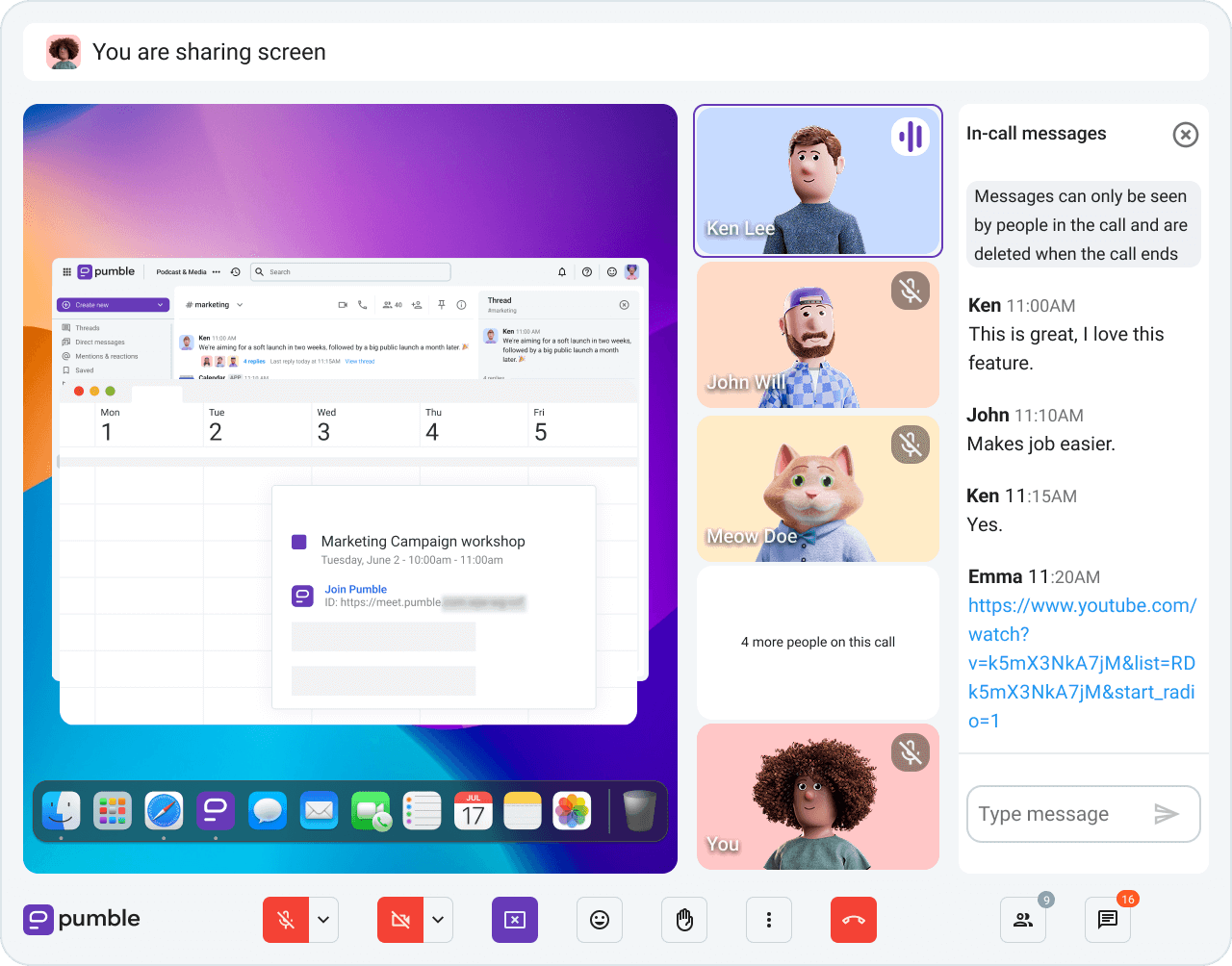
Comparte noticias, gestiona tareas y conecta sin problemas, todo en un solo lugar con Pumble
So, if you want to make your meetings more productive, try the team communication app Pumble by CAKE.com, so you can:
- Host one-to-one and group meetings with high video and audio quality.
- Use text, voice, and video messages to replace unnecessary meetings with asynchronous collaboration.
- Record your meetings and keep them on file to reduce meeting load and keep your team updated without the unnecessary overload.
Make the most of your meetings!
Referencias:
- APA. (2021) Nonverbal Overload: A Theoretical Argument for the Causes of Zoom Fatigue. https://tmb.apaopen.org/pub/nonverbal-overload/release/2
- Atlassian. (n.d.). You waste a lot of time at work [Infographic]. https://www.atlassian.com/time-wasting-at-work-infographic
- Bailenson, J. N. (23 de febrero de 2021). Nonverbal overload: A theoretical argument for the causes of zoom fatigue. Technology, Mind, and Behavior. https://tmb.apaopen.org/pub/nonverbal-overload/release/2
- Bingo Card Center. Do Americans have friends at work anymore? https://www.bingocardcreator.com/blog/do-americans-have-friends-at-work-anymore/
- Buffer | State Of Remote Work 2023. (s.f.). Buffer: All-you-need Social Media Toolkit for Small Businesses. https://buffer.com/state-of-remote-work/2023
- Bupa Wellbeing Index 2025: Workplace Health. https://www.bupa.co.uk/~/media/Files/MMS/MMS-hosting/bins-20401.pdf
- Calendly. (2024). The State of Meetings. https://calendly.com/resources/guides/2024-state-of-meetings-report
- Dialpad. (2022). The state of video conferencing 2022. https://www.dialpad.com/blog/video-conferencing-report/
- Fellow. (2024). The State of Meetings Report 2024. https://fellow.ai/resources/state-of-meetings-2024
- Fellow. (2025). 45 Meeting Statistics and Behaviors Trends. https://fellow.ai/blog/meeting-statistics-the-future-of-meetings-report/
- Forbes (2023, September 25). Meeting Fatigue Has Replaced Zoom Fatigue. https://www.forbes.com/sites/forbesbooksauthors/2023/09/25/meeting-fatigue-has-replaced-zoom-fatigue/
- Fortune Business Insights. (s.f.). Video conferencing market size, share, Trends & growth [2029]. https://www.fortunebusinessinsights.com/industry-reports/video-conferencing-market-100293
- HBR. (June, 2018). The Most Productive Teams Have Fewer Than 8 People. https://hbr.org/2018/06/the-most-productive-meetings-have-fewer-than-8-people
- Hubstaff 2026 Global Trends & Benchmarks: How Work Gets Done. https://hubstaff.com/global-work-report
- Insight. Beyond Hypotheticals: Understanding the Real Possibilities of Generative AI. https://www.insight.com/en_US/content-and-resources/gated/beyond-hypotheticals–understanding-the-real-possibilities-of-generative-ai-ac1293.html
- Jolles and Lordan. (2024). When Generations Meet: The productivity potential of multigenerational meetings. A report by The Inclusion Initiative at LSE. https://www.lse.ac.uk/tii/assets/documents/When-Generations-Meet.pdf
- Live Career. (2025) Workplace Tech Survey. https://www.livecareer.com/resources/careers/workplace-technology-survey
- Microsoft. (2025). Work Trend Index Special Report: Breaking down the infinite workday. https://www.microsoft.com/en-us/worklab/work-trend-index/breaking-down-infinite-workday
- National Bureau of Economic Research. (July, 2020) Collaborating During Coronavirus: The Impact of COVID-19 on the Nature of Work. https://www.nber.org/system/files/working_papers/w27612/w27612.pdf
- Software Finder. (2025). The Productivity Cost of Unnecessary Meetings. https://softwarefinder.com/resources/productivity-cost
- Supernormal. (2026). State Of Meetings 2026. https://www.supernormal.com/state-of-meetings
- The Business Research Company. (2026). AI-Powered Meeting Assistants Market Report 2026. https://www.thebusinessresearchcompany.com/report/artificial-intelligence-ai-powered-meeting-assistants-global-market-report
- UNION OF INTERNATIONAL ASSOCIATIONS. (s.f.). International Meetings Statistics Report. https://uia.org/publications/meetings-stats
- Zippia. (2023). 28+ Incredible Meeting Statistics [2023]: Virtual, Zoom, In-Person Meetings And Productivity. https://www.zippia.com/advice/meeting-statistics/
