
Have you ever missed a crucial project deadline just because a key supplier didn’t get the memo?
You’re not alone.
Seamless supplier communication is the secret sauce that turns a vendor into a long-term partner.
Let’s look at how you can lay the foundation for successful vendor relationship management that keeps your business moving forward.
- Vendor communication involves sharing information, updates, and feedback with external partners.
- Define points of contact, pick the right tools for collaboration, and agree on a shared record and escalation plan to keep communication with vendors running smoothly.
- Making your vendor communication plan stick takes enforcing best practice tips in your daily workflow.
What is vendor communication?
Vendor communication is the structured exchange of information, updates, and feedback between a business and its external suppliers.
Among other things, it covers:
- Sharing initial project requirements
- Checking in on milestones
- Resolving unexpected delivery issues
- Reviewing final performance metrics
Why vendor communication matters
When communication breaks down, businesses pay the price. If your team relies on messy email chains for communicating with external partners, you’re probably experiencing some of the common problems:
- Missed deadlines — a simple misunderstanding about a delivery date can stall your entire production line.
- Cost overruns — if project changes aren’t clearly spelled out, vendors might perform off-contract work that ends up costing you extra.
- Lost context — vital details get lost in translation when important decisions are scattered across phone calls, texts, and personal inboxes.
- Friction and stress — constant finger-pointing over who said what destroys trust and ruins the working relationship.
Clear vendor communication protects your operations. It ensures you get exactly what you pay for, right when you need it. By investing in a clear strategy, you prevent small slip-ups from turning into major financial headaches.

How to build a vendor communication plan (step by step)
Contrary to popular belief, you don’t need a 50-page document to keep communication with suppliers running smoothly. A simple and practical vendor communication plan keeps everyone aligned without creating extra paperwork.
Here’s how to set it up.
#1: Define main points of contact
One of the most common mistakes people make in vendor communication is letting too many cooks spoil the broth.
Instead, you should assign one specific person from your team to handle the vendor, and ask the vendor to do the same.
This stops conflicting messages from confusing your supplier and ensures everyone knows exactly who to go to with questions.
#2: Pick your tools and check-in times
Decide early on how you will stay in touch and how often. Will you do a quick weekly sync or a detailed monthly review?
A good rule of thumb is to figure out how to communicate with vendors based on the project’s speed. For example, you might realize that high priority projects need daily check-ins, while standard suppliers only require a monthly update.
#3: Set up a single shared record
Emails (no matter how near and dear to your heart) are burying important project information and files in scattered replies.
To save you and your vendors time and resources, you can switch to a collaboration platform that offers a central location where both teams can access the latest project requirements, contracts, and deadlines anytime.
This can include:
- A shared cloud folder
- A project management board
- A collaborative workspace in a team communication app

#4: Outline an escalation path
Things won’t always go perfectly to plan. When a problem pops up, your team and the vendor need to know what to do next.
To help them resolve an issue, it’s a good practice to define a clear backup plan. Make sure to have a consensus around who steps in next if the primary contact doesn’t solve a problem within 24 hours. This keeps minor issues from turning into huge obstacles.
#5: Review performance together
Your vendor communication plan shouldn’t be a sell-it-and-forget-it type of deal.
To ensure the systems in place are working properly, you can schedule regular check-ins every few months to see how the partnership is going.
Use these meetings to assess:
- The quality of the collaboration
- Data accuracy
- Delivery times
This way, both sides will have an opportunity to make improvements before any real friction occurs.
To help you get started on your supplier communication journey, here’s a vendor communication plan template you can use.
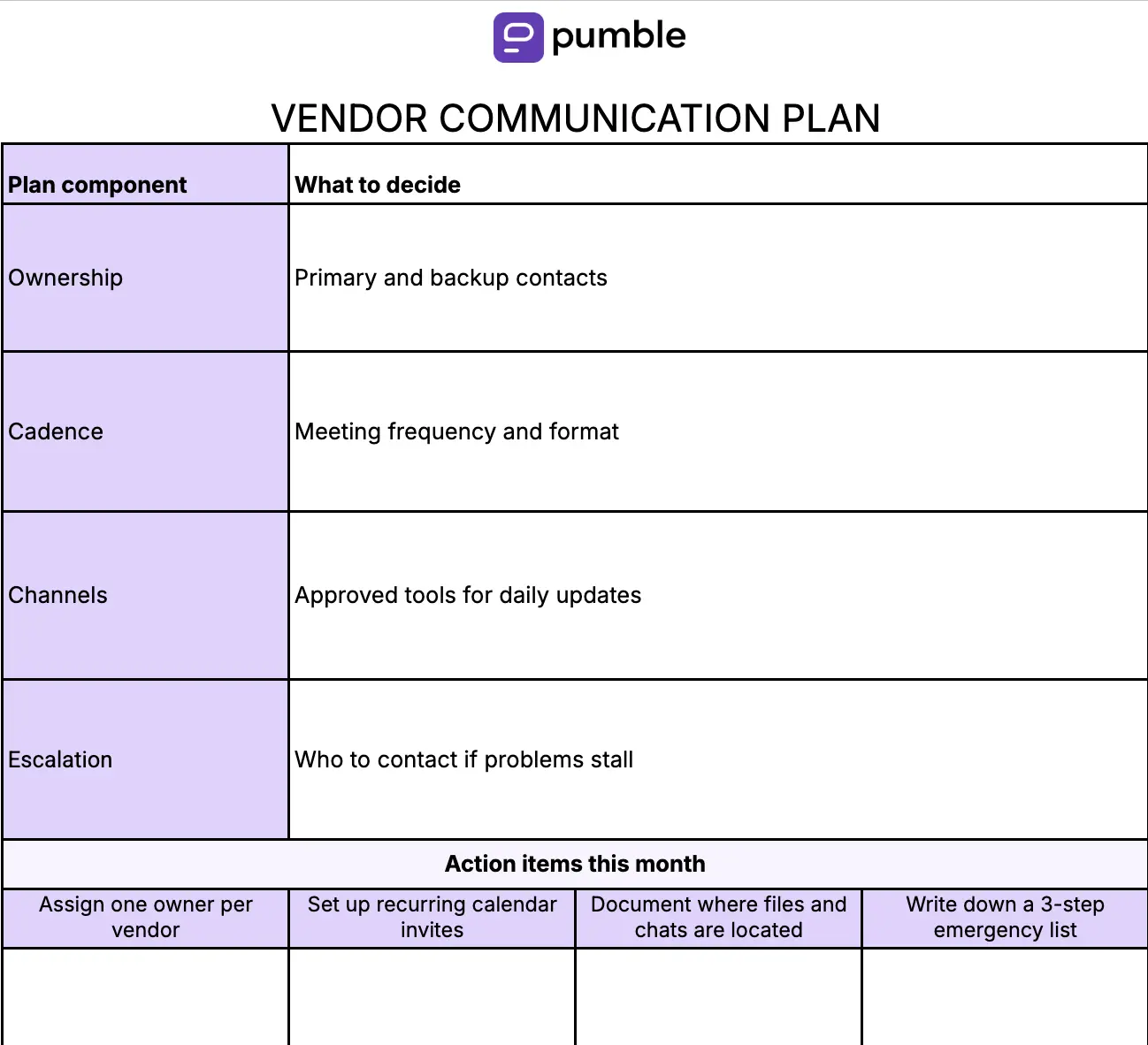
🔽 Vendor communication plan — template
Best practices for communicating with vendors
Having a plan is a great start, but following through is what makes it work.
To achieve truly effective communication with vendors, be sure to keep these practical tips in mind during your daily workflows.
Be crystal clear from day one
As in any type of business communication, it is important to not leave any room for guesswork when communicating with vendors.
For starters, when you assign work, you should try to spell out your:
- Exact specifications
- Deadlines
- Quality standards
Here’s an example of a message you can use to get off to a good start in your vendor communication:
Hi [Vendor name],
We’re ready to start the production process for [Product/Component name]. To ensure alignment on quality and timing from the start, please find our exact specifications, deadlines, and quality control standards below.
Technical specifications
- Part/Item number:
- Blueprints and CAD files: [Filename].pdf
- Material and finish:
- Quantity:
Deadlines and delivery schedule
- Pre-production sample approval:
- Production start date:
- Final QA and packaging:
- Ship date:
Quality standards and testing
- Tolerances: Must strictly adhere to the dimensions noted in the CAD file.
- Defect rate: Maximum acceptable defect rate (AQL) is:
- Inspection: A third-party inspection will be conducted at your facility prior to shipping.
- Documentation: Provide a Material Test Certificate (MTC) and a final dimension inspection report with the shipment.
Please reply to this email/message by [date] to confirm you have reviewed the attachments, accept the production timeline, and possess the necessary materials to begin.
Best regards,
[Your name]
[Your title]
[Your company]
Always strive to be as clear as possible. If a vendor has to guess what you want, you’ll likely end up wasting time on revisions.
Keep a reliable record
Making sure to always keep a paper trail in your communication with vendors will save you a ton of back-and-forth in the long run.
Say, a sudden change happens, and you manage to hash everything out with a supplier over a phone call. It’s still best to follow up with a quick summary in writing.
It doesn’t have to be a long-form essay to make it a reliable source of truth. A brief note confirming what you both agreed on will do just fine.
Here’s an example:
Hi [Vendor name],
Thanks for chatting with me earlier today. Just to confirm what we agreed on regarding the sudden change to our order.
We are switching the fabric color from navy blue to charcoal grey.
You confirmed this will not delay our original delivery date of October 12th.
The price per unit remains the same, with no extra rush fees.
If anything looks incorrect, please let me know by tomorrow morning. Otherwise, we will proceed on this basis.
This ensures no one forgets the important details later on.
Treat vendors like partners
If you think about it, your suppliers are an extension of your team. So, you should treat them as such.
In practice, this could look like sharing your broader business goals and upcoming timelines with them early on.
When your vendors are in on the bigger picture, they can spot potential supply chain bottlenecks or inventory shortages ahead of time and help you change the course of action.
Pay your invoices on time
Good business communication relies on mutual respect, and nothing builds goodwill faster than paying your bills on time.
If an invoice has an error, don’t just ignore it. Bring it up immediately so you can resolve the issue as soon as possible and keep the relationship on solid ground.
Vendor communication email template
Now that we’ve covered all the steps and best practices to communicating with vendors, let’s outline an example of how to kick things off on the right foot.
When you bring a new supplier on board or want to reset an existing relationship, use this straightforward email template to get everyone on the same page.
Subject: Project kickoff
Hi [Vendor contact name],
We are excited to partner with you on [Project name].
Here is how we can best work together:
- Primary contact: [Name] [Email] [Phone number]
- Weekly check-ins: We suggest holding a brief [Time, e.g., 30-minute] weekly sync on [Day of the week, e.g., Tuesday at 10 a.m. EST] to review progress and align on upcoming milestones. Let us know if this time works for you.
- Shared workspace: You can find all project documentation, deliverables, and timelines in our shared [Platform name, e.g., Pumble, Google Drive] folder here: [link].
- Urgent issues: If an urgent blocker pops up outside of our regular syncs, please reach out via [preferred urgent method, e.g., Pumble, phone] with “[URGENT]” in the subject line or message.
Please let us know if this structure works for your team, or if you have any preferred communication channels you’d like to integrate.
Looking forward to a great collaboration!
Best regards,
[Your name]
[Your title]
[Your company]
Choosing a communication channel
The tools you choose can make or break your workflow.
Different tasks call for different tools, and using the wrong channel can seriously stall your progress.
But how do you actually make out which tool works best for your specific vendor communication style and needs?
Let’s compare the 3 most popular options for vendor communication to help you find the answer.
#1 Email: The traditional paper trail
Email is the standard option for official notices, final contract approvals, and formal project updates.
It provides a permanent, searchable record that is perfect for legal compliance and high-level sign-off.
However, email falls short when you need a fast answer. As you’ve probably experienced, important messages easily get buried in chaotic inboxes. And let’s not forget that long reply chains make it almost impossible to figure out who has the latest file version.
#2 Vendor portals: The specialized database
Portals work well for managing structured transactions like submitting purchase orders, tracking large shipments, or uploading compliance paperwork.
They keep specific data organized in one secure space.
On the downside, vendor portals can be clunky for daily conversation. They lack the flexibility needed for quick brainstorming or immediate problem-solving.
#3 Real-time chat channels
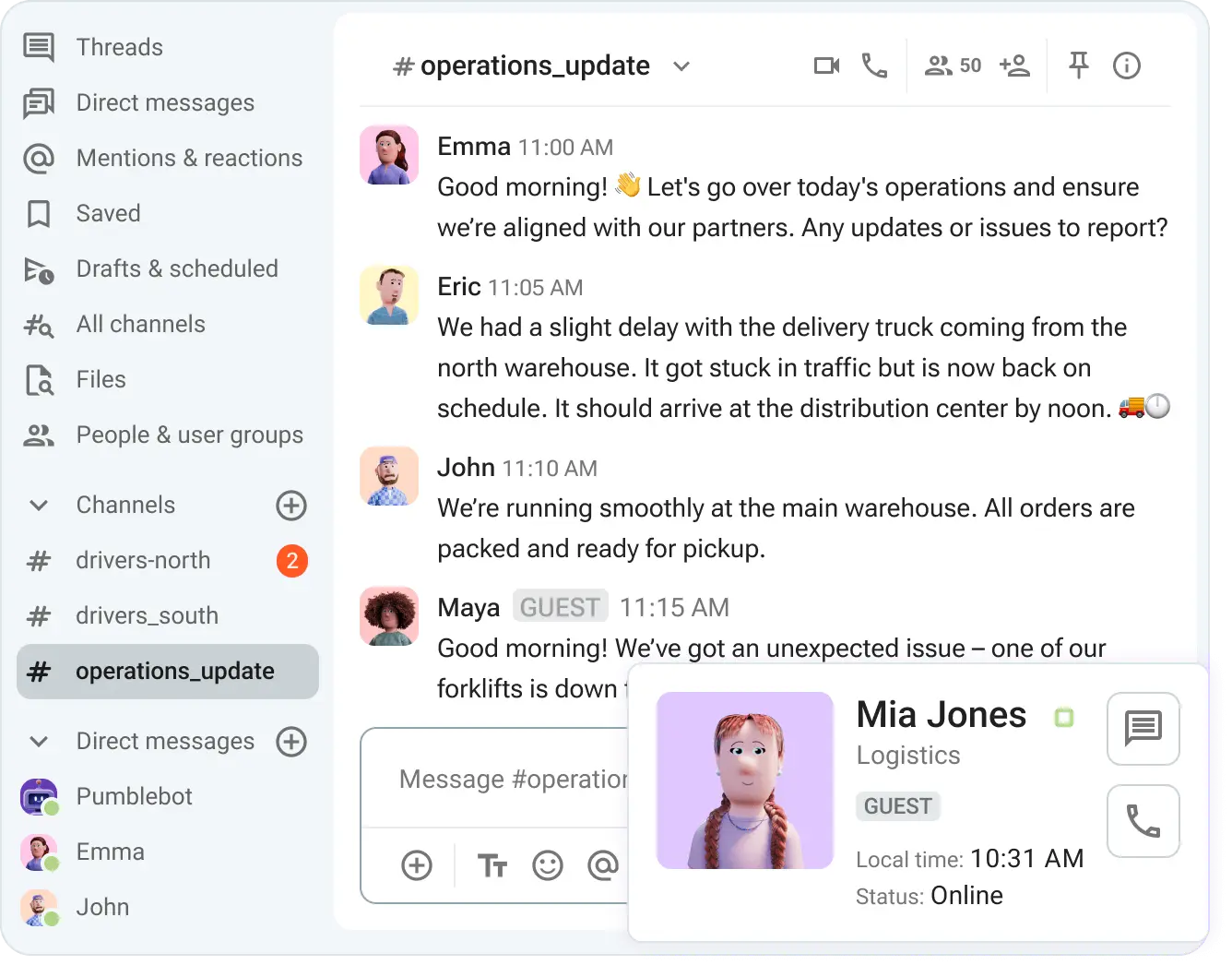
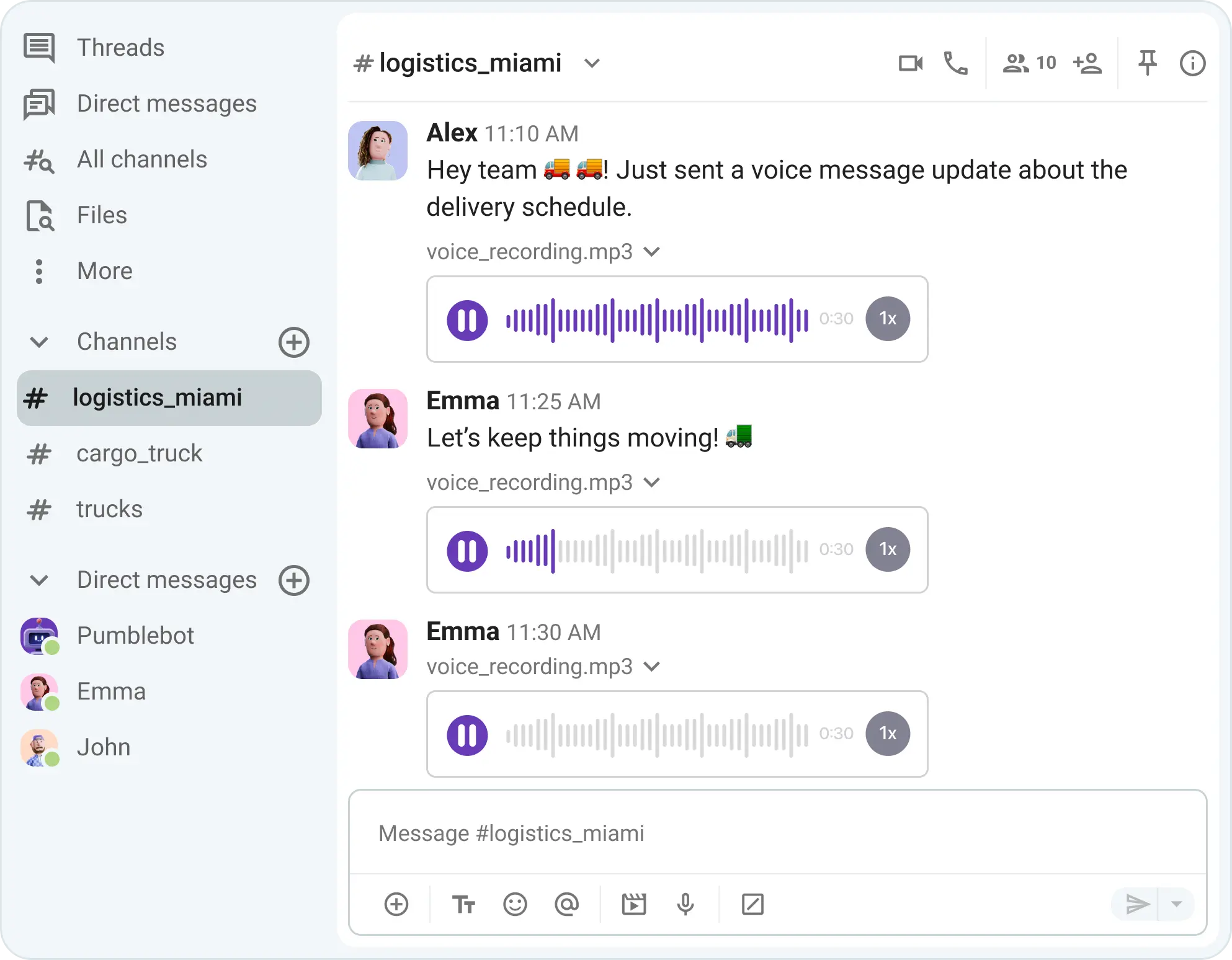
When a project moves fast, you cannot afford to wait hours for an email reply. This is where real-time supplier communication comes to the rescue. Setting up a dedicated communication workspace lets your team collaborate instantly with external vendors.
For example, using a team collaboration software like Pumble allows you to create dedicated channels specifically for external vendors.
Instead of trading dozens of messy emails over a minor layout fix or a quick shipping update, your team and the supplier can:
- Chat in real time in channels and DMs.
- Share files instantly.
- Resolve issues in seconds over video calls.
- Exchange text, audio, or video messages asynchronously.

You can also take advantage of Pumble’s guest access feature to collaborate with vendors and suppliers outside your organization. Grant your suppliers access to specific channels and teams, set time and access limits, and collaborate seamlessly.
Keep projects on track with Pumble
Moreover, Pumble famously offers unlimited searchable message history, even on the Free plan. This means all your messages and files remain in your workspace forever, or for as long as you need them to be.
As a result, your vendor communication never lacks context, as all messages or files ever shared are always one quick search away.
Check out the video below to learn how to search through Pumble to access past conversations and shared files:
Pumble keeps your public inboxes clean, while ensuring project conversations happen right where the work is actually being done.
–––––––––––––––––––––––––––––––––
Let’s take a closer look at a side-by-side comparison of these 3 solutions to assess how their features measure up for vendor communication.
| Feature | Vendor portal | Pumble by CAKE.com | |
|---|---|---|---|
| Best for | Contracts and formal sign-offs | Invoices and shipment tracking | Daily collaboration and quick fixes |
| Speed | Slow to moderate | Slow | Instant, real-time |
| Context retention | Poor (long, messy threads) | High (structured data only) | Excellent (organized channels and unlimited message history) |
| Ease of setup | Low effort | High effort, expensive | Low effort, affordable, fast onboarding |
FAQ
How do you communicate effectively with vendors?
Set clear expectations right from the start. Establish the main point of contact, and use the right tools for the job. Keep your updates regular, put everything in writing, and treat your suppliers as true strategic partners.
How do you talk to a vendor?
Be direct, clear, and professional. State your requirements, deadlines, and budget limits upfront without dancing around the details. If a problem comes up, focus on finding a solution together rather than pointing fingers.
How do you strengthen vendor relationships?
Build trust by paying your bills on time. Make sure to give them plenty of time on new orders, and remember to share constructive feedback regularly. Also, don’t forget that by openly discussing your future business plans, you’re helping vendors better prepare to meet your needs down the road.
What are the 5 C’s of communication?
The 5 C’s stand for:
- Clarity
- Conciseness
- Concreteness
- Correctness
- Courtesy
Applying these principles ensures your messages to vendors are easy to understand, accurate, respectful, and free of confusing fluff.
What are the 4 types of supplier relationships?
Supplier relationships generally fall into 4 categories:
- Transactional: Simple buying with minimal interaction.
- Preferred: A reliable, recurring buyer-seller relationship with basic trust.
- Strategic: A close partnership with shared goals and collaborative planning.
- Alliance: Deep institutional integration where both businesses closely rely on each other to succeed.
What are the 5 essential factors when dealing with suppliers?
The 5 essential factors to focus on are:
- Quality consistency
- On-time delivery reliability
- Fair and transparent pricing
- Clear communication
- Vendor’s financial stability
Master vendor communication with Pumble by CAKE.com
To keep your operations running like clockwork, you need a communication system that leaves no room for misinterpretation.
Picking the right tools and setting up a workflow that keeps your external teams completely aligned are key to effective vendor communication.
Pumble by CAKE.com keeps all your supplier conversations in one centralized hub and helps you prevent misunderstandings that could cost a small fortune.
Try Pumble and build an efficient vendor relationship.
How we reviewed this post: Our writers & editors monitor the posts and update them when new information becomes available, to keep them fresh and relevant.