Updated: février 26, 2026

Tandis que le télétravail continue de remodeler le monde professionnel, comprendre les données les plus récentes peut fournir des indications précieuses sur l'orientation future de la main-d'œuvre.
However, we must dig deeper to answer questions such as “What is the future of remote work in 2026?” and “Is remote work increasing or decreasing?”
After all, remote work is no longer a mere experiment brought on by COVID-19, but an established work model for millions of employees globally.
We’ll examine the most relevant remote work statistics and the percentage of remote workers in 2026 to see how they relate to emerging working-from-home trends. Finally, we’ll reflect on the opinions of both remote workers and employers to see whether their expectations for remote work in 2026 align.

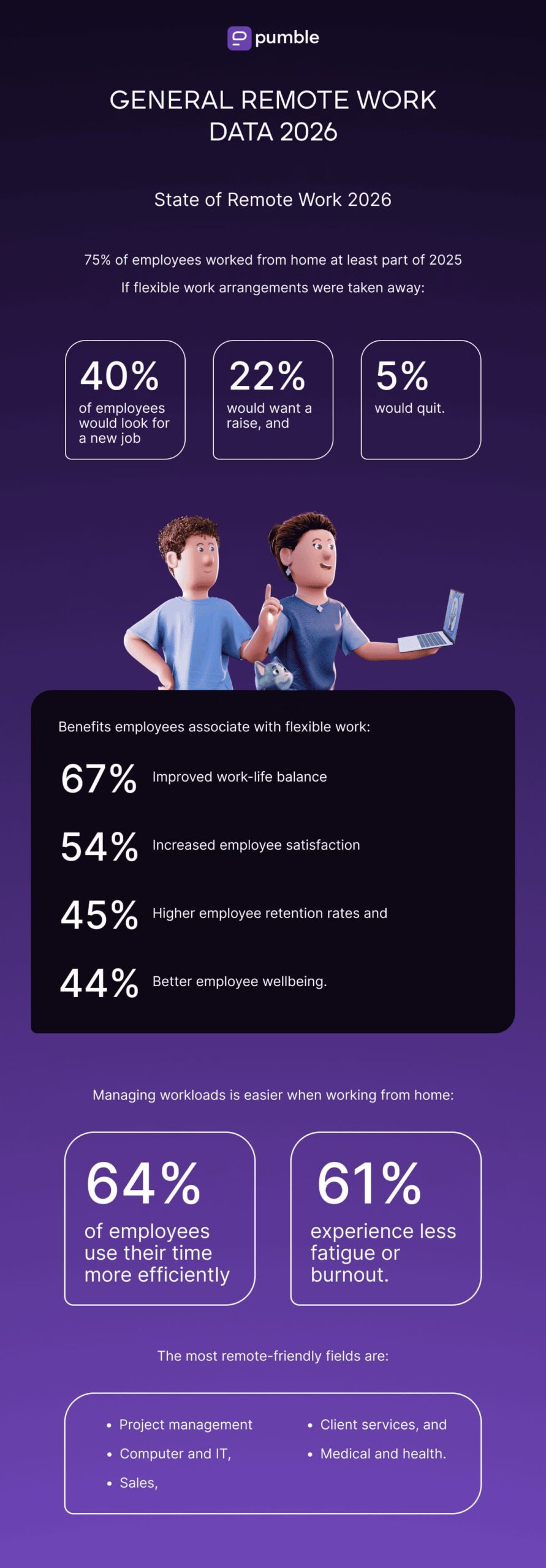
- Throughout 2025, 75% of employees engaged in some form of remote work for at least part of the year.
- Flexibility is on the rise — notably, 40% of workers would seek out other job opportunities if required to return to the office full-time.
- Hybrid creep, a phenomenon referring to employers steadily introducing more on-site stipulations, was prevalent throughout 2024 and 2025. And employees are feeling the pressure, with 30% of remote and hybrid workers feeling that working from home lowers their chances for professional growth.
- Remote and hybrid employees credit flexible work arrangements with improving their work-life balance (67%), boosting overall satisfaction (54%), and enhancing wellbeing (44%).
- Polyworking was also a relevant remote work trend throughout 2025, as 28% of employees admitted to having additional jobs or side hustles.
- On the whole, managers view remote work positively, with 69% stating it has made their teams more productive.
- With hybrid and remote work redefining the way we organize work, 93% of executives emphasize that the right technology is essential for business success.
Statistics that answer the question: “Why remote work?”
Buffer’s ”State of Remote Work” report revealed that 68% of people consider remote work a positive experience. It’s encouraging that no one said that remote work was or is a negative experience for them.
Par ailleurs, selon le même rapport, 98 % des personnes interrogées ont déclaré qu'elles :
- Souhaitent travailler à distance (au moins une partie du temps) pour le reste de leur carrière, et
- Recommandent le travail à distance à leurs collègues, à leurs amis et à leur famille.
According to an Owl Labs report — ”State of Hybrid Work 2023” — 66% of respondents said working from home should be a legal right. In their US-based survey, Owl Labs also found that 29% of hybrid and remote workers would expect a pay rise if forced to return to the office full-time.
But why do people want to work from home?
The ”State of Hybrid Work 2025” report continued to explore remote work trends, finding that employees place the greatest value on flexibility regarding when and where they work. Specifically, the latest numbers indicate that 41% of employees achieve a better work-life balance when working from home.
Now that we’ve covered the initial figures, let’s take a deeper look at the remote work statistics for 2026.
#1 : Le travail à distance est un choix
The 2025 research from The Chartered Institute of Personnel and Development (CIPD) regarding hybrid and remote work practices reveals that for many companies, remote work is a common choice. Namely, 91% of organizations operating in the UK offer some type of flexible arrangement, with:
- 51% supporting full-time remote work or on an ad hoc basis, while
- 55% provide part-time hours.
According to a remote work survey from the Pew Research Center, 75% of employed adults worked from home at least some part of 2025.
That’s not that surprising, given that in 2024, hybrid work was on the rise, as 62% of US companies offered flexible work hours, driving the increase of hybrid workers.
Moreover, many people prefer working from home — so much so that Owl Labs found that if hybrid and remote workers were to lose their flexible arrangements:
- 40% would begin searching for a new job with the desired flexibility,
- 22% would anticipate to see a salary increase, and
- 5% would outright quit.
Going back further to 2024, Owl Labs’ report on hybrid work revealed that 1 in 3 workers (31%) said they would start looking for a new job, while 6% said they would quit if their employer eliminated the flexibility to work remotely.
Earlier data from the ”State of Remote Work 2022” report revealed that interest in remote and hybrid work rose by 24% and 16%, respectively, compared to findings from previous years. Conversely, interest in in-office work dropped by 24%.
The preference for WFH positions persists today. Although companies tightened their in-office requirements throughout 2025 — a phenomenon dubbed “hybrid creep” — employees still prefer remote and hybrid arrangements over being in the office full-time.

#2: Remote work contributes to happiness
One of the emerging remote work trends in 2026 is the array of advantages employees associate with remote and hybrid work. In the 2025 research from CIPD, respondents highlighted the following benefits:
- Improved work-life balance (67%),
- Increased employee satisfaction (54%),
- Higher employee retention rates (45%), and
- Better employee wellbeing (44%).
In the “State of Hybrid Work 2024” report by Owl Labs, employees reported that hybrid work affected their happiness in the following ways:
- 84% ate healthier food when working at home and
- 51% achieved a better work-life balance.
In fact, 71% of respondents agreed that flexible working hours contribute to a healthy work-life balance, which is integral to their happiness (at work or otherwise). What’s more, 25% of them would be willing to take a 15% pay cut to get more flexible working hours.
Selon un rapport antérieur de Buffer, les travailleurs à distance et les travailleurs hybrides préfèrent leurs modèles de travail parce qu'ils leur permettent de :
- Avoir des horaires flexibles — 22 %,
- Choisir la façon dont ils passent leur temps — 19 %, et
- Choisir leur lieu de travail — 13 %.
🎓 Astuce Pro de Pumble
Si vous avez besoin d'aide pour établir des limites entre le travail et la vie privée comme télétravailleur, nous avons les conseils dont vous avez besoin :
#3: Highly educated employees with higher incomes choose remote work more often
The latest Bureau of Labor Statistics telework report from 2025 shows a clear correlation between education levels and remote work adoption rates among US employees.
| Education Level | % Who Teleworked (Total) | % Teleworked Some Hours | % Teleworked All Hours |
|---|---|---|---|
| Less than high school | 3.5% | 1.8% | 1.7% |
| High school graduate (no college) | 8.9% | 3.9% | 5.0% |
| Diplôme d'études universitaires ou d'associé | 18.9% | 8.5% | 10.4% |
| Bachelor’s degree and higher | 38.8% | 22.1% | 16.7% |
| Bachelor’s degree only | 37.3% | 19.9% | 17.3% |
| Diplôme d'études supérieures | 41.3% | 25.4% | 15.8% |
As the Pew Research Center reported in 2023, highly educated employees earning higher salaries are more likely to say they can work from home.
| La fréquence du télétravail en fonction des revenus | Pourcentage |
|---|---|
| Haut revenu | 67% |
| Revenu moyen | 56% |
| Lower income | 53% |
Further reporting supports these figures.
Findings by the Federal Reserve Bank of St. Louis showed that remote work was more prevalent in 2024 compared to pre-pandemic years, particularly among higher-educated and higher-paid workers. This apparent “education gap” highlights the fact that remote work is most accessible to employees who hold bachelor’s or advanced degrees.
🎓 Astuce Pro de Pumble
Many college-educated individuals choose to pursue their careers while traveling and living abroad. To learn more about this intersection between remote work and the digital nomad lifestyle, check out this resource:
Les statistiques sur les lieux de travail des télétravailleurs
À quoi ressemble réellement le travail à domicile ?
Buffer’s findings show that post-pandemic, 82% of remote workers choose their homes as their primary work location.
Seuls 5 % déclarent travailler dans des espaces de coworking, tandis que 2 % préfèrent travailler dans des cafés ou d'autres lieux.
But, while most remote employees worked from the comfort of their homes, some decided to relocate.
A US Census Bureau report shows that, in 2024, approximately 40% of remote workers took advantage of flexible work to move from high-cost urban centers to more affordable regions.
Buffer’s “State of Remote Work” report from 2023 stated that 60% of remote workers preferred the remote work model because it allows them to choose where they live.
In 2021, at the peak of remote work, the numbers were even higher — about 78% of Owl Labs’ “State of Remote Work 2021” study participants stated that they moved away from an urban location due to remote work.
Les statistiques sur l'impact global du travail à distance
The hybrid work indicator by Gallup tracks and analyzes the experiences of remote, hybrid, and on-site employees. The 2025 insights indicate that when working from home:
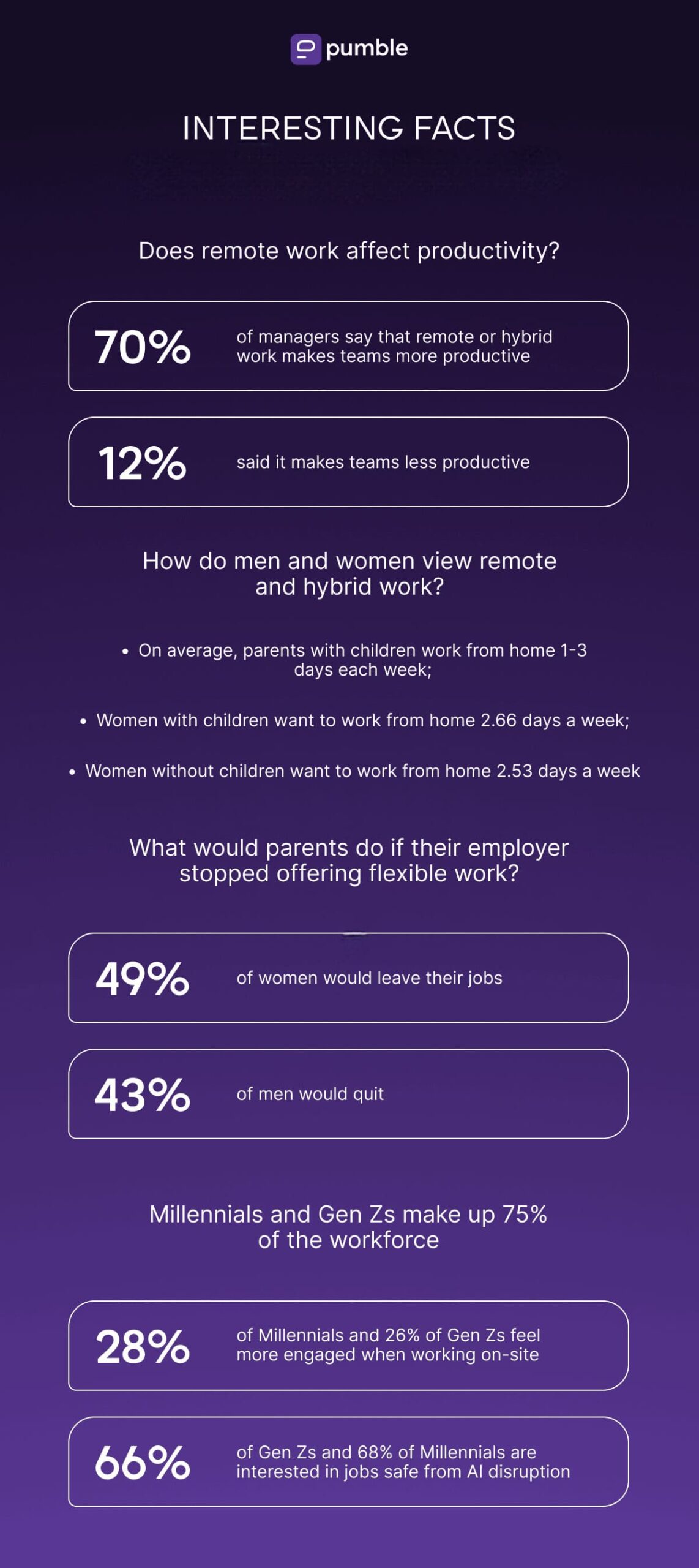
- 64% of employees use their time more efficiently, while
- 61% experience less fatigue or burnout.
But are remote workers more productive than in-office counterparts?Here’s what we can learn from employee productivity statistics.
Owl Labs’ data for 2025 shows that productivity is still intact. Around 70% of managers said that remote or hybrid work makes their teams more productive, while only 12% said it makes them less productive.
However, there seems to have been a mismatch between men and women in previous years.
According to data cited in FlexJobs’ survey from 2021, 80% of female respondents considered remote work one of the most important factors when looking for a new job, compared to 52% of men.
However, these numbers seem to have stabilized, at least when it comes to college-educated women and men working from home in 2025. According to WFH data from SIEPR (Stanford Institute for Economic Policy Research), the number of men and women working remotely remains nearly equal across all regions of the world.
Let’s go into greater detail and examine the impact of remote work in 2026 across:
- Les sexes,
- Les générations,
- Les branches professionnelle, et
- Les pays.
Les statistiques sur l'impact du travail à distance sur les hommes et les femmes
As we’ve mentioned, there has been a significant discrepancy between the genders when it comes to the desire (or lack thereof) to return to the office.
During the initial surge of RTO mandates in 2023, men were more likely to hustle back into offices than women, according to data from the Bureau of Labor Statistics report.
However, in 2024, we saw slightly more male employees working from home — 49.6% compared to 46.4% of female remote workers, as the US Career Institute reports.
Whether men and women were in the office or at home in 2025 depended on whether they had children. According to findings from SIEPR, parents with children were more likely to be working following a hybrid work schedule with 1–3 days of at-home work per week.
Examinons quelques différences entre les sexes quand il s'agit du télétravail.
Le travail à domicile reste plus populaire chez les femmes
Despite the varying statistics, women still predominantly prefer working from home.
This desire to work remotely is even more intense for women with children. SIEPR found that, on average, women with children wanted to work from home 2.66 days a week. For women without children, that number fell to 2.53.
In contrast, the work-from-home preferences of men with children and those without are much more aligned. Even so, men with children do show a slightly higher preference for remote work than their peers without children.
During 2025, parenthood continued to influence remote work preferences — 49% of women (compared to 43% of men) reported they’d be likely to leave their jobs if the option to work from home was no longer available.
The McKinsey report ”Women in the Workplace 2024” shows that 9 out of 10 women gravitated towards remote work.
This is consistent with Owl Labs’ report from 2022, which shows that the inclination of women to work from home was much higher than that of men.
| Style de travail préféré | Femmes | Hommes |
|---|---|---|
| Télétravail | 46% | 39% |
| Hybride | 34% | 37% |
| Bureau | 19% | 24% |
Even in 2019, women accounted for 56% of all home-based workers, ILO reported in their ”Working from home” report.
Mais, pourquoi les femmes ont-elles davantage tendance à travailler à domicile ?
En plus d'être les employées, la plupart des femmes à travers le monde sont également des femmes au foyer et des soignantes.
Avec le travail à domicile, elles peuvent combiner leurs nombreuses responsabilités avec un travail rémunéré, même si cela implique de travailler plus longtemps.
Research on gender inequality in unpaid work, done by CAKE.com, showed that women spend more time than men on unpaid domestic work, specifically:
- Soins aux enfants — les femmes passent 39,45 % de leur temps à prendre soin des enfants, et les hommes 33,37 %.
- Préparation des repas — les femmes passent 31,9 % de leur temps à cette tâche, contre 17,4 % pour les hommes.
- Ménage — les femmes consacrent 22,65% de leur temps au ménage, tandis que les hommes y consacrent 18,2%.
- Lessive — 7,79 % du temps des femmes est dédié à cette tâche, alors que les hommes n'ont pas indiqué que la lessive était une activité courante dans cette enquête.
Selon ce rapport, les femmes font 58 % du travail non rémunéré, contre 42 % pour les hommes.
Les femmes maîtrisent mieux l'équilibre entre vie professionnelle et vie privée que les hommes
Voyons quels sont les avantages dont les femmes et les hommes peuvent bénéficier lorsqu'ils travaillent à domicile.
Selon les conclusions du Pew Research Center, le travail à domicile permet aux hommes et aux femmes de concilier plus facilement travail et vie privée.
Yet, women seem to handle working from home better than men when it comes to:
- Getting work done,
- Meeting deadlines, and
- Advancing their careers.
Also, as the McKinsey report highlights, women report experiencing fewer microaggressions when working remotely.
| Le travail à distance... | Femmes | Hommes |
|---|---|---|
| Facilite l'équilibre entre la vie privée et professionnelle | 46% | 39% |
| Facilite la réalisation du travail et le respect des délais | 34% | 37% |
| Facilite le progrès de la carrière | 19% | 24% |
Les hommes tendent à travailler plus de 10 heures supplémentaires par semaine lorsqu'ils travaillent à distance
Putting in more hours seems to be reserved for men, the Owl Labs 2024 report revealed. They were 41% more likely to work 10+ additional hours per week.
Additionally, Owl Labs found that in 2025, men were more likely to relocate for a flexible work location. While 59% of women would sacrifice their pay for a more flexible arrangement, 66% men stated they would do the same.
En revanche, les femmes déclarent travailler le même nombre d'heures que lorsqu'elles travaillent au bureau.
However, data shows that gendered differences persist and that women focus more on family tasks. For example, a 2022 Ohio State University study examining dual-earner couples underscores that women who work remotely are more likely to feel the need to complete more chores than their partners.
These blurred lines between work and life may sometimes lead to burnout and a sense of guilt.
Les femmes se déclarent plus productives dans les environnements distants
A 2024 US Bureau of Labor Statistics report revealed an overall positive correlation between remote work and productivity increase across 61 industries.
Cependant, une étude de la SHRM de 2021 indique que les femmes sont légèrement plus productives que les hommes.
For example, 40% of women said they are more productive in a remote work environment, while only 35% of men felt the same way.
However, data from a 2023 study titled “Virtuality at Work: A Double-Edged Sword for Women’s Career Equality?”warns that while flexible and remote work allows women to manage non-work demands, they might also reduce women’s opportunities in the workplace, primarily regarding countering social stereotypes.
Les statistiques sur l'impact du travail à distance sur les générations
There are currently 5 generations making up the global workforce:
- Traditionalistes (1928-1945),
- Baby Boomer (1946–1964),
- Génération X (1965-1980),
- Milléniaux (1981-1994), et
- Génération Z (1995-2010).
Today’s workforce mainly consists of Millennials and Gen Zs, whose diverse, people-oriented, and socially responsible worldviews challenge companies to reevaluate their business practices.
Millennials now comprise about 36% of the US workforce, making them the largest demographic in the workforce.
En 2024, le marché du travail américain comptera 50 millions d'employés de la génération Z, indique CAKE.com dans son rapport 2024 Gen Z Effect.
En outre, 2024 marque l'année où la génération Z a dépassé les baby boomers sur le marché du travail.
Mais quel est l'impact du travail à distance sur ces deux générations (et sur d'autres) ?
La plupart des membres de la génération Z et des milléniaux souhaitaient auparavant un mode de travail hybride ou sur place
In Deloitte’s 2023 survey, 77% of Gen Zs and 75% of Millennials said they would start looking for a new job if their company required them to return to the office full time.
However, their 2024 survey edition exposed some changes on that front. Namely, 64% of Gen Z and 66% of Millennials stated they work in companies that recently mandated a return to the office.
La plupart des travailleurs, toutes les générations, travaillent désormais à plein temps sur place, mais ils ont néanmoins des sentiments contradictoires à ce sujet.
| Générations | Modèle de travail sur place | Modèle de travail à distance | Modèle hybride |
|---|---|---|---|
| Génération Z | 51% | 15% | 35% |
| Millénniaux | 57% | 11% | 33% |
Overall, both Millennials and Gen Z workers cite more positive effects of the RTO policy.
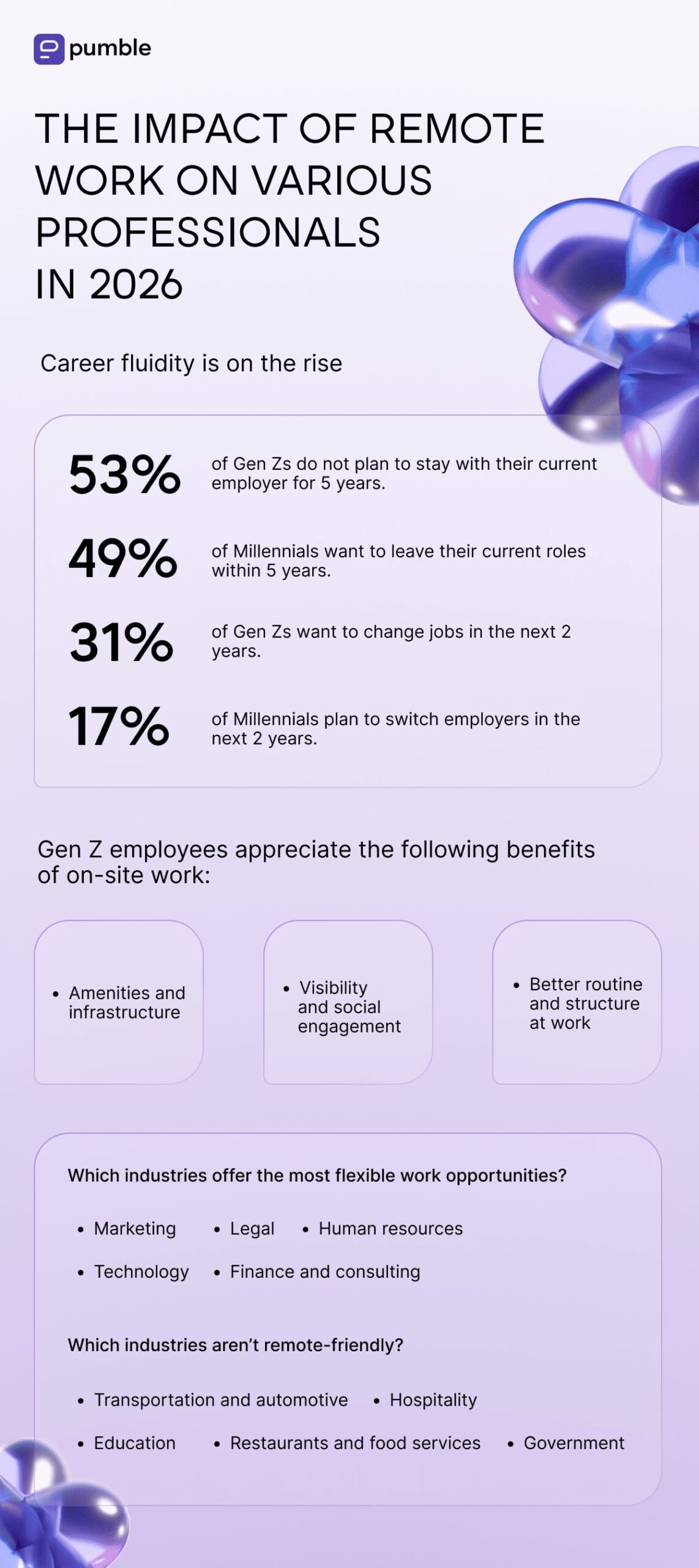
Specifically, 28% of Millennials and 26% of Gen Z workers feel more engaged with their organizations and coworkers when working on-site, and almost the same amount of respondents (27% and 25%, respectively) reported having better routines and structure at work.
The negative impact of on-site work included the financial side (for 17% of Millennials and 21% of Gen Z) and decreased productivity (for 17% of Millennials and 18% of Gen Z respondents).
The ”2025 Gen Z and Millennial Survey” from Deloitte notes that most Gen Z employees began their careers during the COVID-19 pandemic. These circumstances may have shaped their views on work-life balance, influencing which aspects they most appreciate in a job.
Plus de la moitié des milléniaux et de la génération Z considèrent un changement d'emploi
For Millennials and Gen Zs, job changes aren’t uncommon. These generations know what they want in an employer and aren’t afraid to keep looking until they find a perfect match.
In 2024, over 90% of Gen Zs and Millennials were expected to give a positive answer to whether they were considering looking for a new job. This was a huge spike compared to previous years.
According to Microsoft’s report titled ”Great Expectations: Making Hybrid Work Work”, 52% of Gen Z and Millennials changed jobs in 2023. These numbers were the same in 2022.
Interestingly, the prevalence of artificial intelligence (AI) is changing what types of jobs Gen Z and Millennials look for, according to Deloitte’s 2025 survey. Around 66% of Gen Zs and 68% of Millennials stated they would search for jobs safe from AI-powered disruption — like trades or manual labor, for example.
Les milléniaux et la génération Z acceptent de quitter leur emploi actuel
With both generations taking up a majority of the workforce, there has been a more positive shift toward career fluidity.
According to Deloitte’s insights from 2025, approximately 31% of Gen Z workers intend to change their jobs in the following two years. As Millennials are further along in their career trajectories, only 17% plan to switch employers in two years’ time.
When we look 5 years ahead, the numbers are even higher. According to a 2024 Deloitte report, more than half of Gen Z respondents (53%) and 49% of Millennials don’t plan on staying at their current job for longer than 5 years.
Dans son enquête de 2023, Deloitte a indiqué que près d'un quart des membres de la génération Z (23 %) et 13 % des milléniaux prévoyaient de quitter leur emploi dans l'année.
Les choses sont restées les mêmes par rapport à l'enquête 2022 de Deloitte, qui a découvert que 40 % des membres de la génération Z et près de 24 % des milléniaux aimeraient quitter leur emploi dans les deux ans.
La flexibilité et la rémunération sont les principales raisons du changement d'emploi chez les milléniaux et la génération Z
In their report, Deloitte found that pay is the main reason Millennials and Gen Zs left a role in the last two years.
Moreover, research on job-hopping reveals that the average tenure for Gen Z workers in the first 5 years of their professional career is approximately one year. By comparison, for Millennials and Gen X employees, the average is 1.8 and 2.8 years, respectively.
According to a 2024 survey from Qureos, Gen Z and Millennials cited the following motivators to stay in a company:
- L'impact sur la société — 93 %,
- L'équilibre entre vie professionnelle et vie privée — 77 %,
- La diversité et l'inclusion — 77 %,
- L'assurance maladie — 70 %, et
- Le salaire compétitif — 63 %.
These findings suggest that Gen Zs and Millennials would much rather have a better work-life balance (achieved through remote and hybrid work) than a higher paycheck.
Les milléniaux et la génération Z sont susceptibles de gagner plus d'argent grâce à des emplois et affaires secondaires
According to Intuit’s 2024 survey, nearly two-thirds (66%) of Millennials and Gen Zs have started or planned to start a side hustle in late 2024. Moreover, 65% planned to continue their business endeavors through 2025.
Surprisingly, Owl Labs’ “State of Hybrid Work” report for 2023 showed that 68% of people with another job, side business, or project were actually in-office workers. Only 27% were remote or hybrid workers.
The “State of Hybrid Work” report for 2025 reveals that polyworking continues to be a feature of the modern workforce, with 28% of employees having side hustles or additional jobs.
Millennials and Gen Z appreciate the benefits of both remote and on-site work
Pour les milléniaux et la génération Z, les avantages du travail à distance variaient auparavant.
In their 2023 survey, Deloitte discovered the 4 most common benefits for Gen Z and Millennial employees working remotely:
- Meilleur équilibre entre vie professionnelle et vie privée,
- Épargne de l'argent,
- Better productivity, and
- Impact positif sur la santé mentale.
However, a 2024 research paper exploring Gen Z’s desire for hybrid work shows a shift toward more on-site work for Gen Z employees. Namely, Gen Z workers largely report benefits connected to on-site work, which include:
- Amenities and infrastructure,
- Visibility and social engagement, and
- Une meilleure routine et une meilleure structure au travail.
At the same time, Gen Z employees are reevaluating the challenges of remote working more attentively, according to Gallup’s findings from 2025.
The lack of meaningful, face-to-face interactions is a notable factor deterring Gen Z from working fully remotely, most likely because Gen Z is the loneliest across all 5 generations present in the workforce, as Gallup notes.
🎓 Astuce Pro de Pumble
Si vous avez besoin d'un peu d'aide pour améliorer la communication entre les générations sur votre lieu de travail, nous avons préparé quelques conseils pour vous :
Les statistiques sur l'impact du travail à distance dans les différents secteurs d'activité
Quels sont les secteurs qui offrent le plus de possibilités de travail à distance ?
Quelles sont les industries les moins susceptibles de travailler à distance ?
Let’s look at remote work statistics across different industries.
Les secteurs du développement de logiciel et des technologies de l'information sont les plus susceptibles d'adopter le travail à distance
The Remote Work Index by FlexJobs indicates that, in the final quarter of 2025, the most remote-friendly career fields were:
- Project management,
- Computer and IT,
- Sales,
- Client services, and
- Medical and health.
Data from Robert Half, a US-based staffing and HR consulting firm, backs these findings, showing that the tech sector was among the top industries offering either fully remote or hybrid work at the end of 2025. Specifically, the professional fields with the most flexible job opportunities were:
- Marketing,
- Technology,
- Legal,
- Finance and consulting, and
- Human resources.
Pour certaines industries et professions, le travail à distance n'est pas une option
The ”UK Job Market Report” from Adzuna reveals that, in 2025, remote job postings fell to their lowest levels since 2020. In contrast, on-site vacancies have been steadily increasing.
This insight makes sense to an extent — not all professional fields can afford to implement remote work. According to the Bureau of Labor Statistics, the occupations and industries that cannot operate in a remote setting include:
- Services de protection,
- Nettoyage et entretien des bâtiments et des espaces,
- Services et soins à la personne,
- Construction et extraction, et
- Agriculture, pêche et foresterie.
Similarly, the Flex Report shows that the top 5 industries requiring full-time in-office work in 2025 were:
- Transportation and automotive — 55%,
- Hospitality — 53%,
- Éducation — 50 %,
- Restaurants and food services — 49%, and
- Government — 46%.
Les statistiques sur l'impact du travail à distance dans les différents pays
Le travail à distance, le télétravail ou le « travail de n'importe où » diffèrent d'un pays à l'autre. Voyons cela en détail :
- Which countries are best for remote workers in 2026?
- Which parts of the world are the most attractive to digital nomads?
- Quels sont les pays qui n'ont pas encore pleinement adopté le travail à distance ?
Le Danemark est classé meilleur pays pour les travailleurs à distance
In their ”Global Remote Work Index” report, NordLayer listed the best countries to work remotely from.
Ils ont classé les pays en fonction de quatre catégories différentes :
- La cybersécurité,
- La sécurité économique,
- L'infrastructure numérique et physique, et
- La sécurité sociale.
Le Danemark est le premier pays de la liste, avec un score élevé dans les quatre catégories, et il est suivi de près par neuf autres pays européens. Les États-Unis et le Canada sont placés respectivement aux position 16 et 14 dans la liste.
| Les 10 meilleurs pays pour les travailler à distance | Points |
|---|---|
| Danemark | 0.874 |
| Pays-Bas | 0.843 |
| Allemagne | 0.842 |
| Espagne | 0.825 |
| Suède | 0.824 |
| Portugal | 0.824 |
| Estonie | 0.818 |
| Lituanie | 0.808 |
| Irlande | 0.803 |
| Slovaquie | 0.802 |
La Croatie est le meilleur pays pour les nomades numériques
Meanwhile, other reports, such as Pumble’s Digital Nomad Statistics, show what different countries with digital nomad visas offer regarding working conditions and the opportunities for exploring outside the usual 9–5 routine.
Selon les conclusions de Pumble, la Croatie arrive en tête de la liste des pays les plus appréciés par les nomades numériques en 2024, suivie de près par :
- La Grèce,
- La Corée du Sud,
- La Malaisie, et
- Le Japon.
The ”Global Digital Nomad Report 2025” from Global Citizens Solutions notes that many countries in Europe stand out due to their structured digital nomad frameworks. This approach makes countries such as Spain, Croatia, Malta, and Portugal highly appealing for long-term relocation.
🎓 Astuce Pro de Pumble
Si vous envisagez de partir en voyage et de devenir un nomade numérique, consultez cette page pour connaître les conditions d'obtention d'un visa dans différents pays :
Certains pays ont mis en place des règles sur le travail à distance
Lorsque la pandémie a contraint de nombreuses personnes à travailler à domicile, elle a révélé les défis posés par le travail à distance.
En conséquence, certains pays ont mis à jour leur législation du travail pour réguler le travail à distance. Bien que certains pays disposent déjà de lois sur le travail à distance, certaines réglementations n'ont jamais été mises en œuvre.
Recent changes to remote work legislation include:
- Exiger des accords écrits pour le travail à distance,
- Obliger les employeurs à fournir aux travailleurs l'équipement nécessaire et à couvrir les coûts connexes tels que l'Internet, et
- Interdire aux employeurs de discriminer les travailleurs sur la base du sexe, de l'âge, du groupe professionnel, du handicap ou de l'ancienneté.
In 2025, more countries, such as Costa Rica, Austria, Oman, and Columbia, have joined in enacting telework regulations.
France continues to resist remote work
Although remote work has changed the ways companies organize their workforce, in France, telework remains an uncommon practice. In 2024:
- Less than 3% of private sector employees worked remotely,
- 26% followed a hybrid arrangement, and
- 78% worked on-site full-time.
If we compare these numbers to those in more remote-friendly countries such as the US, the resistance is clear. By the end of 2024:
- 13% of US employees were fully remote,
- 61% worked on-site, and
- 26% were hybrid workers.
This Bloomberg survey from November 2023 found that, in general, the French offer less flexibility to their workers. In Paris, the economic capital of France, only 7% of responders said that they have fully remote jobs.
On the whole, remote work arrangements remain more common in Europe and North America, reveals a comprehensive 2025 WFH research study. The study also confirms what the above figures suggest — across Asia, remote work remains limited. For example, while Japan adopted telework during the COVID-19 pandemic, in 2026, on-site work remains the norm.
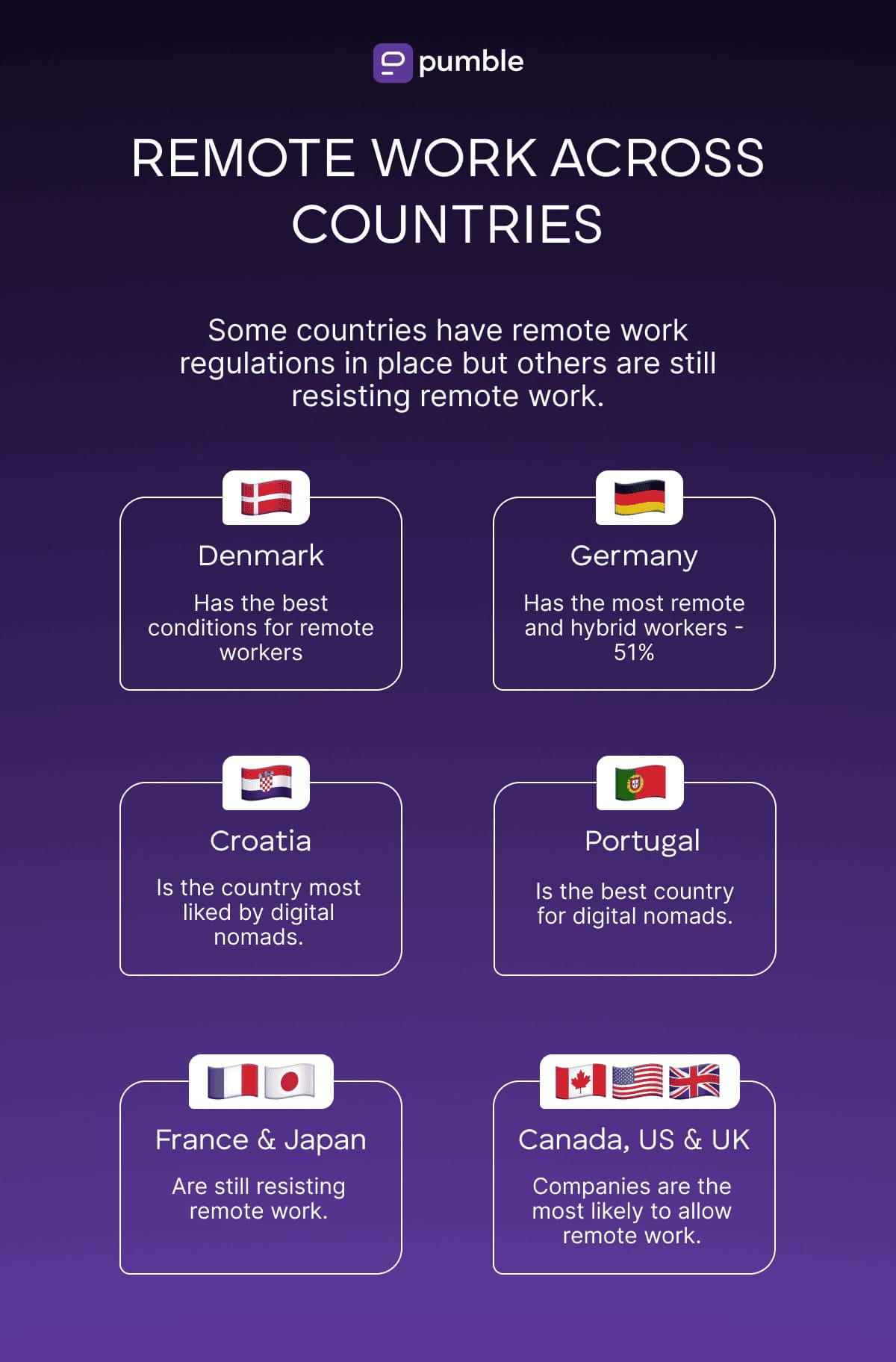
Les entreprises du Canada, des États-Unis et du Royaume-Uni sont plus susceptibles d'autoriser leurs employés à travailler entièrement à distance
Data from WFH found that English-speaking countries are more likely to allow employees to work from home.
In countries like the US, Ireland, and Canada, employees typically spend 1.5–1.9 days working from home per week.
| Pays | Nombre moyen de jours travaillés à domicile |
|---|---|
| Canada | 1.9 |
| Royaume-Uni | 1.8 |
| États-Unis | 1.6 |
| Irlande | 1.5 |
| Nouvelle-Zélande | 1.3 |
| Suède | 1.3 |
| L'Italie | 1.3 |
| Espagne | 1.2 |
| La France | 1 |
For workers in South America and Asia, the numbers are lower.
| Pays | Nombre moyen de jours travaillés à domicile |
|---|---|
| Le Chili | 1.2 |
| Le Mexique | 1 |
| La Chine | 0.6 |
| La Corée du Sud | 0.5 |
Les statistiques montrant les structures de télétravail les plus courantes
Selon le temps passé en télétravail par les employés, on distingue les structures de travail suivantes :
- Télétravail régulier,
- Télétravail majoritairement,
- Hybride et hybride flexible,
- Bureau occasionnel,
- Bureau en majorité, télétravail autorisé, et
- Seulement sur place.
With so many diverse choices available, what have companies implemented so far? More importantly, what are their plans for the future?
Le télétravail régulier est en baisse constante
If we compare numbers from 2022 to 2025, we’ll see that they have changed dramatically. Owl Labs’ reports for these years show a steady decline in fully remote work and an increase in in-office work.
As a result, hybrid and in-office work saw a steady rise throughout 2025, while remote structures took a slight drop.
Consultez les chiffres ci-dessous.
| Type de travail | 2022 | 2023 | 2024 | 2025 |
|---|---|---|---|---|
| Télétravail | 34% | 7% | 11% | 9% |
| Hybride | 25% | 26% | 27% | 28% |
| Bureau | 41% | 66% | 62% | 63% |
A 2025 report from Project.co showed similar numbers. Namely, 36% of respondents said they were in the office 5 days a week, while only 20% worked fully remotely. Meanwhile, the majority (44%) had a hybrid work pattern.
The number of fully remote companies is stabilizing
The”Global Virtual Teams Survey Report 2022”, conducted by CultureWizard, looked into remote work trends and found that about 89% of companies functioned as:
- Télétravail régulier,
- Remote-first, or
- Remote-friendly companies.
Aujourd'hui, la situation est différente.
Bien que beaucoup d'entreprises prônent un retour au bureau, le rapport Flex Index indique qu'entre le début de 2023 et la fin de novembre 2023, le nombre d'entreprises proposant des modèles de travail hybrides est passé de 51 % à 62 %.
The numbers for 2025 were promising — 66% of companies offered location flexibility, while only 34% required full-time in-office work.
Le modèle hybride structuré devient plus populaire
Nombreux sont ceux qui espéraient que 2023 marquerait un retour complet au bureau. Au lieu de cela, c'est l'année où le travail hybride structuré s'est pleinement imposé.
According to the 2024 “Flex Index Report”, the structured hybrid work model rose by 23% compared to 2023.
This model requires employees to work in the office for a specific number of days (or amount of time). Remote work statistics from Owl Labs’ Reports for 2022, 2023, 2024, and 2025 suggest that many companies prefer a hybrid schedule over operating an entirely remote workforce.
Le désir de travailler à distance ou de manière hybride reste donc constant, mais les entreprises semblent réticentes à le satisfaire.
As you can see in the table below, the number of remote and hybrid workers kept decreasing until 2024. Then another dip happened for remote work, though the hybrid model is on a slow but steady rise.
| Modèle de travail | 2021 | 2022 | 2023 | 2024 | 2025 |
|---|---|---|---|---|---|
| Totalement à distance | 27% | 18% | 7% | 11% | 9% |
| Hybride | 60% | 59% | 26% | 27% | 28% |
| Entièrement sur place/au bureau | 13% | 24% | 66% | 62% | 63% |
Les statistiques sur la structure de travail à distance la plus préférée
Buffer’s “State of Remote Work Report 2023” states that about 91% of remote employees would like to keep working in a remote setting — fully remote (71%) or remote-first (20%).
Seulement 1 % d'entre eux aimeraient retourner au bureau.
| La structure de travail à distance la plus appréciée par les employés | Pourcentage |
|---|---|
| Totalement à distance | 71% |
| Surtout à distance | 20% |
| Au bureau occasionnel | 6% |
| Office-first, remote allowed | 2% |
| Entièrement au bureau | 1% |
Furthermore, according to Owl Labs’ report for 2025, remote and flexible work were among the top factors influencing the professional lives of employees, with:
- 83% of employees mentioning flexible hours,
- 82% citing flexibility in terms of work days, while
- 79% highlighting flexibility regarding location.
Mais, les employés et les entreprises ont des préférences divergentes en ce qui concerne le travail à distance.
Nous allons approfondir cette question dans les paragraphes ci-dessous.
Les employeurs et les employés ne sont pas tout à fait d'accord sur le travail à distance
As shown by the 2022 and 2023 Owl Labs reports, most remote workers wanted to keep working from home post-pandemic.
What’s more, their interest in remote and hybrid work remained steady throughout 2021–2023, as you can see from the table below.
| Le style de travail préféré des employés | 2021 | 2022 | 2023 |
|---|---|---|---|
| Télétravail | 34% | 42% | 41% |
| Hybride | 31% | 36% | 37% |
| Bureau | 29% | 22% | 22% |
In 2025, Pew Research Center found that among workers who rarely or never work from home:
- 63 % travailleraient à domicile la plupart du temps ou une partie du temps,
- 19 % choisiraient de travailler à domicile tout le temps, et
- 17 % travailleraient rarement ou jamais à domicile.
However, the data also shows that, while employees are less interested in full-time office positions, companies are less keen to go fully remote. As a result, the hybrid model is the only area where employees and employers come close to reaching common ground.
Les employeurs optent surtout pour des modèles de travail hybrides
Although return to office mandates have been a major topic of conversation the past few years, not much seems to have changed in 2025. In fact, 73% of employees surveyed by Owl Labs stated that there’s been no change in their companies’ remote and hybrid work policies.
That’s not surprising, given that, as the “2024 State of Hybrid Work” report suggests, employers were actively making efforts to better support hybrid work. The study respondents reported that, during 2024:
- 50% of employers have trained managers on how to manage their remote/hybrid teams,
- 49% have trained employees on how to hold effective and inclusive hybrid meetings, and
- 47% have trained employees to use mixed real-time and asynchronous methods of communication.
In the 2023 edition of the report, we first witnessed employers’ willingness to compromise on a hybrid work model. Workers noticed that employers were attempting to make this compromise more appealing, as:
- 63% of respondents attended training for hybrid meetings, and
- 62% said their managers had undergone training on managing distributed teams.
Empower hybrid workers with Pumble
La plupart des employés préfèrent également le travail hybride
It seems that hybrid work is here to stay.
The Pew Research Center study shows that this trend was strong in 2025. Namely, 72% of hybrid employees — working from home most or some of the time — preferred a hybrid arrangement. In comparison, only 24% said they’d work from home all the time.
This is consistent with PwC’s future of work survey in 2021, which found that more than half of employees would prefer a remote or hybrid work arrangement. Only 21% said that the nature of their work doesn’t allow for remote work.
Les statistiques sur comment les entreprises soutiennent le travail à distance
Lorsque la pandémie a commencé, la gestion d'une équipe à distance était une nouveauté pour de nombreux managers et dirigeants, qui ont dû apprendre avec le temps.
WorkTango’s ”2022 Workplace Report” revealed that about 45% of companies implemented flexible scheduling and remote work options.
L'objectif était de favoriser le bien-être des employés et des dirigeants et de prévenir l'épuisement professionnel.
Buffer’s report for 2023 also recorded several ways companies facilitate remote work.
About 93% of employees said their organization trusts them to work remotely. Moreover, 75% of remote workers said their companies help them connect with colleagues at work.
The general sentiment is clear — remote and hybrid work policies yield good results in well-connected workplaces that prioritize trust. Here’s how well companies are doing on that front in 2026.
#1 : Certaines entreprises proposent des horaires de travail flexibles
Pour certaines entreprises, le maintien d'un environnement de travail flexible est un moyen de soutenir leurs travailleurs à distance.
En 2023, 71 % des travailleurs interrogés par Buffer ont déclaré que leur entreprise leur permettait de travailler à distance d'une manière ou d'une autre.
The report also revealed that 63% of employees said their companies offer flexible work, while 30% said their companies don’t do this — but the employees wished they would.
More employers have realized that flexible approaches could result in better outcomes. This comes just in time, as respondents in Own Labs 2024 survey stated that 6% would quit if their employer revoked their hybrid policies, while 31% would start looking for other jobs.
Yet, WTW’s flexible work model survey suggests that the flexible trend may be shifting. It reveals that as many as 61% of US companies have implemented a formal policy mandating a minimum number of days a week in the office.
In 2026, this remote work trend — if we can call it that — continues, and we’re seeing more organizations adopt flexible work within their hybrid work policy.
According to the ”Flex Report” for Q3 of 2025, 71% of Fortune 100 companies offer their employees some kind of hybrid arrangement.
While almost half (45%) of Fortune 100 employees spend 4 or even 5 days in the office, others don’t, as 35% go into the office 3 days a week. That means that full-time in-person work is reserved for only 29% of Fortune 100 employees.
#2 : Une petite partie des entreprises ont une politique de jours sans réunions
Selon les dernières statistiques sur les réunions de Pumble, les gens passent plus de temps que jamais en réunions virtuelles.
Additionally, the Owl Labs report from 2025 found that, on average, employees attend 5 face-to-face meetings and 5 remote meetings each week.
Interestingly, Buffer reported that about 37% of companies have implemented a no-meeting days policy.
An article from the University of Reading analysed the impact of zero-meeting days and concluded that such practices:
- Increase productivity,
- Help employees feel more independent and empowered, and
- Boost employee satisfaction and accountability.
#3 : Certaines entreprises ont adopté une semaine de travail de 4 jours
Certaines entreprises ont introduit une politique de semaine de travail de 4 jours pour réduire les effets de l'épuisement professionnel et du stress.
Une expérience de semaine de travail de 4 jours menée au Royaume-Uni en 2023 et à laquelle 61 entreprises ont participé a donné les résultats suivants :
- 71 % des employés ont déclaré être moins épuisés,
- 60 % des employés ont déclaré qu'il était plus facile à équilibrer le travail et la vie privée,
- 48 % des employés ont déclaré être plus satisfaits de leur travail, et
- 39 % des employés ont déclaré être moins stressés.
Since 2023, we’ve seen more companies explore the possibility of shorter workweeks. A 2024 survey by KPMG found that 30% of large US companies were considering adopting the 4-day workweek.
Moreover, the 4 Day Week Global pilot program, which involved 2,000 businesses across the US and Canada, found that participating companies saw:
- An 8% spike in revenue during the course of the trial,
- More free time employees could spend on personal appointments and leisure activities,
- Improved wellness and mental health in the workplace, and
- A one-hour decrease in time spent commuting.
Les statistiques sur les changements liés au travail à distance
The global spread of remote and hybrid work has brought some changes. Let’s take a deeper look into what they are.
#1 : Les conditions générales de travail ont changé avec le travail à distance
La majorité des changements ont affecté le lieu de travail lui-même. Voici les changements énumérés par les personnes interrogées dans le rapport de Buffer :
- Pour 56 % des personnes interrogées, la communication et la collaboration ont changé depuis qu'elles travaillent à distance.
- Pour 53 % des personnes interrogées, les heures de travail ont changé.
- Environ 51 % des personnes interrogées ont indiqué qu'elles participaient davantage à des réunions vidéo.
- Around 45% said the way they worked has changed.
- Seuls 8 % ont déclaré que rien n'avait changé depuis qu'ils ont commencé à travailler à distance.
#2 : Les gens ont tendance à travailler plus lorsqu'ils travaillent à distance
Selon les statistiques de Buffer sur le travail à distance en 2023, 44 % des travailleurs à distance ont déclaré avoir travaillé plus d'heures en 2023 que l'année précédente.
Seuls 24 % ont déclaré travailler moins et 32 % ont affirmé travailler le même nombre d'heures.
Cependant, le rapport indique également que les gens se sentent plus énergiques qu'auparavant — du moins selon 48 % des personnes interrogées. Environ 31 % ont déclaré que leur niveau d'énergie n'avait pas changé, tandis que 21 % se sont déclarés épuisés.
#3: Amid rising stress levels, most remote workers prioritize mental health
Depuis que certains travailleurs à distance font plus d'heures et travaillent le week-end, ils ont également commencé à s'occuper davantage de leur santé mentale.
Certaines entreprises ont fait de même. Selon l'enquête Deloitte 2023 menée auprès de la génération Z et des milléniaux, plus de 50 % des personnes interrogées ont déclaré que leur entreprise prenait davantage au sérieux les problèmes de santé mentale et prenait des mesures concrètes pour les améliorer.
That’s not to say that employees, especially those in middle-market companies, aren’t still struggling with mental health challenges.
A 2023 survey by RSM International and the US Chamber of Commerce found that executives identified isolation as the top mental health stressor for their employees. The survey results indicate that approximately 73% of remote workers felt isolated, up from 68% the previous year.
Despite these earlier findings, little has been done to remedy these issues in the past couple of years. In 2024, Owl Labs revealed that stress levels are increasing in employees. Employees reported feeling:
- Épuisés (26 %),
- Mal rémunérés (22 %), et
- Feeling their mental health has decreased in the past year (17%).
The report for 2025 notes that stress levels continue to rise. Furthermore, 68% of working parents now worry that their caregiving responsibilities could negatively impact their job performance.
#4 : La connexion dans les lieux de travail à distance est devenue essentielle
Les données du rapport 2022 Workplace Report de WorkTango montrent que 90 % des travailleurs considèrent que la connexion qu'on fait sur le lieu de travail est importante.
Cela n'est pas surprenant, car la relation sur le lieu de travail contribue de manière significative :
- Au sentiment général de bonheur,
- À l'envie d'être productif et
- Au niveau de l'engagement de l'employé.
In 2023, over 75% of respondents in Buffer’s report stated they felt connected to their teammates. So, things seemed to be improving in 2023.
| Niveau de difficulté à établir des relations avec les autres | Travailleurs sur place | Travailleurs à distance |
|---|---|---|
| Pas exigeant | 33% | 33% |
| Un peu exigeant | / | 11% |
| Brièvement exigeant | 17% | 11% |
| Exigeant | 17% | 22% |
| Assez exigeant | / | 17% |
| Très exigeant | 17% | 6% |
However, McKinsey’s future of work report from 2025 highlights that there’s room for further improvement. The report notes that many issues, such as burnout and disconnect, are a result of outdated mindsets and team dynamics — both of which hinder employee experience.
🎓 Astuce Pro de Pumble
If your remote team isn’t feeling all that connected, we’ve made a list of 16 strategies you can try to help them grow closer:
#5 : Il existe une disparité dans la perception de la confiance entre les cadres et les employés
According to the “Future of Work Survey” done by PwC, almost the same number of executives (77%) and employees (72%) agree that leaders and employees have a high level of trust facilitated by transparent communication.
Toutefois, les mandats de RTO ont laissé leur marque sur la confiance entre employeurs et employés. Dans une enquête réalisée en 2024 par PwC, 86 % des employeurs ont déclaré avoir un niveau élevé de confiance dans leurs employés, alors que seulement 60 % des employés ont estimé que c'était le cas. Le rapport montre que la flexibilité et le travail à distance sont parmi les principaux moyens dont disposent les employeurs pour remédier à cette situation.
The latest research from Glassdoor — ”Worklife Trends 2026” — also points to a growing gap between employees and leadership. Namely, workers are showing an increasing lack of faith in senior leadership, especially in the following industries:
- Management and consulting,
- Media & communication, and
- Technology.
Trust will continue to decay unless companies take a closer look at how executives communicate with their staff. Transparency regarding organizational strategy and decision making is a simple way of ensuring employee involvement.
#6 : Les relations de travail solides sont importantes dans un environnement à distance
Lorsque les gens se font confiance, ils sont plus susceptibles d'établir des relations plus solides, indique le rapport de Microsoft.
La moitié des employés à distance ont déclaré avoir des relations fructueuses avec leur équipe directe, tandis que 42 % ont déclaré avoir des relations fructueuses avec des personnes extérieures à leur équipe la plus proche.
According to Owl Labs, employees were still predominantly concerned with relationships with their colleagues (45%) in 2024. That figure rose to 74% in 2025, signalling that office friendships and professional relationships continue to play a significant role in how we experience work.
Friendships could also make managing multigenerational workforces easier, as Deloitte reports only 10% of employers are ready to address this phenomenon.
#7: Remote work has affected pay
Regardless of how pay is calculated, 70% of respondents in Buffer’s 2023 report stated their salary has been impacted by switching to remote work — that’s 3% less than in 2022.
Yet, 35% said their pay is connected to a specific location, and 43% said it isn’t — this is an increase from the previous year, when these numbers were around 40% and 38%, respectively.
However, in 2024, Owl Labs reported that employee behavior changes regardless of the work model. Namely, there was a 25% increase in employees demanding quick promotions and salary increases. In 2025, pay equity remained a top concern for 85% of employees.
Les statistiques sur les défis du télétravail
Le télétravail pose des défis particuliers, tant pour les employeurs que pour les employés.
Voici les données sur les défis du télétravail.
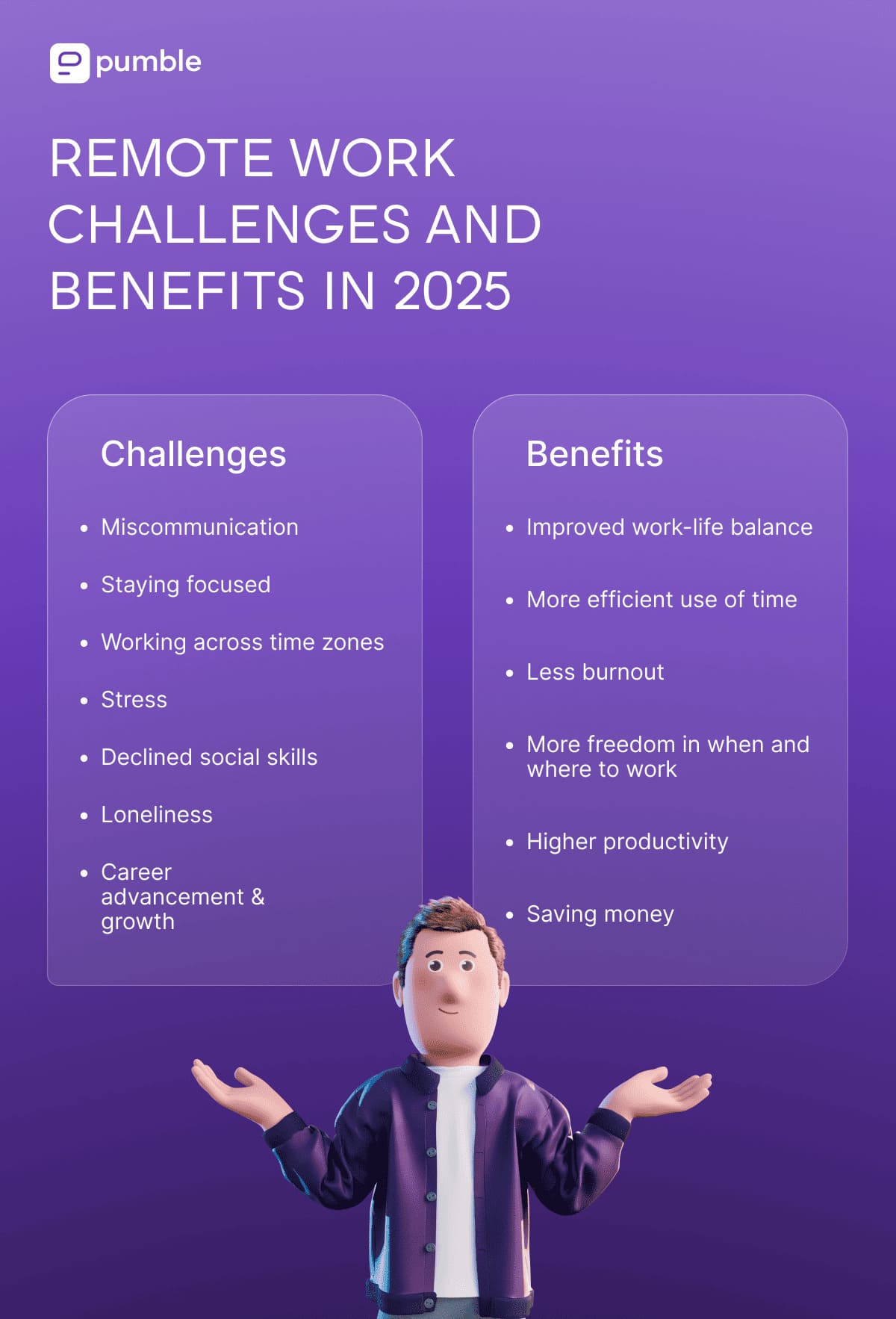
#1 : Pénurie de communication adéquate sur le lieu de travail
Maintenir une communication adéquate sur le lieu de travail pose toujours problème aux travailleurs à distance, mais pas autant qu'avant.
Buffer a indiqué que seulement 8 % des personnes interrogées ont déclaré avoir des difficultés à communiquer et à collaborer avec leurs collègues en 2023.
En 2024, les problèmes de communication au sein des équipes à distance étaient l'une des principales préoccupations des managers (25 %), selon Owl Labs. Les employeurs ont proposé des formations à l'utilisation de méthodes de communication mixtes et asynchrones en temps réel pour y remédier.
Data from 2025 also reflects this trend, as 53% of companies provided employees with training on how to use async communication methods.
🎓 Astuce Pro de Pumble
Consultez les dernières statistiques sur la communication sur le lieu de travail ici :
#2: Staying focused and motivated
Buffer’s 2023 report revealed that some employees struggled with focus and motivation, as 9% had trouble staying focused, while 11% had difficulty staying motivated.
Owl Labs found that reduced employee focus was also one of the major concerns for 21% of remote managers in 2024. At the same time, the share of employees who experience peak focus working from home is the same as the percentage of people feeling best focused in the office — 41%.
However, hybrid work seems to have become a solution for employers worried about hindering their teams’ focus. CIPD’s survey highlights that many organizations feel hybrid work arrangements have brought positive changes, which — besides improved motivation — include:
- Better employee retention rates, especially among new hires, and
- Stronger commitment and loyalty among employees.
#3 : Travailler à travers les fuseaux horaires
Buffer found that 14% of respondents cited working across time zones as a remote work challenge.
Avec l'introduction par de plus en plus d'entreprises de modèles RTO et hybrides, le travail sur plusieurs fuseaux horaires est moins problématique qu'à l'époque où les travailleurs à distance étaient soumis à la politique du « travailler de n'importe où ».
Of course, distributed teams still exist — especially in remote-first companies — so working across time zones remains one of the biggest challenges of 2026.
#4 : Stress lié au travail
Owl Labs’ data for the past 3 years shows that workplace stress remains high.
In 2023, 56% of workers reported increased work stress levels compared to the previous year.
En 2024, 43 % des employés ont déclaré avoir subi une augmentation du stress lié au travail.
The latest numbers reveal that:
- 51% of employees believe that their level of work-related stress hasn’t changed,
- 39% report an increase, while
- 10% believe there has been a decrease.
#5 : Difficultés à établir des relations
Another issue with remote work is that it makes forming meaningful workplace relationships all the more difficult.
Les données de l'enquête de Culture Wizard le confirment — 71 % des personnes interrogées reconnaissent que l'établissement et le maintien de relations constituent un défi majeur pour les équipes virtuelles.
Lorsque les gens ont des difficultés à établir des relations solides au travail, ils ont du mal à gérer les conflits et les désaccords sur leur lieu de travail (54 %) et ont plus de mal à être spontanés avec leurs collègues (68 %).
In its “Work Trend Index Special Report”, Microsoft states that switching to remote and hybrid work has made rebuilding social connections and team cohesion particularly challenging for decision-makers.
Selon les données, 68 % des décideurs considèrent que le maintien des liens sociaux au sein des équipes est l'un de leurs plus grands défis. Malheureusement, les employés subissent les conséquences de ces obstacles.
Environ 51 % d'entre eux estiment que leurs relations avec leurs collègues en dehors de leur équipe se sont affaiblies, et 43 % se sentent déconnectés de l'entreprise. Si les employeurs ne s'attaquent pas à ces chiffres, ils risquent de voir la satisfaction des employés réduire l'efficacité de l'organisation.
Besides these issues, workers can also experience physical consequences that negatively affect their health. The “IWG Hybrid Working Productivity Report” from 2025 states that remote workers surpass their on-site peers in taking sick leave. This disparity is, to an extent, a result of the intensified loneliness and isolation remote workers experience.
#6 : Impossibilité de se déconnecter après le travail
In Buffer’s 2023 report, 11% of respondents cited difficulty disconnecting after work as their biggest challenge. This percentage is a decrease from the previous year, when 25% of remote workers could not unplug when off the clock.
L'enquête 2023 de Deloitte sur les milléniaux et la génération Z a confirmé cela, mais les données montrent également que la Génération Z ne s'en sort pas mieux — ¾ des milléniaux et de la génération Z ne parviennent pas à se déconnecter de leur travail.
These numbers are unfortunate, as there is much to be gained from unplugging post-work.
A University of Pittsburgh study analyzing the connection between profitability and “right-to-disconnect” laws, which spanned 10 years, revealed the following — in countries with legislation that encourages employees to ignore work-related communication outside office hours, companies see higher revenue alongside lower operating costs. On the other hand, employees report better recovery during their after hours.
#7 : Solitude et isolement
In 2024, we’ve seen a slight decline in the number of people who feel lonely and isolated due to remote work. According to Owl Labs’ insights from 2024, managers reported having more concerns over loneliness for remote teams (19%) than their on-site colleagues (14%), yet this is still to a lesser degree compared to previous years.
Selon Buffer, 23 % des travailleurs à distance ont cité la solitude comme leur principal problème en 2023. En plus de se sentir isolés au travail, ils ont également déclaré que la solitude est exacerbée parce qu'ils restent à la maison toute la journée (car le travail à distance ne leur donne pas de raison de sortir).
In 2026, these challenges persist. A comprehensive review of loneliness and isolation during the telework era reveals as much, reiterating that the lack of structured social environments and physical interactions typically leads to:
- Greater emotional strain,
- Poorer job performance, and
- Heightened feelings of detachment.
#8 : Moins d'opportunités d'évolution de carrière et de croissance
Travailler à distance ne devrait pas entraver l'évolution de carrière et la croissance professionnelle.
Buffer’s 2023 report dived deep into how remote work affected employees’ opportunities for career advancement, with 28% of respondents stating that their company doesn’t provide career growth opportunities.
Moreover, 36% of respondents said remote work facilitated their career growth.
Cependant, les conclusions d'Owl Labs pour 2023 montrent que les préjugés liés à la proximité constituent une préoccupation importante pour les télétravailleurs. Près de la moitié des personnes interrogées (48 %) craignent que le fait de travailler à distance signifie qu'elles ne seront pas entendues et que leurs collègues au bureau auront plus d'opportunités de progresser.
La situation est encore plus terrible si l'on considère l'opinion des managers et des responsables de la prise de décision. Plus de la moitié d'entre eux (68 %) estiment que leurs travailleurs à distance ou hybrides ne bénéficient pas d'un feedback constructif et d'opportunités de développement, ce qui peut entraver leur évolution de carrière. Seuls 29 % ne sont pas de cet avis.
The same challenge is present in their 2024 report, with most remote team managers still reporting their team is missing out on impromptu feedback and development opportunities.
| Les managers ont-ils le sentiment que leur équipe à distance manque d'opportunités de développement ? | Pourcentage |
|---|---|
| Oui | 56% |
| Non | 40% |
| Ils ne savent pas | 4% |
The rise of hybrid work has slightly alleviated these concerns. In their latest report, Owl Labs underscores that 30% of remote and hybrid employees feel being out of the office decreases their development opportunities and chances of receiving spontaneous feedback.
Les statistiques sur les avantages du travail à distance
Les statistiques sur les avantages du travail à distance
Évidemment, nous n'aurions pas présenté ces défis sans plusieurs avantages pour les contrebalancer.
Respondents cited the following as the most significant advantages of remote work:
- Les personnes interrogées ont cité les avantages suivants comme étant les plus importants du travail à distance :
- 22% — Flexibilité dans leur emploi du temps,
- 19% — Flexibilité dans le choix de leur lieu de résidence,
- 12% — Plus de temps parce qu'ils ne font pas la navette,
- 11% — Economies d'argent,
- 8% — Meilleure concentration,
- 7% — Travail dans leur propre espace,
- 4% — Flexibilité dans les opportunités de carrière,
- 3% — Sentiment d'être plus en sécurité.
Let’s take a look at more in-depth data.
#1 : Un meilleur équilibre entre vie professionnelle et vie privée
En résumé, l'équilibre entre vie professionnelle et vie privée est la répartition du temps et de l'attention d'une personne entre le travail et les activités familiales ou de loisir.
En général, la plupart des travailleurs bénéficient d'un meilleur équilibre entre vie professionnelle et vie privée lorsqu'ils travaillent à domicile.
Selon le rapport de Zapier, 96 % des personnes interrogées associent l'équilibre entre vie professionnelle et vie privée à leur bonheur au travail.
Comme le montrent les données du rapport Gallup de 2024, l'amélioration de l'équilibre entre vie professionnelle et vie privée se trouve en tête de la liste des avantages du travail hybride.
En effet, 76 % des personnes interrogées ont cité cet avantage comme le plus important, suivi par :
- Une utilisation plus efficace de leur temps (64 %),
- Moins d'épuisement professionnel (61 %),
- Plus de liberté pour choisir quand et où travailler (57 %), et
- Plus de productivité (52 %).
More recent data from IWG confirms these findings. According to the research, flexible work arrangements allow employees to shave off their commute times. Around 40% of this extra time is then spent on completing additional work, while the remaining 60% is allocated to tending to personal matters. In the long term, this redistribution reinforces the boundary between work and personal tasks.
#2 : Plus de flexibilité
Pour les employés à distance, la flexibilité est un autre grand avantage du travail à distance.
Pour 91 % des personnes interrogées par Zapier, la flexibilité des horaires est le deuxième avantage le plus important du travail à distance.
The respondents in Buffer’s report on remote work cited overall flexibility as the most significant benefit of remote work.
Plus, employees can devote more time to family life, thanks to flexible working options.
Les données d'Owl Labs de 2023 ont révélé que 34 % et 33 % des personnes interrogées ont cité les lieux et les horaires de travail flexibles comme les avantages les plus attrayants lors de la recherche d'un nouvel emploi.
Similarly, the respondents in their 2024 report also valued flexibility above all else. Most respondents (41%) said they would look for a job with more flexibility in where and when they work if they lost their hybrid privileges. In 2025, that number remained mostly stable at 40%.
#3 : Plus de temps libre
Environ 59% des employés travaillant à domicile déclarent avoir plus de temps libre parce qu'ils n'ont pas à faire la navette.
De plus, le trafic diminue et les gens marchent plus que jamais par rapport à l'époque pré-pandémique — tout cela grâce à la possibilité de travailler à domicile.
What’s more, according to FlexJobs, the average one-way commute for US employees is just under 30 minutes. The report also notes that commuting for longer than 30 minutes is directly linked to higher levels of anxiety and stress.
#4 : Économiser de l'argent
Another often-cited benefit of remote and hybrid work is saving money.
The Owl Labs 2024 report found that hybrid workers save around $42 per day when they work remotely rather than from the office.
Considering the costs add up, it’s no wonder the same report stated that 29% of respondents would expect a pay increase if they could no longer work remotely or on a hybrid model.
#5 : Diverses options pour ceux qui ne peuvent pas travailler au bureau
Le travail à distance est un bon choix pour les personnes qui ont des difficultés à travailler au bureau ou qui ne peuvent tout simplement pas le faire, selon un rapport de Buffer datant de 2022.
Il s'agit des personnes suivantes :
- Les personnes avec un handicap,
- Les parents et les soignants, et
- Les propriétaires d'animaux de compagnie.
Les personnes qui souffrent d'un handicap ou d'une maladie chronique préfèrent le travail à distance parce qu'il leur offre plus de flexibilité — 44 % des personnes interrogées par Buffer qui ont déclaré souffrir d'un handicap ou d'une maladie chronique sont d'accord avec ce point de vue.
En outre, le travail à distance leur offre un meilleur accès à une gamme complète d'opportunités de développement professionnel.
Another demographic that greatly benefits from remote work are parents — the 2023 Owl Labs findings revealed that 66% of employees had children living at home.
In the 2025 report, 62% of respondents stated their children still lived at home, while:
- 13% had children no longer living at home, and
- 24% had no children.
#6 : Augmentation de l'engagement et du moral des employés
According to Owl Labs, remote work supports better employee engagement and increases morale. This is good news, considering engagement is still one of the top concerns of managers leading hybrid/remote teams in 2026.
Les données montrent que 27 % des managers sont préoccupés par l'engagement des employés.
Le désengagement au travail est également une préoccupation pour les employés — 52 % d'entre eux le citent comme la principale préoccupation.
Heureusement, Buffer indique que plus de 58 % des personnes interrogées qui travaillent à distance sont engagées dans leur travail :
- 35 % sont très engagés,
- 23 % sont plutôt engagés,
- 12 % ne sont ni engagés ni désengagés, et
- 18 % sont désengagés.
Moreover, Gallup’s data shows that remote and hybrid employees have continually surpassed their on-site colleagues in terms of engagement since 2020.
Similar research from IWG suggests that hybrid work — which encompasses occasional get-togethers for in-person teamwork — can maintain high engagement levels. Not only does this diminish the isolation and loneliness employees experience but also translates into tangible gains for employers. Namely, high engagement is directly connected to productivity gains, and US businesses can expect to bring in $17.6 billion by 2030.
🎓 Astuce Pro de Pumble
To get the most valuable figures on employee engagement trends and factors, check out the guide below:
Les statistiques sur le travail à distance et la productivité
Étant donné que le travail à distance et le travail hybride sont de plus en plus répandus, les employeurs et les employés sont préoccupés par les questions de productivité. Cependant, les avis sont partagés quant à l'impact du travail à distance sur la productivité.
Some researchers believe it has reduced employees’ productivity, while others think it has genuinely boosted productivity in the workplace.
Here are the latest remote work productivity statistics and data.
La plupart des employés affirment qu'ils sont plus productifs lorsqu'ils travaillent à domicile
The majority of research shows that employees are more productive when they work remotely. In fact, Owl Labs’ 2025 report reveals that, in general, managers have a positive outlook on hybrid work, with:
- 69% believing it has positively influenced their teams’ productivity,
- 19% stating there have been no shifts in employee productivity, and only
- 12% stating their teams’ have become less productive.
The 2024 edition of the report showed that employee productivity remained consistent among remote and hybrid workers (90%). However, 46% of employees said their company has introduced or increased employee productivity monitoring software in the past year.
In 2023, an overwhelming majority of their respondents — 91% — said they feel they are the same or more productive in their current work model.
D'après les données d'une étude de deux ans menée par Great Place to Work, qui a examiné les réponses de plus de 800 000 employés d'entreprises figurant au classement Fortune 500, la plupart des personnes ont connu des niveaux de productivité stables ou accrus après avoir opté pour le travail à domicile.
Plus de la moitié des personnes déclarent être plus productives lorsqu'elles travaillent au bureau
According to the “Flex Report”, companies with more flexible policies outperform organizations driven by RTO mandates.
Yet, asking employees about their personal productivity brings a more nuanced approach to on-site vs hybrid productivity. Respondents in Owl Labs’ 2024 survey showed that their productivity depends on the activity, not solely on a place of work.
Ainsi :
- 45 % des employés déclarent se sentir plus productifs en respectant les délais sur place (contre 36 % à distance),
- 44 % déclarent se sentir plus productifs en collaborant sur place (contre 24 % à distance), et
- 41 % déclarent se sentir plus productifs en faisant du brainstorming sur place (contre 34 % à distance).
La plupart des leaders restent préoccupés par la productivité de leurs employés
An Atlassian survey of Fortune 500 executives showed that managers and leaders were still worried about productivity levels in 2024.
Although 91% of respondents said they implemented some form of back-to-office mandate, productivity levels were still a major concern — almost as if they were worried that pushing people back into offices would negatively affect their productivity.
Moreover, Owl Labs’ research shows managers’ concerns about employee productivity have increased since 2023. In 2024, they reported that their teams were 62% more productive when working hybrid or remotely — a noticeable decline from 79% reported in 2023. And in 2025, 79% of respondents believed that some employers were pushing RTO policies in a bid to improve productivity and collaboration.
🎓 Astuce Pro de Pumble
Pour garantir la productivité de votre équipe et maintenir une productivité optimale, consultez ce guide complet :
La productivité peut dépendre du type de modèle de travail
In its “Virtual Teams” report, Culture Wizard revealed that not all work models have the same impact on employee productivity.
Le principal constat est que les entreprises qui mettent en œuvre différents modèles de travail à distance (par exemple, télétravail régulier, travail à distance prioritaire ou travail hybride) bénéficient d'une productivité accrue.
| Types de modèles de travail | Pourcentage de productivité |
|---|---|
| Totalement à distance | 34% |
| 75 % Travail à distance | 28% |
| 50 % Travail à distance | 20% |
| Complètement sur place | 9% |
Similarly, Owl Labs found in 2024 that employee productivity varies across work models, depending on the productivity category.
Donc, nous constatons que les gens se sentent plus productifs en travaillant de manière indépendante à la maison, alors que les rencontres et le mentorat conviennent mieux au bureau, selon eux. Les espaces de coworking sont les moins appréciés dans presque toutes les catégories.
| Catégorie de productivité/Lieu de travail | À la maison | Espace de coworking | Au bureau |
|---|---|---|---|
| Travailler en autonomie | 50% | 16% | 34% |
| Développer des idées originales | 46% | 21% | 33% |
| Être attentif | 41% | 18% | 41% |
| Respecter les échéances | 36% | 19% | 45% |
| Formation formelle/informelle | 35% | 23% | 42% |
| Innovations/ Brainstorming | 34% | 25% | 41% |
| Réunions d'équipe | 26% | 25% | 49% |
| Faire progresser sa carrière | 26% | 23% | 51% |
| Gérer les autres | 25% | 24% | 51% |
| Collaborer | 24% | 32% | 44% |
| Avoir un mentor | 23% | 26% | 51% |
| Rencontrer de nouvelles personnes | 18% | 27% | 55% |
Les statistiques sur le rôle des outils de collaboration en ligne dans le télétravail
Rester connecté pendant la pandémie, alors que la plupart des entreprises devaient travailler à distance, était essentiel.
Accordingly, the use of online collaboration tools skyrocketed, making it easier for companies to communicate and collaborate with their employees even from afar.
But how much do remote workers rely on collaboration tools for communication?
Quelles mesures les entreprises ont-elles prises pour faciliter la communication et la collaboration de leurs employés à distance ?
Les employés et les employeurs sont-ils satisfaits des outils et des processus facilitant la communication à distance ?
Let’s see whether the 2026 remote work statistics can shed light on these questions.
🎓 Astuce Pro de Pumble
Les technologies collaboratives sont devenues indispensables pour les équipes à distance et hybrides. Découvrez les logiciels de collaboration et comment les utiliser pour améliorer la communication au sein de votre équipe à distance :
Les outils de collaboration ont décollé en 2021 et se sont stabilisés en 2023
According to Gartner’s “Digital Worker Experience Survey“, almost 80% of workers used collaboration tools in 2021. This represents an increase from 55% in 2019 to 44% since the pandemic began.
Un autre groupe d’outils qui a connu une augmentation significative de son utilisation est celui des outils de stockage et de partage de documents, environ 10 %.
De plus, 80 % des télétravailleurs ont utilisé des applications de messagerie instantanée en 2021, contre 75 % en 2019.
Ces chiffres devraient être légèrement inférieurs en 2024, en raison des obligations RTO. Selon l'étude de Zippia, 56 % des travailleurs utilisent quotidiennement des outils de collaboration.
Les statistiques de Buffer sur le télétravail montrent qu'en 2023, les télétravailleurs ont préféré communiquer avec leurs clients et leurs collègues via des applications de messagerie plutôt que par email, soit 50 % contre 22 %.
Companies are recognizing this shift, too. In the “State of Teams 2025” report, 93% of executives highlighted that technology and software play a pivotal role in their success.

La plupart des entreprises ont mis en place un système efficace de communication et de collaboration à distance
Dans le rapport 2023 d'Owl Labs, 39 % des personnes interrogées ont déclaré que leur employeur avait mis à jour sa technologie vidéo pour faciliter la communication hybride et la collaboration.
The report also shows that quite a few employees — 64% — thought they had to juggle too many communication platforms.
Il semble qu'une plateforme de collaboration et de communication interne tout-en-un résoudrait de nombreux problèmes pour les travailleurs à distance et hybrides.
The importance of good collaboration and communication tools cannot be overstated. In the 2024 Owl Lab report, more respondents (86%) stated having online or hybrid meetings than in-person (83%). So, using collaboration tools is a must for many.
Collaborate better with Pumble
Moreover, in 2025, some employers made efforts to simplify digital communication by:
- Hiring more IT staff and support (29%) and
- Installing or upgrading new video and audio equipment (21%).
Les jeunes générations sont plus susceptibles d'utiliser des outils de collaboration
Les outils de collaboration sont un élément important du travail à distance. Dans la plupart des cas, les travailleurs à distance sont censés les utiliser quotidiennement pour rester en contact avec leur équipe et faire leur travail.
However, research on multigenerational workforces shows that younger people are more likely to rely on collaboration tools, especially video conferencing and workplace communication apps. These tools can help them avoid miscommunication and track progress.
More recent data shows similar trends. A 2024 Owl Labs survey found that 51% of the employees who loved their hybrid meeting tech were Millennials, compared to only 17% of Boomers.
L'utilisation d'un logiciel de visioconférence fiable et facile à utiliser peut faire augmenter ce chiffre et créer un environnement de réunion virtuelle plus agréable, sans effort et productif pour toutes les générations.
Toutes les générations se sentent accablées par le nombre d'applications
Bien que les outils de collaboration facilitent la communication et la collaboration, toutes les générations estiment qu'elles perdent souvent du temps à passer d'une application à l'autre.
Par exemple, 60 % des employés âgés de 18 à 24 ans et 63 % de ceux âgés de 25 à 34 ans pensent qu'ils perdent du temps à passer d'un outil de collaboration à l'autre.
Environ 99 % des travailleurs à distance utilisent environ 4,8 outils de conférence différents, selon les statistiques de FinancesOnline.
Even though employees older than 55 usually use fewer collaboration apps, about 40% also think they are wasting time switching between collaboration technologies.
Recently, according to Owl Labs, the desire for more user-friendly tools has grown stronger. In 2025, 8 in 10 respondents stated they lost time due to technical difficulties. Compounding the issue, 1 in 4 respondents reported losing more than 10 minutes when joining a hybrid meeting due to the complex setups.

Les statistiques sur la sécurité du travail à distance
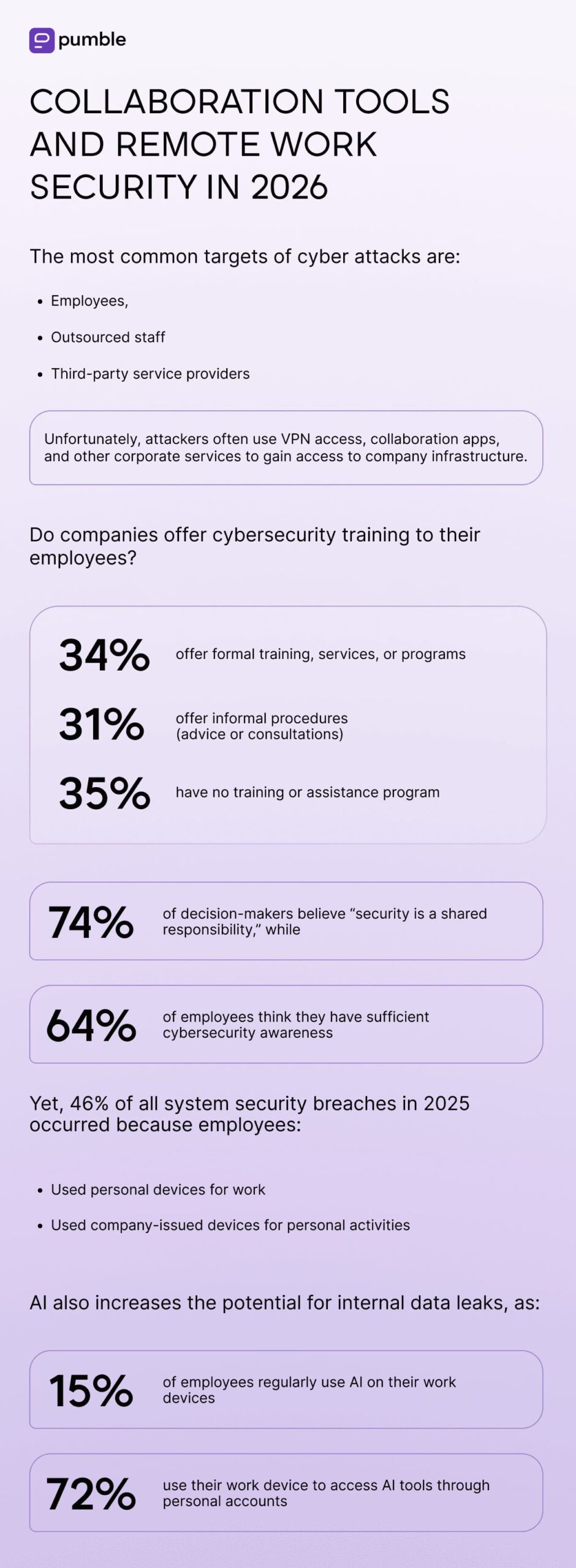
Since remote and hybrid work are here to stay, companies must step up their cybersecurity game.
But, how are they keeping their remote workforce and sensitive data secure?
Do organizations trust their remote workers?
Mettent-elles en œuvre et actualisent-elles régulièrement leurs stratégies de cybersécurité ?
To learn more, we’ll look at the statistics on what companies are doing to ensure cybersecurity in remote work settings in 2026.
More than half of the companies allow remote access to corporate apps from personal devices
According to Check Point’s Cybersecurity Report from 2026, attackers have shifted their approach. Replacing phishing attacks via email, multi-channel social engineering has now become the go-to way of exploiting vulnerabilities. As a result, victims are manipulated into revealing confidential information, withthe most common targets being:
- Employees,
- Outsourced staff, and
- Third-party service providers.
In fact, such attacks spiked by around 500% compared to the year before. That’s why Check Point identifies data protection as a critical security outcome for modern organization.
Data loss incidents from insider-driven events have increased by 28% since 2021. Moreover, most (85%) of information security experts expected this trend to continue in the next 12 months, according to mimecast’s data exposure report for 2024.
Considering the percentage of companies allowing remote employees to use their personal devices for business purposes, it is not surprising that Check Point found that 87% of them have experienced an attempted exploit of an already-known, existing vulnerability.
Pour la majorité des entreprises, les connexions VPN fournissent un accès à distance sécurisé
Selon les données de CyberTalk, 73 % des entreprises utilisent des connexions VPN pour sécuriser l'accès à distance aux applications et outils de l'entreprise.
Cependant, ce n'est pas parce que les entreprises mettent en œuvre certaines fonctions de sécurité que les employés les utiliseront.
For example, according to Tech.co’s 2024 report — “The Impact of Technology on the Workplace” — 59% of respondents stated that they aren’t using a VPN, even though their company provided one.
Moreover, 56% of enterprises have experienced a cyberattack connected to VPN vulnerabilities, according to the 2024 risk report by Cybersecurity Insiders.
Check Point’s latest report supports these findings, noting that VPN access, collaboration apps, and other corporate services are often the entry points attackers exploit to gain access to organizational infrastructure.
These limitations and vulnerabilities have urged many organizations to transition to Zero Trust Network Access (ZTNA) models, offering better security by continually verifying user identities and device compliance.
Ainsi, parfois, il ne suffit pas de s'appuyer sur quelques éléments ici et là pour fournir un accès à distance sécurisé.
C'est là que les politiques de sécurité du travail à distance prennent tout leur sens.
La plupart des entreprises ont une politique de sécurité pour le travail à distance
According to the OpenVPN’s cybersecurity survey, about 93% of companies have a remote work security policy.
But, what exactly do these policies entail?
Le rapport d'OpenVPN a révélé que les 3 principaux éléments que la plupart des entreprises incluent dans leur politique de sécurité pour le travail à distance sont :
- Les VPN (74 %),
- Le chiffrement des données sensibles (69 %), et
- L'interdiction de l'utilisation d'appareils personnels pour les données liées au travail (68 %).
Les autres éléments sont les suivants :
- La formation des employés à la sécurité (66 %),
- La gestion des mots de passe (56 %), et
- Prohibiting BYOD (Bring Your Own Device) (38%).
The “OpenVPN VPN Statistics and Trends for 2025” reported that remote and hybrid workforces demand the continuous refinement of security policies. Consequently, many companies have committed to implementing additional protections, such as:
- Routine updates,
- Vulnerability testing, and
- Threat monitoring.
La perception du risque varie selon les employés et les dirigeants
According to OpenVPN’s Cybersecurity Report, 90% of respondents believe remote work isn’t secure.
De plus, 73 % des vice-présidents et des cadres dirigeants estiment que les travailleurs à distance représentent un risque plus important que les employés sur place.
Environ 48 % des responsables informatiques et 45 % des directeurs informatiques sont du même avis.
These security concerns are a primary reason companies have begun pairing VPNs with Zero Trust technology. The “VPN Statistics and Trends for 2025” report acknowledges that this behaviour reflects the “trust never, verify always” motto many organizations have adopted to bolster their user authentication methods.
Les entreprises organisent généralement des formations à la cybersécurité deux fois par an
Providing proper employee training is a step forward in creating a reliable and secure work-from-home environment.
L'enquête d'OpenVPN a révélé qu'environ 90 % des entreprises offrent une formation à la sécurité pour les employés à distance.
Cependant, elle a également révélé que seulement 23 % des entreprises exigent que leur personnel suive une formation en cybersécurité plus de deux fois par an.
| Combien de fois les entreprises demandent-elles aux travailleurs à distance de suivre un cours de la cybersécurité ? | Pourcentage |
|---|---|
| Plus de deux fois par an | 23% |
| Deux fois par an | 32% |
| Une fois par an | 25% |
| Uniquement lors de l'intégration de l'employé | 8% |
| Ils ont une plateforme d'apprentissage en ligne avec les cours que les employés peuvent suivre | 11% |
Unfortunately, in 2025, many organizations didn’t prioritize cybersecurity training. More recently, the World Economic Forum’s cybersecurity report for 2026 examined whether organizations provide cybersecurity guidance or assistance and found that:
- 34% offer formal training, services, or programs,
- 31% offer informal procedures (such as advice or consultations), and
- 35% have no training or assistance program at all.
Malgré une connaissance accrue, les comportements risqués se poursuivent
Check Point’s 2025 findings show that 96% of exploits in 2024 used vulnerabilities disclosed prior to that year, pointing out the need for more proactive measures.
Findings for 2026 highlight the need for increased vigilance due to frequent voice-fishing. The report summarizes approximately 40 incidents where attackers posed as IT support to compel targets to reveal information, such as passwords and administrative credentials.
This increasing incident rate is a persistent remote work trend throughout the past couple of years.
In the first 9 months of 2023, more than 360 million people fell victim to corporate or institutional data breaches despite being aware of the risks, according to a report by Dr. Stuart E. Madnick titled “The Continued Threat to Personal Data: Key Factors Behind the 2023 Increase”.
Verizon’s “2025 Data Breach Investigations Report” reveals that 46% of incidents involving compromised systems occurred due to employees using:
- Corporate logins on their personal devices, or
- Company-issued devices for personal matters, possibly breaking privacy policies.
Stay safe & productive in Pumble
Gen AI is creating new cybersecurity concerns
Verizon’s report acknowledges that generative AI has become a widely used tool for cyberattacks. Specifically, malicious AI-generated content in emails has doubled in the last two years. However, what may be of greater concern to businesses is the potential for AI tools to become an “in-house” threat.
Internal data leakage is a significant consequence of AI misuse, as:
- 15% of employees admit to using corporate devices to regularly access AI tools.
- 72% of employees have used their corporate devices to access AI tools via their personal email addresses.
With AI being a new frontier in the IT sector, risks regarding data leakage and compromised data raise pressing privacy concerns. Moving into 2026 and beyond, companies across all sectors will likely focus on developing appropriate responses regarding security and compliance.
What is the future of remote work in 2026?
En 2024, la Grande Démission — également connue comme la Grand Démission et de Grand Réorganisation — a fait fureur dans le monde entier.
À partir du début de l'année 2021, la Grande Démission a vu les salariés démissionner volontairement et en masse de leur emploi, principalement à la recherche de meilleures conditions de travail et d'avantages tels que le travail à distance ou les horaires flexibles.
Data from a US Labor of Statistics survey released in 2023 show that 3.9 million workers quit in January alone. In 2021 and 2022, that number regularly exceeded 4 million each month. Some even predicted the “Big Stay” era in 2024.
The Great Resignation paved the way for “Quiet Quitting” — or doing the bare minimum to keep your job, but not a thing beyond that. In best cases, managers took notice and did their best to keep the talent with different incentives such as flexibility. Others saw employees get more scrappy and engage in polyworking — working an additional job — to secure additional income and explore a side project.
Then, in late 2024, we saw employees enter their Great Detachment era. Dissatisfaction with their employers, poor job market, and inflation all led to employees feeling stuck and disconnected. This led to an all-time low share of employees (18%) who reported being satisfied with their jobs and anall-time high percentage of people (51%) watching for or actively seeking a new job.
Finally, 2025 brought a compromise. As RTO mandates disrupted employees who had comfortably settled into a fully remote routine, employers realized that the right balance was key to retaining (and attracting) top talent.
In 2025, Skedda’s report on the modern workplace singled out hybrid work as the most sustainable solution moving forward. Companies are happy with this arrangement, too, as the report notes:
- 87% of HR leaders admit hybrid-work contributes to better work-life balance, while
- 84% believe it has increased job satisfaction among employees.
So, what do the remote work statistics for 2026 predict for the future of work?
How many employees would leave their current jobs without a remote or hybrid work option?
Nous allons le découvrir.
Les gens voudraient continuer à travailler à distance
In 2023, the global workforce leaned even more into remote work. Buffer’s “State of Remote Work 2023” indicates that 98% of employees wish to continue working remotely in some capacity for the rest of their careers.
Les rapports de 2024 montrent que 40 % des employés à distance chercheraient un autre emploi s'ils ne pouvaient plus travailler à distance, tandis que 22 % déclarent qu'ils s'attendraient à une augmentation de salaire.
Findings from 2025 are similar. A poll from the Pew Research Center confirmed that 72% of hybrid workers would like to continue that arrangement. Meanwhile, 62% of respondents who have rarely or never worked from home stated they would like to switch to hybrid work, at least part of the time.
And there’s still palpable resistance to full-time in-person work. Almost half of the respondents (46%) stated they would likely quit if required to permanently return to the office.
Many employees want more flexible arrangements
The “Flex Report 2024” correctly predicted that many companies would issue structured hybrid work policies in 2024. This trend continued throughout 2025, although the ability to work from home is something many workers continue to seek out. According to the “FlexJobs Remote Work Index”, 85% of job seekers rank remote work above other appealing benefits, including salary.
A 2025 report by King’s College London, which explored RTO mandates, notes growing resistance among employees, as only 42% would agree to spending their entire workweek in the office. In 2022, that figure was around 54%.
Certains employés démissionneraient s'ils ne pouvaient plus travailler à distance
In 2023 and 2024, employees were ready to hand in their resignations at their current in-office jobs if a remote opportunity came up.
In the “State of Hybrid Work” report, Owl Labs’ respondents said that if they weren’t allowed to work remotely or hybrid, they would:
- s'attendraient à une augmentation de salaire — 29 %,
- commenceraient à chercher un autre emploi offrant une plus grande flexibilité en termes de lieu de travail — 24 %,
- commenceraient à chercher un autre emploi offrant une plus grande flexibilité en termes d'horaires de travail — 18 %
- resteraient, mais seraient malheureux — 9 %,
- resteraient, mais seraient moins disposés à faire des efforts supplémentaires — 9 %
- ne s'en préoccuperaient pas — 7 %, et
- démissionneraient — 4 %.
Bien que seulement 4 % des travailleurs démissionnent, la plupart d'entre eux choisissent de quitter leur lieu de travail.
The situation was no different in 2025. While 5% of respondents would outright quit, 40% would begin looking for a new position — a noticeable 16% percent increase from 2024.
Les employés à distance recherchent un emploi pour diverses raisons
Après la pandémie, les travailleurs à distance ont modifié leurs priorités et leurs attentes en matière de travail.
The latest Owl Labs report finds that the number of remote and hybrid professionals actively looking for a new job is 27% — the same as in 2024.
Les raisons de cette évolution sont variées :
- Better compensation — 49%,
- Better work-life balance — 48%,
- Better career opportunity — 44%,
- Doing something they enjoy — 35%,
- Lowering stress — 32%,
- More flexibility around when they work — 28%,
- More flexibility around where they work — 24%.
Bien que la rémunération arrive en tête de liste, les salariés ont également déclaré qu'ils chercheraient de nouvelles opportunités d'emploi s'ils n'étaient pas reconnus dans leur travail — peu importe l'argent.
Les employés n'accepteront pas n'importe quelle offre d'emploi
Même si les gens ne sont plus aussi rapides sur la gâchette que lors de la Grande Démission, ils n'accepteront toujours pas une offre d'emploi qui ne répond pas à toutes leurs attentes.
Data from Owl Lab shows there were 5 distinct reasons employees declined a job offer in 2025, and they all have to do with remote/hybrid work policies:
- They don’t have flexible work hours — 37%,
- They have to work in-office full time — 34%,
- They don’t have a flexible work location — 30%,
- They’re required to be in the office during specific days or times — 24%,
- They have to work remotely full time — 20%.
Les employés à distance sont prêts à faire des sacrifices pour rester à distance
In 2024, many people couldn’t work fully remotely. Consequently, they clung to flexible work hours and hybrid work.
The Owl Lab report from that year shows that, for example, 16% of respondents would take a 20% pay cut to get flexible work hours. Meanwhile, 17% of respondents would take the same reduction to work remotely.
In 2025, the average employee was willing to have their annual salary cut by 9% to keep a flexible schedule.
When we look at data across generations, it’s clear that younger employees are more likely to take a pay cut for the sake of flexibility:
- Gen Z — 78%.
- Millennials — 73%.
- Gen X — 57%.
- Boomers — 29%.
Remote, in-office, or somewhere in the middle?
Alors que certaines entreprises prévoient de rester entièrement à distance et que d'autres s'empressent de retourner dans les bureaux, l'avenir est incertain pour certains.
Buffer a indiqué qu'en 2022, 9 % des employés ont déclaré que leur entreprise ne prévoyait pas de rendre permanent le travail à distance, un chiffre presque identique à celui de 2023.
Another novelty revealed in Own Labs’ report for 2023 shows that more than half of respondents (53%) don’t trust that the company policies they had in 2023 would remain in place in 2024. They believed their employer would reduce the remote/hybrid benefits.
In Q4 2024, we witnessed these predictions coming true. According to the Flex Index, the percentage of companies requiring full-time in-office work reached 32% in the last quarter of 2024, becoming the second most prevalent work model. At the same time, fully flexible work models — requiring no obligatory office time — dropped from 31% in 2023 to 25% in 2025.
The “Cisco Global Hybrid Work Study 2025” acknowledges that many companies are attempting to gradually phase out remote and hybrid work. In their inaugural issue of the survey, 62% of respondents worked under some kind of hybrid policy. However, that number dropped to 42% in 2025.
The study also notes that employers have started customizing hybrid policies to meet the needs of modern workforce, as:
- 73% of respondents believe their new working arrangement makes them more productive,
- 50% of top performers are with organizations requiring fewer than 3 days of in-office work, and
- 46% of employees admit their new work policies require more in-person work.
Rather than pushing to a full-scale return to office spaces, employers might try to sustain this balance in 2026.
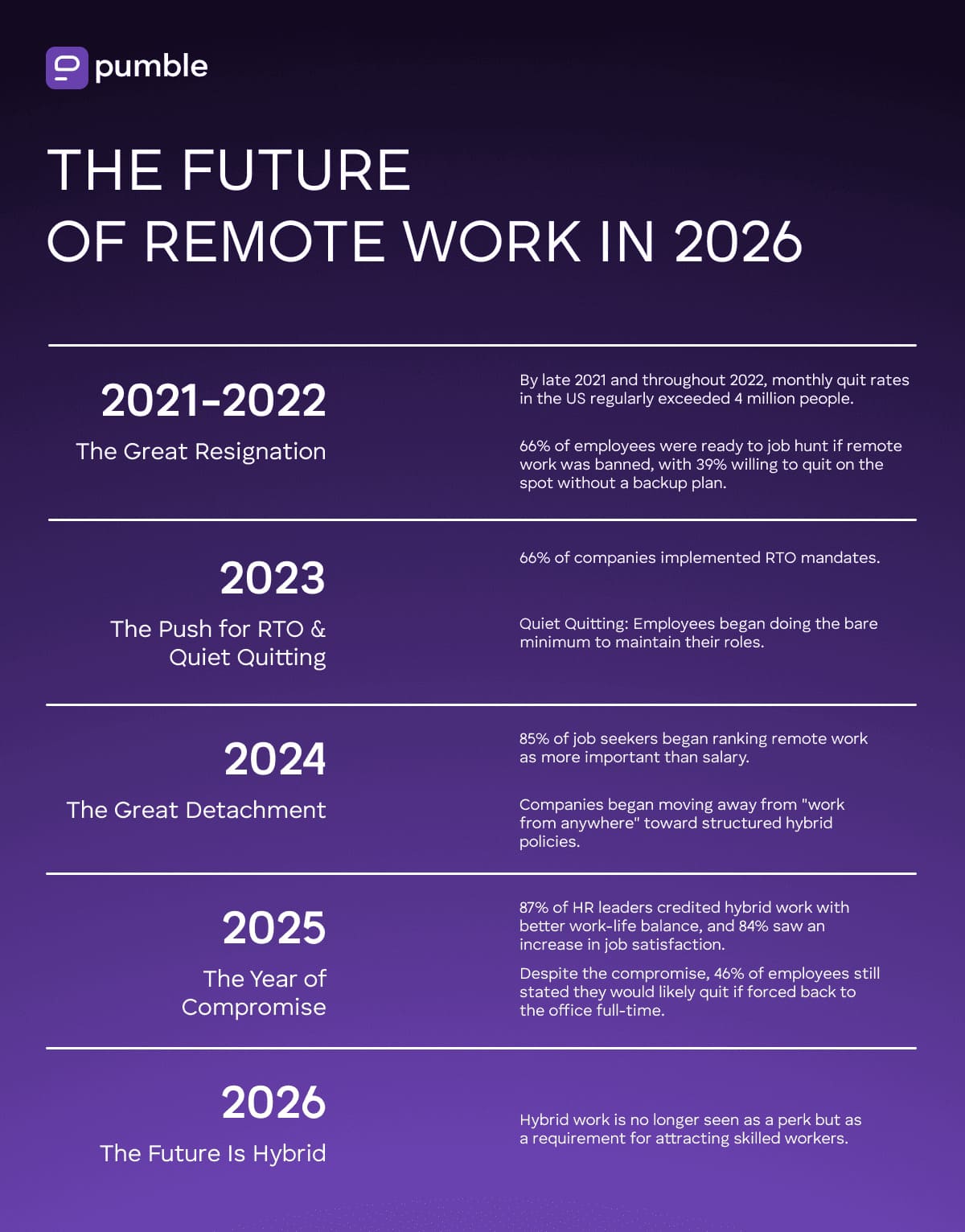
Les statistiques sur les tendances qui façonneront l'avenir du travail
Although we can’t ever truly predict what’s next, experts across the globe have already anticipated a few remote work trends that will most certainly shape the future way of work.
Au début de l'année 2021, beaucoup s'attendaient à un retour à la « normale », c'est-à-dire à un retour au bureau.
Cependant, l'année 2021 s'est révélée plus instable qu'on ne l'imaginait, marquée par une guerre massive pour les talents, des niveaux d'inflation élevés et des taux de démission importants.
Employment Hero rapporte qu'en 2022, notre perception de la normalité a changé, puisque moins de la moitié des employés interrogés (45 %) étaient de retour pour un travail en personne à temps plein. En 2023, ce chiffre a encore augmenté.
Selon le rapport 2024 de Owl Labs, 25 % des travailleurs ont remarqué que leur employeur avait modifié sa politique en matière de travail à distance ou hybride, et nous constatons aujourd'hui que davantage de personnes prennent des vacances pour travailler non déclarées et s'engagent dans plusieures travaux en conséquence.
So, what can we expect for the future of work in 2026? Let’s take a closer look.
#1 : Les entreprises se précipitent pour trouver la stratégie hybride parfaite
As mentioned throughout this report, hybrid work seems to be the future of work.
As predicted, companies have used most of 2025 to polish their hybrid structures.
But, it remains to be seen whether they’ve landed on the perfect ratio of in-office work and work-from-home days.
What’s more, as per CAKE.com’s insights on the future of work, companies will also have to come up with incentives to motivate employees to embrace hybrid work practices.
#2 : Le « coffee badging » restera populaire
If you don’t know what coffee badging is, you’re not alone. This trend, which emerged in 2023, might not be something you’ve heard of, but it’s probably something you’ve done — especially if you’re a hybrid worker.
Le « coffee badging », parfois aussi appelé « peacocking » ou, plus simplement, « posturing », est un phénomène qui consiste pour les travailleurs hybrides à se rendre au bureau pour atteindre le minimum requis par l'entreprise, mais à y passer le moins de temps possible et à rentrer chez eux.
Ils entrent donc, prennent un café rapide, s'assurent que tout le monde les a vus, puis rentrent chez eux.
En 2023, 58 % des travailleurs hybrides font cela, tandis que 8 % sont prêts à essayer. Cela signifie que 66 % des travailleurs hybrides évitent activement le bureau.
Le rapport d'Owl Labs constate que l'évitement du café est resté fort tout au long de l'année 2024. En fait, près de la moitié des travailleurs (40 %) ont déclaré continuer à participer à cette tendance, même si 70 % d'entre eux ont admis que leurs employeurs les avaient repérés.
By 2025, the trend was still relevant, with:
- 43% of employees participating, and
- Another 12% admitting they were planning to start.
#3: The use of AI will continue
In 2023, the Top Employers Institute touched on using AI technology in its “World of Work Trends Report”. According to their data, some businesses were already using AI tools to generate prompts for developing employee learning programs.
In 2024, 24% of respondents in the Owl Labs report said they used AI tools daily, while an additional 23% of them reported using them multiple times a day. Furthermore, 47% of employers used AI technology to replace or augment employee roles.
The 2025 edition of the report revealed that 80% of workers used AI in some capacity — whether their employers were aware of it or not.
The “From Burnout to Balance” report from Upwork indicates that executives have high hopes for AI’s impact on employee productivity in the following years. Namely, as many as 96% of C-level leaders believe AI tools will significantly boost company-wide productivity. This is also seen in their decision to use AI tools, with:
- 39% of companies mandating the use of AI tools, and
- Another 46% encouraging their use.
Toutefois, les employés ne partagent pas encore cet enthousiasme :
- 77 % des employés affirment que les outils font le contraire de ce qui est attendu en augmentant leur charge de travail.
- 47 % des employés déclarent ne pas comprendre comment atteindre les niveaux de productivité escomptés avec l'IA.
CAKE.com’s 2024 report on the “State of Workplace Culture and Work-Life Balance” points out that the adoption of AI is happening slower than expected. Even though 74.13% of workplaces adopted AI tools, most of them (58.31%) only use one or two AI tools.
All things considered, AI will surely become an even bigger staple in both on-site and remote work in 2026. Therefore, both employees and managers should prepare for it.
Leaders should prepare to change and adapt their plans and expectations for Gen AI as tools evolve and employee proficiency improves.
#4 : L'attitude négative envers le travail et #WorkTok
Workers are generally dissatisfied with their jobs and are not afraid to say it.
In 2024, we saw work go social in a major way, with more people than ever publicly putting their employers on blast. Trends such as #WorkTok took over social media, with people detailing the negative practices of their current and former employers. As much as 37% of all workers admitted (to Owl Labs) to posting negatively about their employer on social media.
Disengagement was another big concern for 48% of employees, who cited the following reasons for this attitude toward their work:
- Burnout — 27%,
- Lack of growth opportunities — 24%,
- Increased workload — 22%,
- Rémunération injuste — 22 %,
- Not feeling valued — 22%, and
- Declining mental health — 20%.
In line with this, we’re seeing more workers instilling boundaries on not going beyond their specific job requirements. More than a third of respondents (38%) said they block off time in their calendars to protect it from meetings.
In 2026 and beyond, employers who want to keep their top performers have an immense responsibility in addressing these issues and concerns.
#5 : Les entreprises continueront à faire face à une pénurie de talents
The talent shortage is another major issue in the business world.
Findings from this ManpowerGroup “Global Talent Shortage” survey show that talent shortages plagued organizations throughout 2025 — 73% of companies reported difficulty finding the skilled talent required for their industry.
The survey also showed that the top 5 industries affected by the global talent shortage are:
- Healthcare and life science,
- Energy and utilities,
- IT,
- Transport, logistics, and automotive, and
- Consumer goods and services.
#6 Les Workcations sont en hausse
Workcations or “quiet vacationing” is a relatively new trend among hybrid and remote workers, but it’s quickly picking up. The number of remote and hybrid employees working remotely from different locations other than their homes or coworking spaces is growing.
In its “State of Hybrid” report, Owl Labs found that as much as 58% of remote workers were quiet vacationing in 2024, out of which:
- 26 % ont déclaré être partis en vacances 2 à 3 fois,
- 15 % ont travaillé une fois en dehors de leur domicile ou de leur bureau,
- 9 % ont pris des vacances tranquilles 4 à 5 fois, tandis que
- 8 % des travailleurs à distance ont pris des vacances plus de 5 fois.
On peut supposer que de plus en plus de travailleurs à distance et hybrides adopteront cette tendance, qui semble tout à fait attrayante pour les professionnels à la recherche d'une plus grande flexibilité dans leurs conditions de travail.
#7 Le polytravail devient normal
The Owl Labs report for 2025 suggests that US workers are switching to polyworking after resigning, silently quitting, and detaching.
Approximately 28% of workers admitted to having another job, while 16% said they were planning to join the trend in 2026.
The reasons for this decision vary:
- 40% of workers cited needing additional income,
- 39 % ont indiqué qu'ils appréciaient un projet parallèle,
- 35 % ont admis que leur premier emploi était facile, ce qui leur laissait plus de temps pour explorer d'autres domaines,
- 32 % voulaient plus d'argent (même s'ils n'en avaient pas besoin),
- 31 % voulaient aider un membre de leur famille ou un ami, et
- 28 % ont déclaré que le deuxième emploi était leur véritable passion.
Donnez un coup de pouce à vous-même dans l'espace de travail à distance avec Pumble
Donnez un coup de pouce à vous-même dans l'espace de travail à distance avec Pumble
Even with the push to return to the office in 2023 and 2024, some degree of hybrid and remote will surely survive beyond 2026. .
With this in mind, here are several actions businesses can take to ensure productivity continues to thrive:
- Ensure better workplace communication: Optimize internal communication practices and promote a healthy remote company culture.
- Enact supportive policies: Put forward policies that support WFH employees, protect their mental health, and give them enough flexibility to manage their time.
- Invest in resources: Increase investment in training remote workers and providing them with the necessary software to perform their jobs effectively.
For remote and hybrid workers, collaboration software like Pumble by CAKE.com helps streamline teamwork by:
- Centralizing communication: Keep all conversations in one place, thanks to public and private channels, DMs, groups, and threads.
- Boosting real-time collaboration: Get immediate feedback and establish rapport with audio calls and video conferencing.
- Keeping information accessible: Use third-party access and file sharing to give all team members the info they need.
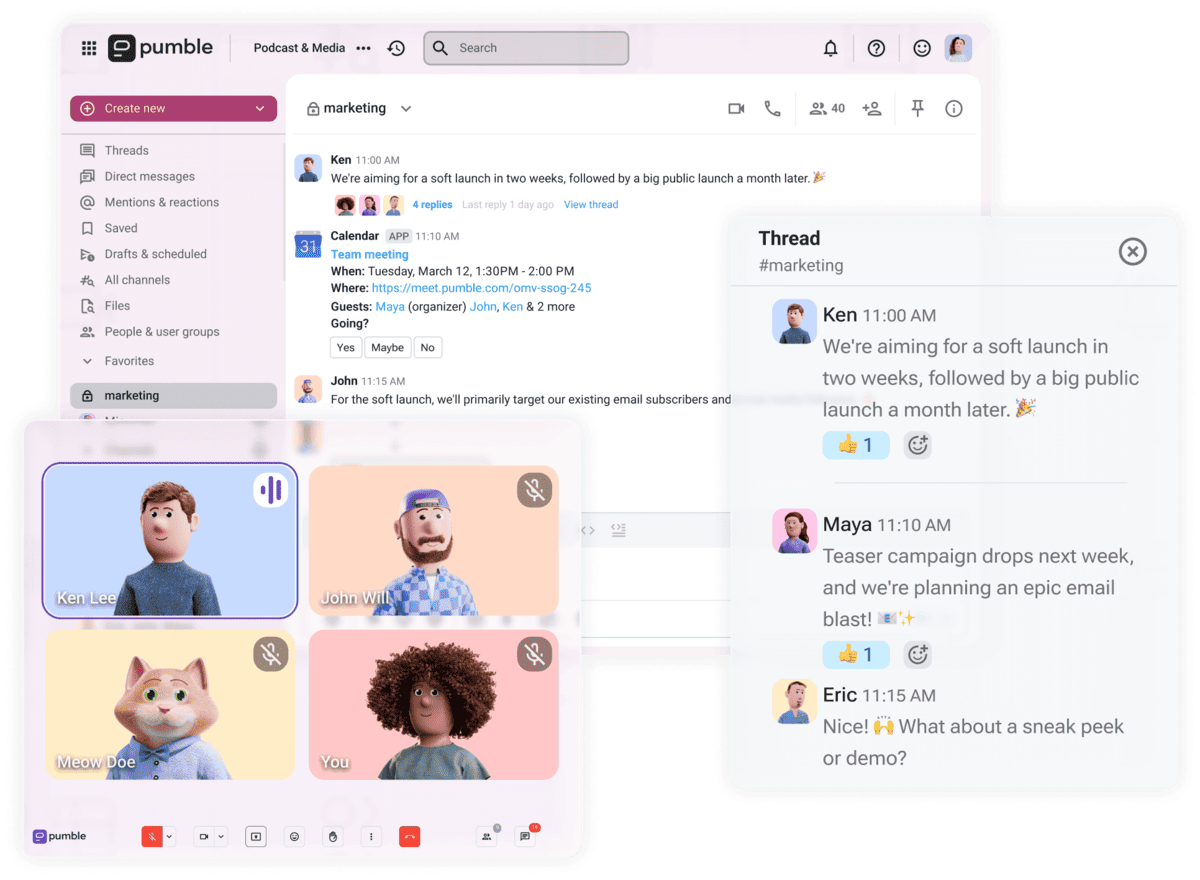
When all data is centralized in one digital space, remote and hybrid work are easy to implement and maintain.
Take charge of your remote workspace.
Démarrez avec Pumble by CAKE.com
Références :
- Adzuna UK Job Market Reports. (2025). UK Job Market Report 2025. Retrieved February 2026, from: https://www.adzuna.co.uk/job-market-report/
- Aksoy, C.G., Barrero, J.M., Bloom, N., Davis, S.J., Mathias Dolls and Zarate, P. (2025). The global persistence of work from home. Proceedings of the National Academy of Sciences, 122(27). Retrieved January 2026, from: https://www.pnas.org/doi/10.1073/pnas.2509892122
- Buffer. (2023). State Of Remote Work 2023. (n.d.). Buffer: All-you-need Social Media Toolkit for Small Businesses. Retrieved February 2025, from https://buffer.com/state-of-remote-work/2023?ref=buffer.com
- Buffer. (2022). 2022 State Of Remote Work Report. Retrieved February 2025, from https://buffer.com/state-of-remote-work/2022
- Business Insider. (2025). ‘Hybrid Creep’ Is Spreading as More Companies Tighten RTO Rules. Retrieved February 2026: https://www.businessinsider.com/hybrid-creep-employers-increasing-rto-days-office-2025-9
- CAKE.com. (2024). The Gen Z Effect and the Workforce Evolution: 2024 Statistics. Retrieved January 2025, from https://cake.com/blog/gen-z-workforce-statistics/
- CAKE.com. (2024). The 2024 Gender Inequality in Unpaid Domestic Work Report. Retrieved January 2025, from https://cake.com/blog/gender-inequality-in-unpaid-work/
- CAKE.com. (2024). 2024 State of Workplace Culture and Work-Life Balance Report. Retrieved January 2025, from https://cake.com/blog/workplace-culture-work-life-balance-report/
- CAKE.com. (2025). 10 Future of Work Trends to Keep an Eye On in 2026. Retrieved January 2026, from https://cake.com/blog/future-of-work-trends/
- CIPD. (2025). Flexible and hybrid working practices in 2025. Retrieved February 2026 from https://www.cipd.org/en/knowledge/reports/flexible-hybrid-working/
- Cisco. (2025). Cisco global hybrid work study 2025: Navigating hybrid work strategies in the evolving workplaces. Retrieved February 2026, from https://newsroom.cisco.com/c/dam/r/newsroom/pdfs/Cisco-Hybrid-Work-Study.pdf
- CheckPoint. (n.d). The 2022 Workforce Security Report. Retrieved March 2024, from https://blog.checkpoint.com/2022/02/02/the-2022-workforce-security-report/
- CheckPoint. (2025). The State of Cyber Security 2025. Retrieved February 2025, from https://www.checkpoint.com/security-report/?flz-category=items&flz-item=report–cyber-security-report-2025
- CheckPoint. (2026). 2025 Cyber security report. Retrieved February 2026, from https://www.checkpoint.com/security-report/
- Chung, H. & Yuan, S. (2025) Return-to-office mandates: What is at stake for workers, companies, and gender equality? King’s Global Institute for Women’s Leadership Report, May 2025. London; King’s College London. Retrieved February 2026, from https://www.kcl.ac.uk/giwl/assets/return-to-office-mandates-what-is-at-stake.pdf
- Code42. (2024). Annual Data Exposure Report 2024. Retrieved February 2025, from https://www.mimecast.com/resources/white-papers/annual-data-exposure-report-2024/
- Concordia University. (2025). Why navigating the new workforce demands upskilling and job fluidity: News. Retrieved January 2026 from: https://www.concordia.ca/cunews/offices/provost/cce/2025/03/04/why-navigating-the-new-workforce-demands-upskilling-and-job-fluidity.html
- CultureWizard. (2022, February 11). Global Virtual Teams Survey Report 2022. Retrieved March 2024, from https://www.rw-3.com/blog/global-virtual-teams-survey-report-2022
- Cybersecurity Insiders. (2024). 2024 VPN Risk Report. Retrieved February 2025, from https://www.cybersecurity-insiders.com/zcaler-threatlabz-2024-vpn-risk-report/
- Deloitte. (2022). The Global 2022 Gen Z & Millennial Survey. Retrieved March 2024, from https://www.deloitte.com/content/dam/assets-shared/legacy/docs/about/2022/deloitte-2022-genz-millennial-survey.pdf
- Deloitte. (2023). The Deloitte Global 2023 Gen Z and Millennial Survey (2023) Deloitte. Retrieved March 2024, from https://www.deloitte.com/global/en/issues/work/genz-millennial-survey.html
- Deloitte. (2024). 2024 Gen Z and Millennial Survey: Living and working with purpose in a transforming world. Retrieved January 2025, from https://www.deloitte.com/content/dam/assets-shared/docs/campaigns/2024/deloitte-2024-genz-millennial-survey.pdf?dlva=1
- Deloitte. (2025). Global Gen Z and Millennial Survey. Retrieved February 2026 from: https://www.deloitte.com/global/en/issues/work/genz-millennial-survey.html
- Deloitte. (2020). The Postgenerational Workforce. Retrieved February 2026, from https://www.deloitte.com/us/en/insights/topics/talent/human-capital-trends/2020/leading-a-multi-generational-workforce.html
- Dennison, K. (2024) How the flexible & remote work debate will carry into 2024, Forbes. Retrieved March 2024 from https://www.forbes.com./sites/karadennison/2024/01/24/how-the-flexible–remote-work-debate-will-carry-into-2024/?sh=740bfc1177c6
- Ding, Y., Ma, M. S., & Niu, Z. (2025). Can’t unplug from work? Right to disconnect laws, firm profitability and employee work-life balance (SSRN Scholarly Paper No. 5394611). Retrieved February 2026, from https://papers.ssrn.com/sol3/papers.cfm?abstract_id=5394611
- Federal Reserve Bank of St. Luis. (2024) Trends in Work from Home in the U.S.: Insights from Six Datasets. Retrieved February 2025, from https://www.stlouisfed.org/on-the-economy/2024/dec/trends-work-from-home-us-insights-six-datasets
- Figueiredo, E., Margaça, C., & Sánchez-García, J. C. (2025). Loneliness and isolation in the era of telework: A comprehensive review of challenges for organizational success. Healthcare, 13(16), 1943. Retrieved February 2026, from https://pmc.ncbi.nlm.nih.gov/articles/PMC12385570/
- Fortune. (2025) Job-hopping gen z only stay at each job 1 year and 54% are regularly browsing for their next role-but a report says they’re not disloyal villains. Retrieved February 2026 from: https://fortune.com/2025/09/11/job-hopping-gen-z-early-career-stay-one-year-in-role-disloyalty-development-ai-disruption-junior-roles-dissappearing-villains/
- Flex Index. (2024). The Flex report predictions for 2024. Retrieved March 2024 from https://www.canva.com/design/DAF2Osz-dBk/a7nCgzVi-o6LK7t8UP1GRg/view?utm_content=DAF2Osz-dBk&utm_campaign=designshare&utm_medium=link&utm_source=editor#1
- FlexJobs. (2022). Survey: Men and Women Experience Remote Work Differently. Retrieved February 2025 from https://www.flexjobs.com/blog/post/men-women-experience-remote-work-survey
- Gallup. (2025) Fully remote work least popular with gen Z. Retrieved February 2026: https://www.gallup.com/workplace/692675/fully-remote-work-least-popular-gen-z.aspx
- Gallup. (2024). Hybrid Work Indicators. Retrieved February 2025, from https://www.gallup.com/401384/indicator-hybrid-work.aspx
- Gallup. (2024). The Great Detachment: Why Employees Feel Stuck. Retrieved February 2025, from https://www.gallup.com/workplace/653711/great-detachment–why-employees-feel-stuck.aspx
- Glassdoor. (2025). Glassdoor’s Worklife Trends 2026 – Glassdoor US. Retrieved February 2026, from https://www.glassdoor.com/blog/worklife-trends-2026/
- Global Citizen Solutions. (2025). Global Digital Nomad Report 2025. Retrieved February 2026 from: https://www.globalcitizensolutions.com/report/global-digital-nomad-report-2025/
- Greene, S., & Masunaga, S. (2024). Quiet quitting. RTO. Coffee badging. What this new vocabulary says about your workplace. Los Angeles Times. Retrieved February 2026, from https://www.latimes.com/business/story/2024-03-04/quiet-quitting-rto-coffee-badging-what-this-new-vocabulary-says-about-the-workplace
- Haan, K. (2024) Remote work statistics and trends in 2024, Forbes. Retrieved March 2024 from https://www.forbes.com/advisor/business/remote-work-statistics/
- International Labour Organization. (2022, January 17). World Employment and Social Outlook Trends 2022. Retrieved January 2025, from https://www.ilo.org/publications/flagship-reports/world-employment-and-social-outlook-trends-2022
- International Workplace Group. (2025). IWG Hybrid Working Productivity Report. Retrieved January 2025, from https://media.iwgplc.com/IWG/MediaCentre/IWG_Hybrid_Working_Productivity_Report_June_2025.pdf
- Intuit. (2024). The Side Hustle Generation: A Study on Gen Z and Millennials’ Redefinition of Success. Retrieved February 2025, from https://www.intuit.com/blog/innovative-thinking/the-side-hustle-generation/
- KPMG. (2024). 2024 KPMG U.S. CEO Outlook Pulse Survey. Retrieved February 2025, from https://kpmg.com/us/en/articles/2024/kpmg-2024-ceo-outlook-pulse-survey.html
- Laker, B. ORCID: https://orcid.org/0000-0003-0850-9744, Pereira, V., Budhwar, P. and Malik, A. (2022) The surprising impact of meeting-free days. MIT Sloan Management Review. ISSN 1532-9194. Retrieved February 2026, from: https://centaur.reading.ac.uk/102394/
- Lockton. (2024). New Remote Working Legislation Around the World. Retrieved February 2026: https://global.lockton.com/us/en/news-insights/new-remote-working-legislation-around-the-world.
- ManpowerGroup. (2025). 2025 Global Talent Shortage. Retrieved February 2026, from https://www.manpowergroup.com/en/insights/2026-global-talent-shortage
- McKinsey Global Institute. (2021, February 18). The future of work after COVID‐19. Retrieved February 2025, from https://www.mckinsey.com/featured-insights/future-of-work/the-future-of-work-after-covid-19
- McKinsey & Company. (2025). Reimagined: Development in the Future of Work. Retrieved February 2026, from https://www.mckinsey.com/~/media/mckinsey/featured%20insights/people%20in%20progress%20blog/learning%20trends%202025/2025_mckinsey%20learning%20perspective.pdf
- Microsoft. (2022, March 16). Great Expectations: Making Hybrid Work Work. Retrieved February 2025, from https://www.microsoft.com/en-us/worklab/work-trend-index/great-expectations-making-hybrid-work-work
- Microsoft. (2022) Hybrid Work Is Just Work. Are We Doing It Wrong? Hybrid Work Is Just Work. Are We Doing It Wrong? Retrieved February 2025, from https://www.microsoft.com/en-us/worklab/work-trend-index/hybrid-work-is-just-work
- NordLayer. Best countries to work remotely | NordLayer. (n.d.). Best Countries to Work Remotely | NordLayer. Retrieved February 2025, from https://nordlayer.com/global-remote-work-index/
- OpenVPN Team. (2025). VPN statistics and trends for 2025: Looking back on a year of possibilities and progress. Retrieved February 2026, from https://blog.openvpn.net/vpn-trends
- Osorio, M.L. and Madero, S. (2025) ‘Explaining gen Z’s desire for hybrid work in corporate, family, and entrepreneurial settings’, Business Horizons, 68(1), pp. 83–93. doi:10.1016/j.bushor.2024.02.008. Retrieved February 2026 from: https://www.sciencedirect.com/science/article/abs/pii/S0007681324000223
- Owl Labs. (2022). State of remote work 2022. Retrieved February 2025, from https://resources.owllabs.com/hubfs/2022-10_SORW/Owl-Labs-State-of-Remote-Work-2022.pdf
- Owl Labs. (2023). State of Hybrid Work 2023 | Global Report. Retrieved February 2025, from https://resources.owllabs.com/hubfs/_2023H2/2023%20State%20of%20Hybrid%20Work%20%28Global%29/23%20SOHW%20Summary%20Download%20PDFs/Owl%20Labs%20SOHW23%20-%20US.pdf
- Owl Labs. (2024). State of Hybrid Work 2024. Retrieved February 2025, from https://owllabs.com/state-of-hybrid-work/2024
- Owl Labs (2025). State of Hybrid Work 2025: US report, Retrieved February 2026 from: https://owllabs.com/state-of-hybrid-work/2025
- Pew Research Center. (2022, February 16). COVID-19 Pandemic Continues To Reshape Work in America. Retrieved February 2025, from https://www.pewresearch.org/social-trends/2022/02/16/covid-19-pandemic-continues-to-reshape-work-in-america/
- Pew Research Center. (2025, January 13). Many remote workers say they’d be likely to leave their job if they could no longer work from home. Retrieved February 2025, from https://www.pewresearch.org/short-reads/2025/01/13/many-remote-workers-say-theyd-be-likely-to-leave-their-job-if-they-could-no-longer-work-from-home/
- Robert Half. (2026). Remote work statistics and trends for 2026. Retrieved January 2026: https://www.roberthalf.com/us/en/insights/research/remote-work-statistics-and-trends
- Project.co. (2024) Communication statistics 2024 (2024) Project.co. Retrieved February 2025, from https://project.co/communication-statistics/
- PwC. (2021). Pulse Survey: Future of Work. Retrieved February 2025, from https://www.pwc.com/us/en/library/pulse-survey/future-of-work.html
- PwC. (2024). 2024 Trust Survey. Retrieved February 2025, from https://www.pwc.com/us/en/library/trust-in-business-survey.html
- Stanford Institute for Economic Policy Research (SIEPR). (2025). Working from home in 2025: Five key facts. Retrieved January 2026 from: https://siepr.stanford.edu/publications/essay/working-home-2025-five-key-facts
- Skedda. (2025). To RTO or not to RTO: Adapting to the modern workplace. State of the Modern Workplace 2025. Retrieved February 2026, from https://www.skedda.com/resources/modern-workplace-2025/rto-or-not-rto
- Upwork. (2024). From Burnout to Balance: AI-Enhanced Work Models. Retrieved February 2025, from https://www.upwork.com/research/ai-enhanced-work-models
- US Bureau of Labor Statistics. (2025). Telework or work from home for pay. Retrieved February 2026, from https://www.bls.gov/cps/telework.htm
- US Census Bureau. (2025) Return Home Migration. Retrieved February 2025, from https://www.census.gov/library/stories/2025/01/return-home-migration.html
- Verizon Business. (2025). 2025 Data breach investigations report: Small- and medium-sized business snapshot. Retrieved February 2026, from https://www.verizon.com/business/resources/infographics/2025-dbir-smb-snapshot.pdf
- Wickersham, P. (2025) Industries with the most remote work opportunities, Industries with the Most Remote Work Opportunities. Retrieved January 2026: https://remote.com/blog/remote-work/remote-job-roles
- Wrike. (2021). COVID-19 and the Future of Work Security: Is Remote Work Really Secure?. Retrieved February 2025, from https://cdn.wrike.com/ebook/COVID-19_and_the_Future_of_Work_Security.pdf
- Working from home around the Globe: 2023 report. Retrieved February 2025, from https://wfhresearch.com/wp-content/uploads/2023/06/GSWA-2023.pdf
- Workforce special report. (2023, January 25). Workforce Special Report. Retrieved February 2025, from https://rsmus.com/middle-market/workforce-mmbi.html
- World Economic Forum. (2026). Global Cybersecurity Outlook 2026. Retrieved February 2026, from https://www.weforum.org/publications/global-cybersecurity-outlook-2026/
- WTW. (2024). Flexible Work Models Pulse Survey. Retrieved February 2025, from https://www.wtwco.com/en-us/news/2024/12/us-companies-push-for-greater-in-office-presence-to-drive-engagement-opposing-a-leading-benefit
- Zapier. (2022, June 3). The future of work report 2022. Retrieved February 2025, from https://zapier.com/blog/future-of-work-report/