In 2026, the cost of poor communication in the workplace has been estimated to be anywhere between $9,284 to well over $30,000 per employee per year.
That means that US businesses are collectively losing well over $2 trillion due to ineffective communication.
Past reports have shown that 86% of employees and executives cite the lack of effective collaboration and communication as the main causes of workplace failures, and the situation isn’t much better in 2026.
To learn more about how the latest internal communication trends are affecting employee retention and productivity, we’ve prepared an overview of workplace communication statistics for 2026.
- 79% of employees said that the quality of communication they get from leaders affects how well they understand organizational goals, which further impacts their productivity, motivation, and job satisfaction.
- Poor communication is costing companies between $9,284 and $30,000 per employee annually.
- 76% of professionals have been communicating across more channels at work than they had the previous year.
- 97% of Gen Z want to show their personality in professional communication, which is why 49% of them use instant messaging platforms at work.
- 63% of people who are looking to quit their jobs claimed that poor internal communication influenced their decision.
- 53% of communicators believe that inter-departmental communication is the greatest challenge they are navigating in 2026.
- 80% of employees use or have experimented with AI, with 69% of using it for communication and related tasks.
Statistics on the cost of poor communication in the workplace
We all know that miscommunication in the workplace can have serious repercussions for a business. But are there any numbers that corroborate those claims? What are the statistics on poor communication in the workplace?
Well, according to Grammarly’s 2025 The Productivity Shift report, business leaders have noted 5 major consequences of ineffective communication at work, with:
- 84% reporting decreased productivity,
- 81% citing increased costs,
- 78% claiming decreased customer satisfaction,
- 74% citing lost business or deals, and
- 74% reporting eroded brand reputation.
Going forward, we’re going to look at workplace communication statistics that showcase the cost of poor communication strategies in 3 major areas:
- Burnout and subsequent decreased productivity,
- Professional failures, and
- Financial consequences for corporations.
Consequence #1: Poor communication leads to employee burnout and decreased productivity
According to a recent Forbes article, the physical and mental toll of burnout also tends to affect employee engagement and productivity at work.
And, leaders aren’t the only ones who’ve noticed the correlation between poor communication and productivity. After all, knowledge workers surveyed for Grammarly’s report claim to experience these effects more viscerally, with:
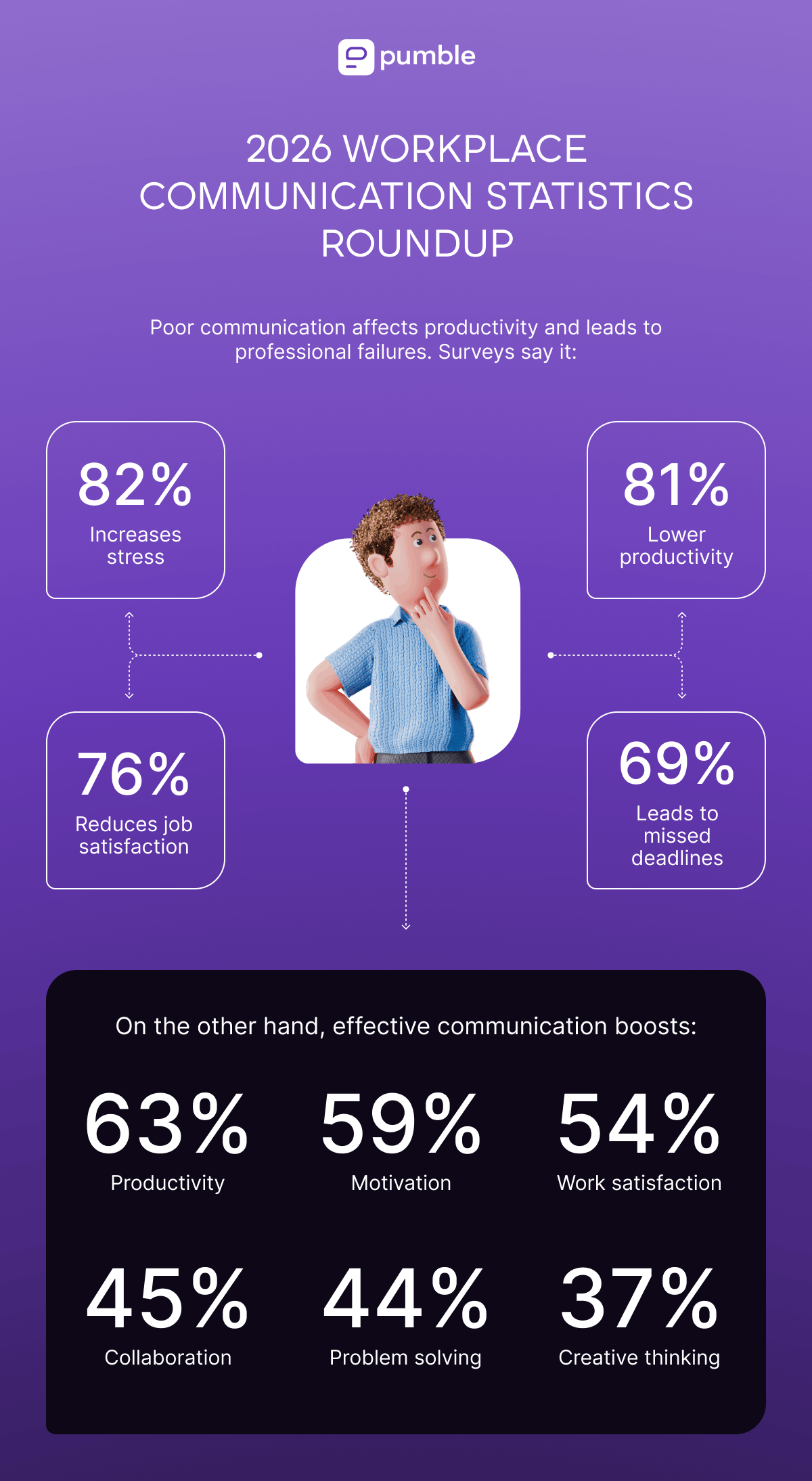
- 82% admitting that poor communication has increased their overall stress levels,
- 81% noting a decrease in productivity due to poor communication, and
- 76% reporting that it has decreased their job satisfaction, too.
Generally, 66% of professionals agree that the expectation to always be connected contributes to their burnout and stress levels.
The fact that stress and burnout are major consequences of poor communication in the workplace has also been confirmed by Project.co’s Communication Statistics 2026, which showed that 40% of survey respondents have experienced burnout, stress, and fatigue due to workplace communication issues.
One of the ways poor communication can decrease productivity is by taking up too much of our time. After all, according to Grammarly’s most recent report, professionals are wasting 13 hours per week on ineffective communication.
Then again, Contact Monkey’s Global State of Internal Communications 2026 report has that number closer to 1–3 hours per week for about 50% of professionals, while:
- 29% claim that the number is closer to 4–6 hours per week,
- 14% claim to lose less than an hour on poor communication, and
- 7% report losing 7+ hours per week.
Since communication overload and poor targeting affects the reach of internal messages, 56% of professionals complain about occasionally missing key updates, while 30% note that it happens often or very often.
Because of this, 28% of the internal communicators surveyed for the report hope to make reducing information overload and communication fatigue one of their day-to-day priorities for 2026.
Simplify communication with Pumble
Consequence #2: Poor communication leads to professional failures
Of course, the most obvious problems caused by poor communication have to do with professional failures.
According to a poll conducted by Fierce, Inc., which surveyed over 1,400 employees, corporate executives, and educators, 86% of survey respondents believe ineffective communication is the underlying reason for workplace failures.
Namely, ineffective communication can lead people to misunderstand the scope of their professional responsibilities, which can, in turn, lead to increased project failure rates and missed deadlines.
To get a clearer picture of the cost of poor communication, consider the results of Project.co’s most recent survey, which showed that:
- 53% of survey respondents have wasted time at work due to communication issues,
- 46% have missed messages,
- 26% have lost files,
- 25% reported having a poor customer experience as a result of poor communication at work,
- 16% have lost customers to competitors due to miscommunication, and
- 9% have even lost employees.
Grammarly’s most recent report confirms some of these findings, with:
- 69% of workers reporting that poor communication has made them miss deadlines in the past,
- 63% admitting that it has made them consider finding a new job, and
- 60% saying that the constant flow of notifications makes it difficult to concentrate on tasks.
Still, some of these issues can be solved by implementing a more effective communication solution.
For example, team communication apps like Pumble by CAKE.com can prevent users from wasting precious time by promoting asynchronous communication.
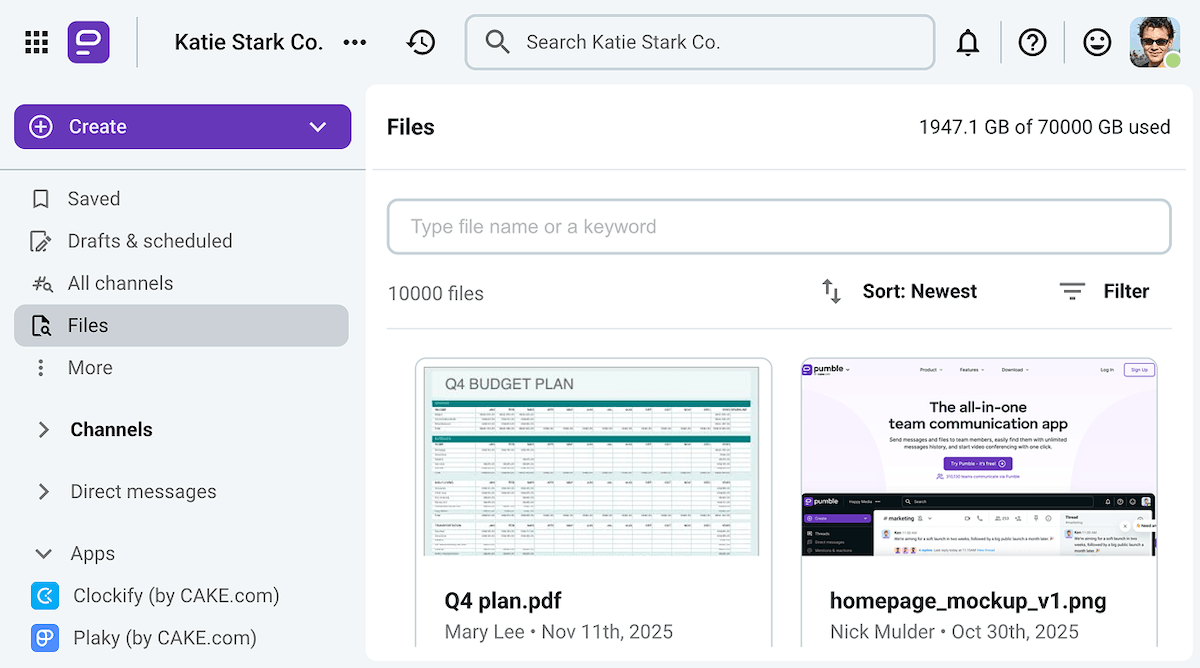
If the messaging software you opt for has a simple, user-friendly design, you should be able to spot missed messages at a glance and have easy access to all your important files.
Share files and documents on Pumble
Consequence #3: Poor communication takes a financial toll on businesses
According to the 2025 State of Internal Communication Report from Axios HQ, the cost of poor communication in the workplace amounts to anywhere between $3,640 and $37,440 per employee per year, depending on their annual salary.
Grammarly’s statistics on poor communication in the workplace tell a similar story, noting that miscommunication costs companies $9,284 per employee per year, which adds up to $9.3 million annually per every 1,000 employees.
That means US businesses are losing $2 trillion annually due to poor communication — which aligns with the estimate Axios HQ had proposed in their 2023 report.
Basically, these numbers highlight the fact that workers are spending hundreds of hours every year responding to unnecessary messages from coworkers and clients alike.
On top of that, Project.co’s report confirmed that among customers who moved to a competitor in 2026, 66% report having done so due to the poor business communication skills of company representatives.
So, prioritizing effective communication on an organizational level can help you hang onto customers, clients, and employees alike.
Statistics on why effective communication is important in the workplace
Practicing effective team communication can have a positive effect on your employees in terms of:
- Productivity,
- Engagement,
- Retention, and
- Trust.
Now, let’s see some effective communication statistics to find out how to achieve these outcomes.
Benefit #1: Effective communication increases productivity
Arguably, one of the most important benefits of effective communication in the workplace is that it positively affects employee productivity.
According to the latest report from Axios HQ, 79% of the employees surveyed said that the quality of communication they get from leaders affects how well they understand organizational goals. Good communication has been shown to increase or improve:
- Productivity (according to 63% of respondents),
- Motivation (59%),
- Job satisfaction (54%),
- Collaboration (45%),
- Problem-solving ability (44%),
- Creative thinking (37%), and even
- The ability to stick to project timelines (35%).
And that’s not the only source that has linked effective communication to productivity.
According to Grammarly’s 2025 The Productivity Shift report, effective communication can save workers up to 25.2 hours per week.
However, the same report makes a distinction between workers who have adopted AI tools more readily and those who haven’t, by noting that AI-avoidant workers are seeing slightly lower time savings (of 18.5 hours per week) than those who have integrated the technology into their work processes.
Moreover, the report noted that 82% of AI-avoidant workers who practice effective communication are more productive, though that number jumps to 96% among AI-fluent workers.
Other benefits of effective communication highlighted in this report include:
- Better quality of work (according to 83% of AI-avoidant and 95% of AI-fluent workers),
- Better work satisfaction (according to 81% of AI-avoidant and 96% of AI-fluent workers), and
- Increased confidence at work (according to 84% of AI-avoidant and 96% of AI-fluent workers).
But, of course, that’s not the only benefit of effective communication in the workplace.
Collaborate effectively with Pumble
Benefit #2: Effective communication improves engagement
According to Gallup’s State of the Global Workplace: 2025 Report, disengaged employees cost the world an unbelievable $438 billion in lost productivity.
Though Gallup’s data previously showed some improvement, with employee engagement numbers going from 20% in 2020 to 23% in 2022, the percentage dropped by 2 points in 2024.
On top of that, more recent data gathered for the Achievers Workforce Institute’s 2026 Employee Engagement and Retention Report showed similar numbers, claiming that only 26% of employees are engaged in their work.
On the other hand, Contact Monkey’s Global State of Internal Communications report offers some more optimistic employee engagement statistics. But even that report shows that engagement levels remain moderate for the most part (according to 54% of employees), with:
- 33% of employees reporting high or very high levels of engagement, and
- 12% reporting low or very low levels.
So, what can be done to bring these numbers up?
Well, Gallup’s overview of the key trends in employee engagement, indicates that this dip in engagement can be resolved by:
- Clarifying expectations,
- Showing empathy and care, and
- Focusing on employee development.
More quality communication from leadership seems to be exactly what the employees surveyed by Axios HQ want, too, as 72% of them claim that this would positively affect their engagement levels.
Fortunately, the same report noted that leaders also see the way communication can affect employee engagement, as 46% of the leaders surveyed say that the purpose of the communication team in their organization is to improve employee engagement and productivity.
The Global State of Internal Communications report confirmed these findings, noting that employee engagement is the primary strategic goal for 42% of internal communicators in 2026, with other priorities being:
- Employee experience (for 48% of communicators),
- Employee recognition (for 29% of communicators),
- Collecting and acting on employee feedback (for 27% of communicators), and
- Engaging deskless or frontline employees (for 24% of communicators).
Benefit #3: Effective communication increases retention
While we’re on the subject of employee engagement, we might as well discuss the best result of high engagement — low turnover.
Having engaged workers reduces turnover by:
- 51% in low-turnover organizations, and
- 21% in high-turnover organizations.
Yet, according to Gallup’s latest report on employee engagement, 62% of global workers are not engaged at work, while only 21% claim to be engaged.
That leaves 17% in the actively disengaged group. But, that doesn’t account for the 50% of workers who are reportedly actively looking for new employment (or 34%, according to the Achievers Workforce Institute).
So, what can you do to make your employees stick around?
Once again, it all comes down to communication and engagement.
After all, 63% of people who are looking to quit their jobs claimed that poor internal communication influenced their decision.
Conversely, 76% of the employees who rate their internal communication as “excellent” also said that they were “very likely” to stay with their company (with 14% being “somewhat” likely to do so).
One way to effectively communicate your way to higher retention rates is to give your workers the recognition and appreciation they deserve as a part of your overall employee retention strategy.
As it stands, only 25% of employees surveyed for the 2026 Employee Engagement and Retention feel appreciated at work. And, within that group, only 28% is actively looking for new jobs in 2026, as opposed to 71% of those who feel undervalued.
At the end of the day, employees who feel appreciated are:
- 12 times more likely to find their work meaningful,
- 17 times more likely to feel connected to their coworkers, and
- 17 times more likely to see a long-term career at their current company.
Luckily, strengthening retention and recruiting is already seen as one of the main goals of the communication teams by at least 31% of the leaders surveyed for the most recent report from Axios HQ.
Benefit #4: Effective communication facilitates trust
According to the Global State of Internal Communications 2026 report, 58% of employees mostly trust their employers.
However, since fewer than 9% could state that they trust their employers completely, there’s still room for improvement.
Then again, these numbers may not be entirely conclusive, as the latest data from the 2026 Edelman Trust Barometer notes that 78% of employees around the world can confidently state that they trust their employer to do what’s right — a 2 point increase from the previous report.
Of course, the varying levels of trust among employees could be explained by different factors.
For example, low-income workers seem to have a harder time trusting their employers, as only 48% of them can claim to do so, as opposed to 63% of high-income professionals. This income-based trust divide has more than doubled since 2012.
Still, trust in the workplace seems to be on the rise, as:
- 31% of employees report having gained trust in their fellow employees, as opposed to 20% who report losing trust, and
- 30% of employees report increased trust in their CEOs, as opposed to 21% who lost trust.
However, a lack of trust is still reflected in workers’ worry over losing their jobs in the upcoming recession, which is felt by ⅔ of respondents (67%).
Still, communicators are taking this issue seriously, as 36% of the internal communicators surveyed for the Global State of Internal Communications report say that strengthening leadership visibility and trust will be one of their day-to-day priorities in 2026.
To achieve that goal, organizations should focus on practicing transparent communication and training management to provide helpful, constructive feedback without having to be asked.
On top of that, simply caring about your employees can go a long way towards building trust.
Statistics on how people prefer to communicate in the workplace
Now that we know the benefits of effective workplace communication, it’s time to take off the rose-colored glasses and take in the reality of being an internal communicator in 2026.
To do so, we’ll go over some stats pointing out:
- What people believe the purpose of internal communication is,
- Some of the communication barriers that make it more difficult,
- How gathering employee feedback can help us improve communication,
- The communication skills recruiters are looking for in job applicants, and
- How generative AI is changing the way we communicate at work.
Communication statistics on the purpose of internal workplace communication
According to Gallagher’s State of the Sector 2025 report, businesses hold the communicators within their ranks at least partially responsible for:
- Behavior change — according to 81% of survey respondents (though another 4% of communicators felt they were solely responsible for this metric),
- Employee engagement — according to 79% of communicators (with another 14% feeling they were solely responsible),
- Strategy awareness — according to 69% of respondents (and another 24% felt they were solely responsible),
- Employee advocacy — according to 66% of respondents (with another 9% feeling they were solely responsible), and
- Policy compliance — according to 63% of people (with another 4% feeling they were solely responsible).
But, what do communicators see as the purpose of internal communication strategy?
Well, the top 3 purposes they highlighted were:
- Strategic alignment (i.e., creating clarity around the company purpose and vision),
- Culture and belonging (i.e., creating an inclusive culture where employees feel valued), and
- Organizational agility (i.e., supporting the adoption of new behaviors.)
But, if alignment is the goal, communicators may be missing the mark.
According to the latest report from Axios HQ, perceptions on the clarity and relevance of essential communications varied between leadership and employees, with:
- 80% of leaders stating that essential communications at their organization are helpful and relevant — seconded by only 53% of employees,
- 80% of leaders claiming that this communication was also clear and engaging — though only 50% of employees agreed, and
- 72% of leaders claiming that their communication was timely — with only 48% of employees agreeing.
Moreover, the report also showed that most employees preferred getting updates on:
- Operational changes regarding process and policy updates,
- Organizational goals such as new initiatives and plans,
- Business updates on projects, products, and clients,
- Personnel updates such as new hires or departures,
- Culture and values like mission and vision,
- People operations such as benefits or DEI initiatives,
- Competitive insights and industry news, and
- Work updates.
Yet, more than half of these employees claimed to only get updates on the topics they cared about hearing every few months (or less frequently).
🎓 PUMBLE PRO TIP
If you find drafting messages for internal communication difficult, check out these resources:
Update your employees on Pumble
Communication statistics on the barriers to internal communication in the workplace
Knowing what challenges lay ahead should help internal communicators set themselves up for success.
With that in mind, let’s talk about the communication challenges that may hinder internal communication in 2026.
According to the the Global State of Internal Communications 2026 report, these challenges include:
- Inter-departmental communication (according to 53% of respondents),
- Low employee responsiveness (46%),
- Difficulty tracking and measuring communications (40%),
- Securing budget and leadership buy-in (32%),
- Limited or inconsistent employee feedback (30%), and
- Engaging remote or hybrid employees (29%).
Of course, the best way to stay ahead of the curve on these issues is to cross-check them against challenges outlined in different reports.
For example, the communicators surveyed for the latest State of the Sector report mentioned the following factors as the main barriers to their success:
- Lack of time/capacity on teams (according to 49% of communicators),
- Change fatigue (44%),
- Poor people manager communication skills (41%),
- Lack of direction from the top (39%), and
- Poor leadership communication (38%).
And, when asked to highlight the top issues that are standing in their organization’s way of producing more effective communications, leaders surveyed by Axios HQ also mentioned:
- Making time to communicate well (29%),
- A well-resourced comms team (25%),
- Breaking through information overload (25%),
- Data and feedback to measure success (22%), and
- Writing in a concise, engaging way (22%).
So, if you suspect that any of these issues are affecting the efficacy of your internal communications, find a way to resolve them.
Communication statistics on the importance of gathering employee feedback
Communication isn’t just about broadcasting — it’s also about listening to what others have to say.
And, in the case of internal communication, that means:
- Setting up channels of upward communication to effectively gather employee feedback,
- Having a system for processing and acting on that feedback, and
- Communicating the reasoning behind certain decisions.
The Global State of Internal Communications 2026 report showed that 95% of organizations collect employee feedback through:
- Comprehensive engagement surveys (76%),
- Short pulse surveys (53%),
- Face-to-face feedback (46%), and
- Anonymous comments (40%).
We saw similar results in the State of the Sector 2025 report, which showed that the most common ways of gathering employee feedback are:
- Engagement surveys (76%),
- Post-event feedback (53%),
- Email (49%),
- Focus groups and panels (41%), and
- Leader sessions (34%).
Unfortunately, the Global State of Internal Communications 2026 report notes that only 15% of those organizations follow through on the feedback they receive with clearly communicated and visible actions, with:
- 47% saying actions are sometimes shared,
- 31% saying follow-up is inconsistent or delayed, and
- 7% reporting little or no follow-up.
However, closing that feedback loop with two-way communication is crucial for setting up an environment in which employees feel comfortable sharing their honest opinions.
As it stands, only 39% of employees have that sense of psychological safety, with another 39% feeling somewhat comfortable and 17% feeling uncomfortable sharing their feedback.
So, when the Axios HQ report tells us that 74% of leaders believe that their employees have an easy way to share feedback about internal communications, it’s worth noting that only 46% of the surveyed employees agree with that statement.
🎓 PUMBLE PRO TIP
Feedback is an opportunity to improve. To learn more, check out this article:

Communication statistics on the most desirable communication skills in job candidates
You know what’s even easier than teaching your employees to communicate more effectively? Hiring people who are already great communicators.
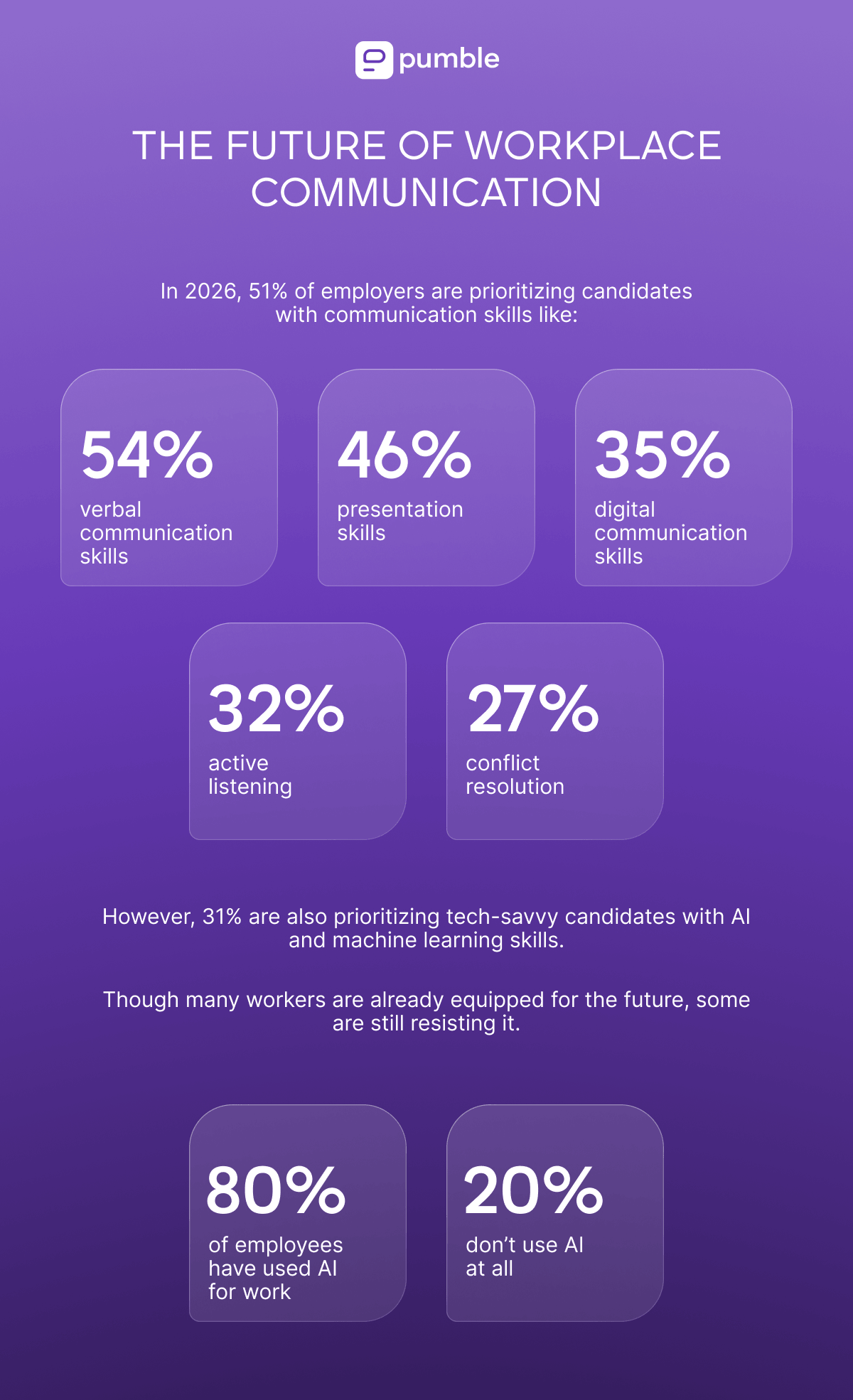
According to the latest GMAC Corporate Recruiters Survey, that’s exactly what many employers are doing, with 51% of global employers finding communication the most desirable skill in potential recruits, along with:
- Interpersonal/teamwork skills (according to 44% of employers),
- Emotional intelligence (40%),
- Networking and relationship building (35%), and
- Cross-cultural competence or cultural intelligence (26%).
When asked to rank different communication skills in order of importance, the surveyed recruiters highlighted:
- Verbal communication skills (54%),
- Presentation skills (46%),
- Digital communication skills (the ability to effectively communicate via email or internal communication software) (35%),
- Active listening (32%),
- Conflict resolution (27%),
- Writing skills (25%),
- Negotiation (25%), and
- Cross-cultural communication (19%).
Conversely, the least valued communication skills among employers were:
- Multilingualism, which was valued by only 12% of respondents,
- Nonverbal communication skills (11%), and
- Video conferencing skills (10%).
Still, the exact skills employers value largely depend on the industry one wants to break into — so keep that in mind before you start neglecting your language studies.
Communication statistics on the use of generative AI at work
With artificial intelligence on everyone’s minds, it should come as no surprise that 31% of the recruiters surveyed for the GMAC report also highlighted AI and machine learning skills as the most desirable skills in job candidates.
In fact, the technology is already being widely used in offices around the world, as 80% of employees surveyed for Owl Labs’ State of Hybrid Work 2025 report use or have experimented with AI in their work, with:
- 90% of managers using it, and
- 55% of individual contributors following suit.
Of the 76% of workers who said that their employer has made changes to the office in 2025, 31% indicated that those changes had to do with the introduction of AI tools.
However, that’s not to say that there’s no resistance to this technology. As noted by the 2026 Edelman Trust Barometer, low income workers are still worried about being replaced by AI, with:
- 65% of low income workers in the US and 71% of low income workers in the UK worry about being replaced by AI, as opposed to only
- 47% and 38% of high income workers in the US and the UK.
The reluctance to take advantage of generative AI has created new classes of workers, separated by their level of AI proficiency, with Grammarly’s most recent report showing that:
- 13% of knowledge workers and 30% of business leaders are AI fluent,
- 26% of knowledge workers and 33% of leaders are AI literate,
- 39% of workers and 28% of leaders are AI familiar, and
- 22% of workers and 9% of leaders are AI avoidant.
Though only 44% of AI-avoidant employees are willing to see AI as an assistant and not a replacement for human workers, AI-fluent workers are already making the most of the technology with:
- 95% of them saying that AI makes their work feel less overwhelming, and
- 93% saying that it frees up their time for more meaningful work.
On top of that, 69% of these power users rely on AI for communication, namely for:
- Research (65% of AI fluent and 42% of AI familiar workers),
- Editing (59% and 35%, respectively),
- Content creation (53% and 42%), and
- Task automation (52% and 39%).
In any case, it’s safe to say that even though the fear of replacement keeps some people from using AI, many still find the technology useful.
Statistics on the most used languages in business communication
Verbal and written communication are arguably the most important types of communication in the workplace — and beyond.
However, even these straightforward types of communication can be unsuccessful if the employees of a company don’t speak the same language.
The modern professional landscape is becoming increasingly multinational, so speaking a universal language has become a requirement, especially in industries like customer service, healthcare, and international business.
According to Preply’s recent bilingualism report, knowing more than one language can even increase your salary by 12.7% on average, with that figure being closer to:
- 18.8% in the US, and
- 11.5% in the UK.
With that in mind, let’s talk about the languages you might want to add to your resume in 2026.
Business languages for international teams
If you want to know which languages you should learn to increase your chances of successful collaboration with global teams, you should start by considering which markets you’re looking to break into.
Or, if you don’t have an answer to that question, you could consider the Gross Domestic Product or financial value of different languages.
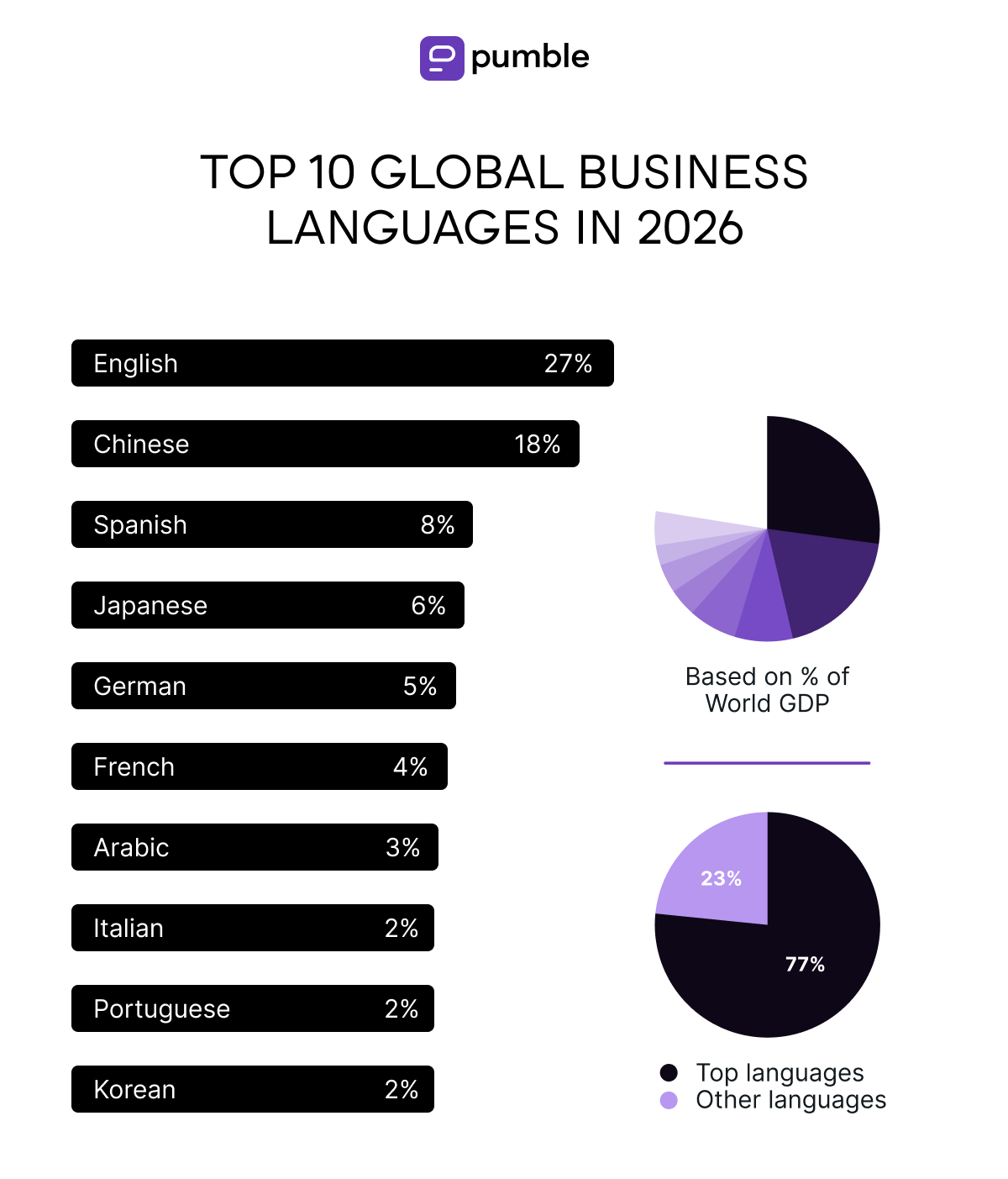
The table below shows the 10 most valuable business languages to know based on that very metric, according to the UN’s analysis of the GDP of various languages, as well as the total number of people who speak these languages, as reported by Ethnologue.
| Language | GDP in $US trillion | % of world GDP | Number of worldwide speakers |
|---|---|---|---|
| English | 23.94 | 27 | 1.5+ billion |
| Chinese | 16.54 | 18 | 1.2+ billion |
| Spanish | 6.99 | 8 | 558.5+ million |
| Japanese | 5.01 | 6 | 125.6+ million |
| German | 4.91 | 5 | 134+ million |
| French | 3.44 | 4 | 311.9+ million |
| Arabic | 2.43 | 3 | 334.8+ million |
| Italian | 2.18 | 2 | 66.2+ million |
| Portuguese | 1.95 | 2 | 266.6+ million |
| Korean | 1.86 | 2 | 81.6+ million |
Even though Russian and Hindi have dropped below the top 10, they remain crucial languages in the professional world, along with Dutch, Turkish, and Malay-Indonesian.
Though this GDP ranking may be a bit outdated, it’s worth noting that this list generally overlaps with the most used languages on the Internet in late 2025, as well as the most popular languages studied on Duolingo in 2025, which include:
- English,
- Spanish,
- French,
- Japanese,
- German,
- Korean,
- Italian,
- Chinese,
- Portuguese, and
- Hindi.
Then again, different countries tend to prioritize other business languages. Let’s take a look.
Build global teams with Pumble
Business languages in the US
Official statistics show that 78% of the US population only speak English. However, the remaining 74.82 million Americans also speak:
- Spanish,
- Chinese,
- Tagalog,
- Vietnamese, and
- Arabic — among other languages.
Notably, Preply’s bilingualism statistics suggest that French, Korean, Russian, Hindi, German, and Portuguese are also fairly commonly spoken in the United States.
Still, American students — the future of the US workforce — tend to favor Spanish when selecting a foreign language to learn. According to a report by the Modern Language Association of America, college and university students are mostly signing up to study:
- Spanish — with a share of 49.42%,
- French — with a share of 11.42%,
- American Sign Language — with a share of 9.12%,
- Japanese — with a share of 5.55%, and
- German — with a share of 4.52%.
This focus on the Spanish language was also confirmed by Duolingo’s most recent report. Yet, interestingly, the same report showed that the second most popular course for US-based language learners was actually the English language course.
Business languages in the UK
According to the data from the 2021 census, 91.1% of the UK population speak English as their mother tongue.
Still, the population survey showed that other than English (and Welsh, in Wales), people in the UK also speak:
- Polish — 1.1% of the population,
- Romanian — 0.8% of the population,
- Punjabi — 0.5% of the population, and
- Urdu — 0.5% of the population.
Preply’s report reveals a different story, showing that French is the most commonly spoken language in the UK other than English, with 25% of the population speaking it, followed by:
- Spanish, 11%,
- German, 11%,
- Urdu, 10%,
- Hindi, 9%,
- Punjabi, 6%.
On top of that, there were also plenty of languages spoken by less than 5% of the population — Italian, Gujarati, Cantonese, Afrikaans, Mandarin, Arabic, Portuguese, and Bengali.
As for foreign language studies, a 2024 brief noted that most schools offer French, German, and Spanish classes — though the government doesn’t promote the teaching of languages in any particular way. As a result, only 32% of 15–30-year-olds in the UK report knowing 2 or more languages, compared to 80% of the population in EU member states.
Luckily, according to Duolingo’s report, all signs indicate that UK-based language learners are looking to increase their language skills, as Spanish and French are the most popular courses on the app within the country.
Remote communication statistics in 2026
Learning a second language may be the best way to find remote employment in an international company.
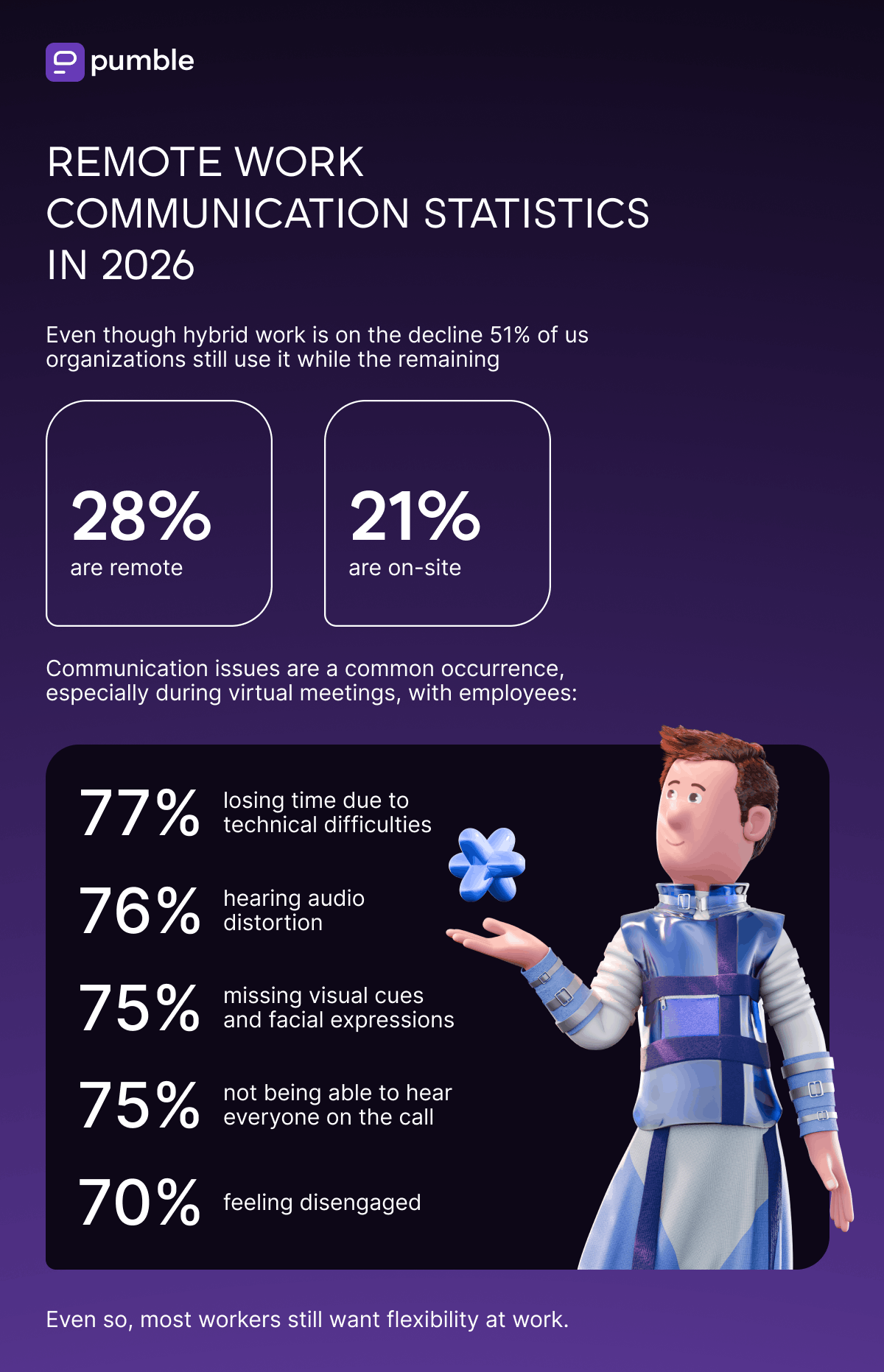
Landing a hybrid or remote job shouldn’t be too difficult, since as many as 51% of organizations were hybrid in 2025, with employees spending 46% of their work week on-site, according to the latest data from Gallup.
Still, hybrid work seems to be on the decline, unlike remote and on-site work, which are on the rise, with 28% and 21% of organizations opting for those work models.
Of course, other sources may have different numbers, like the Global State of Internal Communications 2026 report, which claims that:
- 62% of workers are hybrid with a predetermined split,
- 19% have a flexible working environment (allowing employees to choose),
- 12% are fully in-office, and
- 7% are entirely remote.
These differences may have something to do with the industries the surveyed participants are in, as Gallup’s data shows.
For example, after going mostly hybrid during the pandemic, government workers are now mostly working on-site again, with:
- 46% working on-site,
- 28% being hybrid, and
- 26% working remotely.
Conversely, tech workers are largely remote and hybrid, with:
- 47% being remote,
- 45% working hybrid, and only
- 9% having to work on-site.
The key to making hybrid or remote work effective is trust. However, only 54% of the remote managers Gallup surveyed claimed to fully trust their remote employees.
Still, this remote work challenge is easy to overcome if everyone is willing to communicate effectively.
Luckily, most of Gallup’s respondents (87%, to be exact) felt that they received timely and consistent communication about what’s happening on their team, regardless of whether they’re working remotely or on-site.
So, let’s talk about the asynchronous communication platforms that make that possible.
Check in asynchronously with Pumble
🎓 PUMBLE PRO TIP
Effective communication is arguably the only way to boost productivity in remote work settings. To learn more about what remote workers need to thrive, check out our remote work statistics:
Workplace communication statistics on asynchronous communication platforms and channels
You might think that remote and hybrid work models make it difficult to keep everyone on the same page.
Indeed, half of the communicators surveyed for the State of the Sector 2025 report noted that they were dissatisfied with their communication channels’ ability to reach all employees, regardless of work location or type.
However, half of them also believed that having hybrid and remote employees was a low-impact barrier to communication, at best.
In other words, they found the technology they were using to communicate perfectly adequate and effective, with:
- Email being used at a rate of 92% and considered to be 78% effective as a broadcast channel,
- All-employee virtual conferences being used by 68% of organizations with an effectiveness of 86%,
- E-newsletters being used 65% of the time with an effectiveness of 75%,
- All-employee in-person conferences being used 52% of the time with an effectiveness of 87%, and
- Employee or staff forums being used 36% of the time with an effectiveness of 68%.
The same report also noted that most commonly used channels for employee-to-employee, lateral communication are:
- Enterprise chat tools (like Pumble by CAKE.com), which are used 75% of the time and are about as effective,
- Informal get-togethers (in person or virtual), which account for 63% of employee communication, and are 75% effective, and
- Knowledge-sharing sessions, which account for 49% of communication among employees and are 75% effective.
Once again, other reports may show a different picture, especially when it comes to the differences between internal communication and communication with third parties like clients or customers.
For example, the Communication Statistics 2026 report from Project.co claims that email is the most popular communication tool for both internal (33%) and external communication (53%), followed by team communication tools and project management tools, as seen below.
| Internal communication | External communication | |
|---|---|---|
| 33% | 53% | |
| Online chat tools | 19% | 10% |
| Project management tools | 23% | 16% |
| Other | 10% | 6% |
| Phone calls | 7% | 10% |
| Face-to-face interactions | 7% | 5% |
But, since many online chat tools now have guest account options, and email is not the best solution for remote communication, these numbers may not reflect your average remote worker’s reality.

Need an award-winning time tracker, task management, and communication tool? You’re in luck. CAKE.com has everything your team needs to collaborate, for one affordable price.

Statistics on remote work communication barriers
Even though remote workers have access to all these departmental communication tools, many of them wish communication could be more streamlined. According to Grammarly’s most recent report:
- 76% of professionals have been communicating across more channels at work than they had the previous year, and
- 55% found it challenging to navigate the multitude of work communications.
The report also found that knowledge workers spend up to 38.9 hours per week communicating across various channels, a number that was even higher among the surveyed business leaders, who clocked in 47.1 hours per week on verbal, written, and in-tool exchanges.
Worse still, 44% of Grammarly’s respondents were generally dissatisfied with the communication tools they use, believing their company doesn’t have communication tools that can help them be more effective in their role.
Even when they do have access to good remote communication tools, remote workers may find their attempts at communication disrupted by any number of technical problems.
According to Owl Labs’ report, 77% of people report losing time in meetings due to technical difficulties, in addition to:
- 76% hearing echoing and audio distortion during virtual meetings,
- 75% not being able to hear everyone on the call,
- 75% missing visual cues during virtual meetings,
- 70% feeling disengaged during meetings,
- 68% having difficulty contributing to the conversation, and
- 66% being unable to see the presentation on the shared screen.
Even though using a reliable video conferencing app can eliminate some of these concerns, some barriers will remain insurmountable due to factors like internet connectivity and power supply.
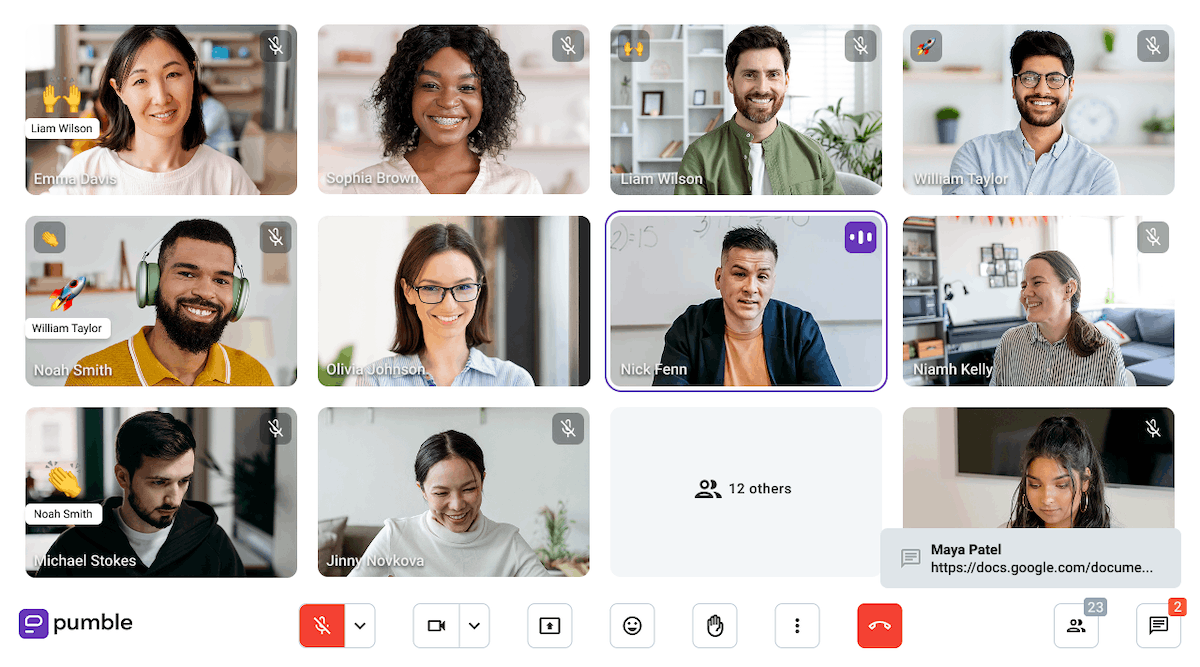
No fuss video calls with Pumble
🎓 PUMBLE PRO TIP
Not being able to see peoples’ faces on video calls is a big problem if you’re trying to practice nonverbal communication — but it’s not the only communication barrier you could experience during a meeting. For more statistics about communication in meetings, check out our meeting statistics article:
Remote work and nonverbal communication
Momentarily losing sight of your coworkers during a virtual meeting is one thing, but spending most of your time communicating through text messages can make it pretty difficult to convey the tone of your message.
After all: isn’t 93% of communication supposed to be nonverbal?
As impressive as this would-be factoid sounds, it is a misconception that has been debunked so many times, it even has a name — the Mehrabian Myth.
By all accounts, this misconception stems from a misinterpretation of Albert Mehrabian’s 1967 research paper concerning the decoding of inconsistent messages.
In the study, Mehrabian and his coauthor, Morton Wiener, posited that, when faced with inconsistent messaging (for example, when someone says something that may not be entirely truthful), people usually look for the speaker’s:
- Body language (and facial expression) — at a rate of 55%, and
- Tone of voice — at an instance of 38%.
In other words, only 7% of the meaning the audience absorbs in instances of inconsistent messaging comes from the actual words the speaker used to convey their message.
So, now that we’ve cleared that up, what do we actually know about nonverbal communication in the workplace?
Unfortunately, nonverbal communication in professional settings hasn’t been studied as rigorously as it should.
Existing research, like the 2020 study on the impact of nonverbal signals in business communication, are regrettably limited in scope, with researchers surveying only 150 people.
Still, that paper found that:
- 85% of the professionals surveyed believed eye contact plays a vital role in business communication,
- 70% said that facial expressions (like smiling) impact business communication, and
- 55% claimed to be able to accurately guess the emotions behind certain facial expressions.
The main takeaway of the study was that our professional exchanges are affected by factors pertaining to nonverbal communication, such as:
- A lack of knowledge of adaptive facial signals (according to 75% of respondents),
- Employers not understanding the potential of nonverbal signals (according to 70% of respondents), and
- A lack of soft skills training (according to 65% of respondents) — to name a few.

Gen Z workplace communication trends for 2026
According to one Forbes estimate, the number of Gen Z workers is projected to reach 30% by 2030. But, what effect is this influx of Gen Z workers having on our workplace communication habits?
Well, according to a study by Barclays LifeSkills, 71% of workers believe that the younger generation is changing the formality standards of workplace communication.
Though older generations prefer keeping things formal with email, 49% of Gen Z workers prefer instant messaging platforms where they can show off their personality, which is a priority for 97% of the generation.
Since 57% of Gen Z workers are unsure about how formal they need to be over email, according to a report from ZeroBounce, opting out of using email could also be a way to work around that insecurity.
In any case, younger generations are still dealing with a pretty big volume of communication, with Grammarly’s newest report showing that:
- Millennials are spending 43.2 hours per week on communication,
- Gen Z workers are spending 39.3 hours a week,
- Gen Xers are spending 34.8 hours a week, and
- Boomers are spending 30.5 hours per week on communication.
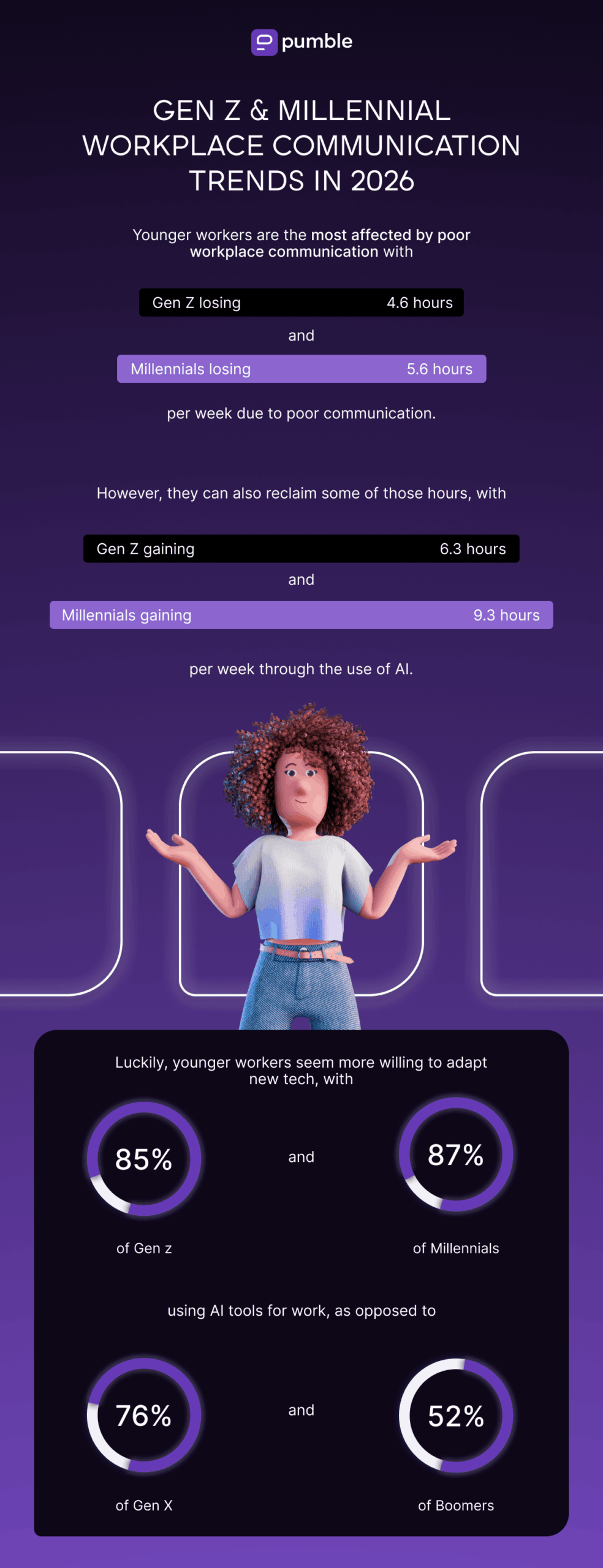
As expected, younger generations are also the most affected by poor workplace communication, with miscommunication costing Gen Zers 4.6 and Millennials 5.6 hours each week.
However, Grammarly’s report also shows that the younger generations can also regain many of the hours they lost by incorporating AI tools into their communication, with Gen Z reclaiming 6.3 and Millennials 9.3 hours per week.
Luckily, these two generations are the most open to using AI for professional purposes, at least according to Owl Labs’ report, as the technology is already being used by:
- 87% of Millennials,
- 85% of Gen Z,
- 76% of Gen X, and
- 52% of Boomers.
Improve your workplace communication outcomes with Pumble by CAKE.com
As workplaces shift from offices to online environments, effective communication is becoming more important than ever — increasing the need for effective digital tools and proper training.
Yet, as we have learned from the State of the Sector 2025 report, half of communicators are dissatisfied with their communication channels’ ability to reach all employees.
Even Grammarly’s most recent report shows that both business leaders and knowledge workers want better communication tools.
So, give the people what they want!
If your employees struggle to maintain effective internal or external communication — try the employee communication app, Pumble!
- Organize your conversations with direct messages, threads, and channels.
- Use roles and permissions to limit access to confidential information.
- Send voice and video messages or organize video conferencing for teams — and use guest access for clients and have your team join in.
Make the most of your workplace communication.
References:
- Achievers Workforce Institute. 2026 Engagement and Retention Report. Retrieved February 2026, from https://www.achievers.com/wp-content/uploads/2025/12/2026-Engagement-and-Retention-Report.pdf
- Axios HQ. (2025). 2025 State of Internal Communications. Retrieved February 2026, from https://views.axioshq.com/assets/67f5970d08670c7825ff6345?utm_source=Paperflite%20Link
- Blanco, C. (2025, December 1). 2025 Duolingo language report. Duolingo. Retrieved February 2026, from https://blog.duolingo.com/2025-duolingo-language-report/
- Contact Monkey. (2026). Global State of Internal Communications Report 2026. Retrieved February 2026, from https://www.contactmonkey.com/ebook/global-state-of-internal-communications-report-2026
- Cruzvergara, C. (2024, December 23). What We Can Expect From Gen Z In The Workforce In 2025. Forbes. Retrieved February 2026, from https://www.forbes.com/sites/christinecruzvergara/2024/12/23/what-we-can-expect-from-gen-z-in-the-workforce-in-2025/
- Dennison, K. (2026, January 15). Why Leaders Should Treat Burnout As A Boardroom Priority In 2026. Forbes. Retrieved February 2026, from https://www.forbes.com/sites/karadennison/2026/01/15/why-leaders-should-treat-burnout-as-a-boardroom-priority-in-2026/
- Edelman Trust Institute. (2026). 2026 Edelman Trust Barometer. Retrieved February 2026, from https://www.edelman.com/sites/g/files/aatuss191/files/2026-01/2026%20Edelman%20Trust%20Barometer%20Global%20Report_Final.pdf
- Gallagher. (2025). Employee Communications Report 2025. Retrieved February 2026, from https://www.ajg.com/employeeexperience/state-of-the-sector/
- Gallup. (2025). State of the Global Workplace: 2025 Report. Retrieved February 2026, from https://www.gallup.com/workplace/349484/state-of-the-global-workplace.aspx
- Gallup. (n.d.). What Is Employee Engagement, and How Do You Improve It? Retrieved February 2026, from https://www.gallup.com/workplace/285674/improve-employee-engagement-workplace.aspx
- Graduate Management Admission Council. (July 2025). Corporate Recruiters Survey – 2025 Report. Retrieved February 2026, from https://www.gmac.com/market-intelligence-and-research/research-library/employment-outlook/2025-corporate-recruiters-survey-report
- Grammarly. (2025). The Productivity Shift 2025. Retrieved February 2026, from https://go.grammarly.com/2025-the-productivity-shift
- Grammarly. (2025, February 27). The Workforce Productivity Trends That Define 2025. Retrieved February 2026, from https://www.grammarly.com/business/learn/workforce-productivity-glossary/
- Harter, J. (2025, January 14). U.S. Employee Engagement Sinks to 10-Year Low. Gallup. Retrieved February 2026, from https://www.gallup.com/workplace/654911/employee-engagement-sinks-year-low.aspx
- Miguelez, C. (2026, January 29). Bilingualism Statistics 2026: Global, US & UK Facts and Figures. Preply. Retrieved February 2026, from https://preply.com/en/blog/bilingualism-statistics/
- Milojevic, N. (2025, October 14). The Gen Z Effect and the Workforce Evolution: 2025 Statistics. CAKE.com. Retrieved February 2026, from https://cake.com/blog/gen-z-workforce-statistics/
- Owl Labs. (2025). State of Hybrid Work 2025. Retrieved February 2026, from https://owllabs.com/state-of-hybrid-work/2025
- Pendell, R. (2025, September 3). Hybrid Work in Retreat? Barely. Gallup. Retrieved February 2026, from https://www.gallup.com/workplace/694361/hybrid-work-retreat-barely.aspx
- Project.co. (2026). Communication statistics 2026. Retrieved February 2026, from https://project.co/communication-statistics/
- Scherber, P. (2025, May 15). 2025 International Employee Communication Impact Study. Staffbase. Retrieved February 2026, from https://staffbase.com/blog/employee-communication-impact-study-2025
- Zero Bounce. (2025). Gen Z at Work: The 2025 Report. Retrieved February 2026, from https://www.zerobounce.net/GenZ-work-report