
Running a business means having a reliable foundation for information sharing.
If you’re still relying on outdated ways to keep everyone aligned, you’re throwing a wrench into your productivity.
Using traditional communication systems means you’ll most certainly experience:
- Delayed communication
- Information silos
- Security vulnerabilities
This guide covers the best internal communication tools and analyzes their core features to help you pick the right solution for your business.
- Internal communication tools are centralized digital platforms, apps, or software that help your team work together smoothly.
- Standard email fails to facilitate effective internal communication, as it eats up too much time, leaves data scattered, and exposes you to security threats.
- Some of the most common types of modern internal communication tools include instant messaging platforms, company intranets, video conferencing software, cloud storage and file-sharing repositories, and project and task management systems.
- Pumble by CAKE.com is a streamlined, real-time messaging app built to organize internal team communication and clear out email mess.
What are internal communication tools?
Internal communication tools are digital platforms, applications, or software built to help coworkers exchange information within an organization.
These platforms serve as a centralized digital headquarters. They make it easy for team members to collaborate seamlessly across departments, time zones, and locations.
Companies use these platforms for real-time chat, knowledge repositories, and video conferencing, thus moving away from chaotic email chains.
Why email alone fails at internal communication
If you rely solely on traditional email for team communication, you’re bound to run into some major operational liabilities that eat away at your profits:
- Wasted time and slower responses
- Fragmented information
- Security and phishing vulnerabilities
- Poor collaboration opportunities
Let’s learn more about each one.
#1: Wasted time and slower responses
Email notoriously moves at a snail’s pace, which drains the life out of your team productivity.
Email formatting etiquette demands formal opening and closing lines. So, putting together even a simple update takes way longer than just sending a quick message on a team chat app.
According to Microsoft’s 2025 research, a knowledge worker receives 117 emails every single day. This digital mess costs an average business nearly $1 million annually in lost productivity.
#2: Fragmented information
Another drawback of using email in internal communication is its linear structure, which is not very well suited for keeping tabs on complex projects.
When you have a single long-winded email chain attempting to address multiple topics, important details are bound to slip through the cracks. In the end, your team pays the price by losing track of key tasks.
Digging through endless CCs and messy, layered email chains creates a fragmented flow of information. This clutter forces employees to waste time searching through their inboxes instead of focusing on their actual work.
On top of that, overly aggressive spam filters frequently block legitimate internal emails, which seriously interrupts daily communication.
#3: Security and phishing vulnerabilities
Company email servers are the number one target for online criminals. Relying on them means your business is constantly exposed to threats.
Sophisticated phishing emails often mimic internal corporate memos or vendor invoices with high precision. All it takes is a single accidental click by an employee to expose confidential client data or institutional credentials to external malicious actors and cause severe financial and regulatory penalties.
#4: Poor collaboration opportunities
Email was designed as a static asynchronous messaging tool where a single person sends a message to an audience, rather than as a dynamic collaboration workspace.
For example, if your team tries to use email to collaborate on a shared marketing script, feedback will get split across multiple different threads. This leads to overlapping ideas and even conflicts around version control.
Traditional email just doesn’t have what it takes to support distributed teams. It completely lacks the tools needed to collaborate smoothly, such as:
- Live, co-authoring integrations that let everyone edit the same file on the go.
- Smart notification systems that ping you instantly, so you’re always up to date.
- Quick video conferencing that lets your team have quick face-to-face sessions whenever necessary.
That’s why successful teams rely on internal communication tools instead of emails.
Types of internal communication tools
Depending on their specific needs and goals, different organizations use specialized internal communication platforms to make sure everyone is aligned.
Some of the most common tools companies use to get the job done include:
- Instant messaging and chat platforms — fast-paced communication systems that replace local conversations with dedicated channels, direct messages, and contextual threads for real-time problem solving.
- Company intranets — organizational portals serving as a single point of reference for company news, documentation, compliance policies, and organizational directories.
- Video conferencing software — audio-visual communication platforms that let distributed teams host remote face-to-face meetings, live screen-sharing, and recorded training sessions.
- Cloud storage and file-sharing repositories — centralized data systems where employees store and collaborate on large documents and design assets.
- Project and task management systems — visual coordination boards for assigning duties and deadlines and tracking dependencies and workflows to ensure complete project transparency.
- Internal email and newsletter platforms — formal asynchronous delivery systems reserved for company-wide executive announcements and legal disclosures.
How to choose the right internal communication tools
So, how do you actually go about picking the right internal communication solution for your team?
Well, there’s a wrong and right way of doing it.
If you decide to follow generic software trends, you’re doomed from the start.
But if you take a step-by-step approach that fits your actual daily workflow, you will definitely be on the path to success.
Here are the main points to consider when mcaking the right choice for your team.
#1: Check your company size
Basically, your headcount dictates your software architecture needs.
A company with fewer than 50 employees can usually get by using a simple chat app without any complex administrative controls.
However, massive corporations need strict permission levels, separate workspace boundaries for different departments, and smart group settings to avoid notification fatigue and information overload.
#2: Balance synchronous vs. asynchronous dynamics
Your tool selection must match how your team works.
Teams that need immediate answers — such as live operations, customer support desks, and incident response units — rely heavily on live chat apps.
At the same time, deeply analytical, engineering, or teams working across time zones require predominantly asynchronous tools, like threaded documentation boards and recorded video briefs, to prevent constant interruptions.
#3: Assess the true costs and per-user pricing
Software prices can skyrocket before you know it.
Business owners need to look past the flashy free trials and figure out what the paid plans will actually cost per person, per month.
You have to plan ahead for future growth. Always check if must-have features — like unlimited message history, advanced user management, or extra cloud storage — will force you to cough up more cash for a pricey corporate plan down the road.
#4: Verify integration ecosystem and API support
Your communication tool shouldn’t operate in isolation. The best platforms act as a central hub that connects your entire software stack.
To stop your team from jumping back and forth between different apps and wasting precious focus time and productivity, make sure your new tool naturally connects to your current project boards, customer databases, and coding files.
A good example of an internal communication software that has native integration with multiple useful software is Pumble. Pumble connects with the time tracker Clockify and project management app Plaky, as part of the CAKE.com ecosystem. You can access all 3 of these tools through the CAKE.com Productivity Suite, which gives you enterprise-level access for all 3 apps under a single, affordable subscription.

#5: Inspect security protocols
When looking over tools for internal communication, take some time to vet their security to make sure your private company information will be protected. This is especially important for organizations handling sensitive data. You need to prioritize software that features:
- Multi-factor authentication (MFA)
- Single sign-on (SSO)
- End-to-end data encryption
- Localized data hosting options
Ensure the tool has verified security credentials, such as SOC 2 Type II certifications and meets the ISO 27001 compliance standards.
💡 Pumble Pro Tip
To learn more about conducting secure business communication and protecting your data, check out our guide on the blog:
The best internal communication tools for teams in 2026
To help you further narrow down your selection, here’s a breakdown of the leading internal communication tools across the categories we mentioned. The list highlights their unique use cases, features, and pricing structures.
Pumble — best business messaging platform
Pumble by CAKE.com is a streamlined, real-time messaging app built to organize internal team communication into:
- Public and private channels
- Private groups
- Direct messages
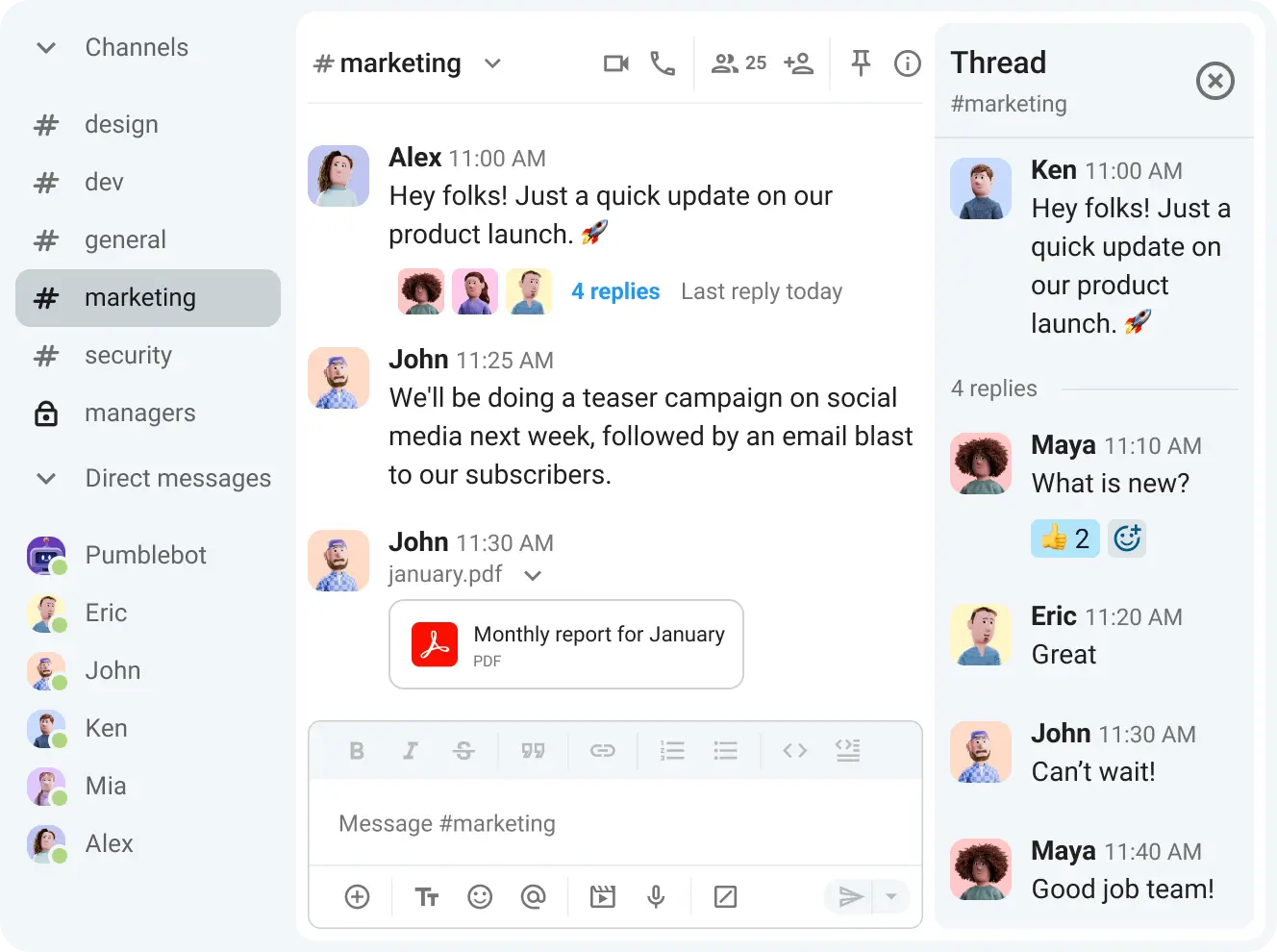
Pumble handles your day-to-day team communication without the clutter of traditional email setups.
Best for: Cost-conscious businesses looking for a secure, searchable communication workspace with free unlimited messaging history.
Key features:
- Unlimited chat history storage, starting from its Free plan
- Customizable user workspace permissions
- Contextual message threads
- Built-in voice and video conferencing capabilities
Limitations: Lacks read receipts
Pricing: Offers a highly functional Free tier, while its paid plans start at $2.49 per user per month.
Slack — most customizable chat app
Slack is a customizable team communication tool that connects conversations with automated software workflows.
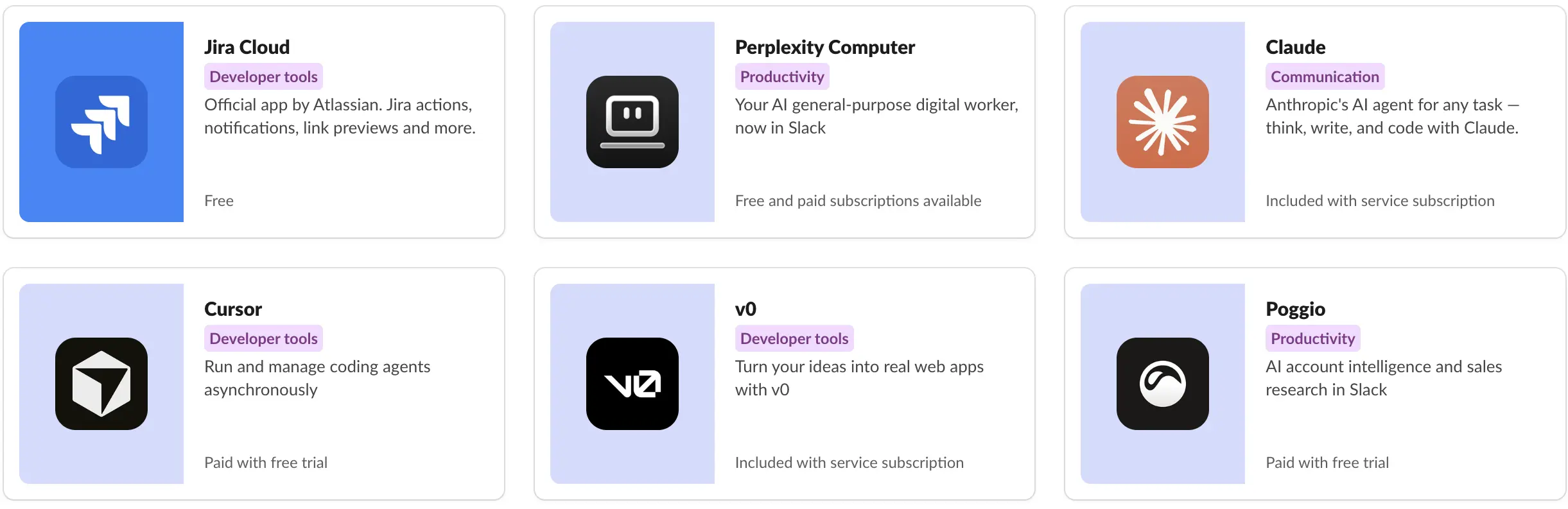
Best for: Tech businesses and organizations requiring extensive third-party software integrations.
Key features:
- Comprehensive integration directory
- Automated workflow builders
- Custom huddle rooms
- Data archiving
Limitations: Accessible messaging history limited to 90 days in the Free tier.
Pricing: Free plan available; premium plans start at $8.75 per user per month.
Microsoft Teams — most popular corporate communication tool
Microsoft Teams is a corporate communication system deeply integrated into the broader Microsoft 365 environment.
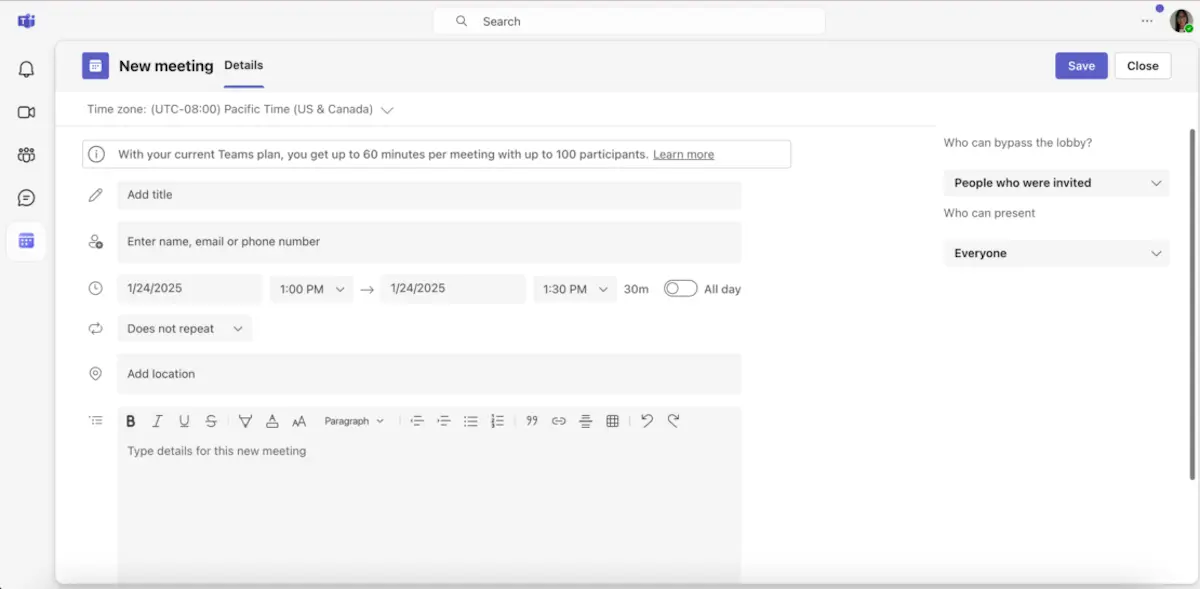
Best for: Large enterprise organizations already using Microsoft infrastructure who need unified communications.
Key features:
- Seamless integration with Office apps
- Enterprise-grade security
- High-capacity live event hosting
- Cloud storage allocation
Limitations: Cluttered design and glitchy app performance.
Pricing: Included in Microsoft 365 business licensing or available as a standalone tier starting at $4 per user per month.
Try Pumble, a simpler alternative
Google Workspace — best workspace and document suite
Google Workspace combines real-time cloud file storage with live, multi-user document editing.
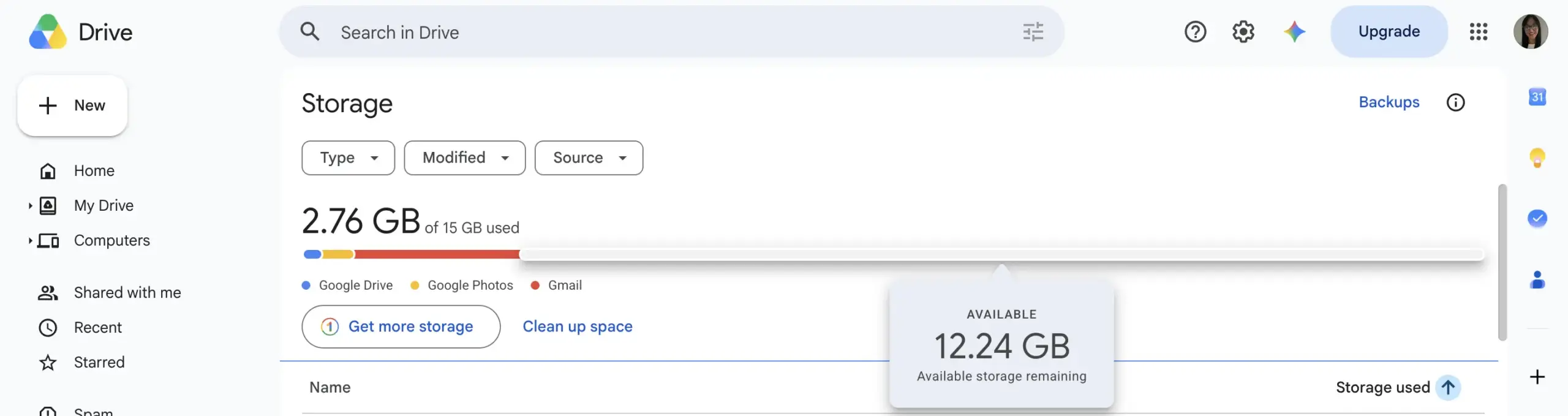
Best for: Teams focused on collaborative content creation, active document co-authoring, and shared cloud file repositories.
Key features:
- Shared corporate drives
- Live collaborative document editing
- Smart canvas integrations
- Unified administrative controls
Limitations: Insufficient document control allowing external viewers with edit access to copy or download sensitive data, unless advanced data loss prevention (DLP) rules are set by IT admins.
Pricing: No permanent free business tier; commercial plans start at $7 per user per month.
Workvivo — best company intranet platform
Workvivo provides a social-media-style employee communication platform designed to drive high engagement and build community across organizations.
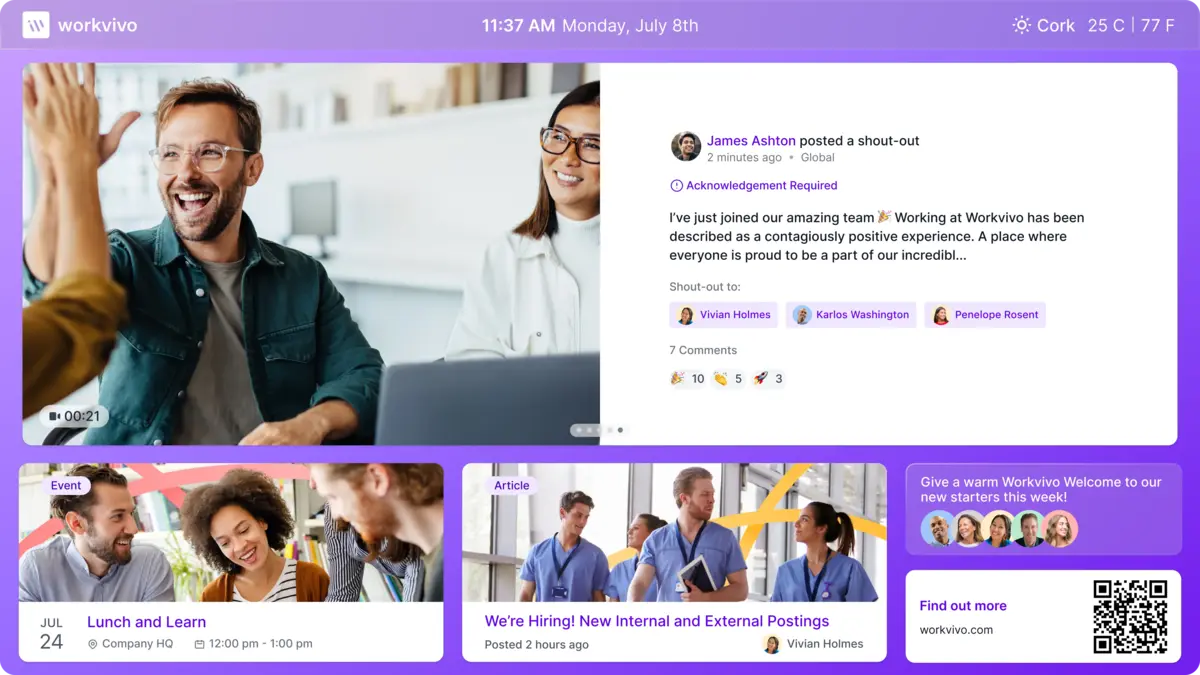
Best for: Distributed and hybrid teams looking for a mobile-first digital workspace that connects office staff and frontline workers through an intuitive interface.
Key features:
- Social activity feeds with peer recognition
- Integrated live video streaming
- Centralized document management
- Workvivo AI for automated content generation and smart platform search
Limitations: Search accuracy depends heavily on manually inputting precise tags.
Price: No standard free tier or a public per-user monthly price; pricing for premium plans available upon request.
Zoom Workplace — most popular video conferencing software
Zoom offers high-performance audio and video conferencing for stable communication across varying network conditions.
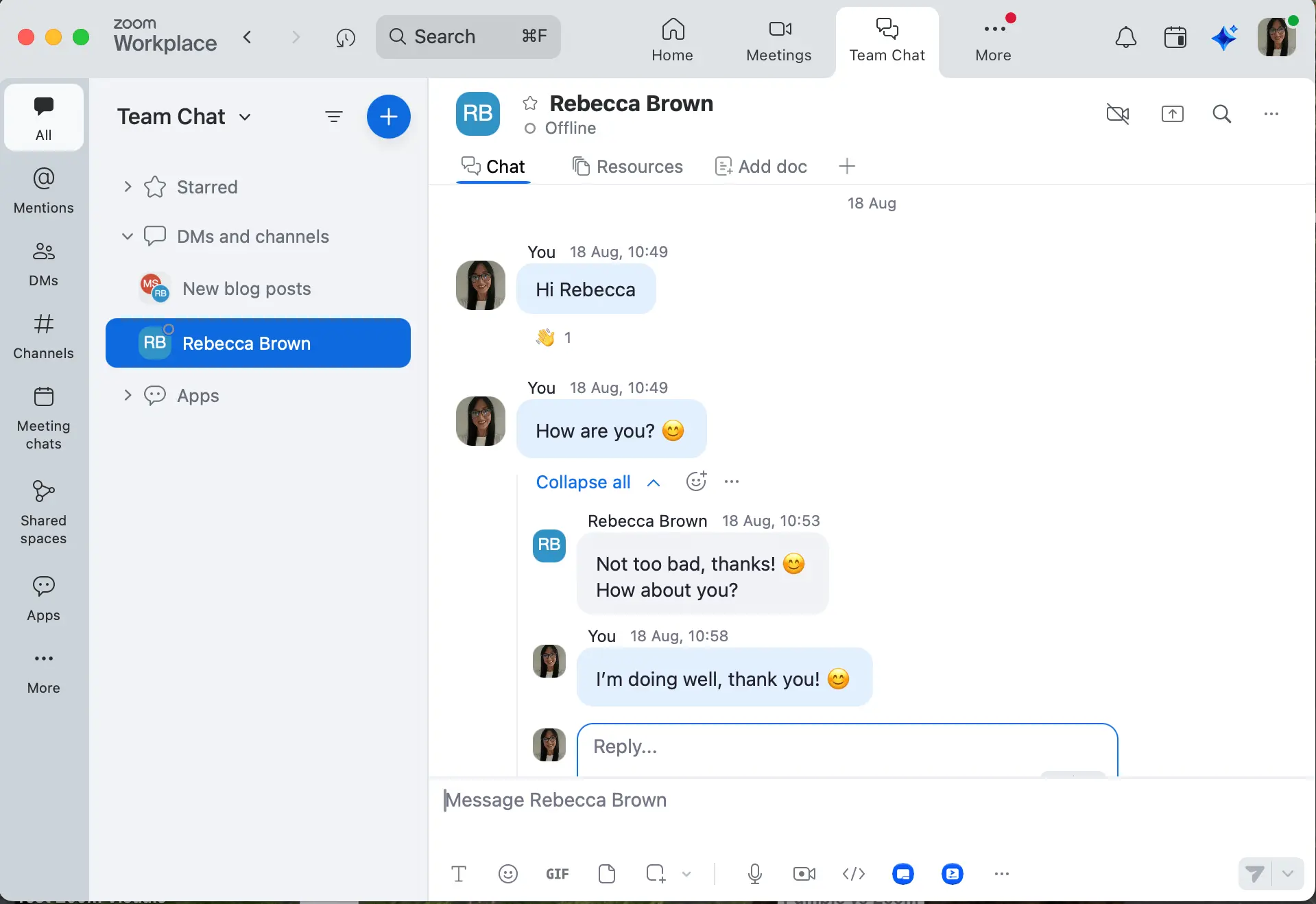
Best for: Hybrid teams requiring reliable video calls, digital whiteboards, and large webinar hosting.
Key features:
- Advanced background noise suppression
- Meeting recording
- Interactive team chat rooms
- Automated transcript generation
Limitations: Pricier business plans; on the Free plan, there is no cloud storage (meeting recordings must be saved locally) and meetings automatically cut off at 40 minutes.
Pricing: Free tier; business plans start at $18.33 per user per month.
Try Pumble, affordable alternative
Comparison overview of top internal communication platforms
Here’s a quick look at how these tools stack up in a side-by-side comparison.
| Platform | Core category | Best match | Free plan availability |
|---|---|---|---|
| Pumble | Instant messaging | Cost-conscious teams wanting full history | Yes (includes unlimited history) |
| Slack | Chat | Integration-heavy dev environments | Yes (restricted 90-day history) |
| Microsoft Teams | Unified enterprise chat | Office 365 enterprise ecosystems | Yes (basic standalone tier) |
| Google Workspace | Cloud document suite | Live document co-authoring teams | No (paid commercial licensing) |
| Workvivo | Social-media-style company intranet | Hybrid teams on the go | No |
| Zoom Workspace | Video conferencing | High-capacity virtual meetings | Yes (40-minute group meeting cap) |
Internal communication tools for small business
Small businesses with 5 to 50 employees face specific operational hurdles. Unlike large corporations with massive IT teams, smaller companies have to plan their software budgets, avoid complicated tech setups, and prevent information from getting scattered across too many apps.
A complex enterprise communication setup can cause more confusion than clarity for lean teams. Small businesses thrive when using simple, straightforward tool stacks that can include:
- Primary messaging and logs: Pumble, for example, serves as your daily digital headquarters. It gives small teams instant messaging and channels without hidden costs or history limits.
- Document storage and email: Google Workspace handles shared calendar scheduling and cloud document storage.
- Project and task tracking: A simple tool like Plaky can manage tasks and deadlines, keeping everyone aligned on project deliverables without overly complex workflows.
By keeping the communication setup simple, your company can stay fast on its feet and keep costs down while building an efficient digital workspace for your team.
Frequently asked questions
What are the types of internal communication tools?
Internal communication software is divided into different categories based on its primary function. These include instant messaging apps for real time chat, company intranets for managing central knowledge bases, video conferencing tools for remote virtual meetings, cloud storage hubs for file sharing, and project management boards for tracking daily tasks.
What is the most used communication tool?
Microsoft Teams is the most widely used platform across the global corporate landscape within enterprise networks. For document collaboration and cloud storage Google Workspace and Microsoft 365 are leading suites, used by businesses of all sizes.
What is the best way to communicate with employees?
The most effective approach combines real-time chat with clear, asynchronous documentation. Use instant messaging channels for daily check-ins and quick problem-solving, but consider moving major company policies and project milestones to an internal wiki or project board to ensure long-term visibility.
What is an intranet tool for internal communication?
An intranet tool is a private, secure company website that acts as a central source of truth for an organization. It stores company-wide notices, standard operating procedures, HR guidelines, and compliance documents, ensuring team members can access verified company information at any time.
How do you communicate internally in a company?
Internal communication is handled through a structured mix of digital channels. Daily project updates and urgent questions move through instant messaging software, detailed project files are managed in shared cloud drives, and formal company announcements or legal notices are sent via email newsletters or posted to the company intranet.
What are the four types of internal communication?
Internal communication is categorized by the direction information flows within an organization:
- Top-down communication — executive leadership sharing directives, corporate goals, or updates with employees.
- Bottom-up communication — frontline employees providing feedback, suggestions, or incident reports to management.
- Horizontal communication — peer-to-peer collaboration between team members on the same hierarchical level within the organization.
- Diagonal communication — information sharing between employees and managers in entirely different business units.
What tools are approved for internal communication?
Approved internal communication tools are platforms that meet strict security and compliance standards, such as SOC 2 Type II or ISO 27001 certifications. These platforms feature central administrative controls, secure login via single sign-on (SSO), multi-factor authentication, and data retention that protect company information.

Ensure effective and safe internal communication with Pumble
If you need a reliable tool for smooth team collaboration, Pumble is your best choice. It keeps your conversations organized and secure. Backed by its parent company, CAKE.com, the platform meets top international safety standards.
Pumble gives your full control over how your team interacts while offering great value, including:
- Unlimited message history on all plans
- Affordable pricing for any budget
- User-friendly features for simple teamwork
- Flexible workspace settings for easy manager control
With these benefits, Pumble perfectly balances functionality and low cost. It stands out as a top choice among internal communication tools.
Solve all your internal communication needs with Pumble.
How we reviewed this post: Our writers & editors monitor the posts and update them when new information becomes available, to keep them fresh and relevant.