



A medida que el trabajo remoto continúa remodelando el mundo profesional, comprender los datos más recientes puede proporcionar información valiosa sobre la dirección futura de la fuerza laboral.
Sin embargo, tenemos que profundizar más para responder preguntas como "¿Cuál es el futuro del trabajo remoto en 2026?" y “¿Está aumentando o disminuyendo el trabajo remoto?”
Después de todo, el trabajo remoto ya no es solo un experimento resultado de COVID-19, sino un modelo de trabajo establecido para millones de empleados globalmente.
Revisaremos las estadísticas de trabajo remoto y el porcentaje de trabajadores remotos en 2026 para ver cómo se relacionan con las tendencias emergentes de trabajo desde casa. Finalmente, reflexionaremos sobre las opiniones tanto de los trabajadores remotos como de los empleadores para ver si sus expectativas para el trabajo remoto en 2026 se alinean.
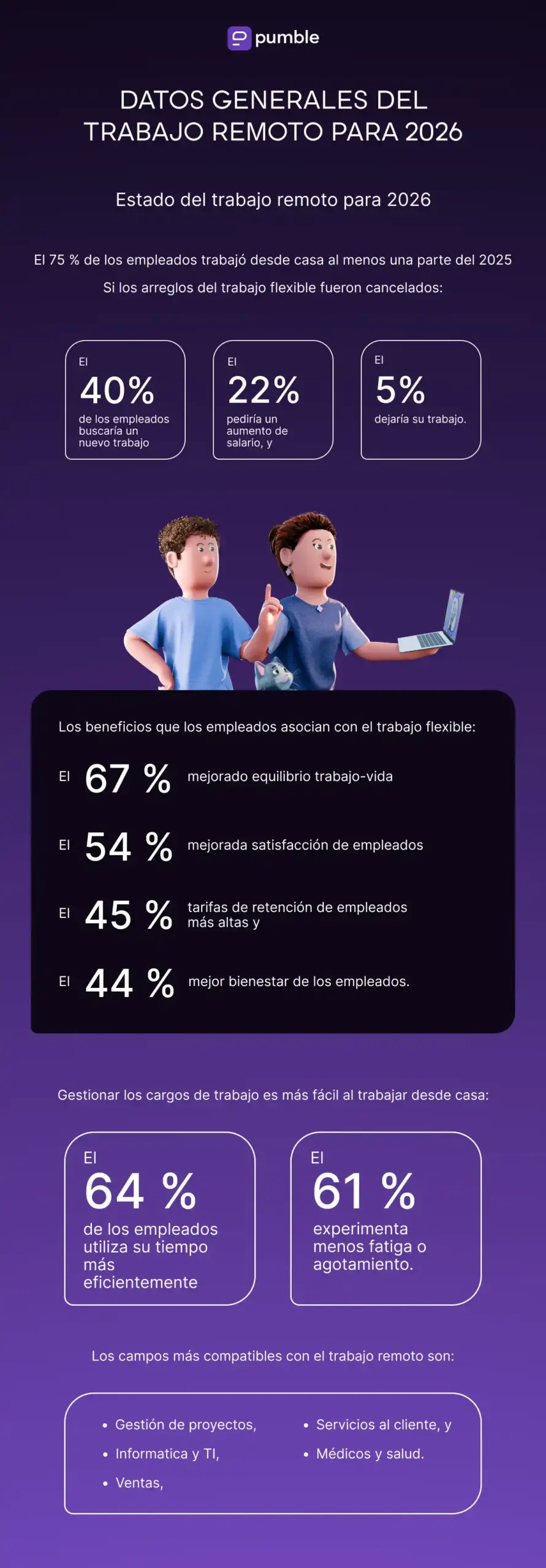
- Durante 2025, el 75 % de los empleados estaban comprometidos en alguna forma de trabajo remoto por al menos una parte del año.
- La flexibilidad está aumentando, notablemente, el 40 % de los trabajadores buscaría otras oportunidades de trabajo si fuera necesario regresar a la oficina a tiempo completo.
- El deslizamiento híbrido (hybrid creep), un fenómeno que se refiere a los empleadores continuamente introduciendo más estipulaciones en situ, fue prevalente en todo 2024 y 2025. Y los empleados sienten la presión, con el 30 % de trabajadores remotos e híbridos sintiendo que trabajar desde casa disminuye sus probabilidades de crecimiento profesional.
- Los empleados remotos e híbridos atribuyen a los acuerdos de trabajo flexible el mejoramiento de su equilibrio trabajo-vida (el 67 %), aumento general de satisfacción (el 54 %) y el mejoramiento del bienestar (el 44 %).
- El polyworking también fue una tendencia de trabajo remoto relevante en 2025, ya que el 28 % de los empleados admitió tener trabajos adicionales o trabajos extra.
- En general, los gerentes ven el trabajo remoto positivamente, con el 69 % de ellos afirmando que hizo sus equipos más productivos.
- En cuanto el trabajo híbrido y remoto redefinen la manera en que organizamos el trabajo, el 93 % de los ejecutivos enfatiza que la tecnología adecuada es fundamental para el éxito del negocio.
Estadísticas que responden a la pregunta: “¿Por qué trabajo remoto?”
El informe ”State of Remote Work” de Buffer reveló que el 68 % de las personas considera el trabajo remoto una experiencia positiva. Además, es alentador saber que nadie dijo que el trabajo remoto fue o es una experiencia negativa para ellos.
Es más, según el mismo informe, el 98% de los encuestados dijo que:
- Les gustaría trabajar de forma remota (al menos parte del tiempo) durante el resto de sus carreras y
- Recomiendan el trabajo remoto a compañeros de trabajo, amigos y familiares.
Según el informe de Owl Labs, ”State of Hybrid Work 2023,” el 66 % de los respondientes dijo que trabajar desde casa debería ser un derecho legal. En su informe basado en los EE.UU., Owl Lab también encontró que 29 % de los trabajadores híbridos y remotos esperaría un aumento en el salario si se vieran obligados a regresar a la oficina a tiempo completo.
Pero, ¿por qué la gente quiere trabajar desde casa?
El informe ”State of Hybrid Work 2025” continuó explorando las tendencias del trabajo remoto, encontrando que los empleados otorgan el mayor valor a la flexibilidad con respecto a dónde y cuándo trabajan. Especialmente, los últimos números indican que el 41 % de los empleados alcanzan un mejor equilibrio trabajo-vida trabajando desde casa.
Ahora que hemos cubierto las cifras iniciales, veamos en más detalles las estadísticas de trabajo remoto para 2026.
1. El trabajo remoto es una opción
La investigación de 2025 de Chartered Institute of Personnel and Development (CIPD) sobre las prácticas del trabajo híbrido y remoto muestra que para muchas empresas, el trabajo remoto es una opción común. Es decir, el 91 % de las organizaciones operando en Reino Unido ofrece algún tipo de acuerdo flexible, con:
- el 51 % apoyando el trabajo remoto a tiempo completo o de forma ad hoc, mientras que
- el 55 % proporciona horas a tiempo parcial.
Según el estudio del Pew Research Center de 2025, el 75% de los empleados trabajaron desde casa al menos parte del tiempo en 2025.
Esto no sorprende dado que en 2024, el trabajo híbrido experimentó un aumento, ya que el 62 % de las empresas estadounidenses ofrecían horarios de trabajo flexibles, lo que aumentó el número de trabajadores híbridos.
Además, muchas personas prefieren trabajar desde casa, tanto que Owl Labs encontró que si los trabajadores híbridos y remotos pierden sus arreglos flexibles:
- el 40 % empezaría a buscar un nuevo trabajo con la flexibilidad deseada,
- el 22 % anticiparía ver un aumento de salario, y
- el 5 % dejaría su trabajo completamente.
En 2024, el informe del trabajo remoto de Owl Labs reveló que cada 1 en 3 trabajadores (el 31 %) dijo que comenzaría a buscar un nuevo trabajo, mientras que el 6 % dijo que dejaría su trabajo si su empleador elimina la flexibilidad de trabajar en remoto.
Los datos más antiguos del informe ”State of Remote Work 2022” revelaron que el interés en el trabajo remoto e híbrido aumentó por un 24 % y 16 % respectivamente, en comparación con los datos del año anterior. En cambio, el interés en el trabajo en la oficina disminuyó un 24 %.
La preferencia de trabajo desde casa persigue hoy. Aunque las empresas apretaron sus requisitos en oficina en 2025, un fenómeno denominado “hybrid creep” (deslizamiento híbrido), los empleados aún prefieren los acuerdos remotos e híbridos en vez de estar en la oficina a tiempo completo.

2. El trabajo remoto contribuye a la felicidad
Una de las tendencias emergentes de trabajo remoto en 2026 es el conjunto de ventajas que los empleados asocian con el trabajo remoto e híbrido. En el informe de 2025 del CIPD, los respondientes destacaron las siguientes ventajas:
- Mejor equilibrio trabajo-vida (el 67 %),
- Mayor satisfacción de empleados (el 54 %),
- Mayores tarifas de retención de empleados (el 45 %), y
- Mejor bienestar de los empleados (el 44 %).
En el informe “State of Hybrid Work 2024” de Owl Labs, los empleados informan las siguientes formas en que el trabajo híbrido afecta su felicidad:
- El 84 % de trabajadores remotos e híbridos comían la comida más saludable cuando trabajaron desde casa y
- El 51 % tuvo el mejor equilibrio entre la vida laboral y profesional.
De hecho, el 71 % de los encuestados estaba de acuerdo en que los horarios de trabajo flexibles contribuyen a un equilibrio saludable entre la vida personal y laboral, lo cual es fundamental para su felicidad (en el trabajo o en cualquier otro lugar). Además, el 25 % de ellos estaría dispuesto a aceptar un salario del 15 % menor para conseguir horarios de trabajo más flexibles.
Según un informe anterior de Buffer, los trabajadores remotos e híbridos prefieren sus modelos de trabajo porque les permiten:
- Tener un horario flexible: 22 %,
- Elegir cómo pasan su tiempo: 19 %, y
- Elegir su ubicación laboral: 13 %.
3. Los empleados con alta educación y altos ingresos más a menudo eligen el trabajo remoto
El informe de teletrabajo más reciente de la Oficina de Estadísticas Laborales de 2025 muestra una correlación clara entre los niveles de educación y adopción de trabajo remoto entre los empleados de Estados Unidos.
| Nivel de educación | % de teletrabajadores (total) | % de teletrabajadores (parcial) | % de teletrabajadores (todo el tiempo) |
|---|---|---|---|
| Menos que la escuela secundaria | 3,5 % | 1,8 % | 1,7 % |
| Graduados de escuela secundaria (sin Universidad) | 8,9 % | 3,9 % | 5,0 % |
| Universidad o grado asociado | 18,9 % | 8,5 % | 10,4 % |
| Licenciatura o título superior | 38,8 % | 22,1 % | 16,7 % |
| Solo licenciatura | 37,3 % | 19,9 % | 17,3 % |
| Posgrado | 41,3 % | 25,4 % | 15,8 % |
Según el informe de Pew Research Center en 2023, los empleados con nivel alto de educación con salarios más altos tienen más probabilidades de trabajar desde casa.
| Cuán común es el trabajo remoto, dependiendo del ingreso | Porcentaje |
|---|---|
| Ingresos altos | 67 % |
| Ingresos medios | 56 % |
| Ingresos bajos | 53 % |
Informes adicionales apoyan estos datos.
Los datos de Federal Reserve Bank of St. Louis muestran que el trabajo remoto fue más frecuente en 2024 en comparación con los años previos a la pandemia, particularmente entre los trabajadores con alta educación y altos ingresos. Esta “brecha educativa” aparente destaca el hecho de que el trabajo remoto es más accesible a los empleados que poseen títulos de licenciatura o posgrado.
🎓 Consejo Pro de Pumble
Muchos individuos con título de licenciatura eligen perseguir sus carreras mientras están viajando y viviendo en el extranjero. Para aprender más sobre esta intersección entre el trabajo remoto y el estilo de vida de nomad digital, consulta este recurso:
Estadísticas que muestran desde dónde trabajan los empleados remotos
¿Cómo es realmente trabajar desde casa?
Los datos de Buffer muestran que después de la pandemia, el 82 % de los trabajadores remotos eligen sus casas como ubicación laboral primaria.
Sólo el 5 % afirmó trabajar en espacios de coworking, mientras que el 2 % prefirió trabajar en cafeterías u otros lugares.
Sin embargo, mientras que la mayoría de los empleados remotos trabajó desde la comodidad de su hogar, algunos decidieron reubicarse.
Un informe de la Oficina de Censo de EE. UU. muestra que, en 2024, aproximadamente el 40 % de los trabajadores remotos aprovechó el trabajo flexible para mudarse de centros urbanos de alto coste para regiones más asequibles.
El informe “State of Remote Work” de Buffer de 2023 destaca que el 60 % de teletrabajadores prefirió el modelo del trabajo remoto porque le permite elegir dónde vivir.
En 2021, en el punto álgido del trabajo remoto, los números fueron aún más altos, alrededor del 78 % de los respondientes de “State of Remote Work 2021” de Owl Labs destacó que se mudó de las ubicaciones urbanas debido al trabajo remoto.
Estadísticas que muestran el impacto general del trabajo remoto
El indicador de trabajo híbrido de Gallup sigue y analiza las experiencias de empleados remotos, híbridos y en situ. La información para 2025 indica que al trabajar desde casa:
- el 64 % de los empleados utilizan su tiempo más eficientemente, mientras que
- 61% experience less fatigue or burnout.
Sin embargo, ¿son los trabajadores remotos más productivos que los empleados trabajando en la oficina? Aquí es lo que podemos aprender de la estadística de productividad de empleados.
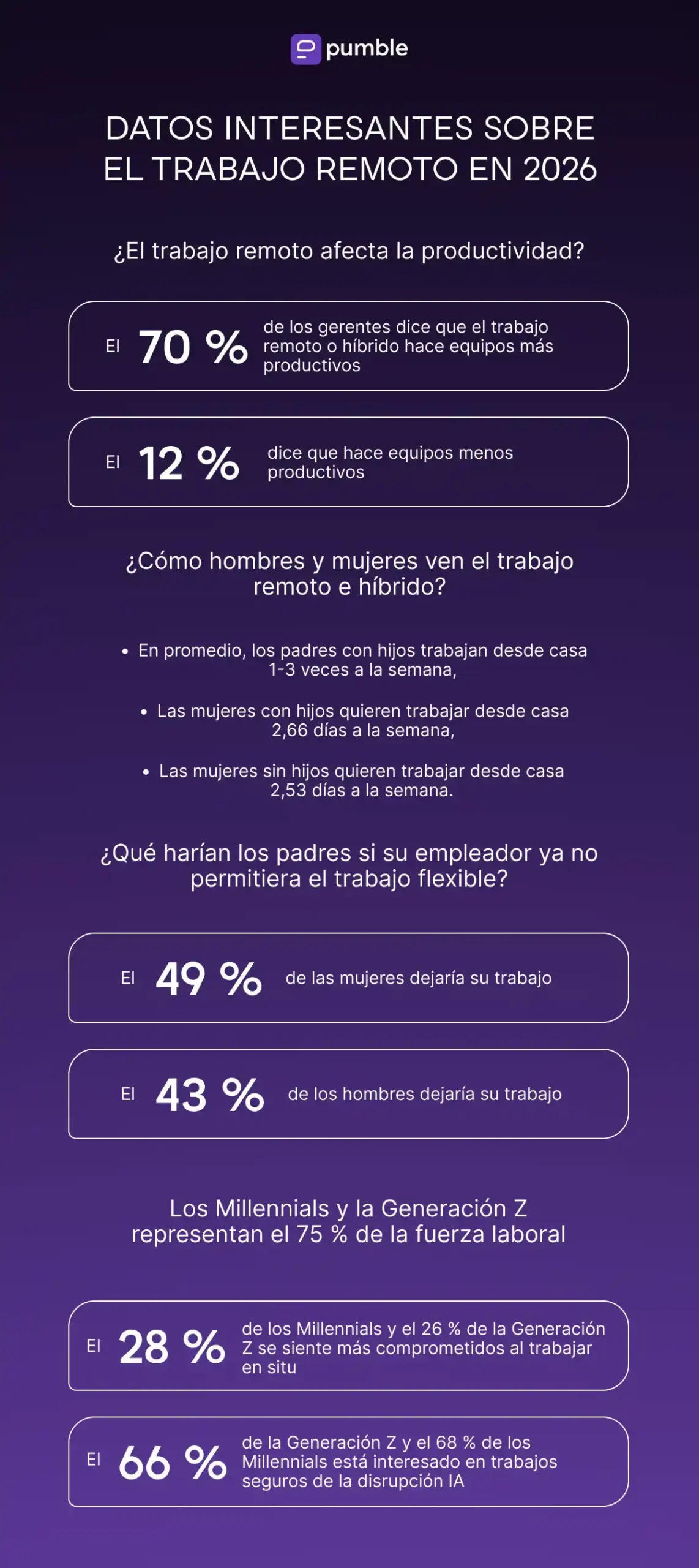
Los datos de Owl Labs para 2025 muestran que la productividad sigue intacta. Alrededor del 70 % de los gerentes dijo que el trabajo de forma remota o híbrida hace sus equipos más productivos, mientras que el 12 % dijo que les hace menos productivos.
Sin embargo, parece que hubo un desajuste entre hombres y mujeres el año pasado.
Según los datos de la encuesta de FlexJobs de 2021, el 80% de las mujeres encuestadas considera el trabajo remoto uno de los factores más importantes a la hora de buscar un nuevo trabajo, en comparación con el 52% de los hombres.
Sin embargo, parece que estos números se han estabilizado, al menos cuando se trata de mujeres y hombres con licenciatura que trabajan desde casa en 2025. Según los datos de WFH de SIEPR (Instituto de Investigación de Política de Economía de Stanford), el número de hombres y mujeres que trabajan en remoto queda casi igual en todos las regiones del mundo.
Profundicemos en más detalles y examinemos el impacto del trabajo remoto en 2026 en:
- Géneros,
- Generaciones,
- Industrias, y
- Países.
Estadísticas que muestran el impacto del trabajo remoto en diferentes géneros
Como hemos mencionado, hubo una discrepancia significativa entre los géneros en cuanto al deseo (o la falta) de regresar a la oficina.
Durante la oleada inicial de mandados RTO (regreso a la oficina o en inglés “return to office”) en 2023, los hombres tenían más probabilidades de regresar a las oficinas que las mujeres, según los datos del informe de la Oficina de Estadísticas Laborales.
Sin embargo, en 2024 hemos visto un poco más de trabajadores trabajando desde casa, el 49,6 % en comparación con el 46,4 % de trabajadoras remotas, como informa el US Career Institute.
En 2025 si hombres y mujeres estuvieran en la oficina o en casa dependía de si tienen hijos. Según los datos de SIEPR, los padres con hijos tenían más probabilidades de trabajar un horario de trabajo híbrido con 1-3 días de trabajo desde casa por la semana.
Veamos algunas diferencias entre géneros sobre el trabajo remoto.
Las mujeres siguen siendo más propensas a trabajar desde casa
A pesar de las estadísticas diversas, las mujeres siguen prefiriendo predominantemente trabajar desde casa.
Este deseo de trabajar en remoto es aún más intenso para mujeres con hijos. SIEPR encontró que, en promedio, las mujeres con hijos desean trabajar desde casa 2,66 días a la semana. Para mujeres sin hijos, este número cayó a 2,53.
En contraste, la preferencia por trabajar desde casa entre hombres con hijos y los sin ellos fue mucho más alineada. Aún así, los hombres sin hijos muestran una preferencia un poco más alta para el trabajo remoto que sus compañeros sin hijos.
Durante 2025, la parentalidad continuó influyendo las preferencias de trabajo remoto, el 49 % de las mujeres (en comparación con el 43 % de los hombres) informó que dejaría su trabajo si la opción de trabajar desde casa ya no estuviera disponible.
El informe ”Women in the Workplace 2024” de McKinsey muestra que 9 en cada 10 mujeres gravita hacia trabajo remoto.
Esto coincide con los datos del informe de Owl Labs para 2022, que mostró que la inclinación de las mujeres a trabajar desde casa es mucho mayor que la de los hombres.
| Estilo de trabajo preferido | Mujeres | Hombres |
|---|---|---|
| Remoto | 46 % | 39 % |
| Híbrido | 34 % | 37 % |
| En oficina | 19 % | 24 % |
Incluso en 2019, las mujeres representaban el 56% de todos los trabajadores a domicilio, según informa ILO en su ”informe “Working from home”.
Pero, ¿por qué las mujeres tienen mayor tendencia a trabajar desde casa?
Bueno, además de ser empleadas, la mayoría de las mujeres en todo el mundo también son amas de casa y cuidadoras.
Al optar por trabajar desde sus hogares, pueden combinar sus múltiples responsabilidades con el trabajo remunerado, incluso si eso significa trabajar más horas.
Una investigación sobre la desigualdad de género en el trabajo no remunerado, realizada por CAKE.com, mostró que las mujeres dedican más tiempo que los hombres al trabajo doméstico no remunerado, específicamente:
- Cuidado de hijos: las mujeres cuidan a los niños el 39,45 % de su tiempo y los hombres dedican el 33,37 % de su tiempo a esa actividad.
- Preparación de comidas: las mujeres dedican el 31,9 % de su tiempo a esta tarea, en comparación con el 17,4 % del tiempo que dedican los hombres.
- Limpieza de la casa: las mujeres limpian el 22,65 % de su tiempo, mientras que los hombres dedican a esta tarea el 18,2 % de su tiempo.
- Lavandería: el 7,79 % del tiempo de las mujeres se dedica a esta tarea, mientras que los hombres no informaron que lavar la ropa fuera una tarea rutinaria en este informe.
Según este informe, las mujeres realizan el 58% de trabajo no remunerado, mientras que los hombres realizan el 42 %.
Las mujeres manejan mejor el equilibrio entre vida personal y laboral que los hombres
Exploremos qué beneficios pueden disfrutar tanto las mujeres como los hombres cuando trabajan desde casa.
Según los hallazgos del Pew Research Center, tanto a hombres como a mujeres les resulta igualmente fácil equilibrar el trabajo y la vida personal cuando trabajan desde casa.
Sin embargo, parece que las mujeres manejan el trabajo desde casa mejor que los hombres a la hora de:
- Completar el trabajo,
- Cumplir con los plazos, y
- Avanzar en sus carreras.
Y, como destaca el informe de McKinsey, las mujeres reportan menos casos de microagresiones cuando trabajan de forma remota.
| El trabajo remoto lo hace... | Mujeres | Hombres |
|---|---|---|
| Más fácil mantener el equilibrio entre la vida laboral y personal | 46 % | 39 % |
| Más fácil realizar el trabajo y cumplir los plazos | 34 % | 37 % |
| Más fácil avanzar en su carrera | 19 % | 24 % |
Los hombres tienden a trabajar más de 10 horas adicionales a la semana cuando trabajan de forma remota
Dedicar más horas al trabajo parece reservado a los hombres, reveló el informe de Owl Labs. Tienen un 41 % más de probabilidades de trabajar más de 10 horas adicionales por semana.
Adicionalmente, Owl Labs encontró que en 2025, los hombres estuvieron más propensos a mudarse por una ubicación de trabajo flexible. Aunque el 59 % de mujeres sacrificaría su salario para un arreglo más flexible, el 66 % de hombres afirmó que haría lo mismo.
Por el contrario, las mujeres afirman trabajar las mismas horas que cuando trabajaban en la oficina.
Sin embargo, los datos muestran que persisten las diferencias de género y que las mujeres se centran más en las tareas familiares. Por ejemplo, un estudio de 2022 que examinó parejas con dos ingresos de la Universidad Estatal de Ohio subraya que las mujeres que trabajan de forma remota tienen más probabilidades de sentir la necesidad de completar más tareas que sus parejas.
Estas líneas borrosas entre el trabajo y la vida a veces pueden provocar el agotamiento y una culpa abrumadora.
Las mujeres afirman ser más productivas en entornos remotos
El estudio de US Bureau of Labor Statistics de 2024 reveló una correlación positiva general entre el trabajo remoto y el aumento de la productividad en 61 industrias.
Aún así, las mujeres informaron siendo un poco más productivas que los hombres, según el estudio SHRM de 2021.
Por ejemplo, el 40 % de las mujeres dijo que son más productivas en un entorno de trabajo remoto, mientras que el 35 % de los hombres sintió lo mismo.
Sin embargo, los datos de un estudio de 2023 advierte que si bien el trabajo flexible y remoto deja espacio para que las mujeres controlen las demandas no laborales, también podría reducir la cantidad de oportunidades que tienen en el lugar de trabajo, principalmente cuando se trata de contrarrestar los estereotipos sociales.
Estadísticas que muestran el impacto del trabajo remoto en diferentes generaciones
Actualmente estas 5 generaciones que componen la fuerza laboral global:
- Tradicionalistas (1928–1945),
- Baby Boomers (1946–1964),
- Generación X (1965–1980),
- Millenials (1981–1994), y
- Generación Z (1995–2010).
La fuerza laboral actual está compuesta principalmente por los Millennials y la Gen Z, cuyas visiones del mundo diversas, orientadas a las personas y socialmente responsables están haciendo que las empresas reevalúen su forma de hacer negocios.
Los Millennials representan hoy alrededor del 36 % de la fuerza laboral de los EE.UU., lo que los hace el grupo demográfico más grande en la fuerza laboral.
En 2024, el mercado laboral estadounidense contó 50 millones de empleados de la Generación Z, informa CAKE.com en su informe Gen Z Effect de 2024.
Además, 2024 marca el año en que la Generación Z supera a los Baby Boomers en el mercado laboral.
Pero, ¿cómo ha impactado el trabajo remoto a estas dos (y otras) generaciones?
La mayoría de la Generación Z y los Millennials solían querer un modelo de trabajo híbrido o remoto
Según la encuesta de Deloitte de 2023, el 77 % de la Generación Z y el 75 % de los Millennials dijo que comenzarían a buscar un nuevo trabajo si su empresa les exigiera regresar a la oficina a tiempo completo.
Sin embargo, su edición de encuesta de 2024 expuso algunos cambios en ese frente. Es decir, el 64 % de la Generación Z y el 66 % de los Millennials cuyas empresas recientemente ordenaron el regreso a la oficina, revelaron algunos datos interesantes.
La mayoría de los trabajadores ahora trabajan completamente en situ en ambas generaciones, pero tienen sentimientos mezclados, al respecto.
| Generaciones | Modelo de trabajo en situ | Modelo de trabajo completamente remoto | Modelo de trabajo híbrido |
|---|---|---|---|
| Generación Z | 51 % | 15 % | 35 % |
| Millennials | 57 % | 11 % | 33 % |
En general, tanto los trabajadores Millennials y de la Generación Z citan efectos más positivos de la política de RTO.
Específicamente, el 28 % de los Millennials y el 26 % de la Generación Z se siente más comprometido con su organizaciones y compañeros cuando trabaja en situ, y casi la misma cantidad de respondientes (el 27 % y el 25 %, respectivamente) informó tener mejores rutinas y estructuras en el trabajo.
El impacto negativo del trabajo en situ incluyó la parte financiera (el 17 % de los Millennials y el 21 % de la Generación Z) y la disminución de la productividad (el 17 % de los Millennials y el 18 % de la Generación Z).
La ”encuesta de Generación Z y Millennials para 2025” de Deloitte anota que la mayoría de los empleados de la Generación Z comenzó su carrera durante la pandemia COVID-19. Es posible que estas circunstancias han formado sus vistas sobre el equilibrio trabajo-vida, influyendo qué aspectos aprecian más en un trabajo.
Más de la mitad de los Millennials y la Generación Z consideran cambiar de trabajo
Para los Millennials y la Generación Z, los cambios de trabajo no son infrecuentes. Estas generaciones saben lo que buscan en un empleador y no temen seguir buscando hasta encontrar la combinación perfecta.
En 2024, se esperaba que más del 90 % de la Generación Z y los Millennials dieran una respuesta positiva sobre si estaban considerando buscar un nuevo trabajo. Este es un aumento enorme en comparación con años anteriores.
Según el informe de Microsoft “Great Expectations: Making Hybrid Work Work”, solo el 52 % de la Generación Z y los Millennials cambiaron de trabajo en 2023. Estos números fueron los mismos en 2022.
Curiosamente, la prevalencia de inteligencia artificial (IA) está cambiando qué tipos de trabajos buscan la Generación Z y los Millennials, según la encuesta de Deloitte de 2025. Alrededor del 66 % de la Generación Z y el 68 % de los Millennials afirmó que buscaría trabajos seguros de la disrupción impulsada por IA, como por ejemplo, comercios o trabajo manual.
Tanto los Millennials como la Generación Z están de acuerdo con dejar sus trabajos actuales
Ya que ambas generaciones ocupan la mayoría de la fuerza laboral, hubo un turno positivo hacia la fluidez laboral.
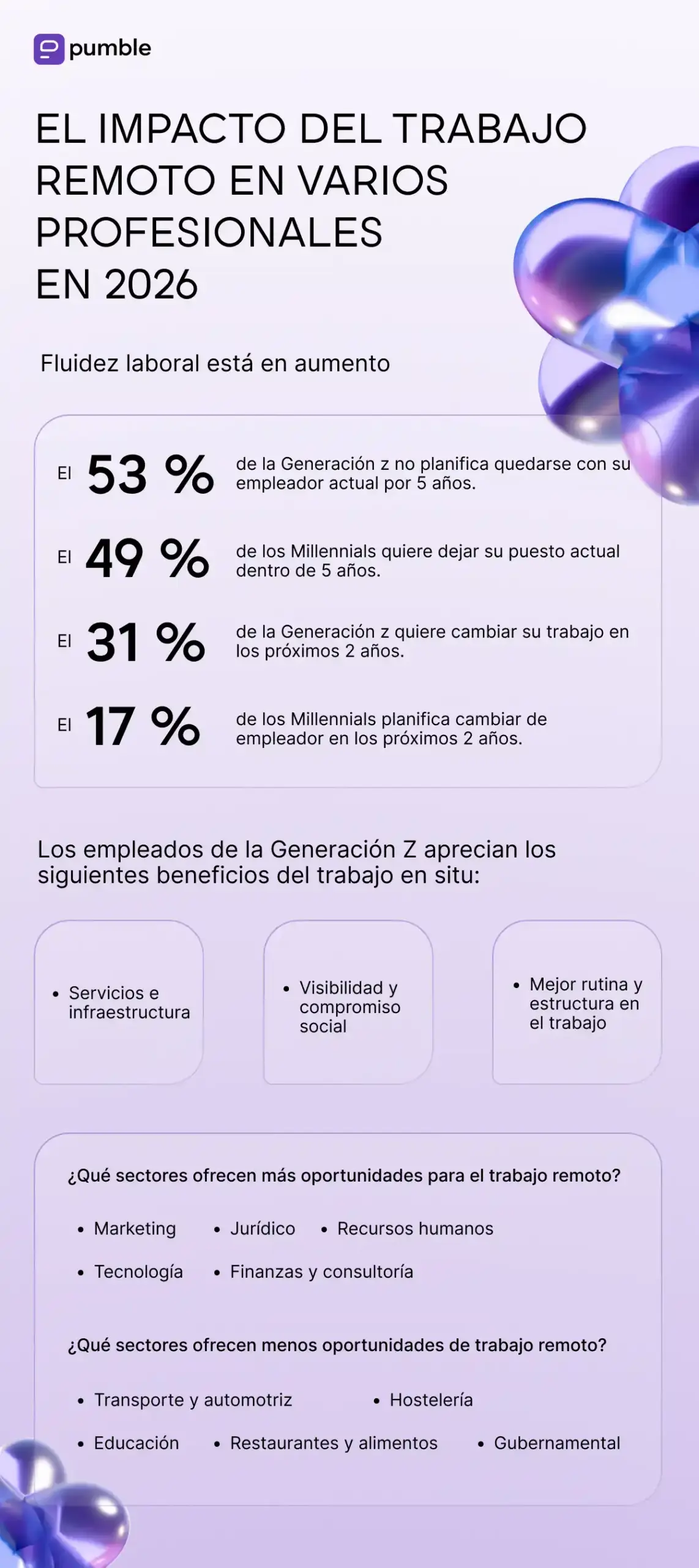
Según los datos de Deloitte de 2025, aproximadamente el 31 % de los trabajadores de la Generación Z pretenden cambiar su trabajo en los próximos dos años. Ya que los Millennials están más avanzados en su trayectoria profesional, solo el 17 % planea cambiar de empresa en los próximos dos años.
Cuando miramos hacia adelante 5 años, los números son aún más altos. Según un informe de Deloitte de 2024, más de la mitad de los encuestados de la Generación Z (el 53 %) y el 49 % de los Millennials no planean quedarse en su trabajo actual durante 5 años.
En su encuesta de 2023, Deloitte informó que casi una cuarta parte de la Generación Z (el 23%) y el 13% de los Millennials planificó dejar su trabajo dentro de un año.
Las cosas han quedado consistentes con la encuesta de Deloitte de 2022, que descubrió que al 40% de la Generación Z y casi al 24% de los Millennials les gustaría dejar sus trabajos dentro de dos años.
La flexibilidad y el salario son las principales razones por las que los Millennials y la Generación Z cambian de trabajo
En su informe que examinó de cerca a los Millennials y la Generación Z, Deloitte encontró que el salario es la razón principal por la que dejaron un puesto en los últimos 2 años.
Además, la investigación sobre el cambio de trabajo revela que la tenencia promedio para los trabajadores de la Generación Z en los primeros 5 años de su carrera profesional es aproximadamente un año. En comparación, para los empleados Millennials y Generación Z, el promedio es de 1,8 y 2,8 años, respectivamente.
Sin embargo, según una encuesta de Qureos de 2024, la Generación Z y los Millennials citaron los siguientes motivos para permanecer en una empresa:
- Impacto en la sociedad: el 93 %,
- Equilibrio entre la vida personal y laboral: el 77 %,
- Diversidad e inclusión: el 77 %,
- Seguro médico: el 70 %, y
- Salario competitivo: el 63 %.
Estos hallazgos indican que tanto la Generación Z como los Millennials preferirían tener un mejor equilibrio entre el trabajo y la vida personal (logrado a través del trabajo remoto e híbrido) que un sueldo más alto.
Los Millennials y la Generación Z son más propensos a ganar más dinero a través de trabajos y negocios secundarios
Según la encuesta de Intuit de 2024, casi dos tercios (el 66 %) de los Millennials y la Generación Z inició o planificó empezar un trabajo extra a finales de 2024. Además, el 65 % planificó continuar su esfuerzo comercial durante 2025.
Sorprendentemente, el informe “State of Hybrid Work” de Owl Lab para 2023 muestra que el 68% tienen otro trabajo, negocio paralelo o proyecto son en realidad trabajadores de oficina. Sólo el 27 % de ellos son trabajadores remotos o híbridos.
El informe “State of Hybrid Work” para 2025 reveló que el “polyworking” continúa siendo una característica de fuerza laboral moderna, con el 28 % de los empleados teniendo trabajos adicionales.
Los Millennials y la Generación Z aprecian los beneficios del trabajo remoto y en situ
Para los Millennials y la Generación Z, los beneficios del trabajo remoto varían.
En su encuesta de 2023, Deloitte descubrió los 4 beneficios más comunes para los empleados de la Generación Z y Millennials que trabajan de forma remota:
- Un mejor equilibrio entre la vida laboral y personal,
- Ahorrar dinero,
- Mejor productividad, y
- Impacto positivo en la salud mental.
Sin embargo, un informe de 2024 explorando el deseo por el trabajo híbrido entre la Generación Z muestra un cambio hacia un trabajo más presencial con beneficios y prioridades similares para los empleados de la Generación Z. Es decir, la Generación Z y los Millennials informan en gran medida beneficios relacionados con el trabajo en situ, que incluyen:
- Servicios e infraestructura,
- Visibilidad y compromiso social, y
- Mejor rutina y estructura en el trabajo.
Al mismo tiempo, ambas generaciones siguen evaluando los desafíos del trabajo remoto con más atención, según los datos de Gallup de 2025.
La falta de interacciones cara a cara significativas es un factor notable que impide a la Generación Z del trabajo completamente remoto, probablemente porque la Generación Z es la más solitaria entre las 5 generaciones presentes en la fuerza laboral, según Gallup.
🎓 Consejo Pro de Pumble
Si necesitas un poco de ayuda para mejorar la comunicación entre generaciones en tu lugar de trabajo, hemos preparado algunos consejos para ti:
Estadísticas que muestran el impacto del trabajo remoto en diferentes industrias
¿Qué industrias ofrecen más oportunidades para el trabajo remoto?
¿Qué industrias tienen menos probabilidades de operar de forma remota?
Veamos algunos datos de estadísticas de trabajo remoto en diferentes industrias.
Las industrias de software y TI son las más propensas a adoptar el trabajo remoto
Los datos del informe de Flex Jobs sobre trabajo remoto indican que, en el último trimestre de 2025, los campos profesionales más compatibles con el trabajo remoto fueron:
- Gestión de proyectos,
- Informática y TI,
- Ventas,
- Servicios de cliente, y
- Médico y salud.
Los datos de Robert Half, una empresa de consultoría personal y de recursos humanos de EE. UU., confirman estos datos, mostrando que el sector tecnológico se encontraba entre las principales industrias que ofrecen el trabajo completamente remoto o híbrido al final del año 2025. Específicamente, los campos profesionales con la mayoría de las oportunidades de trabajo flexible fueron:
- Marketing,
- Tecnología,
- Jurídico,
- Finanzas y consultoría, y
- Recursos humanos.
Para algunas industrias y puesto de trabajo, el trabajo remoto no es una opción
El ”UK Job Market Report” de Adzuna revela que, en 2025, las publicaciones de trabajo remoto cayeron a sus niveles más bajos desde 2020. En contraste, los puestos en situ se ha ido aumentando de forma constante.
Estos datos tienen cierto sentido, no todos los campos profesionales pueden permitirse implementar el trabajo remoto. Según la Oficina de Estadísticas de Trabajo, las ocupaciones e industrias que no pueden operar en un entorno remoto incluyen:
- Servicio de protección,
- Limpieza y mantenimiento de edificios y terrenos,
- Atención y servicio personal,
- Construcción y extracción, y
- Agricultura, pesca y silvicultura.
Similarmente, el informe de Flex muestra que las principales 5 industrias que requieren el trabajo completamente en la oficina en 2025 fueron:
- Transporte y automotriz: el 55 %,
- Hospitalidad: el 53 %,
- Educación: 50%,
- Restaurantes y servicios de alimentos: el 49 %, y
- Gobierno: el 46 %.
Estadísticas que muestran el impacto del trabajo remoto en diferentes países
El trabajo remoto, el teletrabajo o el “trabajo desde cualquier lugar” se ven diferentes de un país a otro. Echemos un vistazo detallado para descubrirlo:
- ¿Qué países son mejores para los trabajadores remotos en 2026?
- ¿Qué partes del mundo son más atractivas para los nómadas digitales?
- ¿Qué países todavía no adoptan plenamente el trabajo remoto?
Dinamarca está clasificada como el mejor país para trabajadores remotos
En su informe ”Global Remote Work Index,” NordLayer enumeró los mejores países para trabajar de forma remota.
Clasificaron los países según 4 categorías diferentes:
- Seguridad cibernética,
- Seguridad económica,
- Infraestructura digital y física, y
- Seguridad social.
Dinamarca ocupa el primer lugar en la lista, con puntuaciones altas en las 4 categorías, y le siguen de cerca otros 9 países europeos. Estados Unidos y Canadá ocupan los puestos 16 y 14 de la lista, respectivamente.
| Los 10 mejores países para trabajadores remotos | Puntos |
|---|---|
| Dinamarca | 0,874 |
| Países Bajos | 0,843 |
| Alemania | 0,842 |
| España | 0,825 |
| Suecia | 0,824 |
| Portugal | 0,824 |
| Estonia | 0,818 |
| Lituania | 0,808 |
| Irlanda | 0,803 |
| Eslovaquia | 0,802 |
Croacia es la mejor país para nómadas digitales
Al mismo tiempo, otros informes, como las Estadísticas de nómadas digitales de Pumble, muestran qué diferentes países con visas de nómadas digitales ofrecen en cuanto a las condiciones laborales y las oportunidades para explorar fuera de la rutina de 9 a 5.
Según los datos de Pumble, Croacia fue el primer país en la lista de los países más preferidos por los nómadas digitales en 2024, seguido de cerca por:
- Grecia,
- Corea del Sur,
- Malasia, y
- Japón.
El ”Informe de Nómada digital global de 2025” de Global Citizen Solutions nota que muchos países en Europa se destacan debido a sus marcos estructurados para nómadas digitales. Este enfoque hace que los países como España, Croacia, Malta y Portugal sean muy atractivos para una reubicación a largo plazo.
🎓 Consejo Pro de Pumble
Si estás pensando en emprender el viaje y convertirte en un nómada digital, consulta la siguiente página para conocer los requisitos de diferentes países:
Algunos países cuentan con regulaciones de trabajo remoto
Cuando la pandemia obligó a muchos a trabajar desde casa, destacó los desafíos del trabajo remoto.
Como resultado, algunos países han actualizado sus leyes laborales para regular el trabajo a distancia. Aunque algunos países ya contaban con algún tipo de legislación sobre trabajo a distancia, algunas de esas regulaciones nunca se habían puesto en práctica.
Los últimos cambios en la legislación sobre trabajo remoto incluyen:
- Requerir acuerdos escritos para el trabajo remoto,
- Obligar a los empleadores a proporcionar a los trabajadores el equipo necesario y cubrir los costes relacionados, como Internet, y
- Prohibir a los empresarios discriminar a los trabajadores por motivos de género, edad, grupo profesional, discapacidad o antigüedad.
En 2025, más países, como Costa Rica, Austria, Omán y Colombia, han promulgado las regulaciones de teletrabajo.
Francia sigue resistiéndose al trabajo remoto
Aunque el trabajo remoto ha cambiado la manera en que las empresas organizan su fuerza de trabajo, en Francia, el teletrabajo aún no es una práctica tan común. En 2024:
- Menos del 3 % de los empleados del sector privado trabajó en remoto,
- El 26 % siguió un arreglo híbrido, y
- El 78 % trabajó en situ completamente.
Si comparamos estos numeros con estos en países más remotos como EE. UU., la resistencia es clara. Hasta el fin de 2024:
- El 13 % de los empleados de EE. UU. fueron completamente remotos,
- El 61 % trabajó en situ, y
- El 26 % trabajó en situ completamente.
La encuesta de Bloomberg de noviembre de 2023 encontró que, en general, los franceses ofrecen menos flexibilidad a sus trabajadores. En París, la capital económica de Francia, solo el 7 % de los respondientes dijo que tiene trabajo completamente remoto.
En general, los trabajos remotos permanecen más comunes en Europa y América del Norte, según un estudio completo sobre el teletrabajo en 2025. El estudio también confirma que estos datos sugieren que, en Asia, el trabajo remoto permanece limitado. Por ejemplo, aunque Japón adoptó el teletrabajo durante la pandemia COVID-19, en 2026 el trabajo en situ permanece la norma.
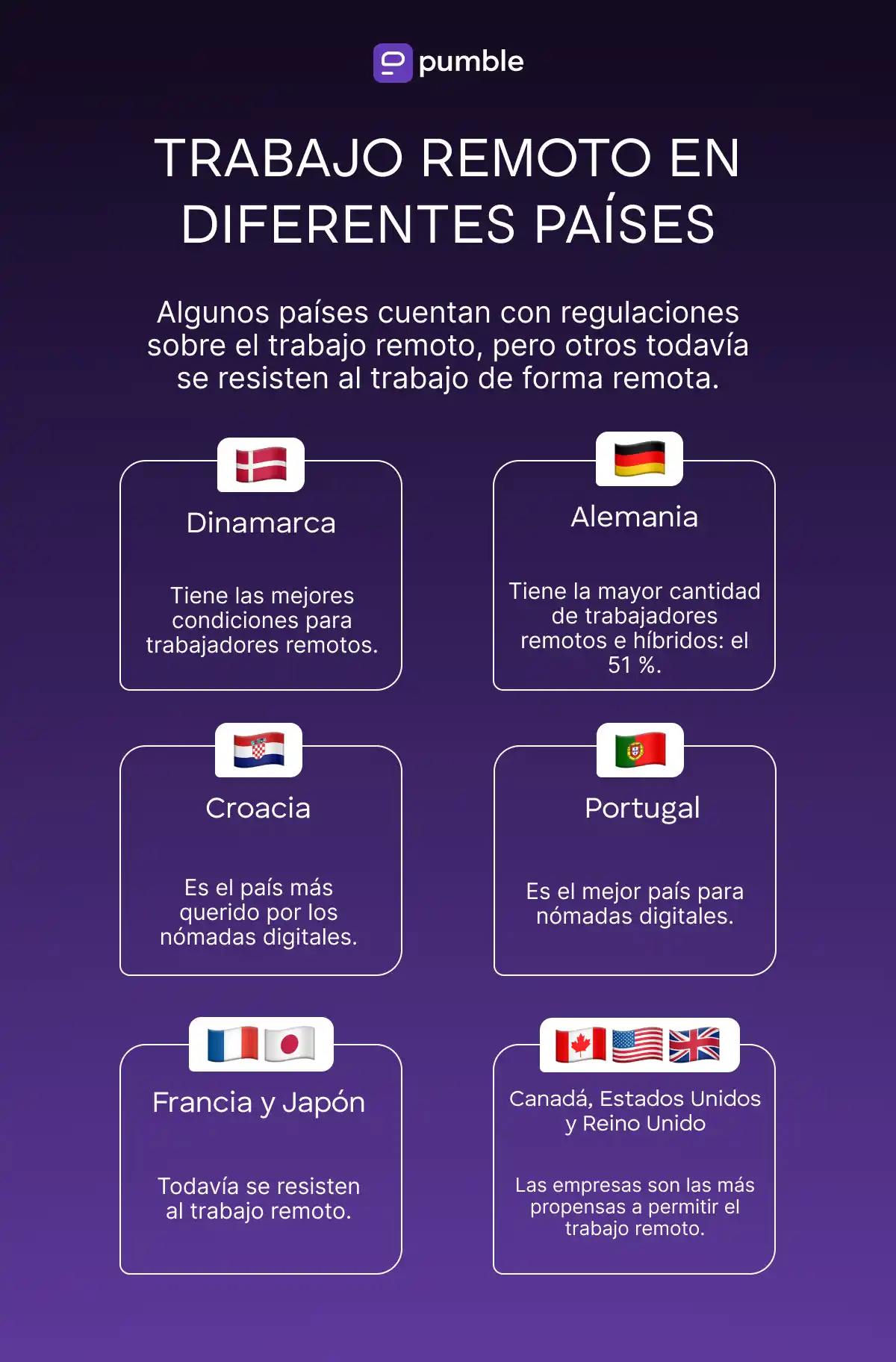
Las empresas de Canadá, EE. UU. y el Reino Unido son más propensas a permitir que los empleados trabajen de forma completamente remota
Los datos sobre el trabajo remoto indican que los países de habla inglesa tienden a ser más propensos a permitir que los empleados trabajen desde casa.
En países como EE. UU., Irlanda y Canadá, los empleados típicamente dedican entre 1,5 y 1,9 días a la semana trabajando desde casa.
| País | Número medio de días trabajados desde casa |
|---|---|
| Canadá | 1,9 |
| Reino Unido | 1,8 |
| Estados Unidos | 1,6 |
| Irlanda | 1,5 |
| Nueva Zelanda | 1,3 |
| Suecia | 1,3 |
| Italia | 1,3 |
| España | 1,2 |
| Francia | 1 |
Para los trabajadores en América del Sur y Asia, los números son más bajos.
| País | Número medio de días trabajados desde casa |
|---|---|
| Chile | 1,2 |
| México | 1 |
| China | 0,6 |
| Corea del Sur | 0,5 |
Estadísticas que muestran la estructura de trabajo remoto más común
En función del tiempo que los empleados dedican a trabajar en remoto, podemos distinguir entre las siguientes estructuras laborales:
- Trabajo totalmente remoto,
- Remoto en primer lugar,
- Híbrido e híbrido flexible,
- Trabajo desde la oficina ocasional,
- Trabajo desde la oficina en primer lugar, con trabajo remoto permitido, y
- Trabajo completamente desde la oficina.
Con tantas opciones diversas disponibles, ¿qué han implementado las empresas hasta ahora? Y lo más importante, ¿cuáles son sus planes para el futuro?
El trabajo totalmente remoto está en constante declive
Si comparamos las cifras desde 2022 hasta 2025, veremos que han cambiado drásticamente. Los informes de Owl Lab muestran una disminución constante del trabajo totalmente remoto y un aumento del trabajo en la oficina.
Como resultado, hemos visto un aumento ligero en los modelos remotos e híbridos en 2025, aunque la estructura en la oficina tuvo una caída ligera.
Echa un vistazo a los números a continuación.
| Tipo de trabajo | 2022 | 2023 | 2024 | 2025 |
|---|---|---|---|---|
| Remoto | 34 % | 7 % | 11 % | 9 % |
| Híbrido | 25 % | 26 % | 27 % | 28 % |
| En oficina | 41 % | 66 % | 62 % | 63 % |
Un informe de Project.co de 2025 mostró cifras similares. Es decir, el 36 % de los encuestados dijeron que están en la oficina 5 días a la semana, mientras que solo el 20 % de ellos dijeron que trabajan de forma totalmente remota. Mientras tanto, la mayoría, el 44 %, afirmó tener un modelo de trabajo híbrido.
El número de empresas totalmente remotas se está estabilizando
El ”Global Virtual Teams Survey Report 2022”, realizado por CultureWizard, investigó las tendencias de trabajo remoto y encontró que alrededor del 89 % de las empresas funcionaban como:
- Trabajo totalmente remoto,
- Remotas en primer lugar, o
- Con las opciones de trabajo remoto.
Hoy las cosas son diferentes.
Aunque muchas empresas están presionando para volver a la oficina, en 2023 se produjo un aumento masivo en la cantidad de empresas que ofrecen modelos de trabajo híbridos. Entre principios de 2023 y finales de noviembre de 2023, la cifra aumentó del 51 % al 62 %.
Las cifras para 2025 eran prometedoras, el 66 % de las empresas ofreció una flexibilidad de ubicación, mientras que solo el 34 % requería el trabajo completamente en la oficina.
El modelo híbrido estructurado está en pleno auge
Muchos esperaban que en 2023 se produjera un regreso completo a las oficinas. Más bien, fue el año en que se estableció plenamente el trabajo híbrido estructurado.
Según “Flex Index Report” de 2024, el trabajo híbrido estructurado está aumentando por un 23% en comparación con 2023.
Este modelo requiere que los empleados estén presentes en la oficina durante una cantidad específica de días (o cantidad de tiempo). Las estadísticas del trabajo remoto de los informes de Owl Labs para 2022, 2023, 2024 y 2025 sugieren que muchas empresas prefieren un horario híbrido en vez de una fuerza laboral completamente en remoto.
Así, el deseo por el trabajo remoto o híbrido se mantiene firme, pero las empresas ya no están interesadas en cumplirlo.
Como puedes ver en la tabla a continuación, los números de trabajadores remotos e híbridos irán aumentando hasta 2024. Entonces hubo otra inclinación del trabajo remoto, aunque el modelo híbrido tiene un aumento lento pero constante.
| Tipo de modelo de trabajo | 2021 | 2022 | 2023 | 2024 | 2025 |
|---|---|---|---|---|---|
| Totalmente remoto | 27 % | 18 % | 7 % | 11 % | 9 % |
| Modelo híbrido | 60 % | 59 % | 26 % | 27 % | 28 % |
| Totalmente desde la oficina/in situ | 13 % | 24 % | 66 % | 62 % | 63 % |
Estadísticas que muestran la estructura de trabajo remoto más preferida
El informe “State of Remote Work Report 2023” de Buffer dice que alrededor del 91% de los empleados remotos quisieran seguir trabajando en un entorno remoto, completamente remoto (el 71 %) o remoto en primer lugar (el 20 %).
A tan solo el 1 % le gustaría volver a la oficina.
| La estructura de trabajo remoto preferida entre los empleados | Porcentaje |
|---|---|
| Totalmente remoto | 71 % |
| Remoto en primer lugar | 20 % |
| Trabajo desde la oficina ocasionalmente | 6 % |
| Desde la oficina en primer lugar, con trabajo remoto permitido | 2 % |
| Completamente desde la oficina | 1 % |
Además, según el informe de Owl Labs para 2025, el trabajo remoto y flexible fue entre los factores más influyentes en las vidas profesionales de los empleados:
- el 83 % de los empleados menciona horas flexibles,
- el 82 % cita flexibilidad en términos de días laborales, y
- el 79 % destaca la flexibilidad con respecto a la ubicación.
Sin embargo, cuando se trata de trabajo remoto, los empleados y las empresas parecen tener preferencias distintas.
Exploremos eso con más profundidad en las siguientes líneas.
Los empleadores y los empleados no están completamente de acuerdo sobre el trabajo remoto
Según los informes de 2022 y 2023 de Owl Labs, a la mayoría de los trabajadores remotos les gustaría seguir trabajando desde casa posteriormente a la pandemia.
Es más, su interés por el trabajo remoto e híbrido no ha disminuido en los últimos años, como puede verse en la siguiente tabla.
| Estilo de trabajo preferido de los empleados | 2021 | 2022 | 2023 |
|---|---|---|---|
| Remoto | 34 % | 42 % | 41 % |
| Híbrido | 31 % | 36 % | 37 % |
| Desde la oficina | 29 % | 22 % | 22 % |
En 2025, Pew Research Center descubrió que entre los trabajadores que rara vez o nunca trabajan desde casa:
- Al 63 % le gustaría trabajar desde casa por algún tiempo o la mayoría del tiempo,
- El 19 % elegiría trabajar desde casa todo el tiempo, y
- El 17 % casi nunca o nunca trabajaría desde casa.
Sin embargo, los datos también muestran que, si bien los empleados están menos interesados en puestos de oficina a tiempo completo, las empresas están menos dispuestas a trabajar de forma totalmente remota. Como resultado, el modelo híbrido es el único ámbito en el que empleados y empleadores se acercan a llegar a puntos en común.
Los empleadores se inclinan mayoritariamente por modelos de trabajo híbridos
Aunque los mandatos de regreso a la oficina han sido tema principal de las conversaciones en los últimos años, parece que no mucho ha cambiado en 2025. De hecho, el 73 % de los empleados encuestados por Owl Labs indica que no hay un cambio en las políticas de trabajo remoto e híbrido de sus empresas.
No sorprende, ya que, como sugiere el informe “2024 State of Hybrid Work”, los empleadores están haciendo esfuerzos para apoyar mejor el trabajo híbrido. Los encuestados informaron que, durante 2024:
- El 50 % de los empleadores que han capacitado a los gerentes sobre cómo gestionar sus equipos remotos o híbridos,
- El 49 % que han capacitado a sus empleados sobre cómo organizar reuniones híbrida efectivas e inclusivas, y
- El 47 % de los empleadores que han capacitado a los empleados a utilizar métodos de comunicación asíncronos y mixtos en tiempo real.
En la edificación de 2023 del mismo informe, por primera vez fuimos testigos de la disposición de los empleadores de llegar a un acuerdo con respecto al modelo de trabajo híbrido. Los trabajadores notaron que los empleadores intentaron hacer este arreglo más interesante, ya que:
- el 63 % de los encuestados asistió la formación para reuniones híbridas, y
- el 62 % dijo que sus gerentes recibieron formación de la gestión de equipos distribuidos.
Empodera trabajadores híbridos con Pumble
La mayoría de los empleados también prefiere el trabajo híbrido
Parece que el trabajo híbrido está aquí para quedarse.
El estudio de Pew Research Center también muestra esta tendencia en 2025. Es decir, el 72 % de los empleados híbridos, trabajando desde casa la mayoría del tiempo o algunas veces, prefiere un arreglo híbrido. En comparación, solo el 24 % dijo que trabajaría desde casa todo el tiempo.
Esto es consistente con el informe de 2021 Future of Work Survey de PwC, que descubrió que más de la mitad de los empleados preferirían un acuerdo de trabajo remoto o híbrido. Solo el 21 % dijo que la naturaleza de su trabajo no permite el trabajo remoto.
Estadísticas que muestran cómo las empresas apoyan el trabajo remoto
Cuando comenzó la pandemia, manejar un equipo remoto era una novedad para muchos gerentes y líderes, por lo que tuvieron que aprender a adaptarse.
Según ”2022 Workplace Report” de WorkTango alrededor del 45 % de empresas implementó horarios flexibles y opciones de trabajo remoto.
El objetivo era fomentar el bienestar de los empleados y gerentes y prevenir el burnout.
El informe de Buffer para 2023 también registró varias formas en que las empresas facilitan el trabajo remoto.
Alrededor del 93 % de los empleados dijeron que su organización confía en ellos para trabajar de forma remota. Además, el 75 % de los trabajadores remotos dijeron que sus empresas les ayudan a conectarse con sus compañeros de trabajo.
En sentimiento general es claro: las políticas de trabajo remoto e híbrido dieron resultados positivos en los espacios de trabajo bien conectados que priorizan la confianza. Aquí es cómo empresas exitosas están haciendo en ese sentido en 2026.
1. Algunas empresas ofrecen horarios de trabajo flexibles
Para algunas empresas, mantener un entorno de trabajo flexible es una forma de apoyar a sus trabajadores remotos.
En 2023, el 71 % de los trabajadores encuestados por Buffer afirmaron que su empresa les permite trabajar de forma remota de alguna manera.
El informe también reveló que el 63 % de los empleados dijeron que sus empresas ofrecen trabajo flexible, mientras que el 30 % dijo que sus empresas no hacen esto, pero los empleados desearían que lo hicieran.
Más empleadores se han dado cuenta de que los enfoques flexibles podrían producir mejores resultados. Esto llega justo a tiempo, ya que los encuestados de Owl Lab afirman que el 6 % de ellos renunciaría si se revocaran sus políticas híbridas, mientras que el 31 % de ellos comenzaría a buscar otros trabajos.
Aún así, la encuesta de modelo de trabajo flexible de WTW sugiere que la tendencia flexible puede estar cambiando. Revela que hasta el 61 % de las empresas estadounidenses han implementado una política formal exigiendo el número mínimo de días por la semana en la oficina.
En 2026, esta tendencia de trabajo remoto, si la podemos llamar así, continúa, y veamos más organizaciones adoptar el trabajo flexible dentro de sus políticas de trabajo híbrido.
Según el ”informe de Flex” para T3 de 2025, el 71 % de las empresas de Fortune 100 ofrecen a sus empleados algún tipo de arreglo híbrido.
Aunque casi la mitad (el 45 %) de los empleados de Fortune 100 dedican 4 o incluso 5 días a la oficina, otros no, ya que el 35 % se van a la oficina 3 días a la semana. Esto significa que el trabajo completamente presencial está reservado solo para el 29 % de los empleados de Fortune 100.
2. Una pequeña parte de las empresas tiene una política de días sin reuniones
Según las Estadísticas de reuniones más recientes de Pumble, la gente pasa más tiempo que nunca en reuniones virtuales.
Adicionalmente, el informe de Owl Lab de 2025 encontró que, en promedio, los empleados tienen 5 o más reuniones presenciales y 5 reuniones remotas cada semana.
Sorprendentemente, Buffer informó que alrededor del 37 % de las empresas han implementado una política de días sin reuniones.
Un artículo de la Universidad de Lectura analizó el impacto de días sin reuniones y concluyó que esta práctica:
- Aumenta la productividad,
- Ayuda a los empleados sentirse más independientes y empoderados, y
- Aumenta la satisfacción y responsabilidad.
3. Algunas empresas han adoptado una semana laboral de 4 días
Algunas empresas introdujeron una política de semana laboral de 4 días (4DWW, por sus siglas en inglés) para reducir los efectos del burnout y el estrés.
Un experimento de la semana laboral de 4 días realizado en el Reino Unido durante 2023 en el que participaron 61 empresas encontró los siguientes resultados:
- El 71 % de los empleados informaron estar menos agotados,
- El 60 % de los empleados afirmó que era más fácil encontrar el equilibrio entre el trabajo y la vida personal,
- El 48 % de los empleados informaron estar más satisfechos con su trabajo, y
- El 39 % de los empleados informaron estar menos estresados.
Desde 2023, hemos visto más empresas explorar la posibilidad de semanas laborales más cortas. Una encuesta de 2024 de KPMG encontró que el 30 % de empresas grandes de EE. UU. consideraron adoptar la semana laboral de 4 días.
Además, el programa piloto de 4 Day Week Global que incluyó 2000 empresas en EE. UU. y Canadá, encontró que las empresas participantes experimentaron:
- Un aumento del 8 % en ingresos durante el curso de esta prueba,
- Más tiempo libre que los empleados pueden dedicar a citas personales y actividades de ocio,
- Mejoras del bienestar y salud mental en el espacio de trabajo, y
- Una reducción de una hora en el tiempo dedicado a los viajes diarios.
Estadísticas que muestran los cambios que vienen con el trabajo remoto
La expansión global del trabajo remoto e híbrido trajo consigo algunos cambios. Echemos un vistazo más profundo a cuáles son.
1. Las condiciones laborales generales cambiaron con el trabajo remoto
La mayoría de los cambios afectaron al propio lugar de trabajo. Esto es lo que los encuestados han listado en el informe de Buffer:
- Para el 56 % de los encuestados, la comunicación y la colaboración han cambiado desde que empezaron a trabajar de forma remota.
- Para el 53 % de los encuestados, el horario de trabajo ha cambiado.
- Alrededor del 51 % dijo que ahora participa en más videoreuniones.
- Alrededor del 45 % dijo que la forma en que trabajaban había cambiado.
- Sólo el 8 % afirmó que nada ha cambiado desde que empezaron a trabajar de forma remota.
2. Las personas tienden a trabajar más cuando trabajan de forma remota
Según State of Remote Work 2023 Report de Buffer, el 44 % de los trabajadores remotos declararon que trabajaron más horas en 2023 que el año anterior.
Sólo el 24 % dijo que trabajaba menos y el 32% afirmó que trabajaba el mismo número de horas.
Sin embargo, al mismo tiempo, el informe afirma que la gente se siente con más energía que antes, al menos según el 48 % de los encuestados. Alrededor del 31 % de ellos afirmó que no había cambios en sus niveles de energía, mientras que el 21 % dijo que estaban agotados.
3. En medio de niveles del estrés crecientes, la mayoría de los trabajadores remotos ahora prioriza la salud mental
Ya que algunos empleados remotos han trabajado más horas y los fines de semana, también han comenzado a cuidar más su salud mental.
Algunas empresas han hecho lo mismo. Según la encuesta de Deloitte 2023 entre la Generación Z y los Millennials, más del 50 % de los encuestados dijeron que sus empresas están tomando más en serio los problemas de salud mental y tomando medidas concretas para mejorarlos.
Eso no quiere decir que los empleados, especialmente los de empresas medianas, no hayan enfrentado ningún problema de salud mental.
Una encuesta de 2023 realizada por RSM International y la Cámara de Comercio de EE. UU. encontró que los ejecutivos identificaron el aislamiento como el principal factor estresante de salud mental de sus empleados. Los resultados de la encuesta indican que aproximadamente el 73 % de los trabajadores remotos se sentían aislados, mientras que esta cifra era el 68 % el año anterior.
A pesar de estos hallazgos iniciales, se ha hecho poco para remediar estos problemas. En 2024, Owl Labs reveló que los niveles de estrés han aumentado en los empleados. Los empleados informaron sentirse:
- Agotados (el 26 %),
- Injustamente remunerados (el 22 %), y
- Que su salud mental ha empeorado en el último año (el 17 %).
El informe para 2025 nota que los niveles de estrés continúan aumentando. Además, el 68 % de los padres trabajando ahora se preocupan de que sus responsabilidades de cuidado podrían afectar negativamente su rendimiento laboral.
4. Conectarse en lugares de trabajo remotos se ha vuelto esencial
Los datos del Informe sobre el lugar de trabajo de 2022 de WorkTango muestran que el 90% de los trabajadores consideran importante conectarse en el lugar de trabajo.
Esto no es sorprendente, ya que la conexión en el lugar de trabajo contribuye significativamente a:
- Sensación general de felicidad de empleados,
- Deseo de ser productivos, y
- Nivel de compromiso en su trabajo.
En 2023, más del 75 % de los encuestados en el informe de Buffer afirmaron que se sentían conectados con sus compañeros de equipo. Entonces, las cosas parecen estar mejorando.
| Nivel de dificultad para conectarse con otros | Trabajadores en oficina | Trabajadores completamente remotos |
|---|---|---|
| No desafiante | 33 % | 33 % |
| Un poco desafiante | / | 11 % |
| Algo desafiante | 17 % | 11 % |
| Desafiante | 17 % | 22 % |
| Bastante desafiante | / | 17 % |
| Muy desafiante | 17 % | 6 % |
Sin embargo, el informe de futuro de trabajo de McKinsey de 2025 destaca que hay espacio para mejoras en el futuro. El informe nota que muchos problemas, como el agotamiento y sentir una desconexión, son un resultado de mentalidad fuera de moda y los dinámicos del equipo, ambos que entorpecen la experiencia de los empleados.
Mantente conectado con Clockify
5. Existe una disparidad en las percepciones de confianza entre ejecutivos y empleados
Según la encuesta “Future of Work Survey” realizada por PwC, casi el mismo número de ejecutivos (el 77 %) y empleados (el 72 %) coinciden en que los líderes y empleados tienen un alto nivel de confianza facilitado por una comunicación transparente.
Sin embargo, los mandatos de RTO han dejado su marco en la confianza entre los empleadores y los empleados. En un informe de 2024 realizado por PwC, el 86 % de los empleadores informó altos niveles de confianza en sus empleados, mientras que solo el 60 % de los empleados sintió que esto era cierto. El informe muestra que la flexibilidad y el trabajo remoto son las principales maneras en las que los empleadores pueden remediar esto.
La última investigación de Glassdoor : “Worklife Trends 2026” también destaca una brecha creciente entre los empleados y el liderazgo. Es decir, los trabajadores están mostrando un aumento en la falta de fe en el liderazgo senior, especialmente en las siguientes industrias:
- Gestión y consultoría,
- Medios y comunicación, y
- Tecnología.
La confianza continuará disminuyendo a menos que las empresas investiguen detalladamente cómo los ejecutivos se comunican con su personal. La transparencia con respecto a la estrategia organizacional y toma de decisiones es una forma muy simple de garantizar el compromiso de los empleados.
6. Las relaciones laborales sólidas son importantes en un entorno remoto
Cuando las personas confían entre sí, es más probable que establezcan relaciones más sólidas, según el informe de Microsoft.
La mitad de los empleados remotos dijeron que tenían una relación próspera con su equipo directo, mientras que el 42 % dijo que tenían una relación próspera con personas fuera de su equipo más cercano.
Según un informe de Owl Labs, los empleados aún están predominantemente preocupados con las relaciones con sus compañeros (el 45 %) en 2024. En 2025, esta cifra aumentó hasta el 74 %, señalando que las amistades de la oficina y relaciones profesionales continúan jugando un papel importante en cómo experimentamos el trabajo.
Las amistades también pueden facilitar la gestión de fuerzas laborales multigeneracionales, ya que solo el 10 % de los empleadores están dispuestos a abordar este fenómeno, según el informe de Deloitte.
7. El trabajo remoto ha afectado el salario
Independientemente de cómo se calcule el salario, el 70 % de los encuestados en el informe de Buffer de 2023 dicen que su salario no se ha visto afectado por el cambio al trabajo remoto; eso es un 3 % menos que en el mismo informe del año anterior.
Sin embargo, el 35 % dice que su salario está relacionado con una ubicación específica y el 43 % dice que no; esto es un aumento con respecto al año anterior, cuando estas cifras rondaban el 40 % y el 38 %, respectivamente.
Sin embargo, en 2024, Owl Labs informó que el comportamiento de los empleados cambia independientemente del modelo de trabajo. Es decir, ha habido un aumento del 25 % en los empleados que exigen promociones rápidas y aumentos de salarios. En 2025, la equidad salarial siguió siendo una de las principales preocupaciones para el 85 % de los empleados.
Estadísticas sobre los desafíos del trabajo remoto
El trabajo remoto trae algunos desafíos particulares tanto para los empleadores como para los empleados.
A continuación encuentra los datos sobre los desafíos del trabajo remoto.
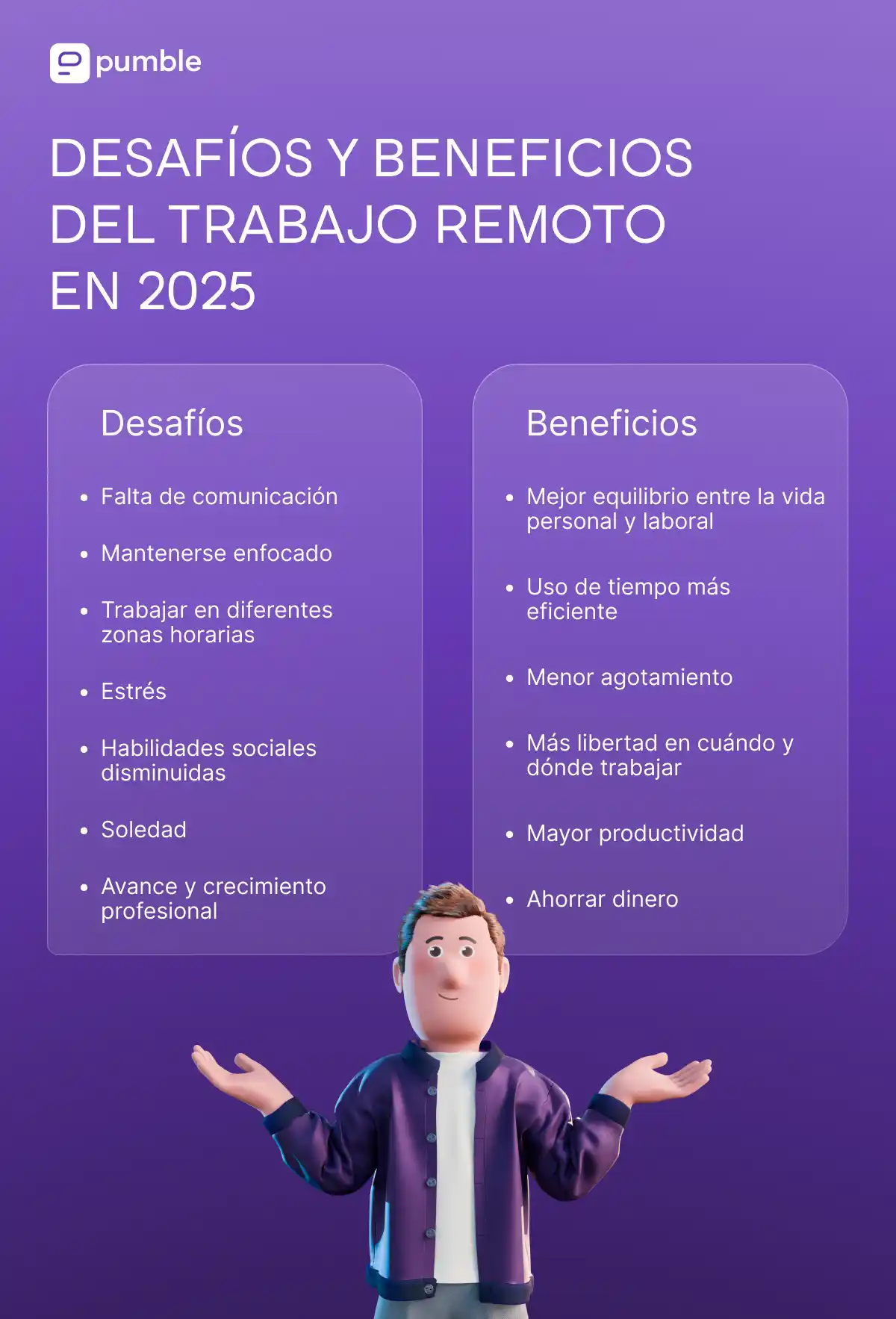
1. Falta de comunicación adecuada en el lugar de trabajo
Mantener una comunicación adecuada en el lugar de trabajo todavía preocupa a la fuerza laboral remota, pero no tanto como antes.
Como informa Buffer, solo el 8% de los encuestados dijeron que tenían problemas para comunicarse y colaborar con sus compañeros de equipo en 2023.
En 2024, la mala comunicación en los equipos remotos fue una de las principales preocupaciones para los gerentes (el 25%), según Owl Labs. Los empleadores han ofrecido capacitación sobre el uso de métodos de comunicación asíncrona mixta y en tiempo real para remediar esto.
Los datos de 2025 también reflejan esta tendencia, ya que el 53 % de las empresas proporcionó a sus empleados la educación sobre cómo usar los métodos de comunicación asíncrona.
🎓 Consejo Pro de Pumble
Consulta las últimas estadísticas sobre la comunicación en el lugar de trabajo aquí:
2. Mantenerse concentrado y motivado
El informe de Buffer de 2023 reveló que algunos empleados tuvieron problemas para mantenerse concentrados y motivados, es decir el 9 % tuvo problemas con concentración, mientras que el 11 % tuvo problemas con motivación.
Owl Labs encuentra que el enfoque reducido de los empleados también fue una de las principales preocupaciones para el 21 % de los gerentes remotos en 2024. Al mismo tiempo, la parte de los empleados que experimentaron el enfoque máximo trabajando desde casa es la misma como el porcentaje de las personas que se sienten mejor centrados en la oficina: el 41 %.
Sin embargo, parece que el trabajo híbrido se ha convertido en una solución para los empleadores preocupados por entorpecer la concentración de su equipo. La encuesta de CIPD destaca que muchas organizaciones sienten que los arreglos del trabajo remoto han producido cambios positivos, los que, además de mejorar la motivación, incluyen:
- Mejores tarifas de retención de empleados, especialmente entre los nuevos, y
- Mayor compromiso y lealtad entre empleados.
3. Trabajar en diferentes zonas horarias
Buffer encontró que el 14 % de los encuestados citó el trabajo en diferentes zonas horarias como un desafío del trabajo remoto.
Con cada vez más empresas introduciendo el RTO (return to office, o en español - vuelta a las oficinas) y modelos híbridos, trabajar en diferentes zonas horarias es un problema menor que cuando los trabajadores remotos operaban bajo la política de “trabajar desde cualquier lugar”.
Por supuesto, todavía existen equipos distribuidos, especialmente en empresas que trabajan de forma remota, por lo que trabajar en diferentes zonas horarias sigue siendo uno de los mayores desafíos de 2026.
4. Estrés relacionado con el trabajo
Los datos para los últimos tres años de Owl Labs muestra que el estrés en el lugar de trabajo permanece alto.
En 2023, el 56 % de trabajadores informó mayores niveles de estrés en comparación con el año anterior.
En 2024, el 43 % de los empleados informaron haber experimentado un mayor estrés relacionado con el trabajo.
Los últimos números revelan que:
- El 51 % de los empleados cree que sus niveles de estrés relacionado con el trabajo no han cambiado,
- El 39 % informa un aumento, mientras que
- El 10 % cree que hubo una disminución.
5. Dificultades para construir relaciones
Otro problema del trabajo remoto es que dificulta aún más la formación de relaciones laborales significativas.
Los datos de la encuesta de Culture Wizard lo confirman: el 71 % de los encuestados está de acuerdo en que construir y mantener relaciones es un gran desafío para los equipos virtuales.
Cuando las personas tienen dificultades para establecer relaciones sólidas en el trabajo, les cuesta manejar los conflictos y desacuerdos en el lugar de trabajo (el 54 %) y les resulta más difícil ser espontáneos con sus colegas (el 68 %).
El cambio al trabajo remoto e híbrido ha hecho que reconstruir las conexiones sociales y la cohesión del equipo sea particularmente difícil para los tomadores de decisiones, afirma Microsoft en su informe “Work Trend Index Special”.
Según los datos, el 68 % de los responsables de la toma de decisiones considera que mantener las conexiones sociales dentro de los equipos es uno de sus mayores desafíos. Desafortunadamente, los empleados sufren las consecuencias de estos obstáculos.
Aproximadamente el 51 % siente que sus relaciones con compañeros de trabajo fuera de su equipo se han debilitado, lo que deja al 43 % sintiéndose desconectado de la empresa. A menos que los empleadores tomen medidas para combatir estas cifras, podrían ver cómo la baja satisfacción de los empleados afecta el éxito de la organización.
Además de estos problemas, los trabajadores pueden también experimentar consecuencias físicas que afectan negativamente su salud. El informe “IWG Hybrid Working Productivity Report” de 2025 indica que los trabajadores remotos superan a sus compañeros que trabajan en situ con respecto a la baja por enfermedad. Esta disparidad es, hasta cierto punto, un resultado de soledad y aislamiento intensificados que experimentan los trabajadores remotos.
6. Incapacidad para desconectarse después del trabajo
En el informe de Buffer de 2023, el 11 % de los encuestados citó la dificultad para desconectarse después del trabajo como el mayor desafío. Este porcentaje supone una disminución con respecto al año anterior, cuando el 25 % de los trabajadores remotos no podían desconectarse cuando no estaban trabajando.
La encuesta de Deloitte de 2023 entre Millennials y la Generación Z lo confirmó, pero los datos también muestran que a la Generación Z no les está yendo mejor: ¾ de los Millennials y la Generación Z no pueden desconectarse de su trabajo.
Estas cifras son lamentables, ya que hay mucho más que se puede ganar de desconectarse después del trabajo.
Un estudio de Universidad de Pittsburgh analizando la conexión entre rentabilidad y leyes de “derechos de desconectarse”, que abarcó 10 años, revela lo siguiente: en los países con legislación que fomenta que los empleados ignoran la comunicación relacionada con el trabajo fuera de las horas de trabajo, las empresas experimentan mayores ingresos junto con los menores costes operativos. Por otro lado, los empleados informan mejor recuperación durante su horario fuera de trabajo.
7. Soledad y aislamiento
En 2024, hemos visto un declive ligero en el número de personas que se sienten solas y aisladas debido al trabajo remoto. Según Owl Labs, los gerentes informaron preocuparse más por la soledad de sus equipos remotos (el 19 %) que sus colegas que trabajan desde la oficina (el 14 %), aún así esto todavía es en un menor grado en comparación con años anteriores.
Según Buffer, el 23 % de los trabajadores remotos citan la soledad como su principal lucha en 2023. Además de sentirse aislados en el trabajo, también afirman que la soledad se ve exacerbada porque se quedan en casa todo el día (ya que el trabajo remoto no les da una razón para salir).
En 2026, estos desafíos persisten. Una revista completa de soledad y aislamiento durante la era de teletrabajo revela tanto, subrayando que la falta de entornos sociales estructurados e interacciones físicas típicamente llevan a:
- Mayor tensión emocional,
- Peor rendimiento laboral, y
- Sentido de aislamiento aumentado.
8. Menos oportunidades de avance y crecimiento profesional
Trabajar de forma remota no debería obstaculizar el desarrollo y el crecimiento profesional.
El informe de Buffer de 2023 profundizó en cómo el trabajo remoto afectaba las oportunidades de avance profesional de los empleados, con el 28 % de encuestados afirmando que su empresa no proporciona oportunidades de crecimiento profesional.
Además, el 36 % de encuestados dijo que el trabajo remoto facilita su crecimiento profesional.
Sin embargo, los hallazgos de Owl Labs de 2023 muestran que el sesgo de proximidad es una preocupación importante para la fuerza laboral remota. Casi la mitad de los encuestados (el 48 %) temen que trabajar de forma remota signifique que no serán escuchados y que sus compañeros de trabajo en la oficina tendrán más oportunidades de progresar.
La situación es aún más grave cuando observamos las opiniones de los gerentes y tomadores de decisiones: el 68 % de ellos siente que sus trabajadores remotos o híbridos se están perdiendo feedbacks constructivos y oportunidades de crecimiento y que eso puede obstaculizar su crecimiento profesional. Sólo el 29 % no se siente así.
El mismo desafío está presente en su informe de 2024, ya la mayoría de los gerentes de equipos remotos aún así informan que sus equipos están perdiendo oportunidades de feedback y desarrollo improvisado.
| ¿Los gerentes sienten que su equipo remoto está perdiendo oportunidades de desarrollo? | Porcentaje |
|---|---|
| Sí | 56 % |
| No | 40 % |
| No lo saben | 4 % |
El aumento del trabajo híbrido ha aliviado un poco estas condiciones. En su último informe, Owl Labs subraya que el 30 % de empleados remotos e híbridos siente que estar fuera de la oficina disminuye las oportunidades de recibir un feedback espontáneo.
Estadísticas sobre los beneficios del trabajo remoto
Por supuesto, no habríamos presentado estos desafíos sin varios beneficios para equilibrarlos.
Los datos de Buffer de su informe mostraron que el trabajo remoto apoya la vida de los empleados en más de un sentido al ofrecer una multitud de beneficios.
Los encuestados citaron los siguientes como los mayores beneficios del trabajo remoto:
- El 22 % — Flexibilidad en la forma en que pasan el tiempo,
- El 19 % — Flexibilidad sobre el lugar donde eligen vivir,
- El 13 % — Flexibilidad para elegir su lugar de trabajo,
- El 12 % — Tener más tiempo porque no viajan diariamente,
- El 11 % — Ahorrar dinero,
- El 8 % — Mejor concentración,
- El 7 % — Trabajar en su propio espacio,
- El 4 % — Flexibilidad en las oportunidades profesionales,
- El 3 % — Sentirse más seguro.
Echamos un vistazo a datos más detallados.
1. Mejor equilibrio entre la vida personal y laboral
En esencia, el equilibrio entre la vida personal y laboral es la división del tiempo y la concentración de una persona entre el trabajo y la familia o las actividades de ocio.
En general, la mayoría de los trabajadores disfrutan de un mejor equilibrio entre la vida laboral y personal cuando trabajan desde casa.
Según el informe de Zapier, el 96% de los encuestados asocia el equilibrio entre la vida personal y laboral con su felicidad en el trabajo.
Como muestran los datos del informe de Gallup de 2024, el mejor equilibrio entre la vida laboral y personal fue en primer lugar de la lista de los beneficios del trabajo híbrido.
Es decir, el 76 % de los encuestados citó esto como el mayor beneficio, seguido por:
- Uso más eficiente de su tiempo (el 64 %),
- Menor agotamiento (el 61 %),
- Más libertad para elegir cuándo y dónde trabajar (el 57 %), y
- Mayor productividad (el 52 %).
Datos más recientes de IWG confirman estos hallazgos. Según la investigación, los acuerdos de trabajo flexible permiten que los empleados corten sus horas de desplazamiento. Alrededor del 40 % de estas horas extras se dedica a realizar el trabajo adicional, mientras que el restante 60 % se dedica a asuntos personales. A largo plazo, esta redistribución refuerza la frontera entre el trabajo y asuntos personales.
2. Más flexibilidad
Para los empleados remotos, la flexibilidad es otra gran ventaja del trabajo remoto.
Para el 91 % de los examinados por Zapier, los horarios flexibles son la segunda ventaja más importante del trabajo remoto.
Los encuestados del informe sobre el trabajo remoto de Buffer citan una flexibilidad general como uno de los beneficios más importantes del trabajo remoto.
Además, los empleados pueden dedicar más tiempo a la vida familiar gracias a opciones de trabajo flexibles.
Los datos de Owl Labs de 2023 encontraron que el 34 % y el 33 % de los encuestados citó la ubicación de trabajo flexible y los horarios de trabajo flexibles como beneficios más atractivos a la hora de buscar un nuevo trabajo.
Similarmente, los encuestados en su informe de 2024 también valoraron la flexibilidad por encima de todo. Más encuestados (el 41 %) dijo que buscaría un nuevo trabajo más flexible en dónde y cuándo trabajan si perdieran sus privilegios del trabajo híbrido. En 2025, este número permaneció mayormente estable al 40 %.
3. Tiempo libre adicional
Alrededor del 59 % de los empleados que trabajan desde casa dicen que disfrutan de más tiempo libre porque no viajan al trabajo.
Además, el tráfico está disminuyendo y la gente camina más que nunca en comparación con la época anterior a la pandemia, todo gracias a la posibilidad de trabajar desde casa.
Es más, según FlexJobs, el viaje de ida promedio para los empleados de los EE. UU. es un poco menos de 30 minutos. El informe también nota que el viaje más largo de 30 minutos está directamente vinculado a niveles más altos de ansiedad y estrés.
4. Ahorrar dinero
Otro beneficio del trabajo remoto que se cita con frecuencia es el ahorro de dinero.
El informe de Owl Labs de 2024 encontró que los trabajadores híbridos ahorran alrededor de 42 $ al día cuando trabajan en remoto y no desde la oficina.
Teniendo en cuenta que los costes se acumulan, no es de extrañar que el mismo informe afirma que el 29 % de los encuestados esperaría un aumento salarial si ya no pudieran trabajar de forma remota o en un modelo híbrido.
5. Diversas opciones para quienes no pueden trabajar en la oficina
El trabajo remoto es una buena opción para las personas a las que les resulta difícil o simplemente no pueden trabajar desde la oficina, reveló el informe de Buffer de 2022.
Estos son:
- Gente con discapacidades,
- Padres y cuidadores, y
- Dueños de mascotas.
Las personas con una discapacidad o enfermedades crónicas prefieren el trabajo remoto porque les da más flexibilidad: el 44 % de los encuestados de Buffer que identificaron tener una discapacidad o enfermedad crónica están de acuerdo.
Además, el trabajo remoto les brinda un mejor acceso a una gama completa de oportunidades de crecimiento profesional.
Otra demográfica que se beneficia del trabajo remoto son los padres: el informe de Owl Labs de 2023 reveló que el 66 % de los empleados tuvieron niños en la casa.
En el informe de 2025, el 62 % de los encuestados indicó que sus niños aún viven en la casa, mientras que:
- el 13 % de los empleados tuvo niños que aún no viven en la casa, y
- el 24 % no tuvo niños.
6. Mejor compromiso y moral de los empleados
According to Owl Labs, remote work supports better employee engagement and increases morale. This is good news, considering engagement is still one of the top concerns of managers leading hybrid/remote teams in 2026.
Los datos muestran que el 27% de los gerentes están preocupados por el compromiso de los empleados.
La falta de compromiso en el trabajo también es una preocupación para los empleados: el 52% de ellos afirma que está en lo más alto de su lista.
Afortunadamente, Buffer informa que más del 58% de los encuestados que trabajan de forma remota están comprometidos en su trabajo:
- El 35% está muy comprometido,
- El 23% está algo comprometido,
- El 12% no está ni comprometido ni indiferente, y
- El 18% está desconectado.
Además, los datos más recientes de Gallup muestran que los empleados remotos e híbridos han superado continuamente a sus colegas que trabajan desde la oficina en términos del compromiso desde 2020.
Una investigación similar de IWG sugiere que el trabajo híbrido, que ocasionalmente incluye el trabajo en equipo en persona, puede mantener los niveles altos de compromiso. Eso no solo disminuye la experiencia del aislamiento y la soledad sino también se transforma en unas ganancias tangibles para los empleadores. Es decir, el compromiso alto está directamente relacionado a las ganancias de productividad, y las empresas de EE. UU. pueden esperar ganar 17, 600 millones de dólares hasta 2030.
🎓 Consejo Pro de Pumble
Para obtener los números más importantes sobre las tendencias y los factores del compromiso de los empleados, consulta la siguiente guía:
Estadísticas sobre trabajo remoto y productividad
Desde que el trabajo remoto e híbrido se volvieron más predominantes, los pensamientos sobre la productividad han preocupado a empleadores y empleados. Sin embargo, las opiniones están divididas sobre el impacto del trabajo remoto en la productividad.
Algunos investigadores creen que ha hecho que los empleados sean menos productivos, mientras que otros piensan que realmente ha aumentado la productividad en el lugar de trabajo.
Aquí están las estadísticas y los datos de productividad en el trabajo remoto.
La mayoría de los empleados afirman que son más productivos cuando trabajan desde casa
La mayoría de las investigaciones muestran que los empleados son más productivos cuando trabajan de forma remota. De hecho, el informe de Owl Labs de 2025 revela que, en general, los gerentes tienen una perspectiva positiva en el trabajo híbrido, con:
- el 69 % creyendo que ha afectado positivamente la productividad de su equipo,
- el 19 % afirmando que no ha habido cambios en la productividad de los empleados, y solo
- el 12 % afirmando que sus equipos se han vuelto menos productivos.
La edición 2024 del informe de Owl Labs muestra que la productividad de los empleados ha permanecido constante entre los trabajadores remotos e híbridos (el 90 %). Sin embargo, el 46 % de los empleados dijo que su empresa ha introducido o aumentado el software de monitoreo de la productividad de los empleados en el último año.
En 2023, una abrumadora mayoría de los encuestados: el 91 % dijo que siente que es igual o más productivo en su modelo de trabajo actual.
Según los datos de un estudio de dos años realizado por Great Place to Work que examinó las respuestas de más de 800 000 empleados de empresas Fortune 500, la mayoría de las personas experimentaron niveles de productividad estables o aumentados después de cambiar de oficina a trabajar desde casa.
Más de la mitad de las personas dicen sentirse más productivas trabajando en la oficina
Según “Flex Report”, las empresas con políticas más flexibles superan a las organizaciones impulsadas por los mandatos RTO (regreso a la oficina).
Aún así, preguntar a los empleados sobre su productividad personal trae un enfoque más sutil a la productividad en situ vs. híbrida. Los encuestados en el informe de Owl Labs de 2024 mostraron que su productividad depende de la actividad, no solamente del lugar de trabajo.
Por lo tanto:
- El 45 % de los empleados informó sentirse más productivos al cumplir las fechas límites en la oficina (vs. el 36 % en remoto),
- El 44 % informó sentirse más productivos colaborando en la oficina (en comparación con el 24 % en remoto), y
- El 41 % informó sentirse más productivo al realizar las lluvias de ideas en la oficina (vs. el 34 % en remoto).
La mayoría de los líderes todavía están preocupados por la productividad de los empleados
Una encuesta de Atlassian de los ejecutivos de empresas Fortune 500 mostró que los gerentes y líderes todavía están preocupados por los niveles de productividad en 2024.
Aunque el 91 % de los encuestados dijeron que implementaron algún tipo de mandato de regreso a la oficina, los niveles de productividad siguen siendo una preocupación importante, casi como si les preocupara que obligar a la gente a regresar a las oficinas afecte negativamente su productividad.
Además, Owl Labs muestra que las preocupaciones de los gerentes sobre la productividad de los empleados han aumentado desde 2023. En 2024, informó que sus equipos fueron más productivos por un 62 % cuando trabajan de forma híbrida o remota, un declive notable del 79 % que informaron en 2023. Y en 2025, el 79 % de los encuestados creía que algunos empleadores estaban impulsando las políticas de regreso a la oficina en un intento de mejorar la productividad y colaboración.
🎓 Consejo Pro de Pumble
Para garantizar que tu equipo siga siendo productivo y mantenga la máxima productividad, consulta esta guía completa:
La productividad puede depender del tipo de modelo de trabajo
En su informe “Virtual Teams”, Culture Wizard reveló que no todos los modelos de trabajo tienen el mismo impacto en la productividad de los empleados.
La conclusión clave fue que las empresas que implementan cualquier tipo de modelo de trabajo remoto (por ejemplo, totalmente remoto, remoto en primer lugar o híbrido) disfrutan de una mayor productividad.
| Tipos de modelos de trabajo | Porcentaje de productividad |
|---|---|
| Totalmente remoto | 34 % |
| 75 % remoto | 28 % |
| 50 % remoto | 20 % |
| Completamente en oficina | 9 % |
De manera similar, Owl Labs encontró en 2024 que la productividad de los empleados varía según los modelos de trabajo dependiendo de la categoría de proactividad.
Por lo tanto, veamos que las personas se sienten más productivas trabajando independientemente desde su casa, mientras que, en su opinión, conocer nuevas personas y participar en mentorías es más adecuado para la oficina. Los espacios de coworking reciben la menor cantidad de crédito en casi todas las categorías.
| Categoría de productividad/ Ubicación de trabajo | Casa | Espacio de coworking | Oficina |
|---|---|---|---|
| Trabajar independientemente | 50 % | 16 % | 34 % |
| Pensar creativamente | 46 % | 21 % | 33 % |
| Centrarse | 41 % | 18 % | 41 % |
| Cumplir las fechas límites | 36 % | 19 % | 45 % |
| Aprendizaje formal/ informal | 35 % | 23 % | 42 % |
| Innovación/ Lluvia de ideas | 34 % | 25 % | 41 % |
| Reuniones de equipo | 26 % | 25 % | 49 % |
| Desarrollo de carrera | 26 % | 23 % | 51 % |
| Gestionar a otros | 25 % | 24 % | 51 % |
| Colaborar | 24 % | 32 % | 44 % |
| Tener un mentor | 23 % | 26 % | 51 % |
| Conocer nuevas personas | 18 % | 27 % | 55 % |
Estadísticas que muestran el papel de las herramientas de colaboración online en el trabajo remoto
Mantenerse conectado durante la pandemia, cuando la mayoría de las empresas tuvieron que trabajar de forma remota, fue esencial.
En consecuencia, el uso de herramientas de colaboración en línea se disparó, lo que facilitó a las empresas comunicarse y colaborar con sus empleados incluso desde lejos.
¿En qué medida los trabajadores remotos dependen de las herramientas de colaboración para comunicarse?
¿Qué han hecho las empresas para facilitar la comunicación y la colaboración de su fuerza laboral remota?
¿Están satisfechos los empleados y empleadores con las herramientas y procesos que facilitan la comunicación remota?
Veamos si las estadísticas de trabajo remoto de 2026 pueden arrojar luz sobre estas cuestiones.
🎓 Consejo Pro de Pumble
La tecnología de colaboración se ha vuelto indispensable para los equipos remotos e híbridos. Obtén más información sobre el software de colaboración y aprende cómo utilizarlo para mejorar la comunicación de tu equipo remoto:
Las herramientas de colaboración despegaron en 2021 y se estabilizaron en 2023
Según la encuesta “Digital Worker Experience Survey“, de Gartner, casi el 80 % de los trabajadores utilizaron herramientas de colaboración en 2021. Esto representa un aumento del 55 % en 2019 y un aumento del 44 % desde que comenzó la pandemia.
Otro grupo de herramientas que experimentó un aumento significativo en su uso fueron las herramientas de almacenamiento e intercambio de documentos: alrededor del 10 %.
Además, el 80 % de los trabajadores remotos utilizaban aplicaciones de mensajería instantánea en 2021, un aumento del 75 % en 2019.
En 2024, estas cifras serán algo más bajas debido a los mandatos de regreso a las oficinas. Por ejemplo, el 56 % de los trabajadores utiliza herramientas de colaboración a diario, según la investigación de Zippia.
El informe State of Remote Work de Buffer muestra que en 2023 los trabajadores remotos preferirán comunicarse con clientes y compañeros de equipo a través de aplicaciones de mensajería mucho más que por correo electrónico: el 50 % frente al 22 %.
Las empresas también están reconociendo este cambio. En el informe “State of Teams 2025”, el 93 % de los ejecutivos destacó que la tecnología y el software juegan un papel crucial en su éxito.

La mayoría de las empresas introdujeron un sistema adecuado para la comunicación y colaboración remotas
En el informe de 2023 Owl Labs, el 39 % de los encuestados dijo que su empleador ha actualizado su tecnología de vídeo para permitir una colaboración y comunicación más híbrida.
El informe también muestra que muchos empleados están de opinión que sus empresas se han excedido con la tecnología de comunicación: el 64 % piensa que tiene que utilizar demasiadas plataformas de comunicación.
Parece que la plataforma de colaboración y comunicación interna todo en uno resolvería muchos problemas para trabajadores remotos e híbridos.
La importancia de una buena herramienta de colaboración y comunicación no se puede exagerar. En el último informe de Owl Labs, más encuestados, el 86 %, destacó tener más reuniones en línea o híbridos que las reuniones en persona, el 83 %. Por lo tanto, usar herramientas de colaboración es obligatorio para muchos.
Además, en 2025, algunos empleadores se esforzaron para simplificar la comunicación digital:
- Contratando más personal y soporte TI (el 29 %) y
- Instalando o actualizando nuevo equipo de vídeo y audio (el 21 %).
Las generaciones más jóvenes tienden a utilizar más las herramientas de colaboración
Las herramientas de colaboración son una parte importante del trabajo remoto. En la mayoría de los casos, se espera que los trabajadores remotos las utilicen a diario para mantenerse en contacto con su equipo y realizar su trabajo.
Sin embargo, la investigación sobre las diferencias entre generaciones muestra que los jóvenes dependen más de herramientas de colaboración, especialmente cuando se trata de herramientas de videoconferencia y aplicaciones de comunicación en el lugar de trabajo. Estas herramientas les pueden ayudar a evitar la falta de comunicación y realizar un seguimiento del progreso.
Los datos más recientes muestran tendencias similares. Un informe de 2024 de Owl Labs encontró que el 51 % de los empleados que disfrutaron de su tecnología de reunión híbrida fueron los Millennials, en comparación a solo el 17 % de los Boomers.
Utilizar un software de videoconferencias confiable y fácil de usar puede aumentar este número y crear un ambiente de reunión virtual agradable, natural y productivo para todas las generaciones.
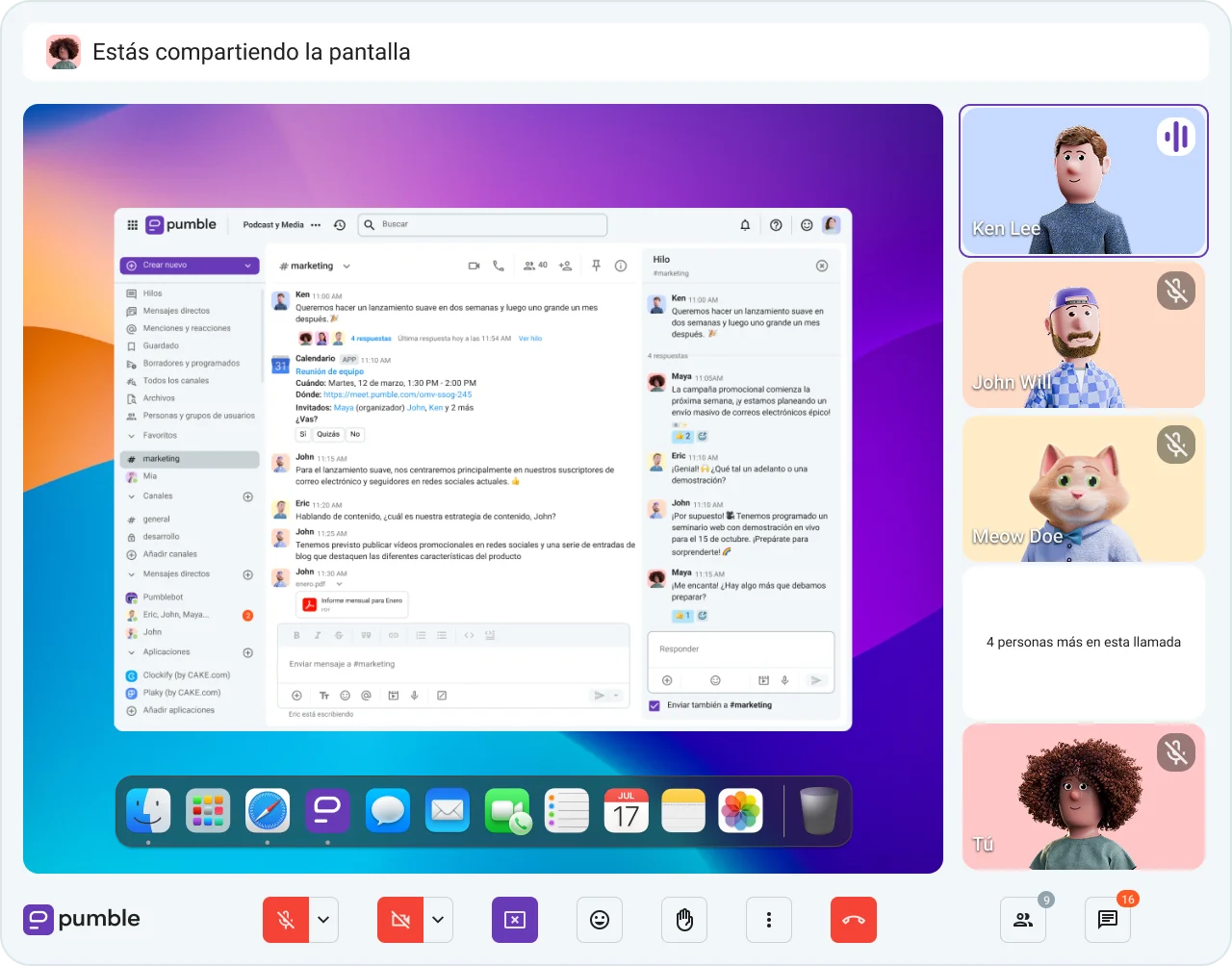
Todas las generaciones se sienten agobiadas por la multitud de las aplicaciones
Si bien las herramientas de colaboración facilitan la comunicación y la colaboración, todas las generaciones sienten que cambiar entre estas aplicaciones a menudo les hace perder el tiempo.
Por ejemplo, el 60 % de los empleados de entre 18 y 24 años y el 63 % de entre 25 y 34 años creen que pierden el tiempo cambiando entre herramientas de colaboración.
Alrededor del 99 % de los trabajadores remotos utilizan aproximadamente 4,8 herramientas de reuniones diferentes, según revelan los datos de las estadísticas de FinancesOnline.
Aunque los empleados mayores de 55 años suelen utilizar menos aplicaciones de colaboración, alrededor del 40 % también cree que están perdiendo el tiempo cambiando entre tecnologías de colaboración.
Recientemente, según Owl Labs, el deseo por las herramientas más fáciles de usar se ha vuelto más fuerte. En 2025, cada 8 en 10 encuestados afirmó que perdió tiempo debido a dificultades tecnológicas. Agravando el problema, cada 1 en 4 encuestados informó perder más de 10 minutos al unirse a una reunión híbrida debido a pasos complejos.

Estadísticas que muestran cuán seguro es el trabajo remoto
Ya que el trabajo remoto llegó para quedarse, las empresas deben intensificar su ciberseguridad.
Pero, ¿cómo las empresas mantienen la seguridad de su fuerza laboral remota y de sus datos confidenciales?
¿Las empresas confían en sus trabajadores remotos?
¿Implementan y actualizan sus estrategias de ciberseguridad periódicamente?
Para obtener más información, veamos las estadísticas sobre lo que están haciendo las empresas para garantizar la ciberseguridad en un entorno de trabajo remoto en 2026.
Más de la mitad de las empresas permiten el acceso remoto a aplicaciones corporativas desde dispositivos personales
Según el informe de ciberseguridad de CheckPoint de 2026, los atacantes han cambiado su enfoque. Reemplazando los ataques de phishing a través del correo electrónico, la ingeniería social multicanal se ha convertido en forma en camino de explotar vulnerabilidades. Como resultado, las víctimas están manipuladas en revelar información confidencial, con la mayoría de las víctimas siendo:
- Empleados,
- Personal subcontratado, y
- Proveedores de servicios de terceros.
De hecho, estos ataques aumentaron por un 500 % en comparación con el año anterior. Es por esta razón que Check Point identifica la protección de datos como un resultado de seguridad crítica para organizaciones modernas.
Los incidentes de pérdida de datos de los eventos impulsados por información privilegiada han aumentado un 28 % desde 2021. Además, la mayoría de los expertos de la información, el 85 %, espera que esta tendencia continúe en los próximos 12 meses, según el informe de exposición de datos para 2024.
Considerando el porcentaje de las empresas permitiendo que los empleados remotos utilicen sus dispositivos para propósitos empresariales, no sorprende que Check Point encontró que el 87 % de ellos han experimentado algún intento de explotación de una vulnerabilidad ya conocida y existente.
Para la mayoría de las empresas, las conexiones de VPN proporcionan un acceso remoto seguro
Según los datos de CyberTalk, el 73 % de las empresas depende de las conexiones de VPN para garantizar el acceso remoto a las aplicaciones y herramientas de la empresa.
Sin embargo, el hecho de que las empresas implementen algunas funciones de seguridad no significa que los empleados las utilicen.
Por ejemplo, según el informe de Tech.co de 2024: “The Impact of Technology on the Workplace”: el 59 % de los encuestados dijo que no está utilizando un VPN, a pesar de que su empresa proporcionó uno.
Además, el 56 % de las empresas han experimentado un ciberataque conectado a las vulnerabilidades de VPN, según el informe de riesgo de 2024 VPN de Cybersecurity Insiders.
El último informe de Check Point apoya estos datos, notando que el acceso VPN, las aplicaciones de colaboración y otros servicios corporativos son a menudo puntos de entrada que los atacantes explotan para obtener el acceso a la infraestructura de la organización.
Estas limitaciones y vulnerabilidades han instado a muchas empresas a realizar la transición a modelos del acceso a la red de confianza cero (ZTNA por sus siglas en inglés), ofreciendo mejor seguridad al verificar continuamente la identidad de los usuarios y la conformidad del dispositivo.
Por lo tanto, a veces, depender de un par de elementos de vez en cuando para proporcionar un acceso remoto seguro no es suficiente.
Aquí es donde las políticas de seguridad del trabajo remoto resultan útiles.
La mayoría de las empresas tienen una política de seguridad para el trabajo remoto
Según la encuesta de ciberseguridad de OpenVPN, alrededor del 93 % de las empresas cuentan con una política de seguridad del trabajo remoto.
Pero, ¿exactamente qué incluyen en sus políticas de seguridad para el trabajo remoto?
El informe de OpenVPN reveló que los 3 elementos principales que la mayoría de las empresas incluyen en sus políticas de seguridad para el trabajo remoto son:
- VPN (el 74 %),
- Cifrado de datos confidenciales (el 69 %), y
- Prohibición del uso de dispositivos personales para datos relacionados con el trabajo (el 68 %).
Otros elementos incluyen:
- Capacitación sobre la seguridad para empleados (el 66 %),
- Gestión de contraseñas (el 56 %), y
- Prohibición de traer tu propio dispositivo (el 38 %).
El “OpenVPN VPN Statistics and Trends for 2025” informa que la fuerza laboral remota e híbrida demanda un refinamiento continuado de políticas de seguridad. Consecuentemente, muchas empresas se han comprometido a implementar protecciones adicionales, como:
- Actualizaciones rutinarias,
- Pruebas de vulnerabilidad, y
- Monitoreo de amenazas.
La percepción del riesgo varía entre empleados y ejecutivos
Según los datos de Cybersecurity Report, el 90 % de los encuestados cree que el trabajo remoto no es seguro.
Adicionalmente, el 73 % de vicepresidentes y ejecutivos de alto nivel dice que los trabajadores remotos representan un mayor riesgo que los empleados en la oficina.
Alrededor del 48 % de los gerentes de TI y el 45 % de los directores de TI están de acuerdo.
Estas preocupaciones de seguridad son la razón principal por la que las empresas han empezado a conectar los VPN con la tecnología de confianza cero. El informe “VPN Statistics and Trends for 2025” reconoce que este comportamiento refleja la motivación “confía nunca, verifica siempre” que muchas organizaciones han adoptado para reforzar sus métodos de autenticación de usuario.
Las empresas suelen organizar capacitaciones en ciberseguridad dos veces al año
Proporcionar una formación adecuada a sus empleados es un paso adelante en la creación de un entorno de trabajo desde casa fiable y seguro.
La encuesta de OpenVPN encontró que alrededor del 90 % de las empresas ofrecen capacitación en seguridad para sus empleados remotos.
Sin embargo, también se ha revelado que sólo el 23 % de las empresas exigen que sus empleados reciban formación en ciberseguridad más de dos veces al año.
| ¿Con qué frecuencia las organizaciones exigen que los trabajadores remotos reciban capacitación en ciberseguridad? | Porcentaje |
|---|---|
| Más de dos veces al año | 23 % |
| Dos veces al año | 32 % |
| Una vez al año | 25 % |
| Sólo durante la incorporación de empleados | 8 % |
| Disponen de una plataforma e-learning que ofrece cursos para que los empleados los realicen cuando quieran | 11 % |
Desafortunadamente, en 2025, muchas organizaciones no priorizaron la capacitación de ciberseguridad. Más recientemente, el informe de ciberseguridad de World Economic Forum para 2026 examinó si las organizaciones proporcionan guías o asistencia de ciberseguridad y encontró que:
- el 34 % ofrece capacitación, servicios o programas formal,
- el 31 % ofrece procedimientos informales (como consejo o consultas), y
- el 35 % no tiene ningún programa de capacitación o asistencia.
A pesar de una mayor conciencia, los comportamientos de riesgo continúan
Los datos de CheckPoint de 2025 muestran que el 96 % de los exploits en 2024 usaron las vulnerabilidades reveladas antes de ese año, destacando la necesidad de unas medidas más proactivas.
Los datos para 2026 destacan la necesidad de aumentar la vigilancia debido a la frecuente búsqueda de información por voz. El informe resume aproximadamente 40 incidentes donde los atacantes se hacen pasar por soporte TI para obligar a los objetivos para revelar la información, como las contraseñas y credenciales administrativas.
El aumento de tasas de incidentes es una tendencia de trabajo remoto persistente a lo largo de los últimos dos años.
En los últimos 9 meses de 2023, más de 360 millones de personas fueron víctimas de brechas de datos corporativos o institucionales a pesar de ser conscientes de los riesgos, según un informe del Dr. Stuart E. Madnick titulado “The Continued Threat to Personal Data; Key Factors Behind the 2023 Increase”.
Los datos de “2025 Data Breach Investigations Report” de Verizon revela que el 46 % de incidentes involucrando sistemas comprometidos ocurrieron porque los empleados utilizaron:
- Inicio de sesión corporativo en sus dispositivos personales, o
- Dispositivos corporativos para asuntos personales, posiblemente violando las políticas de privacidad.
Mantente seguro y productivo en Pumble
La IA generativa está creando nuevas preocupaciones de ciberseguridad
El informe de Verizon reconoce que la IA generativa se ha convertido en una herramienta utilizada ampliamente para ciberataques. Específicamente, el contenido malicioso de IA generativa en correos electrónicos se ha doblado en los últimos dos años. Sin embargo, lo que puede ser una preocupación aún más grande para las empresas es la posibilidad de que la IA generativa se convierta en una amenaza “interna”.
La brecha de datos interna es una consecuencia significativa del uso malo de IA, ya que:
- El 15 % de los empleados admite utilizar dispositivos corporativos para acceder regularmente a herramientas AI.
- El 72 % de los empleados ha utilizado sus dispositivos corporativos para acceder a las herramientas de IA a través de sus direcciones de correo electrónico personales.
Con la IA siendo una nueva frontera en el sector de TI, los riesgos sobre la brecha de datos y los datos comprometidos plantean serias preocupaciones de privacidad. Pasando a 2026 y más adelante, es probable que las empresas en todos los sectores se centren en desarrollar respuestas adecuadas sobre la seguridad y cumplimiento.
¿Cuál es el futuro del trabajo remoto en 2026?
En 2024, La Gran Renuncia, también conocida como la Gran Dimisión, fue una tendencia en todo el mundo.
Desde principios de 2021, La Gran Renuncia ha hecho que los empleados renuncien voluntariamente a sus trabajos de forma masiva, principalmente en busca de mejores condiciones laborales y beneficios como trabajo remoto u horarios de trabajo flexibles.
Los datos de una encuesta de la Oficina de Estadísticas Laborales de EE. UU. muestran que 3,9 millones de trabajadores renunciaron solo en enero. En 2021 y 2022, esa cifra superó regularmente los 4 millones cada mes. Algunos incluso dicen que entraremos en la era de la “Gran Estancia” (“Big Stay”) en 2024.
La Gran Renuncia allanó el camino de “la renuncia silenciosa” (el quiet quitting), o hacer lo mínimo para mantener su trabajo, pero nada más. En los mejores casos, los gerentes tomaron nota e hicieron todo lo posible para retener el talento con diferentes incentivos como la flexibilidad. Otros vieron a los empleados volverse más desordenados y participar en polyworking — hacer un trabajo adicional, para garantizar ingresos adicionales y explorar un proyecto paralelo.
Al final, a finales de 2024, vimos a los empleados entrar en su era de Gran Desprendimiento. Insatisfacción con sus empleadores, escaso mercado laboral e inflación todo esto hizo que los empleados se sintieran estancados y desconectados. Esto llevó a una proporción históricamente baja (el 18 %) de empleados que informaron estar satisfechos con su trabajo y un porcentaje históricamente alto (el 51 %) de personas buscando activamente un nuevo trabajo.
Al final, 2025 trajo un compromiso. Ya que los mandatos de regresar a la oficina han interrumpido la comodidad de rutinas de los empleados completamente remotos, los empleadores han realizado que el equilibrio adecuado fue la clave para retener (y atraer) a los principales talentos.
En 2025, el informe de Skedda sobre el espacio de trabajo moderno destacó el trabajo híbrido como la solución más sostenible para el futuro. Las empresas son también satisfechas con este arreglo, como nota el informe:
- el 87 % de los líderes de recursos humanos admite que el trabajo híbrido contribuye al mejor equilibrio trabajo-vida, mientras que
- el 84 % cree que ha aumentado la satisfacción con el trabajo entre los empleados.
Por lo tanto, ¿qué predicen las estadísticas de trabajo remoto en 2026 para el futuro del trabajo?
¿Cuántos empleados dejarían sus trabajos actuales sin una opción de trabajo remoto o híbrido?
Vamos a averiguarlo.
A la gente le gustaría seguir trabajando de forma remota
En 2023, la fuerza laboral mundial se inclinaba aún más hacia el trabajo remoto. “State of Remote Work 2023 de Buffer” indica que el 98 % de los empleados quieren continuar trabajando de forma remota de alguna manera durante el resto de sus carreras.
Los informes de 2024 mostraron que el 40 % de los empleados remotos buscaría un nuevo trabajo si ya no pudiera trabajar de remoto, mientras que el 22 % dijo que esperaría un aumento de salario.
Los datos de 2025 son similares. Una encuesta de Pew Research Center confirmó que al 72 % de trabajadores híbridos le gustaría continuar este arreglo. Al mismo tiempo, el 62 % de los encuestados que han trabajado rara vez o nunca desde casa indicó que le gustaría cambiar al trabajo híbrido, al menos por una parte del tiempo.
Aún así hay una resistencia palpable hacia el trabajo completamente en persona. Casi la mitad de los encuestados (el 46 %) indicó que probablemente dejará su trabajo si fuera necesario regresar a la oficina.
Muchos empleados desean acuerdos más flexibles
El “Flex Report 2024” predijo correctamente que muchas empresas emitirán políticas de trabajo híbrido estructuradas en 2024. Esta tendencia continuó en 2025, aunque la habilidad de trabajar desde casa es algo que muchos trabajadores siguen buscando. Según “FlexJobs Remote Work Index”, el 85 % de los que buscan trabajo valoran el trabajo remoto por encima de otros beneficios atractivos, incluyendo el salario.
Un informe de 2025 de King's College London, que exploró los mandatos de regreso a la oficina, nota una resistencia creciente entre los empleados, ya que solo el 42 % estaría de acuerdo con pasar su semana laboral entera en la oficina. En 2022, esta cifra fue alrededor del 54 %.
Algunos empleados renunciarían si ya no pudieran trabajar de forma remota
En 2023 y 2024, los empleados estaban preparados para presentar su renuncia en sus puestos de trabajo actuales si aparecía una oportunidad de trabajo remoto.
En el informe “State of Hybrid Work”, los encuestados de Owl Lab dijeron que, si no se les permitiera trabajar de forma remota o híbrida, harían lo siguiente:
- Esperar un aumento de sueldo: el 29 %,
- Empezar a buscar otro trabajo con más flexibilidad de ubicación: 24 %,
- Empezar a buscar otro trabajo con más flexibilidad en el horario laboral: 18 %,
- Quedarse en trabajo actual, pero no ser feliz: 9 %,
- Quedarse en trabajo actual, pero estar menos dispuestos a hacer un esfuerzo adicional: 9 %,
- No les importaría: 7 %, y
- Dejar el trabajo actual: 4 %.
Aunque sólo el 4 % de la fuerza laboral renunciaría, claramente la mayoría de ellos abandonaría el lugar de trabajo en algún momento.
La situación fue igual en 2025. Aunque el 5 % de los encuestados renunciaría por completo, el 40 % empezaría a buscar nuevo puesto, un aumento notable del 16 % en comparación con 2024.
Los empleados remotos buscan trabajo por diversos motivos
Después de la pandemia, los trabajadores remotos cambiaron sus prioridades y las expectativas en el lugar de trabajo.
Como indica el último informe de Owl Lab que el número de profesionales remotos e híbridos buscando activamente un nuevo trabajo es el 27 %, el mismo como en 2024.
Las razones para esto son distintas:
- Mejor compensación: el 49 %,
- Mejor equilibrio trabajo-vida: el 48 %,
- Mejores oportunidades profesionales: el 44 %,
- Hacer algo que les apetece: el 35 %,
- Reducir el estrés: el 32 %,
- Mayor flexibilidad en cuanto a sus horas de trabajo: el 28 %,
- Mayor flexibilidad en cuanto al lugar donde trabajan: el 24 %,
Aunque la compensación es la razón más importante en la lista, los empleados también declararon que buscarían nuevas oportunidades laborales si no fueran reconocidos en el trabajo — sin importar el dinero.
Los empleados no aceptarán cualquier oferta de trabajo
Aunque las personas no son tan rápidas en cambiar de trabajo como lo fueron durante la Gran Renuncia, todavía no aceptarán una oferta de trabajo que no cumpla todos sus requisitos.
Los datos de Owl Lab muestran que hay 5 razones distintas por las que los empleados rechazaron una oferta de trabajo en 2025 y todas tienen que ver con políticas de trabajo remoto/híbrido:
- No tienen horarios de trabajo flexibles: el 37 %,
- Tienen que trabajar en la oficina a tiempo completo: el 34 %.
- No tienen un lugar de trabajo flexible: el 30 %,
- Tienen que estar en la oficina durante días o tiempo específicos: el 24 %,
- Tienen que trabajar de forma remota a tiempo completo: el 20 %.
Los empleados remotos están dispuestos a sacrificar mucho para permanecer remotos
En 2024, muchas personas no podían trabajar completamente remoto, por lo que se aferraron a horas laborales flexibles y al trabajo híbrido.
El informe de Owl Lab muestra que, por ejemplo, el 16 % de los encuestados aceptaría un recorte salarial del 20 % para obtener horarios de trabajo flexibles. Mientras tanto, el 17 % de los encuestados aceptaría el mismo recorte salarial para trabajar de forma remota.
En 2025, el empleado promedio estaba dispuesto a ver su salario reducido por el 9 % para mantener su horario flexible.
Cuando observamos los datos en diferentes generaciones, es claro que los empleados más jóvenes son más propensos de aceptar un recorte salarial para mantener la flexibilidad:
- Generación Z: el 78 %,
- Millennials: el 73 %,
- Generación X: el 57 %,
- Boomers: el 29 %.
¿Trabajo remoto o en la oficina, o un punto medio?
Si bien algunas empresas planean permanecer completamente remotas y otras se apresuran a regresar a las oficinas, para algunas el futuro es incierto.
Buffer informó que en 2022, el 9 % de los empleados dijeron que su empresa no planeaba hacer que el trabajo remoto fuera permanente, que es casi idéntico a sus hallazgos de 2023.
Otra novedad revelada en el informe de Own Labs para 2023 muestra que más de la mitad de los encuestados, el 53 % no confía que las políticas de la empresa que tenía en 2023 permanecerán en 2024. Cree que su empleador reduciría sus beneficios remotos e híbridos.
En T4 de 2024, fuimos testigos de cómo estas predicciones se hacían realidad. Según el informe de Flex Index, el porcentaje de empresas exigiendo horario completamente en la oficina alcanzó el 32 % en el último trimestre de 2024, significando que el modelo de trabajo presencial se convirtió en el modelo de trabajo prevalente. Al mismo tiempo, los modelos del trabajo completamente flexible, que no exige tiempo obligatorio en la oficina, disminuyeron del 31 % en 2023 al 25 % en 2025.
El “Cisco Global Hybrid Work Study 2025” confirma que muchas empresas están intentando eliminar gradualmente el trabajo remoto e híbrido. En su número inaugural de encuesta, el 62 % de encuestados trabajó bajo algún tipo de política híbrida. Sin embargo, este número disminuyó hasta el 42 % en 2025.
El estudio también nota que los empleadores han comenzado personalizando políticas híbridas para cumplir las necesidades de la fuerza laboral moderna, ya que:
- El 73 % de los encuestados cree que su nuevo acuerdo de trabajo le hace más productivo,
- El 50 % de los principales empleados están en las organizaciones que requieren menos de 3 días de trabajo en la oficina, y
- El 46 % de los empleados admiten que sus nuevas políticas de trabajo requieren más trabajo en persona.
En vez de empujar por un regreso completo a la oficina, los empleadores deben intentar sostener este equilibrio en 2026.
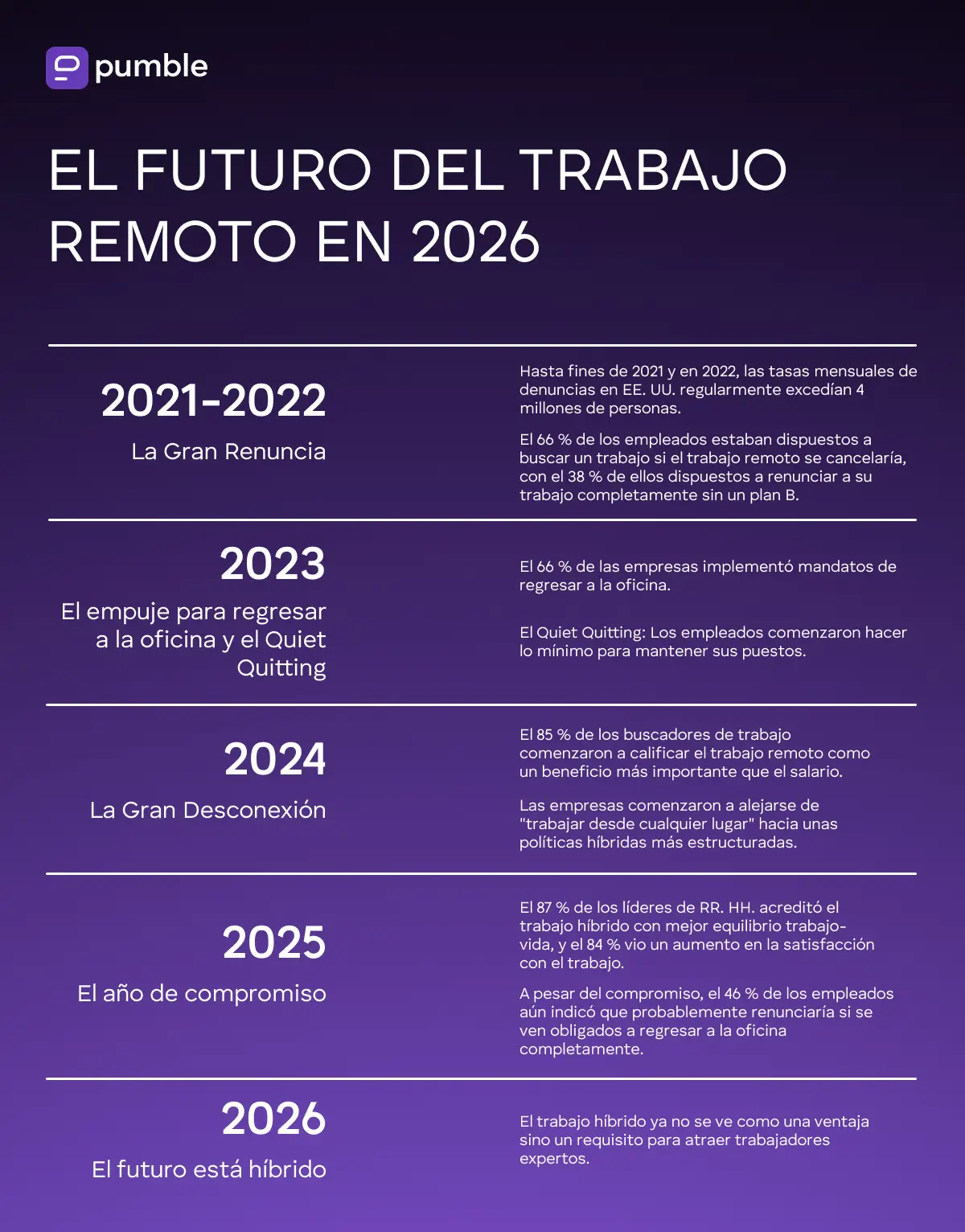
Estadísticas que muestran las tendencias que darán forma al futuro del trabajo
Aunque nunca podemos predecir realmente el futuro, expertos de todo el mundo ya han anticipado algunas tendencias de trabajo remoto que sin duda darán forma a la forma de trabajo en futuro.
A principios de 2021, muchos esperaban un regreso a la "normalidad": un regreso a la oficina.
Sin embargo, 2021 resultó más inestable de lo imaginado, marcado por una guerra masiva por los talentos, altos niveles de inflación y altas tasas de renuncia.
Employment Hero informa que en 2022, nuestra percepción de la normalidad cambió, ya que menos de la mitad de los empleados encuestados (el 45 %) regresaron para trabajar en persona a tiempo completo. En 2023, esa cifra aumentó aún más.
Según el informe de 2024 de Owl Labs, el 25 % de los trabajadores notó que su empleador ha cambiado su política de trabajo remoto o híbrido, y ahora estamos viendo que más personas toman vacaciones de trabajo secretas y como resultado participan en el polyworking como resultado.
Por lo tanto, ¿qué podemos esperar del futuro del trabajo en 2026? Echemos un vistazo más de cerca.
1. Las empresas se apresurarán a encontrar la estrategia híbrida perfecta
Como se menciona a lo largo de este informe, el trabajo híbrido parece ser el futuro del trabajo.
Como se predijo, las empresas utilizaron la mayor parte de 2025 para pulir sus estructuras híbridas.
Pero, aún queda por ver si lograron la proporción perfecta entre trabajo en la oficina y días de trabajo desde casa.
Es más, según los datos de CAKE.com sobre el futuro del trabajo remoto, las empresas también tendrán que idear incentivos para motivar a los empleados a adoptar las prácticas del trabajo híbrido.
2. El “coffee badging” se volverá más popular
Si no sabes qué es el “coffee badging”, no estás solo. Esta tendencia que surgió en 2023, coffee badging puede no ser algo de lo que hayas oído hablar, pero probablemente sea algo que hayas hecho, especialmente si eres un trabajador híbrido.
“Coffee badging” (que se puede traducir como 'fichar para un café'), a veces también denominada “peacocking” (o, en español, postureo) es un fenómeno en el que los trabajadores híbridos van a las oficinas para cumplir con el mínimo exigido por la empresa, pero pasan el menor tiempo posible allí y regresan a casa.
Entonces entran, toman un café rápido, se aseguran de que todos los hayan visto y luego regresan a casa.
En 2023 el 58 % de los trabajadores híbridos hace esto, mientras que otro 8 % está ansioso por probarlo. Eso significa que el 66 % de la fuerza laboral híbrida evita activamente la oficina.
El informe de Owl Labs encuentra que el coffe badging se ha mantenido fuerte durante todo 2024. De hecho, casi una mitad de los trabajadores (el 40 %) informó que aún así está participando en la tendencia aunque el 70 % admitió que sus empleadores ya se dieron cuenta de ellos.
Hasta 2025, la tendencia aún fue relevante, con:
- El 43 % de los empleados participando, y
- Otro 12 % admitiendo que planeaba hacerlo.
3. El uso de la Inteligencia Artificial continúa
En 2023, Top Employers Institute abordó el uso de la tecnología de inteligencia artificial en su informe “World of Work Trends Report”. Según sus datos, algunas empresas ya utilizan herramientas de inteligencia artificial para generar indicaciones para desarrollar programas de aprendizaje para empleados.
En 2024, el 24 % de los encuestados del informe de Owl Labs dijo que utilicen las herramientas de IA diariamente, aunque un 23 % adicional de ellos informó utilizarlas múltiples veces al día. Además, el 47 % de los empleadores utiliza la tecnología de IA para reemplazar o mejorar los roles de los empleados.
La edición 2025 del informe revela que el 80 % de los trabajadores utilizó IA de alguna forma, independientemente de si sus empleadores estaban conscientes o no.
El informe de Upwork, “From Burnout to Balance” indica que los ejecutivos tienen grandes esperanzas en el impacto que la IA tendrá en la productividad de los empleados en los siguientes años. Es decir, hasta el 96 % de los líderes de nivel C cree que las herramientas de IA aumentarán significativamente los niveles de productividad de su empresa. Esto también se ve en su decisión de usar las herramientas de IA, con:
- El 39 % de las empresas exigiendo el uso de las herramientas de IA, y
- Otro 46 % fomentando su uso.
Sin embargo, los empleados aún no comparten este entusiasmo:
- El 77 % de los empleados dice que las herramientas están haciendo lo contrario de lo esperado añadiendo más carga de trabajo.
- El 47 % de los empleados informa no entender cómo lograr los niveles de productividad esperados con IA.
En el informe “State of Workplace Culture and Work-Life Balance” para 2024 de CAKE.com, estamos viendo que la adopción de la IA ocurre más lentamente de lo esperado. Aunque el 74,13 % de los espacios de trabajo adoptó las herramientas de IA, la mayoría de ellos (el 58,31 %) solo usaría una o dos herramientas de IA.
Considerando todo, es seguro que la IA se convertirá en elemento básico aún más importante tanto en el trabajo presencial como en el remoto en 2026. Por lo tanto, tanto los empleados como los gerentes se deben preparar para usarla.
Los líderes deberían prepararse para cambiar y adaptar sus planes y expectativas para la IA generativa ya que las herramientas evolucionan y la competencia de los empleados mejora.
4. La actitud negativa hacia el trabajo y el #WorkTok
Los trabajadores generalmente no están satisfechos con sus trabajos y no tienen miedo de decirlo.
En 2024, hemos visto cómo el trabajo se ha vuelto social de forma importante, con más personas que nunca criticando públicamente a sus empleadores. Las tendencias como #WorkTok se han apoderado de las redes sociales, con las personas detallando las prácticas negativas de sus empleadores actuales y pasados. Hasta el 37 % de todos los trabajadores admite (a Owl Labs) a publicar negativamente en las redes sociales sobre su empleador.
La desconexión es otra gran preocupación para el 48 % de los empleados, que citan las siguientes razones para esta actitud hacia su trabajo:
- El burnout: el 27 %,
- La falta de oportunidades de crecimiento: el 24 %,
- El cargo de trabajo aumentado: el 22 %,
- La compensación injusta: el 22 %,
- La falta de sentimiento de valoración: el 20 %, y
- Declive de salud mental: 20 %.
En consecuencia, estamos viendo más trabajadores estableciendo límites para no ir más allá de sus requisitos laborales específicos. Más de la mitad de los encuestados, (el 38 %), dijeron que bloquean el tiempo en su calendarios para protegerlo de las reuniones.
En 2026 y más allá, los empleadores que desean conservar a sus empleados de mayor rendimiento tienen una tarea seria de abordar estos problemas y preocupaciones.
5. Las empresas seguirán lidiando con una escasez de talento
La escasez de talento es otro problema importante en el mundo empresarial que debe abordarse.
Como muestran los resultados de la encuesta “Global Talent Shortage” de ManpowerGroup, la escasez de talento alcanzó su punto más alto en 2023: el 73 % de las empresas han informado tener problemas para encontrar personal calificado para su industria.
La encuesta también mostró que las cinco profesiones con mayor demanda a nivel mundial son:
- Salud y las ciencias de vida,
- Energía e utilidades,
- TI,
- Transporte, logística y automotriz, y
- Bienes y servicios de consumo.
6. Las Workcations están en aumento
Las vacaciones de trabajo o “las vacaciones silenciosas” es una tendencia relativamente nueva entre los trabajadores híbridos y remotos, pero está mejorando rápidamente. El número de trabajadores remotos e híbridos trabajando a distancia desde distintas ubicaciones a sus hogares o espacios de coworking está aumentando.
En su informe “State of Hybrid”, Owl Labs encuentra que hasta el 58 % de los trabajadores remotos fue de vacaciones silenciosas en 2024, de los cuales:
- El 26 % informó ir de vacaciones de trabajo 2-3 veces,
- El 15 % trabajó fuera de sus casas y oficinas una vez,
- El 9 % se fue de vacaciones silenciosas 4-5 veces, mientras que
- El 8 % de los trabajadores remotos se fue de vacaciones de trabajo más de 5 veces.
Es seguro asumir que más trabajadores remotos e híbridos adoptarán esta tendencia, que parece bastante atractiva a los profesionales buscando más flexibilidad en sus arreglos profesionales.
7. El Polyworking se afianzará
El informe de Owl Labs de 2025 sugiere que los trabajadores estadounidenses están cambiando a tener varios trabajos después de renunciar, dejarlo en silencio o distanciarse.
Aproximadamente el 28 % de los trabajadores admite tener otro trabajo, mientras que el 18 % dijo que está planificando unirse a la tendencia en 2026.
Las razones de esta decisión varían:
- El 40 % de los trabajadores citó necesitar ingresos adicionales,
- El 39 % dijo que disfruta de un proyecto adicional,
- El 35 % admitió que su primer trabajo fue fácil, proporcionándole tiempo libre para explorar otras cosas,
- El 32 % deseó más dinero (aunque no lo necesitara),
- El 31 % deseó ayudar a un miembro de la familia o un amigo, y
- El 28 % dijo que el segundo trabajo es su verdadera pasión.
Date una ventaja en el espacio de trabajo remoto con Pumble
Aunque el cambio hacia el trabajo totalmente remoto no fue planificado y repentino, los datos globales mostraron que el trabajo remoto tuvo un impacto significativo en el mundo.
Incluso con el impulso para regresar a la oficina en 2023 y 2024, en 2026 veremos al menos cierto grado de trabajo híbrido y remoto.
Teniendo esto en cuenta, algunos de los factores más importantes que las empresas tienen que considerar para mantener sus niveles de productividad incluyen:
- Garantizar una mejor comunicación en el lugar de trabajo: Optimizar las prácticas de comunicación interna y promover una cultura empresarial remota saludable.
- Promulgar políticas de apoyo: Proponer políticas que apoyen a quienes trabajan desde casa, protejan su salud mental y les brinden suficiente flexibilidad para gestionar su tiempo, y
- Invertir en recursos: Invertir más en capacitar adecuadamente a los trabajadores remotos y proporcionarles el software necesario para realizar su trabajo.
Para trabajadores remotos e híbridos, el software de colaboración como Pumble by CAKE.com ayuda a agilizar el trabajo en equipo:
- Centralizando la comunicación: Mantén todas las conversaciones en un solo lugar gracias a canales públicos y privados, mensajes directos, grupos e hilos.
- Impulsando la colaboración en tiempo real: Obtén feedback inmediato y establece entendimiento con llamadas de audio y videoconferencias, y
- Manteniendo la información accesible: Utiliza el acceso de terceros y comparte los archivos para que todos los miembros del equipo tengan la información que necesitan.
Cuando todo tu trabajo remoto está centralizado en un espacio digital, el trabajo remoto e híbrido son fáciles de implementar y mantener.
Toma el control de tu espacio de trabajo remoto.
Empieza a utilizar Pumble by CAKE.com
Referencias:
- Adzuna UK Job Market Reports. (2025). UK Job Market Report 2025. Recuperado en febrero de 2026, de: https://www.adzuna.co.uk/job-market-report/
- Aksoy, C.G., Barrero, J.M., Bloom, N., Davis, S.J., Mathias Dolls and Zarate, P. (2025). The global persistence of work from home. Proceedings of the National Academy of Sciences, 122(27). Recuperado en enero de 2026, de: https://www.pnas.org/doi/10.1073/pnas.2509892122
- Buffer. (2023). State Of Remote Work 2023. (n.d.). Buffer: All-you-need Social Media Toolkit for Small Businesses. Recuperado en febrero de 2025, de: https://buffer.com/state-of-remote-work/2023?ref=buffer.com
- Buffer. (2022). 2022 State Of Remote Work Report. Recuperado en febrero de 2025, de: https://buffer.com/state-of-remote-work/2022
- Business Insider. (2025). ‘Hybrid Creep’ Is Spreading as More Companies Tighten RTO Rules. Recuperado en febrero de 2026, de: https://www.businessinsider.com/hybrid-creep-employers-increasing-rto-days-office-2025-9
- CAKE.com. (2024). The Gen Z Effect and the Workforce Evolution: 2024 Statistics. Recuperado en enero de 2025, de: https://cake.com/blog/gen-z-workforce-statistics/
- CAKE.com. (2024). The 2024 Gender Inequality in Unpaid Domestic Work Report. Recuperado en enero de 2025, de: https://cake.com/blog/gender-inequality-in-unpaid-work/
- CAKE.com. (2024). 2024 State of Workplace Culture and Work-Life Balance Report. Recuperado en enero de 2025, de: https://cake.com/blog/workplace-culture-work-life-balance-report/
- CAKE.com. (2025). 10 Future of Work Trends to Keep an Eye On in 2026. Recuperado en febrero de 2026, de: https://cake.com/blog/future-of-work-trends/
- CIPD. (2025). Flexible and hybrid working practices in 2025. Recuperado en febrero de 2026, de: https://www.cipd.org/en/knowledge/reports/flexible-hybrid-working/
- Cisco. (2025). Cisco global hybrid work study 2025: Navigating hybrid work strategies in the evolving workplaces. Recuperado en febrero de 2026, de: https://newsroom.cisco.com/c/dam/r/newsroom/pdfs/Cisco-Hybrid-Work-Study.pdf
- CheckPoint. (s.f). The 2022 Workforce Security Report. Recuperado en marzo de 2024, de: https://blog.checkpoint.com/2022/02/02/the-2022-workforce-security-report/
- CheckPoint. (2025). The State of Cyber Security 2025. Recuperado en febrero de 2025, de: https://www.checkpoint.com/security-report/?flz-category=items&flz-item=report–cyber-security-report-2025
- CheckPoint. (2026). 2025 Cyber security report. Recuperado en febrero de 2026, de: https://www.checkpoint.com/security-report/
- Chung, H. & Yuan, S. (2025) Return-to-office mandates: What is at stake for workers, companies, and gender equality? King’s Global Institute for Women’s Leadership Report, May 2025. London; King’s College London. Recuperado en febrero de 2026, de: https://www.kcl.ac.uk/giwl/assets/return-to-office-mandates-what-is-at-stake.pdf
- Code42. (2024). Annual Data Exposure Report 2024. Recuperado en enero de 2026, de: https://www.mimecast.com/resources/white-papers/annual-data-exposure-report-2024/
- Concordia University. (2025). Why navigating the new workforce demands upskilling and job fluidity: News. Recuperado en enero de 2026, de: https://www.concordia.ca/cunews/offices/provost/cce/2025/03/04/why-navigating-the-new-workforce-demands-upskilling-and-job-fluidity.html
- CultureWizard. (11 de febrero de 2022). Global Virtual Teams Survey Report 2022. Recuperado en enero de 2026, de: https://www.rw-3.com/blog/global-virtual-teams-survey-report-2022
- Cybersecurity Insiders. (2024). 2024 VPN Risk Report. Recuperado en febrero de 2025, de: https://www.cybersecurity-insiders.com/zcaler-threatlabz-2024-vpn-risk-report/
- Deloitte. (2022). The Global 2022 Gen Z & Millennial Survey. Recuperado en marzo de 2024, de: https://www.deloitte.com/content/dam/assets-shared/legacy/docs/about/2022/deloitte-2022-genz-millennial-survey.pdf
- Deloitte. (2023). The Deloitte Global 2023 Gen Z and Millennial Survey (2023) Deloitte. Recuperado en marzo de 2024, de: https://www.deloitte.com/global/en/issues/work/genz-millennial-survey.html
- Deloitte. (2024). 2024 Gen Z and Millennial Survey: Living and working with purpose in a transforming world. Recuperado en enero de 2025, de: https://www.deloitte.com/content/dam/assets-shared/docs/campaigns/2024/deloitte-2024-genz-millennial-survey.pdf?dlva=1
- Deloitte. (2025). Global Gen Z and Millennial Survey. Recuperado en febrero de 2026, de: https://www.deloitte.com/global/en/issues/work/genz-millennial-survey.html
- Deloitte. (2020). The Postgenerational Workforce. Recuperado en febrero de 2026, de: https://www.deloitte.com/us/en/insights/topics/talent/human-capital-trends/2020/leading-a-multi-generational-workforce.html
- Dennison, K. (2024) How the flexible & remote work debate will carry into 2024, Forbes. Recuperado en marzo de 2025, de: https://www.forbes.com./sites/karadennison/2024/01/24/how-the-flexible–remote-work-debate-will-carry-into-2024/?sh=740bfc1177c6
- Ding, Y., Ma, M. S., & Niu, Z. (2025). Can’t unplug from work? Right to disconnect laws, firm profitability and employee work-life balance (SSRN Scholarly Paper No. 5394611). Recuperado en febrero de 2026, de: https://papers.ssrn.com/sol3/papers.cfm?abstract_id=5394611
- Federal Reserve Bank of St. Luis. (2024) Trends in Work from Home in the U.S.: Insights from Six Datasets. Recuperado en febrero de 2025, de: https://www.stlouisfed.org/on-the-economy/2024/dec/trends-work-from-home-us-insights-six-datasets
- Figueiredo, E., Margaça, C., & Sánchez-García, J. C. (2025). Loneliness and isolation in the era of telework: A comprehensive review of challenges for organizational success. Healthcare, 13(16), 1943. Recuperado en febrero de 2026, de: https://pmc.ncbi.nlm.nih.gov/articles/PMC12385570/
- Fortune. (2025) Job-hopping gen z only stay at each job 1 year and 54% are regularly browsing for their next role-but a report says they’re not disloyal villains. Recuperado en febrero de 2026, de: https://fortune.com/2025/09/11/job-hopping-gen-z-early-career-stay-one-year-in-role-disloyalty-development-ai-disruption-junior-roles-dissappearing-villains/
- Flex Index. (2024). The Flex report predictions for 2024. Recuperado en marzo de 2025, de: https://www.canva.com/design/DAF2Osz-dBk/a7nCgzVi-o6LK7t8UP1GRg/view?utm_content=DAF2Osz-dBk&utm_campaign=designshare&utm_medium=link&utm_source=editor#1
- FlexJobs. (2022). Survey: Men and Women Experience Remote Work Differently. Recuperado en febrero de 2025, de: https://www.flexjobs.com/blog/post/flexjobs-survey-remote-work-insights-of-women-and-men
- Gallup. (2025) Fully remote work least popular with gen Z. Recuperado en febrero de 2026, de: https://www.gallup.com/workplace/692675/fully-remote-work-least-popular-gen-z.aspx
- Gallup. (2024). Hybrid Work Indicators. Recuperado en febrero de 2025, de: https://www.gallup.com/401384/indicator-hybrid-work.aspx
- Gallup. (2024). The Great Detachment: Why Employees Feel Stuck. Recuperado en febrero de 2025, de: https://www.gallup.com/workplace/653711/great-detachment–why-employees-feel-stuck.aspx
- Glassdoor. (2025). Glassdoor’s Worklife Trends 2026 – Glassdoor US. Recuperado en febrero de 2026, de: https://www.glassdoor.com/blog/worklife-trends-2026/
- Global Citizen Solutions. (2025). Global Digital Nomad Report 2025. Recuperado en febrero de 2026, de: https://www.globalcitizensolutions.com/report/global-digital-nomad-report-2025/
- Greene, S., & Masunaga, S. (2024). Quiet quitting. RTO. Coffee badging. What this new vocabulary says about your workplace. Los Angeles Times. Recuperado en febrero de 2026, de: https://www.latimes.com/business/story/2024-03-04/quiet-quitting-rto-coffee-badging-what-this-new-vocabulary-says-about-the-workplace
- Haan, K. (2024) Remote work statistics and trends in 2024, Forbes. Recuperado en marzo de 2025, de: https://www.forbes.com/advisor/business/remote-work-statistics/
- International Labour Organization. (17 de enero de 2022). World Employment and Social Outlook Trends 2022. Recuperado en enero de 2025, de: https://www.ilo.org/publications/flagship-reports/world-employment-and-social-outlook-trends-2022
- International Workplace Group. (2025). IWG Hybrid Working Productivity Report. Recuperado en enero de 2025, de: https://media.iwgplc.com/IWG/MediaCentre/IWG_Hybrid_Working_Productivity_Report_June_2025.pdf
- Intuit. (2024). The Side Hustle Generation: A Study on Gen Z and Millennials’ Redefinition of Success. Recuperado en febrero de 2025, de: https://www.intuit.com/blog/innovative-thinking/the-side-hustle-generation/
- KPMG. (2024). 2024 KPMG U.S. CEO Outlook Pulse Survey. Recuperado en febrero de 2025, de: https://kpmg.com/us/en/articles/2024/kpmg-2024-ceo-outlook-pulse-survey.html
- Laker, B. ORCID: https://orcid.org/0000-0003-0850-9744, Pereira, V., Budhwar, P. and Malik, A. (2022) The surprising impact of meeting-free days. MIT Sloan Management Review. ISSN 1532-9194. Recuperado en febrero de 2026, de: https://centaur.reading.ac.uk/102394/
- Lockton. (2024). New Remote Working Legislation Around the World. Recuperado en febrero de 2026, de: https://global.lockton.com/us/en/news-insights/new-remote-working-legislation-around-the-world.
- ManpowerGroup. (2025). 2025 Global Talent Shortage. Recuperado en febrero de 2026, de: https://www.manpowergroup.com/en/insights/2026-global-talent-shortage
- McKinsey Global Institute. (18 de febrero de 2021). The future of work after COVID‐19. Recuperado en febrero de 2025, de: https://www.mckinsey.com/featured-insights/future-of-work/the-future-of-work-after-covid-19
- McKinsey & Company. (2025). Reimagined: Development in the Future of Work. Recuperado en febrero de 2026, de: https://www.mckinsey.com/~/media/mckinsey/featured insights/people in progress blog/learning trends 2025/2025_mckinsey learning perspective.pdf
- Microsoft. (16 de marzo de 2022). Great Expectations: Making Hybrid Work Work. Recuperado en febrero de 2025, de: https://www.microsoft.com/en-us/worklab/work-trend-index/great-expectations-making-hybrid-work-work
- Microsoft. (2022) Hybrid Work Is Just Work. Are We Doing It Wrong? Hybrid Work Is Just Work. Are We Doing It Wrong? Recuperado en febrero de 2025, de: https://www.microsoft.com/en-us/worklab/work-trend-index/hybrid-work-is-just-work
- NordLayer. Best countries to work remotely | NordLayer. (s.f.). Best Countries to Work Remotely | NordLayer. Recuperado en febrero de 2025, de: https://nordlayer.com/global-remote-work-index/
- OpenVPN Team. (2025). VPN statistics and trends for 2025: Looking back on a year of possibilities and progress. Recuperado en febrero de 2026, de: https://blog.openvpn.net/vpn-trends
- Osorio, M.L. and Madero, S. (2025) ‘Explaining gen Z’s desire for hybrid work in corporate, family, and entrepreneurial settings’, Business Horizons, 68(1), pp. 83–93. doi:10.1016/j.bushor.2024.02.008. Recuperado en febrero de 2026, de: https://www.sciencedirect.com/science/article/abs/pii/S0007681324000223
- Owl Labs. (2022). State of remote work 2022. Recuperado en febrero de 2025, de: https://resources.owllabs.com/hubfs/2022-10_SORW/Owl-Labs-State-of-Remote-Work-2022.pdf
- Owl Labs. (2023). State of Hybrid Work 2023 | Global Report. Recuperado en febrero de 2025, de: https://resources.owllabs.com/hubfs/_2023H2/2023StateofHybridWorkGlobal/23SOHWSummaryDownloadPDFs/OwlLabsSOHW23-US.pdf
- Owl Labs. (2024). State of Hybrid Work 2024. Recuperado en febrero de 2025, de: https://owllabs.com/state-of-hybrid-work/2024
- Owl Labs (2025). State of Hybrid Work 2025: US report, Recuperado en febrero de 2026, de: https://owllabs.com/state-of-hybrid-work/2025
- Pew Research Center. (16 de febrero de 2022). COVID-19 Pandemic Continues To Reshape Work in America. Recuperado en febrero de 2025, de: https://www.pewresearch.org/social-trends/2022/02/16/covid-19-pandemic-continues-to-reshape-work-in-america/
- Pew Research Center. (13 de enero de 2025). Many remote workers say they’d be likely to leave their job if they could no longer work from home. Recuperado en febrero de 2025, de: https://www.pewresearch.org/short-reads/2025/01/13/many-remote-workers-say-theyd-be-likely-to-leave-their-job-if-they-could-no-longer-work-from-home/
- Robert Half. (2026). Remote work statistics and trends for 2026. Recuperado en enero de 2026, de: https://www.roberthalf.com/us/en/insights/research/remote-work-statistics-and-trends
- Project.co. (2024) Communication statistics 2024 (2024) Project.co. Recuperado en febrero de 2025, de: https://project.co/communication-statistics/
- PwC. (2021). Pulse Survey: Future of Work. Recuperado en febrero de 2025, de: https://www.pwc.com/us/en/library/pulse-survey/future-of-work.html
- PwC. (2024). 2024 Trust Survey. Recuperado en febrero de 2025, de: https://www.pwc.com/us/en/library/trust-in-business-survey.html
- Stanford Institute for Economic Policy Research (SIEPR). (2025). Working from home in 2025: Five key facts. Recuperado en enero de 2026, de: https://siepr.stanford.edu/publications/essay/working-home-2025-five-key-facts
- Skedda. (2025). To RTO or not to RTO: Adapting to the modern workplace. State of the Modern Workplace 2025. Recuperado en febrero de 2026, de: https://www.skedda.com/resources/modern-workplace-2025/rto-or-not-rto
- Upwork. (2024). From Burnout to Balance: AI-Enhanced Work Models. Recuperado en febrero de 2025, de: https://www.upwork.com/research/ai-enhanced-work-models
- US Bureau of Labor Statistics. (2025). Telework or work from home for pay. Recuperado en febrero de 2026, de: https://www.bls.gov/cps/telework.htm
- US Census Bureau. (2025) Return Home Migration. Recuperado en febrero de 2025, de: https://www.census.gov/library/stories/2025/01/return-home-migration.html
- Verizon Business. (2025). 2025 Data breach investigations report: Small- and medium-sized business snapshot. Recuperado en febrero de 2026, de: https://www.verizon.com/business/resources/infographics/2025-dbir-smb-snapshot.pdf
- Wickersham, P. (2025) Industries with the most remote work opportunities, Industries with the Most Remote Work Opportunities. Recuperado en enero de 2026, de: https://remote.com/blog/remote-work/remote-job-roles
- Wrike. (2021). COVID-19 and the Future of Work Security: Is Remote Work Really Secure?. Recuperado en febrero de 2025, de: https://cdn.wrike.com/ebook/COVID-19_and_the_Future_of_Work_Security.pdf
- Working from home around the Globe: 2023 report. Recuperado en febrero de 2025, de: https://wfhresearch.com/wp-content/uploads/2023/06/GSWA-2023.pdf
- Workforce special report. (2023, January 25). Workforce Special Report. Recuperado en febrero de 2025, de: https://rsmus.com/middle-market/workforce-mmbi.html
- World Economic Forum. (2026). Global Cybersecurity Outlook 2026. Recuperado en febrero de 2026, de: https://www.weforum.org/publications/global-cybersecurity-outlook-2026/
- WTW. (2024). Flexible Work Models Pulse Survey. Recuperado en febrero de 2025, de: https://www.wtwco.com/en-us/news/2024/12/us-companies-push-for-greater-in-office-presence-to-drive-engagement-opposing-a-leading-benefit
- Zapier. (3 de junio de 2022). The future of work report 2022. Recuperado en febrero de 2025, de: https://zapier.com/blog/future-of-work-report/
