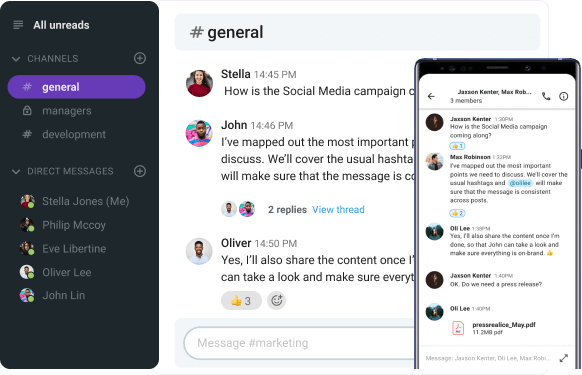
Whether you’re running a small business or a large enterprise, facilitating effective communication is probably at the top of your priority list.
A reliable business messaging app can simplify this process while improving your team communication and productivity.
But how do you pick the right one?
Unfortunately, many of the available options are part of overcluttered software suites, so finding lean, cost-effective alternatives takes some work. Not to mention, the tiered pricing of legacy tools can make you feel pressured to upgrade your subscription just to keep up with new releases.
In short, the entire thing is a lot more complicated than it needs to be.
To save you the headache, I’ve tested 8 different instant messaging apps to find the best ones — so you’ll surely find the right fit for your business on my list.
Now, let’s get into it!

Why trust us?
The apps we talk about are selected, tested, and written about by human reviewers who follow strict review and editorial guidelines. We pick solutions that are practical, purposeful, and can offer real value for the specific use case or business context we’re covering — while also being justified in their pricing. Our methodology is transparent, clear, and available to everyone:
Overview: Best instant messaging apps for business in 2026
Before we get into a detailed review, let’s get a quick overview of the standout features and pricing of the business messaging apps on our list.
| Business messaging app | Best for | Standout feature | Pricing (per user per month) |
|---|---|---|---|
| Pumble | Teams that need full access to their conversations & shared files | Unlimited message history | Free; Paid plans start at $2.49 per user per month |
| Google Chat | Teams using Google Workspace | Generous cloud storage | Free; Paid plans start at $7 per user per month |
| Mattermost | Teams looking for open-source collaboration software | Robust security | Free; Paid plans start at $10 per user per month |
| Slack | Teams that require extensive integrations | Powerful integrations | Free; Paid plans start at $8.75 per user per month |
| Microsoft Teams | Enterprises needing substantial collaboration functionality | Integration with Microsoft 365 | Free; Paid plans start at $4 per user per month |
| Chanty | Teams focused on task management | Teambook with conversations, tasks, and members | Free; Paid plans start at $3 per user per month |
| Rocket.Chat | Teams that require high data protection | Self-managed deployment | Free; Paid plans come with customized pricing |
| Twist | Teams looking to attend fewer video meetings | Threads | Free; Paid plans start at $6 per user per month |
Pumble by CAKE.com — best for remote & hybrid teams who need persistent communication history
Pumble is an asynchronous collaboration and communication tool offering many nifty features, including:
- Instant messaging,
- File sharing,
- Video conferencing, and more.
Thanks to its extensive free plan — which includes unlimited users and a fully searchable message history — Pumble has gained a reputation as one of the top internal communication tools for hybrid teams.
Pros of using Pumble as a business messaging app:
As part of a remote team, my teammates and I rely on Pumble for all things communication and collaboration, and we’ve never had any issues whatsoever.
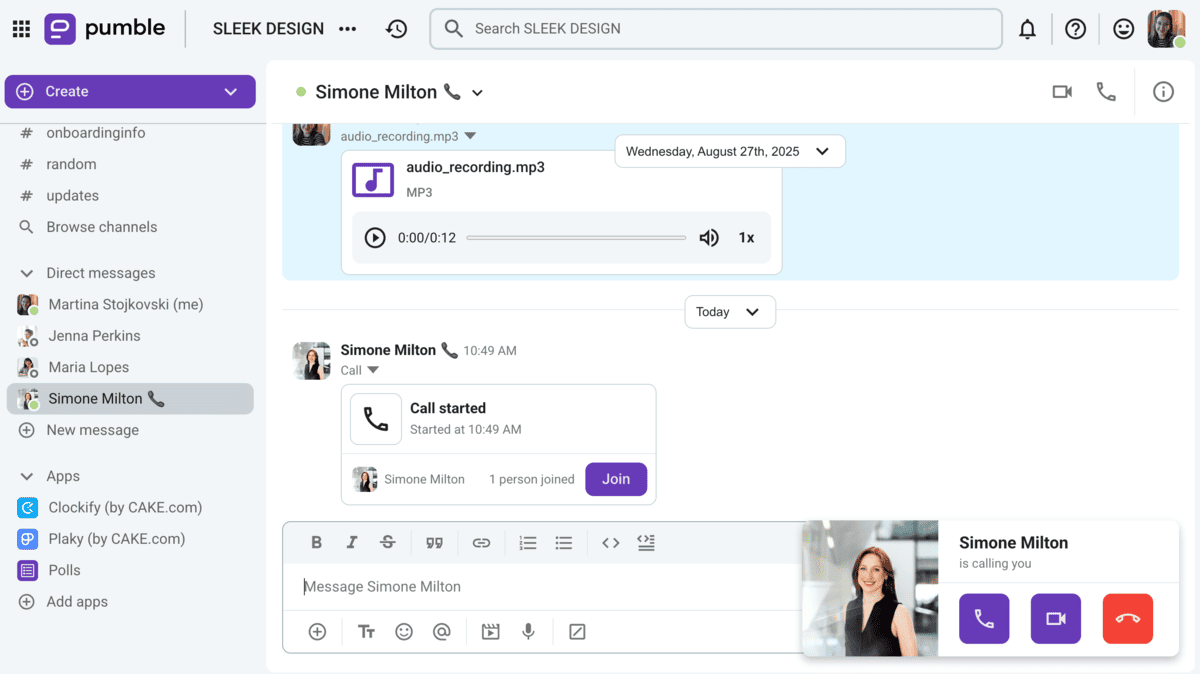
Besides connecting with coworkers and clients through direct messages, I can also join private and public channels — perfect for sharing updates and announcements. Not only can I choose which channels to join or leave, but all conversations are organized into threads. This way, I can keep up with relevant replies without the pressure to respond immediately.
The unlimited message history — available across all plans — preserves all the DMs, files, and links you’ve sent, so the information you need is ready whenever you log in.
Most importantly,the layoutand design are very user-friendly, giving you access to advanced features without a steep learning curve!
Cons of using Pumble as a business messaging app:
There are currently no read receipts in Pumble. Thus, you won’t know whether your coworker has seen your message unless they leave a reaction or respond back.
What’s new in Pumble: Users can now zoom in/out when sharing their screen during video meetings.
Available for: Web, Mac, Windows, Linux, Android, and iOS
Pricing: Free plan available; paid plans start at $2.49 per user per month
Google Chat — best for Google Workspace users
Fans of the Google Workspace arsenal of tools might have tried Google Chat, a team chat app with a simple interface and a decent volume of features.
Although more basic than other messaging apps on our list, Google Chat can meet the communication needs of most teams — especially if they already use the Google Workspace suite.
Pros of using Google Chat as a business messaging app:
Google Chat offers exactly what I’d expect from a simple instant messaging app — 1-on-1 conversations and group messaging.
The interface reminded me of Gmail. While not the most creative, it’s functional, and the left-side panel displayed my:
- Shortcuts,
- DMs, and
- Spaces.
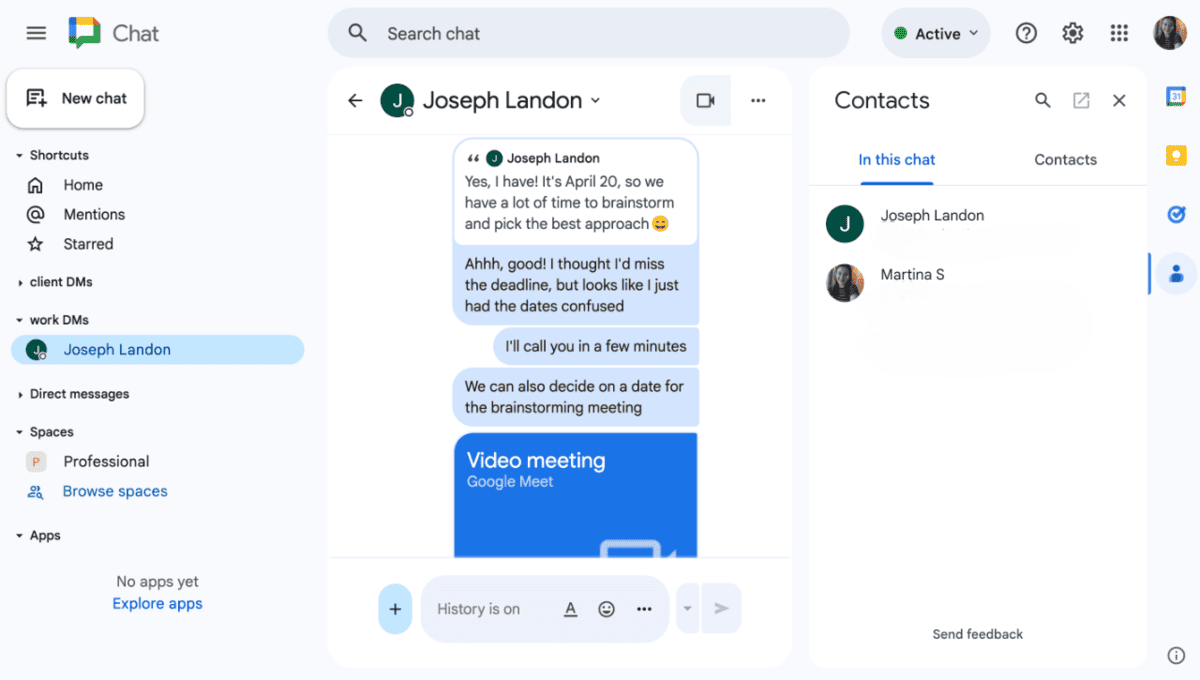
Spaces are like channels in other chat apps, which help categorize your conversations by topics or teams. You can go one step further and organize your chats into different sections.
Of course, you cansend files to share knowledge with your team and enrich your messages with context. And, if your team exchanges lots of messages, threads will prevent the discussion from veering off-topic.
Unlike more complex software, which often comes with convoluted pricing plans, Google has kept its Workspace pricing relatively stable. So, if your team has an active Google subscription, using Chat comes at no extra cost, making it one of the better “free” messaging apps for professional use.
Cons of using Google Chat as a business messaging app:
Organizations that rely on Google products for everything from project management to employee communication will probably have a good time in Google Chat.
Otherwise, you might experience some surprising downsides, like the one I encountered myself when I couldn’t find any contacts who use the app regularly. So, be sure to assess how many of your regular collaborators and clients actually use Google Chat before moving your entire business communication there.
What’s new in Google Chat: Google has recently integrated Gemini AI into Google Chat to provide users with:
- Smart replies,
- Conversation summaries, and
- Missed message recaps.
Available for: Web, Windows, Mac, Linux, Android, and iOS
Pricing: Free plan available; paid plans start at $7 per user per month

Mattermost — best for teams looking for an open-source messaging app
Mattermost is an open-source collaboration platform that supports:
- Messaging,
- File sharing, and
- Guest access.
As a result, it offers an elaborate structure for both remote communication and secure, in-office instant messaging.
Pros of using Mattermost as a business messaging app:
Whether you’re an individual user or managing a team, you’ll find plenty of native features and integrations in the app.
As open-source software, Mattermost is particularly suitable for tech-savvy teams in need of a comprehensive app that can handle:
- Task allocation,
- Business communication, and
- Project management.
Video calls are available through integrations, which surprised me, as many Mattermost alternatives provide native video conferencing. In fact, most of the instant messaging apps on this list double as video conferencing software.
Still, the built-in instant messaging feels smooth.
It’s safe, too, as Mattermost is known for strict security practices, which include:
- End-to-end encryption (E2EE),
- Multi-factor authentication, and
- Audit logs.
Unlike some other internal communication tools for hybrid teams, Mattermost offers self-deployment options catering to high security sectors like defense and government. Consequently, you can deploy Mattermost in an independent, air-gapped environment without the use of cloud services or the Internet.
Cons of using Mattermost as a business messaging app:
I find the app’s open-source nature to be a double-edged sword. For one, although you have more control over your workspace, you might need more advanced technical knowledge to navigate the UI and set up integrations.
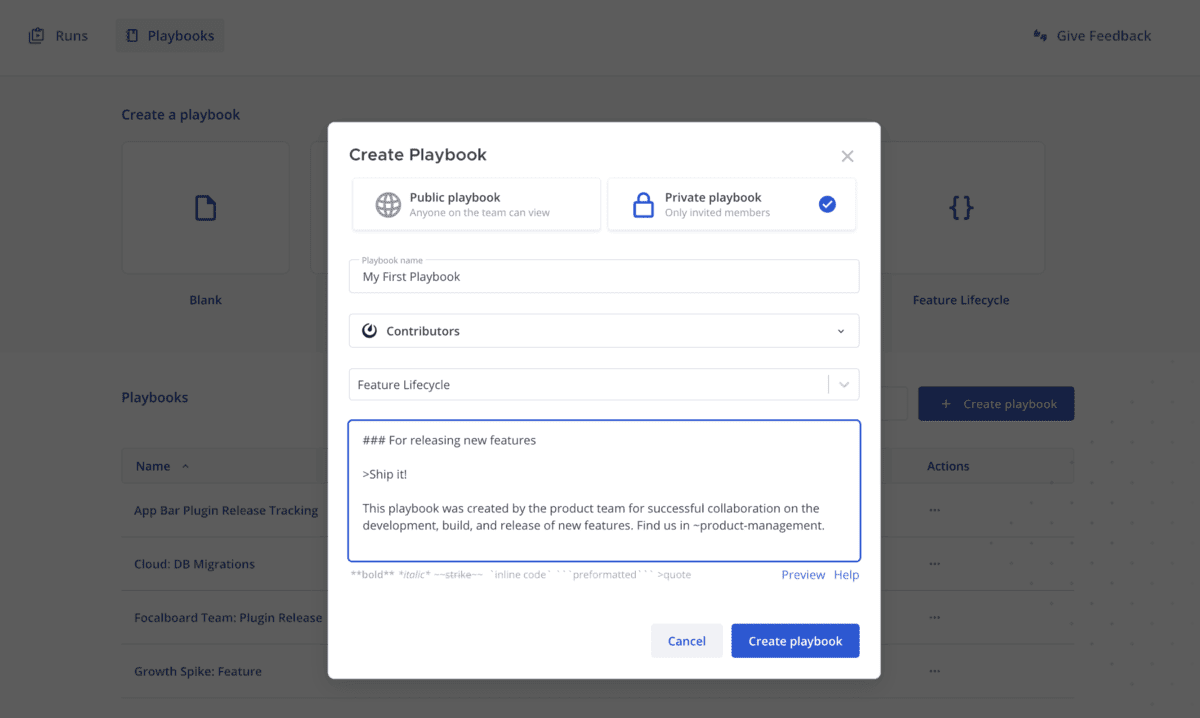
Moreover, it seems that the volume of features inevitably leads to clutter. The app does let you organize your conversations in channels, playbooks, and boards, yet it still manages to feel overwhelmingly busy.
Simplify communication with Pumble
What’s new in Mattermost: Multi-view threads are the newest addition in the Mattermost web app. The feature helps users open multiple windows and navigate several workflows simultaneously.
Available for: Windows, Mac, Linux, Android, and iOS
Pricing: Free plan available; paid plans start at $10 per user per month
💡 Pumble Pro Tip
Secure messaging has become an integral part of both internal and external communication, so don’t leave your data privacy up to chance. Find software you can trust here:
Slack — best for extensive integrations
Slack also makes an appearance in our round-up, offering:
- Direct messaging,
- Channels, and
- 1-on-1 and group calls (Huddles).
Pros of using Slack as a business messaging app:
Setting up and customizing Slack to suit your needs is pretty straightforward — at least in my case with the free app version. You don’t need any technical knowledge to create a workspace and invite your team to collaborate in channels.
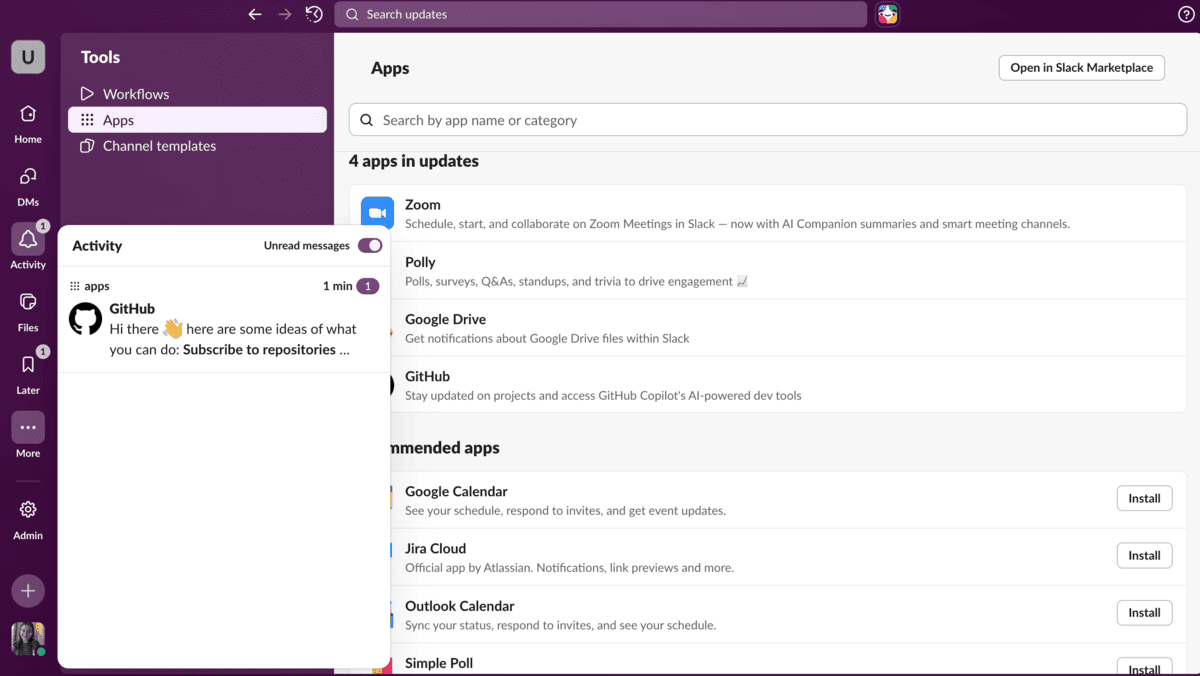
I was impressed with the Slack Marketplace, which houses over 2,500 third-party apps in its directory. This variety makes sense, as Slack mostly targets teams needing extensive integrations to get their job done. Still, if you’re not picky with the tools you use daily, it can get too busy on the interface front pretty quickly.
Anyone can create a public or private channel, which could suit teams handling many different projects. Similarly, it can add unnecessary noise to your digital headquarters. Fortunately, the threaded conversations kept my messages organized, so I could easily follow along, even in lengthy discussions.
Cons of using Slack as a business messaging app:
Despite its popularity, Slack offers a limiting experience, especially in the free plan.
The message history, which deletes your conversations after 90 days, is a personal deal breaker. Once you hit that 90-day limit, you’ll need to switch to a paid plan to access your full conversation history. This can be far too restrictive for teams who want a searchable database, and several Slack alternatives provide the same features at a more affordable price point.
Keep your messaging history forever
What’s new in Slack: Slack recently upgraded Slackbot, transforming it from a notification manager into an AI-powered agent.
Available for: Web, Mac, Windows, Linux, Android, and iOS
Pricing: Free plan available; paid plans start at $8.75 per user per month
💡 Pumble Pro Tip
Slack is a popular business messenger, but far from the only app that can handle team collaboration. For more options to compare against Slack, check out our selection:
Microsoft Teams — best for Microsoft 365 users
Microsoft Teams is a well-known enterprise instant messaging solution integrated into Microsoft 365, with features such as:
- Messaging,
- Video conferencing, and
- File sharing.
Its comprehensive feature set allows Teams to function on a UCaaS (Unified Communications as a Service) model — a single interface that grants users access to multiple tools and functionalities.
Pros of using Microsoft Teams as a business messaging app:
One thing I understood immediately about Microsoft Teams is that the app’s deep integration with Microsoft 365 makes it the obvious choice for companies already using the Microsoft suite.
Thus, it’s easy to go beyond messaging by accessing Office tools like:
- Word,
- Excel, and
- SharePoint.
The integration is seamless, and Microsoft’s SAML-based SSO (single sign-on) protocol makes it easy to access multiple apps after only signing in once.
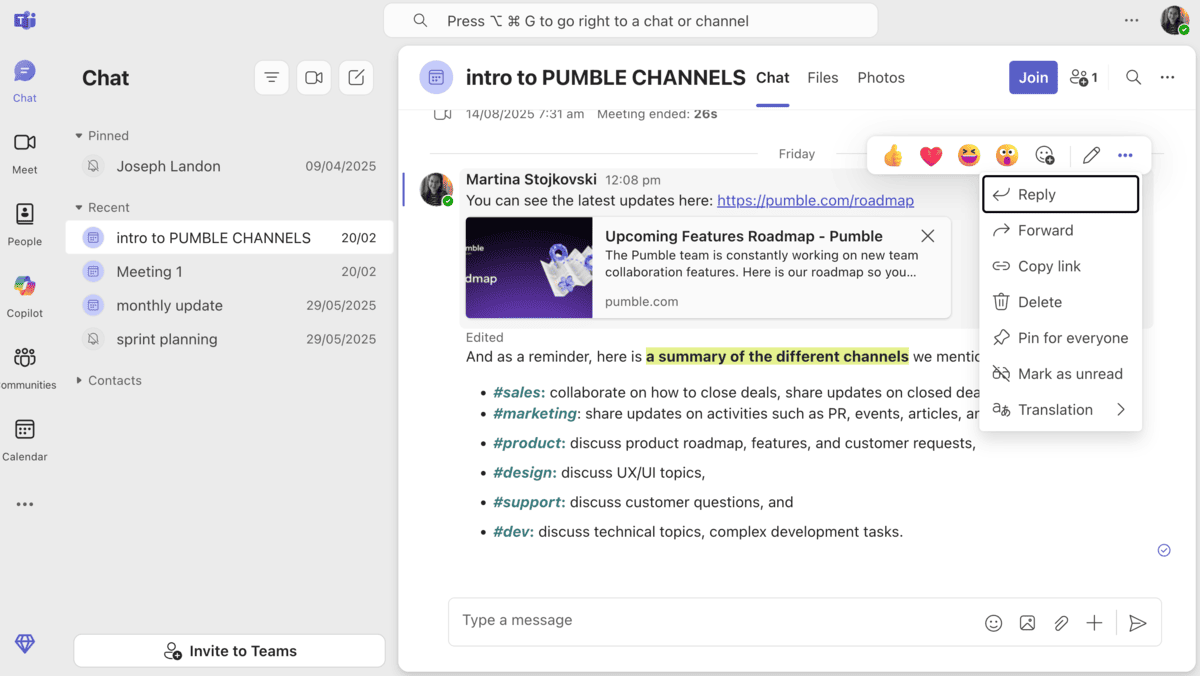
Similarly, I could easily switch between video calls and messages thanks to the left-hand panel. Teams also gives users the option to pin important channels and chats, which helps save time on days when incoming messages seem never-ending.
Cons of using Microsoft Teams as a business messaging app:
Unfortunately, the interface can get quite busy in no time. The left-hand panel does add a touch of order to the chaos, but your work can still get buried under unread messages and frequent calls.
Moreover, the July 2026 Microsoft pricing increases may redirect Business Basic and Business Standard subscribers toward a more affordable and user-friendly Teams alternative.
What’s new in Microsoft Teams: Users with a Microsoft Copilot license can receive customized recap summaries by choosing an existing template or creating one from scratch.
Available for: Web, Windows, Mac, Linux, Android, and iOS
Pricing: Free plan available; paid plans start at $4 per user per month
💡 Pumble Pro Tip
If you’re looking for more straightforward instant messaging solutions with extra flexibility and lower cost, check out our detailed list:
And for more specifics about the pros and cons of Microsoft Teams, head to our in-depth review:
Try Pumble for flexibility & value
Chanty — best for teams prioritizing task management
Chanty is an instant messaging app focused on task management, with solid team communication features that include:
- Texting,
- Voice and video calls, and
- Audio messages.
Pros of using Chanty as a business messaging app:
What stood out to me while trying Chanty was how task-oriented its features are. Calls and messages have become an industry standard, so unsurprisingly, there were no issues with:
- Video and voice calls,
- Screen sharing, and
- Guest access.
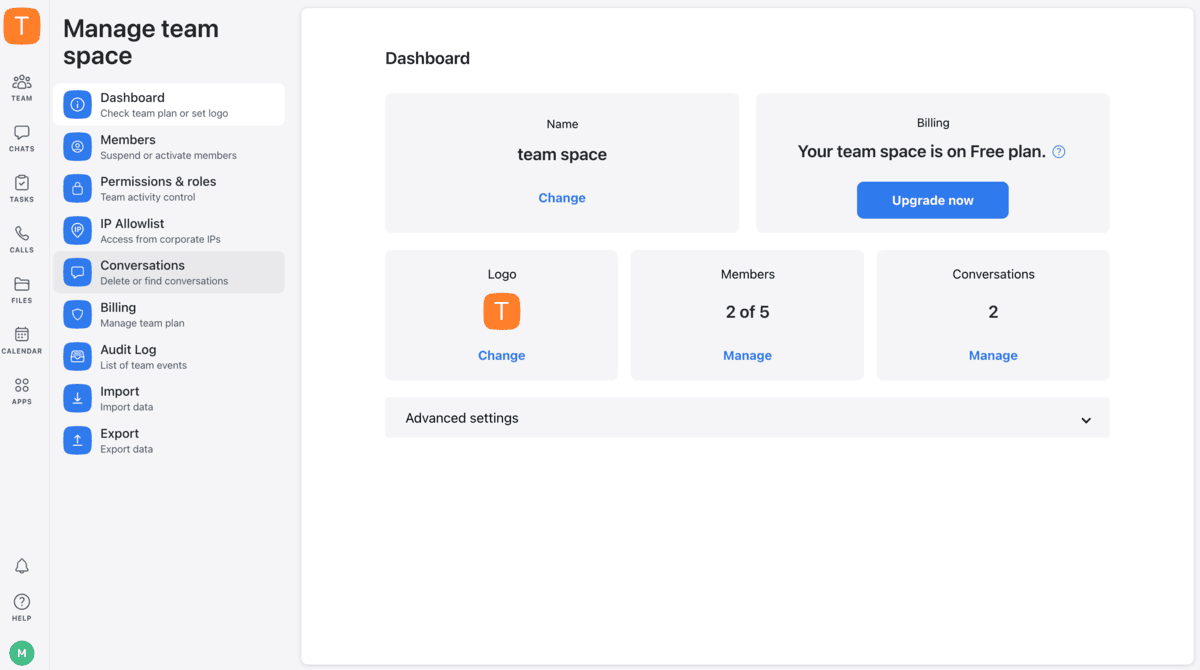
However, with Chanty’s functionalities, I could also:
- Group conversations around relevant tasks,
- Convert messages into tasks and assign them to team members,
- Keep an eye on conversations and shared files through the “Teambook” page.
The above features are easy to navigate, especially the Teambook, which ensures quick access to all team content. It’s then no surprise that many Chanty reviews acknowledge that the app meets most requirements small businesses might have.
Cons of using Chanty as a business messaging app:
Unlike popular Chanty alternatives, the software offers a limited free version that allows a maximum of 5 users. Integrations are limited, too. I could see these setbacks pushing potential users towards collaboration software that provides teams with the space they need to grow and scale.
What’s new in Chanty: The new built-in calendar transforms task lists into centralized overviews of due dates and deadlines.
Available for: Web, Windows, Mac, Linux, Android, and iOS
Pricing: Free plan available; paid plans start at $3 per user per month
💡 Pumble Pro Tip
On the hunt for a collaboration app that streamlines work and gets everyone on the same page? If so, take a look at the following round-up:
Rocket.Chat — best for teams with high data protection standards
Rocket.Chat is a team instant messaging app designed to let businesses have more control over how their sensitive data is managed.
As open-source software, Rocket.Chat prides itself on its numerous customization options and flexibility.
Pros of using Rocket.Chat as a business messaging app:
The app comes with many self-managed deployment options, giving you full ownership over your data. This feature signals that Rocket.Chat is primarily aimed at organizations handling confidential client information.
The app’s internal communication features cover the basics you’d see in a reliable business messaging platform, including:
- Native voice calls,
- Video calls (via integrations),
- File sharing, and
- Screen sharing.
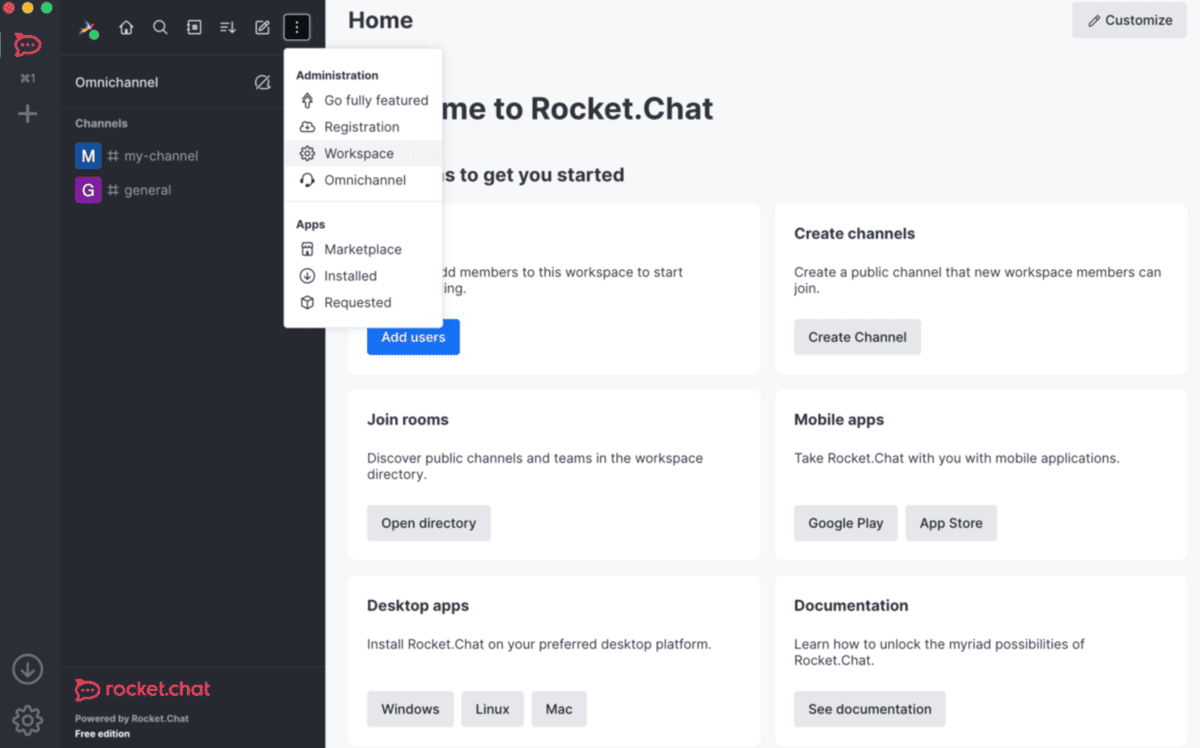
But, Rocket.Chat’s security measures impressed me more than its communication features. Within the app, you can protect sensitive information and systems using:
- Centralized identity management,
- Granular permission control,
- Role-based encryption policies, and
- Encryption passwords.
Similar to Mattermost, Rocket.Chat appeals to highly regulated industries requiring tight security measures. As a result, you can deploy the app on your own server or launch an air-gapped workspace without relying on internet access.
Due to its strong security, Rocket.Chat could be a good option when you want to keep customer communication away from prying eyes.
Cons of using Rocket.Chat as a business messaging app:
Compared to other work messaging apps on this list, Rocket.Chat takes the longest to set up and involves more complex steps. Many of the apps we’ve listed are easy to set up and navigate, making them excellent Rocket.Chat alternatives.
Additionally, the free plan limits businesses to 50 users, which can hinder teams hoping to expand.
Work with unlimited users in Pumble
What’s new in Rocket.Chat: Besides bug fixes, the app’s latest release focused on improving security, as new users are asked to create a strong password the moment they install the app.
Available for: Windows, Mac, Linux, Android, and iOS
Pricing: Free plan available; paid plans come with customized pricing
Twist — best for organizations wanting to cut down on meetings
Twist — an instant messaging app at its core — provides businesses with:
- Messaging,
- Channels,
- Threads, and
- Third-party integrations.
Pros of using Twist as a business messaging app:
With its focus on text messaging, Twist takes away the urgency usually associated with communication platforms like Microsoft Teams and Slack.
In fact, everything in Twist seems to revolve around eliminating distractions. The interface is sleek and intuitive, so from the get-go, I could:
- Send messages,
- Organize channels, and
- Browse threaded conversations from my inbox.
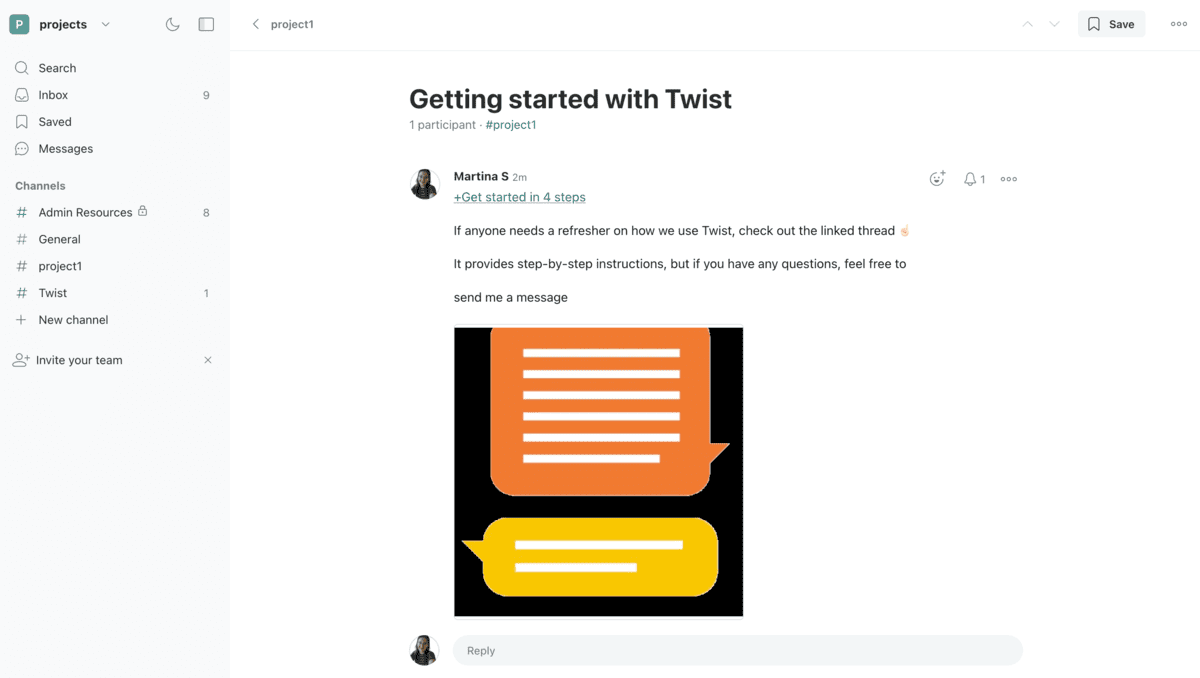
I particularly liked how the app compiled threads into my inbox and removed status activity bubbles, which let other users know whether you’re active or offline. This gave me the opportunity to figure out which discussions were urgent without wasting time combing through channels.
If you still use email but find it disorganized, Twist could be a handy email alternative. Its emphasis on async communication means you don’t have to rush to follow a conversation in real time. When you get the chance to take a closer look, the thread will be waiting in your inbox.
Cons of using Twist as a business messaging app:
The biggest letdown in Twist is that it doesn’t provide any built-in voice and video call features — part of the platform’s dedication to slow-paced conversations with fewer meetings.
Perhaps small distributed teams will make do with direct messaging, but most instant messaging platforms have moved beyond just text communication.
Another minus for Twist is that it reserves unlimited messaging history for paid users only. With the free plan, you can only access the last month of comments and messages.
What’s new in Twist: Twist has put a temporary halt on releasing new features within the app.
Available for: Web, Windows, Mac, Linux, Android, and iOS
Pricing: Free plan available; paid plans start at $6 per user per month
Find the right instant messaging app for your business
Making team communication work is no small thing.
And, the tools you choose to facilitate communication largely determine the outcome of your efforts.
Specialized instant messaging apps can make your business interactions easier and more efficient.
So, be sure to take your time to explore the different options we listed above and determine which communication solution best fits your team’s needs.
Ready to explore how Pumble by CAKE.com can level up your business communication and productivity?