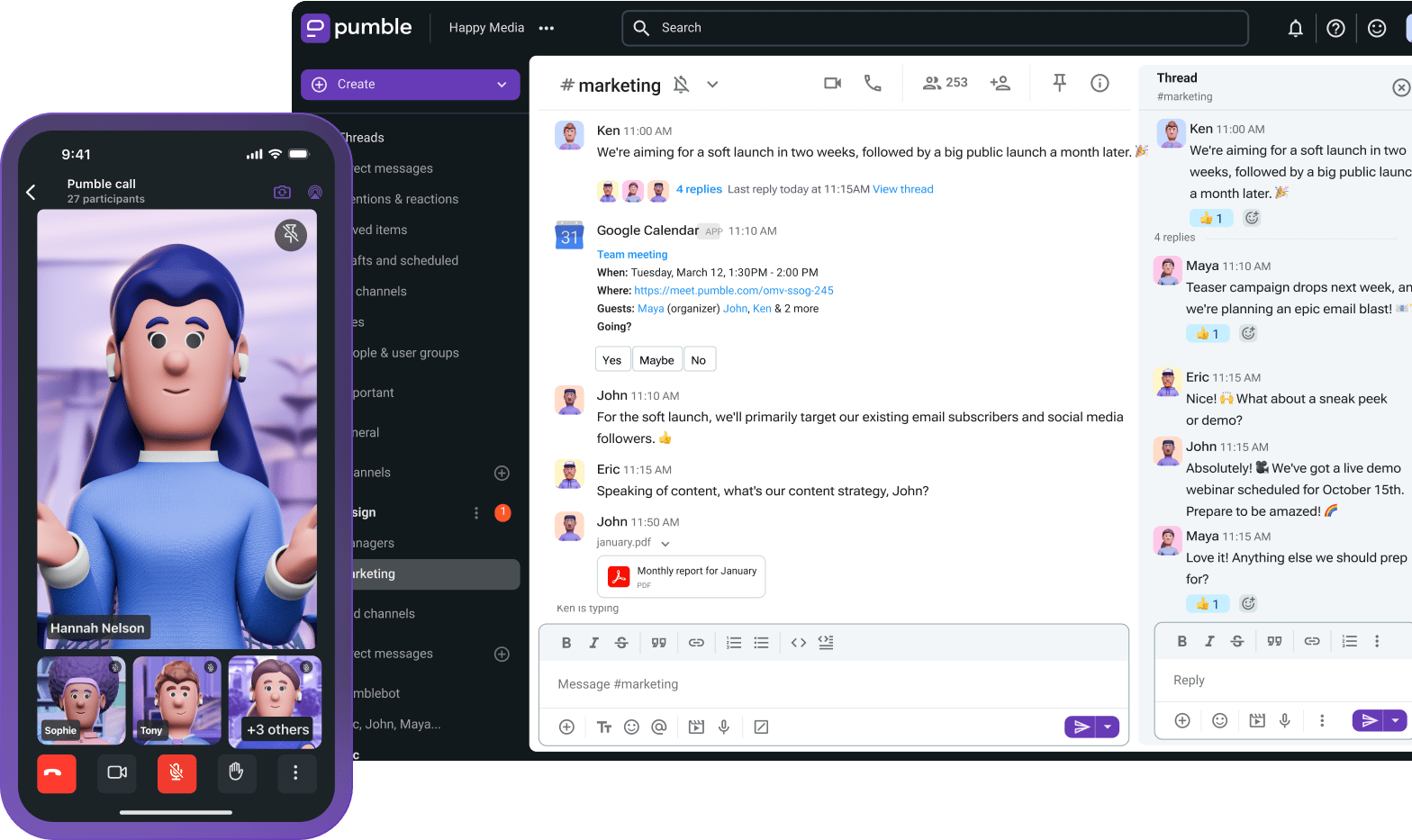
Looking for the best team communication tools for business can feel overwhelming. That’s why I researched, tested, and narrowed down the options.
Let’s take a look at the top 10 internal team communication tools for remote and office-bound teams.
WHY TRUST US?
The apps we talk about are selected, tested, and written about by human reviewers who follow strict review and editorial guidelines. We pick solutions that are practical, purposeful, and can offer real value for the specific use case or business context we’re covering — while also being justified in their pricing. Our methodology is transparent, clear, and available to everyone:
What are team communication tools?
Team communication tools are software platforms that allow teammates to communicate and collaborate through instant messaging, video and voice calls, shared files, and other workplace features.
The best business communication platforms are easy to use and support both synchronous and asynchronous communication, helping teams:
- Make faster decisions.
- Share information.
- Stay productive.
Top 10 team communication tools for business: A quick overview
Let’s first look at how I narrowed down my list of candidates.
Basically, I was looking for apps that had:
- Different communication features, from text to video conferencing and more
- A clean user interface (UI) that doesn’t require specialized training to understand it
- Several price tiers as well as a robust free plan, if possible
- Scalable features, like storage space
Here’s a general overview of the best team communication tools I’ve found.
| App | Best for | Standout feature | Price (per user per month, paid annually) |
|---|---|---|---|
| Pumble by CAKE.com | Teams that value organized communication and collaboration | Unlimited message history, unlimited channels | – Free – Paid plans start at $2.49 |
| Microsoft Teams | Teams that are already using Microsoft 365 | Microsoft 365 integrations | – Free – Paid plans start at $4 |
| Google Chat | Teams that are already paying for the Google Workspace | Google Workspace integrations | – Free – Paid plans start at $7 |
| Zoom | Teams that prioritize video communication | Zoom Meetings | – Free – Paid plans start at $13.33 |
| Slack | Teams that value integrations | Productivity integrations | – Free – Paid plans start at $7.25 |
| Chanty | Teams that want to see their tasks and conversations in the same place | Task management features | – Free – Paid plans start at $3 |
| Flock | Teams that need simple task tracking and collaborative features | Project management lists | – Free – Paid plans start at $4.50 |
| Twist | Teams that appreciate minimalist design | Email-like threads | – Free – Paid plans start at $6 |
| Zoho Cliq | Teams that need in-app productivity features | Remote work module | – Free trial – Paid plans start at $2 |
| Discord | Teams that prioritize voice communication | Always-on voice calls | – Free – Paid plans start at $2.99 |
#1: Pumble — best for organized team messaging and collaboration
Pumble by CAKE.com is a simple but powerful business messaging app that lets you organize your team’s communication into:
- Public and private channels
- Threads
- Direct messages
The app lets you onboard as many users as you want into your workspace and exchange as many messages as you need to — even on the free plan.
On top of that, Pumble’s UI makes it easy to find your footing and customize your experience by adjusting the sidebar and choosing a color theme.
Available for: Web, Windows, Mac, Linux, Android, and iOS
| Pumble’s plans | Pumble’s pricing |
|---|---|
| Free | $0 |
| Pro | $2.49 user/month |
| Business | $3.99 user/month |
| Enterprise | $6.99 user/month |
*billed annually
Organize your team communication
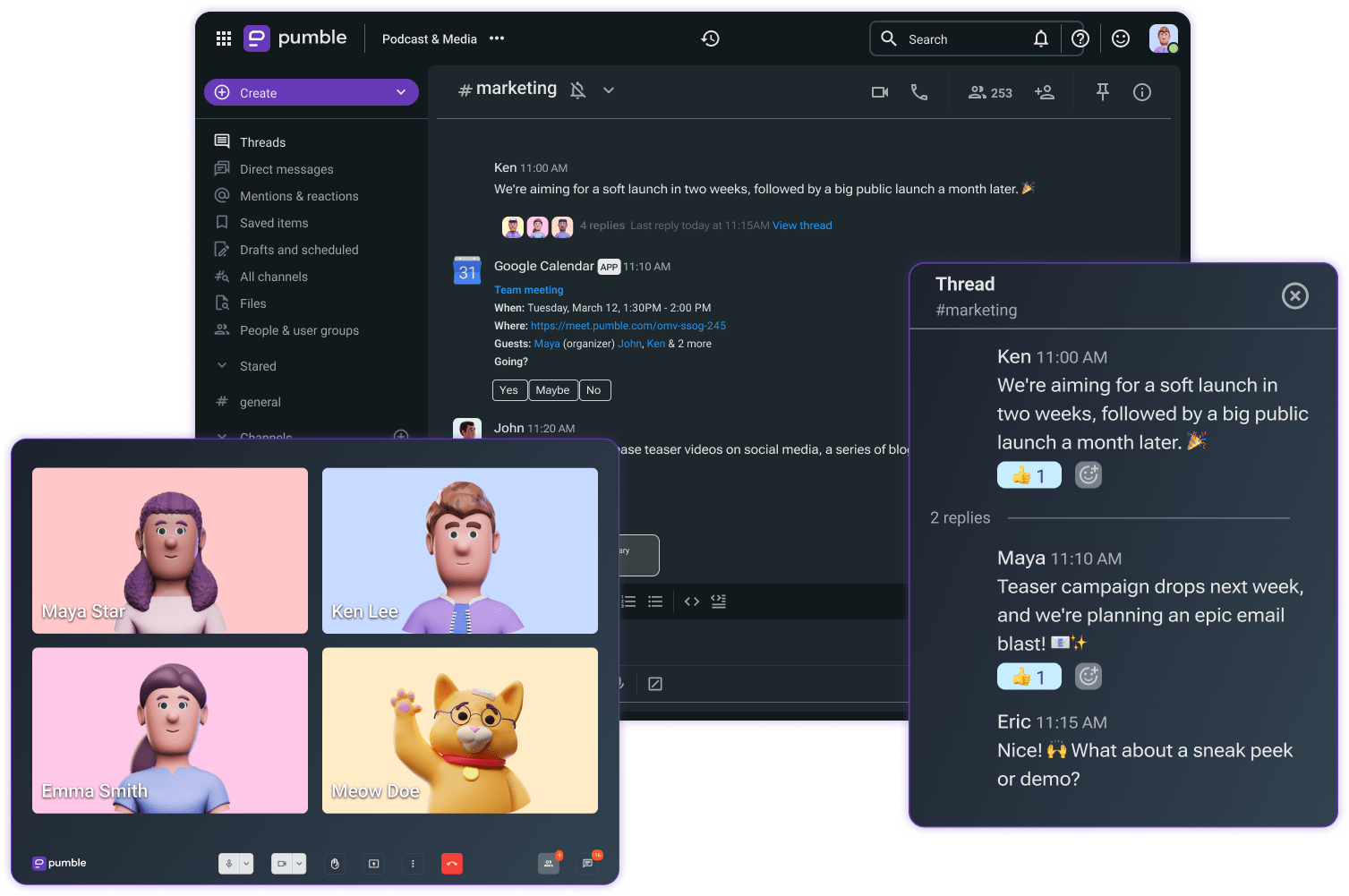
What makes Pumble one of the best team communication tools for business?
In addition to not limiting users’ searchable messaging history, Pumble’s free plan also lets you:
- Create an unlimited number of channels.
- Send voice and video messages.
- Have 1-on-1 meetings through voice and video calls.
- Take advantage of 10 GB of storage per workspace.
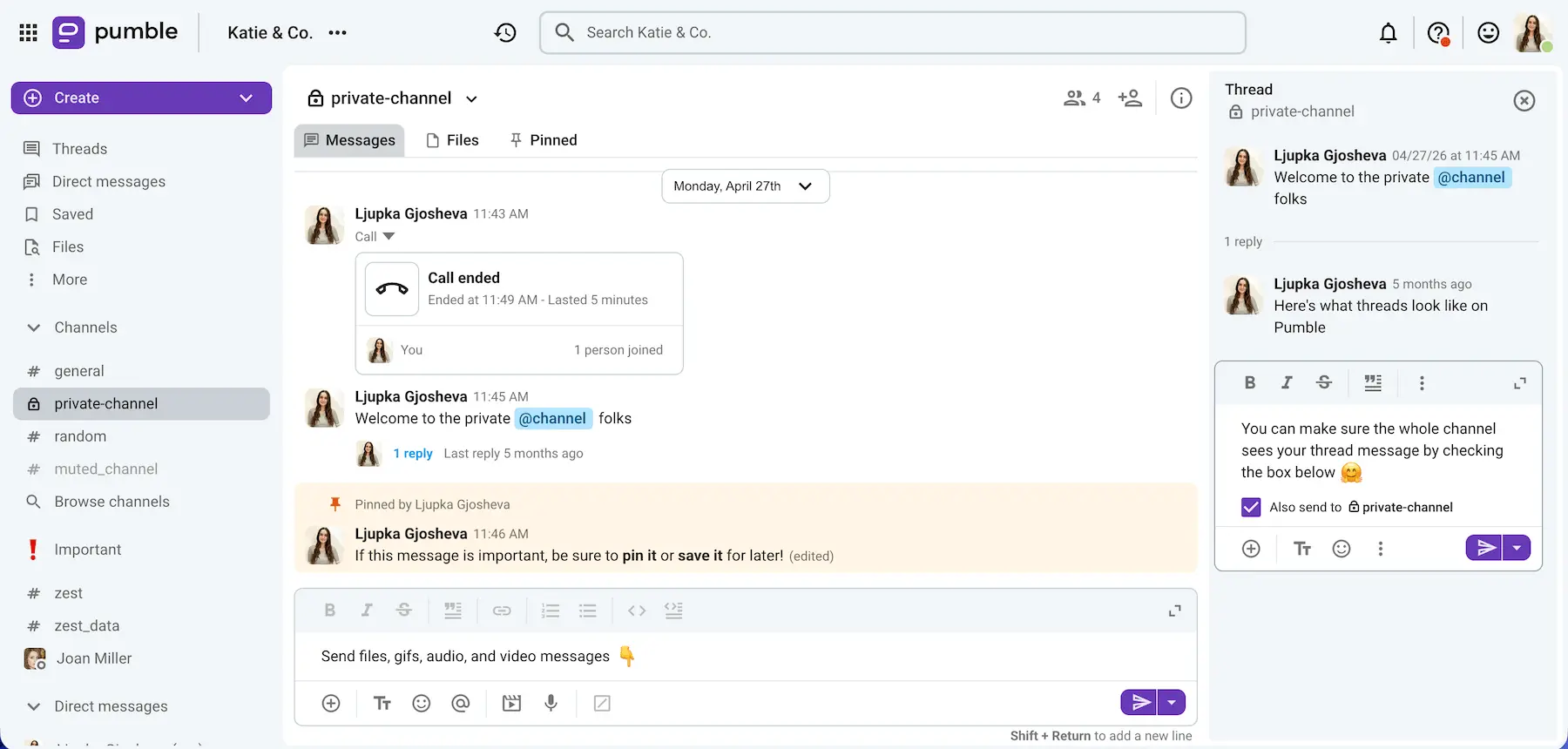
That amount of storage would let small teams share files and documents without much concern. However, you can also expand your storage by moving to one of the paid plans, which come with 10, 20, or 100 GB of storage per seat (allowing for infinite scalability as you onboard more employees).
Of course, Pumble doesn’t make you stick to one type of communication. If you prefer real-time communication, you can also explore the app’s video conferencing features by:
- Sending in-meeting messages
- Sharing your screen during meetings and using annotations
- Inviting external guests with meeting links even if they don’t have an account
- Using emoji reactions to respond to what others are saying without interrupting them
Bring your team together with Pumble
Basically, Pumble is a simple yet comprehensive app that gives you anything you could ever need to communicate and collaborate with your team — without being bloated with unnecessary features. But, if you do end up needing something more, you should be able to get it with Pumble integrations.
If I had to nitpick, I’d say that Pumble could add some virtual backgrounds in that pre-meeting screen. While I was testing the app, I could still set one up through my computer’s camera settings, but I’d love to see that feature added to Pumble itself.
| Pumble’s pros | Pumble’s cons |
|---|---|
| – Unlimited users and searchable message history, even for free plan users – Simple yet customizable user interface – Fantastic notification schedule settings – Channels, threads, and DMs – Video conferencing features – Optional integrations | – No built-in virtual backgrounds for video calls |
What’s new in Pumble?
Pumble recently launched its Trello integration and introduced Audit log, a new feature that helps you track changes and usage to keep your organization secure and prevent misuse.

#2: Microsoft Teams — best for Microsoft 365 users
Microsoft Teams is, without a doubt, one of the most popular team messaging apps on the market. And there are good reasons for that.
Even the free plan I tested offers plenty of features you can use to organize your team’s communication.
However, the app’s biggest advantage comes in the form of Microsoft 365 integrations, which require a paid subscription.
Available for: Web, Windows, Mac, Android, and iOS
| Microsoft Teams’ plans | Microsoft Teams’ pricing |
|---|---|
| Microsoft Teams | $0 |
| Microsoft Teams Essentials | $4 user/month |
| Microsoft Teams Enterprise | $8.55 user/month |
| Microsoft Teams Premium add-on | $10 user/month |
*billed annually
What makes Microsoft Teams one of the best team communication tools for business?
The basic version of Microsoft Teams has most of the features I want to see in my free team communication tools:
- Direct and group messages
- File sharing and search capabilities
- Great video conferencing features
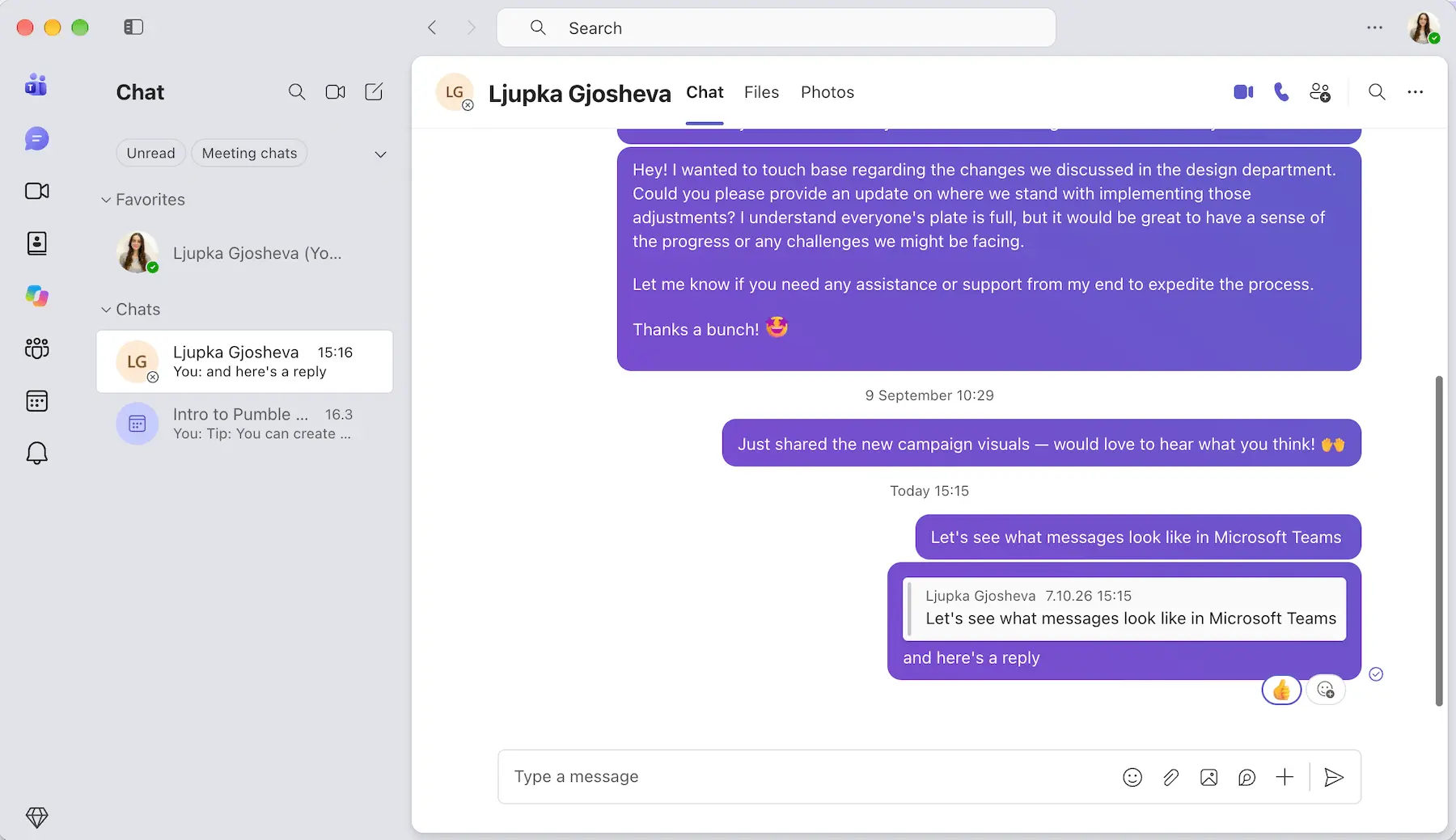
On top of that, free users get 5 GB of storage per user, while paying businesses can expand that to 10 GB per user with the Essentials and Enterprise plans.
Even though Microsoft Teams’ free plan lets you set up a team chat, it doesn’t have channels or threads or even Teams’ Teams feature (I don’t know why they called it that, either). Those all seem to be paid options that require some setup.
The app generally seems to have a steeper learning curve than Pumble, and the only way that wouldn’t concern me is if my employer provided tech onboarding for the app.
From the perspective of an employer, though, I’ll also say that Microsoft Teams costs a pretty penny when it all adds up — which is why most business owners prefer to look for Microsoft Teams alternatives.
| Microsoft Teams’ pros | Microsoft Teams’ cons |
|---|---|
| – Free messaging and file sharing – Video conferencing features – Channels and threads offer organized communication (for paying users) – Microsoft 365 integrations and more | – Complicated user interface (UI) – Channels and threads don’t come with the free plan |
🎓 PUMBLE PRO TIP
For a more in-depth breakdown of Microsoft Teams features and how they compare to Pumble’s, check out the following review:
What’s new in Microsoft Teams?
Teams now uploads shared files in the background, so you can keep working across chats and meetings without waiting for the upload to finish.

#3: Google Chat — best for Google Workspace users
If you’re already using Google Workspace tools to collaborate remotely with your team, why not try Google’s messaging app too?
Granted, even though I’ve been seeing that chat icon every time I went to check my work emails, I’ve never actually tried this messaging tool before this point.
Still, I was pleasantly surprised by the features I found, which included:
- A minimalist user interface
- Direct messages, mentions, and Spaces (which is Google’s version of channels)
- Integrations with Google’s tools and third-party apps
Available for: Web, Android, and iOS
| Google Workspace plans | Google Workspace pricing |
|---|---|
| Free | $0 |
| Business Starter | $7 user/month |
| Business Standard | $14 user/month |
| Business Plus | $22 user/month |
| Enterprise | Custom pricing |
*billed annually
What makes Google Chat one of the best team communication tools for business?
Google Chat functions as a simple messaging app — your voice and video calls will still be connected through Google Meet.
But then, that’s exactly what you’d expect from Google’s messaging tool. Most of the other collaborative features, such as task management, are also outsourced to the relevant Google Workspace apps. For example, any task you assign to someone within a Google Chat Space will appear in the Google Task app as well as your Google Calendar.
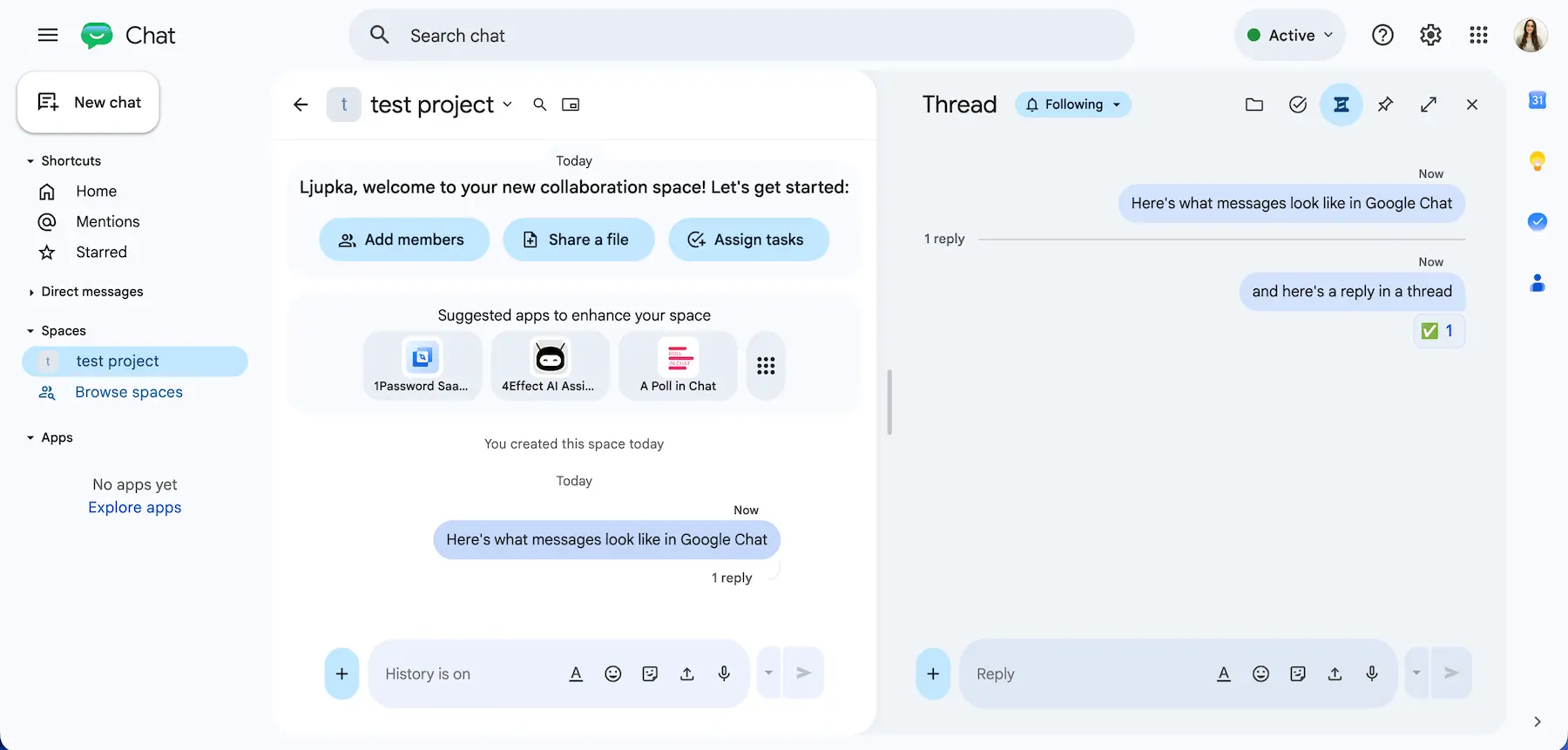
So, even though Google Chat lacks some of these features, it is well supported by the rest of Google’s ecosystem — for better or for worse.
| Google Chat’s pros | Google Chat’s cons |
|---|---|
| – Free with Google Workspace – Simple (but not customizable) interface – AI-powered search and predictive text – Deep integration with Google Workspace tools and some third-party apps | – Can’t be used without the rest of Google Workspace tools |
What’s new in Google Chat?
The new Trello for Google Workspace integration allows users to turn Google Chat messages directly into Trello cards without leaving the conversation.

#4: Zoom — best for collaborative video events
Most people know Zoom as the tool they need to host and participate in web conferences, but that’s not all there is to the software.
Just like Google and Microsoft, Zoom actually offers a large suite of remote team communication tools for business. Though Zoom Meetings is a part of that suite, Zoom Team Chat is also pretty good, letting users:
- Send text, audio, and video messages in DMs and channels.
- Share files and links.
- Easily find them thanks to the intuitive search feature.
Available for: Web, Windows, Mac, Linux, Android, and iOS
| Zoom’s plans | Zoom’s pricing |
|---|---|
| Basic | $0 |
| Workplace Pro | $13.33 user/month |
| Workplace Business | $18.33 user/month |
| Enterprise | Custom pricing |
*billed annually
🎓 PUMBLE PRO TIP
If you’re not a fan of Zoom, but you still need some of its features, you can see how it compares to other apps here:
What makes Zoom one of the best team communication tools for business?
Zoom Team Chat offers users enough features to get by with its Basic, free plan. I found the app easy to use and even aesthetically pleasing.
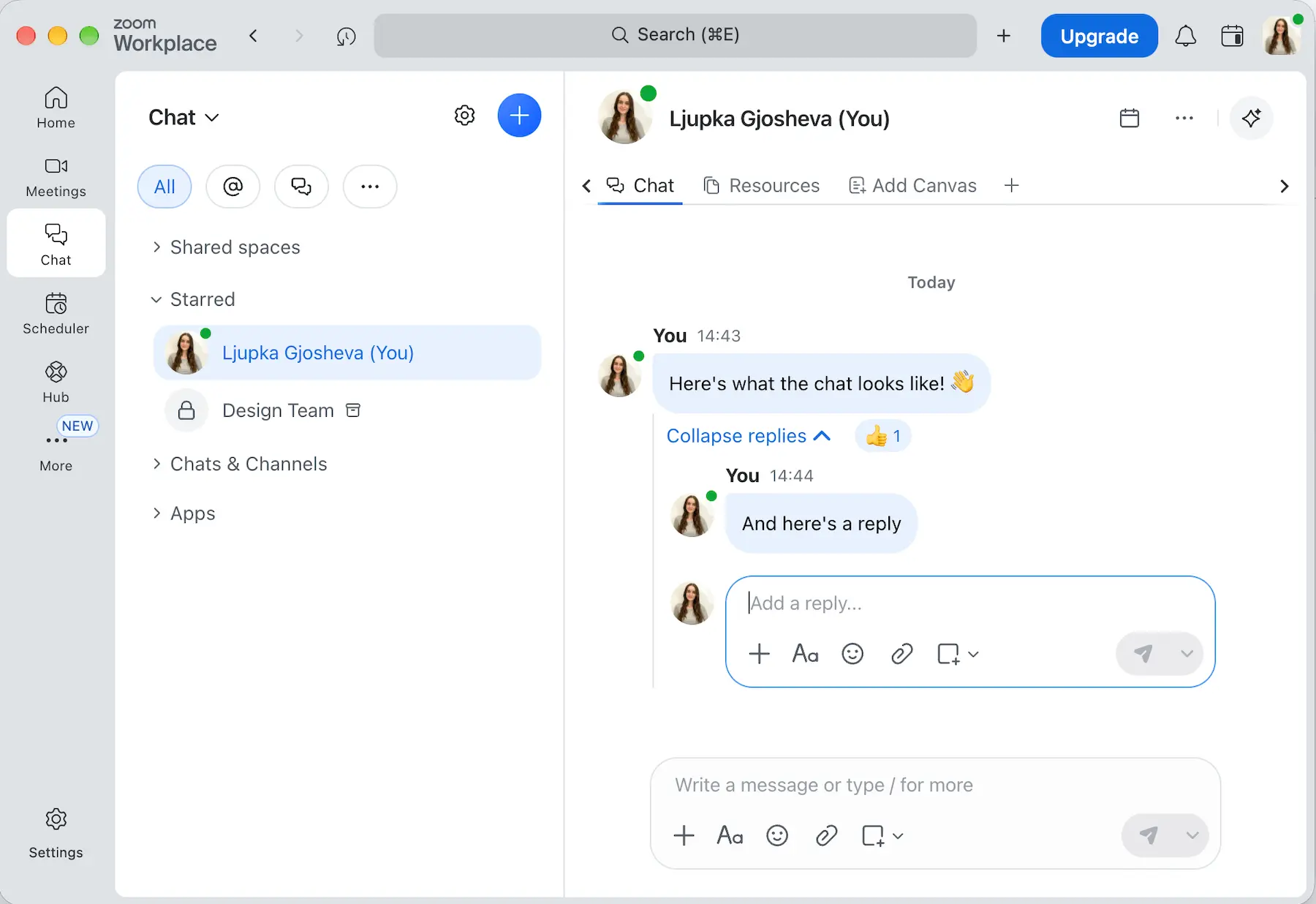
It’s important to note that Zoom also has built-in Mail and Calendar apps, and Meetings are just a tab away as well. Free users get:
- Unlimited number of 40-minute group meetings for up to 100 participants
- Unlimited 1-on-1 meetings
- Screen sharing, virtual backgrounds, and breakout rooms
- 3 editable whiteboards and 5 Zoom Clips (editable video messages)
However, if you’re able to cough up some (serious) cash, you’ll be able to enjoy added benefits like:
- 30-hour meetings
- 10 GB of storage per licence
- An AI companion
- Integrations
- Unlimited clips
I’ll admit that I got a bit lost for a minute there while I was diving through the settings of the app, so there’s something to be said about tech bloat here. But, overall, I find Zoom a great option for teams who prioritize collaborative meetings.
| Zoom’s pros | Zoom’s cons |
|---|---|
| – Highlights collaborative video events – Organized messaging through threaded replies and channels – Minimal design – Integrations (behind a paywall, but they exist) | – Very expensive |
What’s new in Zoom?
Starting October 23, 2026, Zoom Scheduler Basic will no longer be included in Zoom’s Basic and Pro plans. If you used it before September 4, 2026, you will retain access to Zoom Scheduler Basic.

#5: Slack — best for streamlining different tasks and apps
Though some people have become (understandably) disillusioned with Slack due to the limitations of its free plan, we can’t deny that the app is still one of the best virtual team communication tools for business.
Whichever plan you opt for, you’ll find plenty of useful features, including:
- Messages that could be sent through channels, threads, and DMs
- Meetings, or huddles, which could be easily started within the app
- Plenty of customization options and color themes
Available for: Web, Windows, Mac, Linux, Android, and iOS
| Slack’s plans | Slack’s pricing |
|---|---|
| Free | $0 |
| Pro | $7.25 user/month |
| Business+ | $15 user/month |
| Enterprise+ | Custom pricing |
*billed annually
🎓 PUMBLE PRO TIP
Looking for the best Slack alternatives? Check out our top picks:
What makes Slack one of the best team communication tools for business?
Slack is one of the best collaboration tools for teams that aren’t afraid of using apps with a somewhat steep learning curve.
Though the app’s UI is a bit too cluttered for my taste, it’s also chock-full of useful features and customization options.
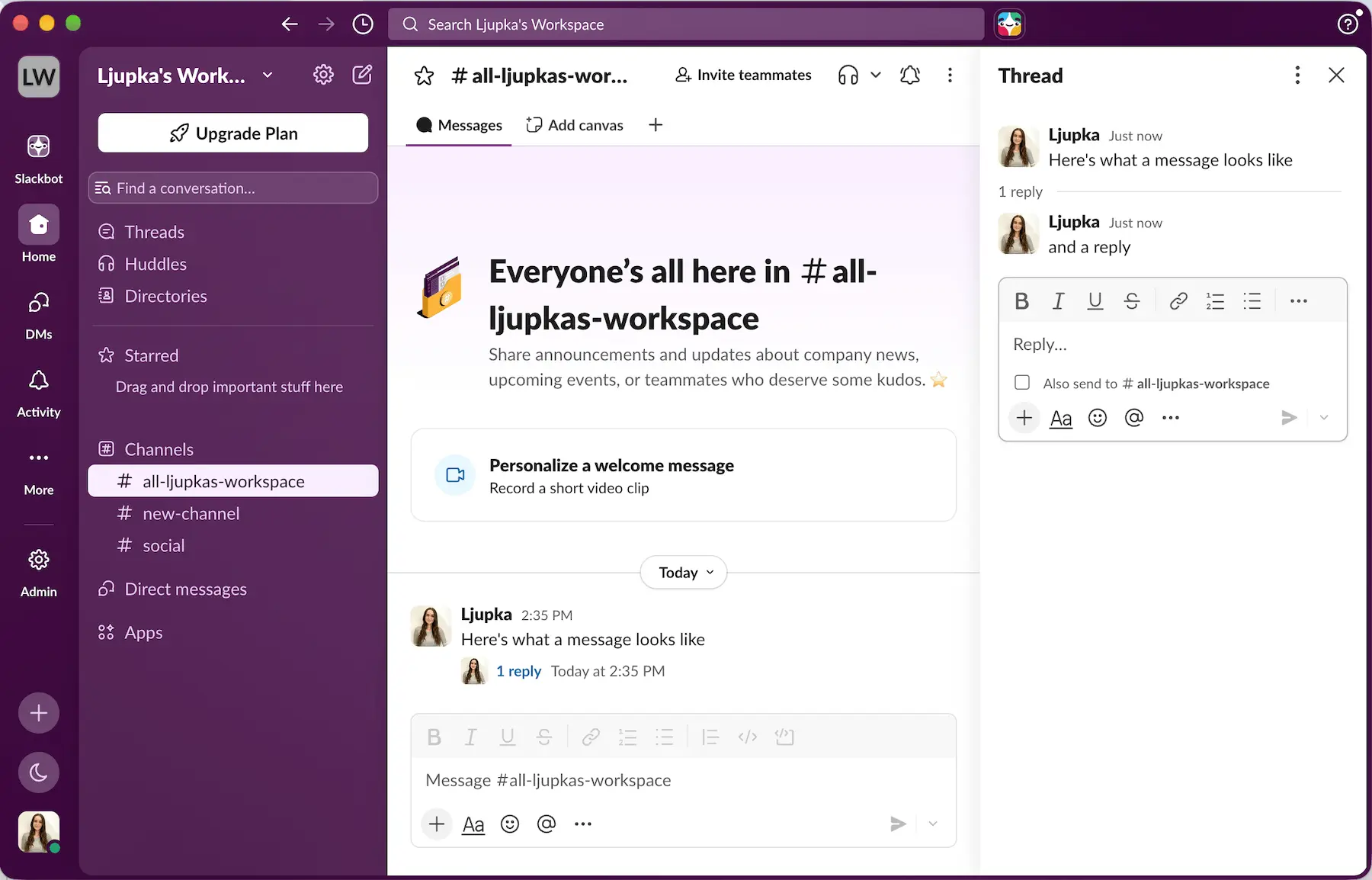
On top of that, the app also has some project management features, allowing users to:
- Track tasks with Lists.
- Create content with Canvases.
- Create workflows with Automations.
Though Slack’s pricing is quite steep, it also increases the functionality of these apps, in addition to adding various AI-powered features and security upgrades.
Still, its free plan comes with plenty of limitations, including:
- 90-day messaging history
- A cap of up to 10 app integrations
- Restricted 1-on-1 meetings and external messages
Get free unlimited messaging history
| Slack’s pros | Slack’s cons |
|---|---|
| – Channels, DMs, and thread messages – Plenty of customization options – Great meeting/huddle feature – Collaborative features like Templates, Canvases, and Lists | – 90-day files and message history limit on the free plan – Cluttered user interface – Free users don’t get 24/7 support |
What’s new in Slack?
Channel Managers in Enterprise organizations can now view the top messages and reactions, activity and membership trends, and post insights for channels with 50+ people directly from channel details.
#6: Chanty — best for organizing tasks and conversations
Like some of the other communication tools for remote teams we’ve discussed, Chanty positions itself as a hub of team communication and collaboration.
The app lets users:
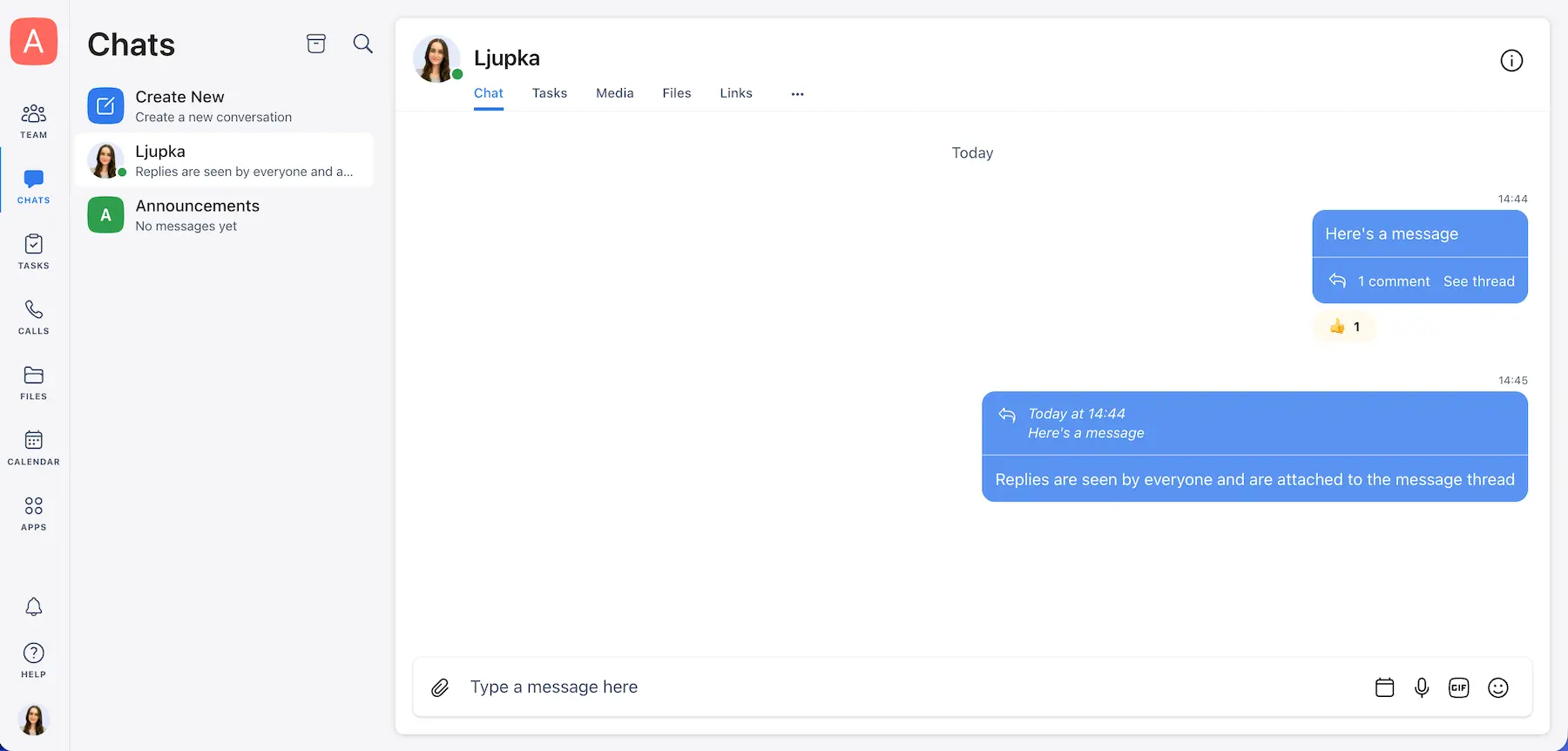
- Send messages and replies, which show up both in the main channel and in the message thread.
- Create tasks, which come up as separate channels in the side bar, allowing you to discuss the way these tasks are handled with everyone involved.
- Make audio and video calls (1-on-1 in the free plan).
Unfortunately, Chanty’s free plan is only available for teams with up to 5 members.
Available for: Web, Windows, Mac, Linux, Android, and iOS
| Chanty’s plans | Chanty’s pricing |
|---|---|
| Free | $0 |
| Business | $3 user/month |
| Enterprise | Custom pricing |
*billed annually
🎓 PUMBLE PRO TIP
Want to see how Chanty compares to a communication app like Pumble? Check out our review:
What makes Chanty one of the best team communication tools for business?
Like Pumble, Chanty’s free plan lets users create as many channels as they need and keep all their messages accessible forever, thanks to the app’s unlimited message history. So, even though limiting free plan teams to under 5 members is a pretty harsh move, I can still recommend the app.
After all, both free and paying users get to experience Chanty’s minimalist user interface, which was a breath of fresh air for me, especially after experiencing Slack’s cluttered interface.
Discover a free Chanty alternative
Even with the additional channels that were added for every one of my test tasks I created, I still found it easy to get around the app.
In fact, the only thing I didn’t really like about the UI was the way the threads and the conversation details panels covered the main messages when I opened those elements. I suspect that those visibility issues could make users miss important messages in the chat.
And, if I’m sharing complaints, I should also note that Chanty only has a light and dark theme, but that’s not necessarily a dealbreaker — just a personal preference thing.
| Chanty’s pros | Chanty’s cons |
|---|---|
| – Unlimited messages and channels – Clean user interface – Incorporated task management – Decent video call interface – Integrations | – Limited customization (dark and light theme) – Extremely limited free plan (up to 5 members) |
What’s new in Chanty?
Chanty rolled out a built-in Polls feature for team conversations in July 2026. With it, you can easily create and manage polls directly within chats.

#7: Flock — best for simple task tracking and collaboration
Flock is another one of those team messaging apps that offer integrated project management features.
However, unlike Chanty, new to-dos don’t appear as separate channels — though they can be opened in separate lists and assigned to different team members.
Overall, Flock has pretty basic features, letting users:
- Send messages and voice notes in channels and direct chats.
- Share files and collaborate with to-dos and polls.
- Use reminders to make sure nothing slips through the cracks.
Available for: Web, Windows, Mac, Linux, Android, and iOS
| Flock’s plans | Flock’s pricing |
|---|---|
| Free | $0 |
| Pro | $4.50 user/month |
| Enterprise | Custom pricing |
*billed annually
🎓 PUMBLE PRO TIP
Curious to see how Flock compares to Pumble? Check out this comparison article:
What makes Flock one of the best team communication tools for business?
As soon as I made my Flock account, I found the app pretty easy to navigate, even though it could get a bit cluttered when I had the sidebars extended.
Still, with only a few clicks, I could make sure I only saw the messages I wanted to focus on.
Aside from the direct messages and channels, you can also send replies, though I could have used the added structure I get from Pumble’s thread feature.
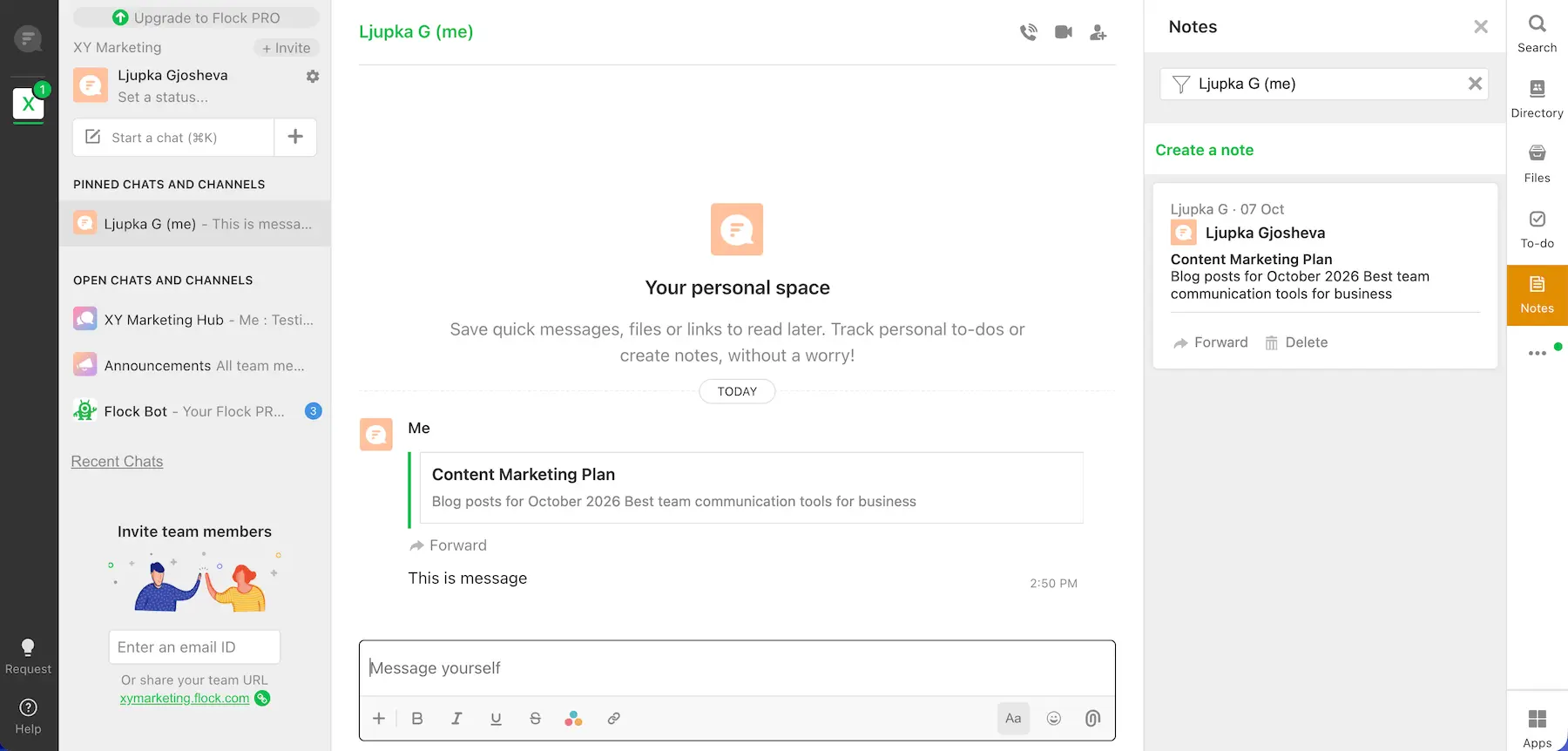
Much like its main communication features, Flock’s video conferencing features were pretty simple, so your team won’t have to worry about learning how to handle complicated tech.
If you’re going to use the free version, you should know that, like Slack, Flock’s free plan also limits users to:
- 10,000 searchable messages
- 10 public channels
- 5 GB of storage per team
Naturally, these features are expanded on the paid plans, which also increase your storage space to 10 or 20 GB per team member — depending on your plan.
| Flock’s pros | Flock’s cons |
|---|---|
| – Simple messaging in DMs and channels – Decent file sharing and search features – Collaborative features like to-dos and polls – Slack import | – 10,000 message history limit on the free plan – Sparse video conferencing features – Limited customization options |
What’s new in Flock?
Flock’s latest documented app updates date from 2025, with recent releases focused on bug fixes and performance, rather than major new features.
#8: Twist — best for teams that prioritize asynchronous communication
Twist is certainly one of the best async team communication tools I’ve seen, as its main features practically discourage users from engaging in real-time communication.
Reducing distractions is the point of this app, which is also supported by its simple UI.
Available for: Web, Windows, Mac, Linux, Android, and iOS
| Twist’s plans | Twist’s pricing |
|---|---|
| Free | $0 |
| Unlimited | $6 user/month |
*billed annually
🎓 PUMBLE PRO TIP
Want to see a more in-depth review of Twist? Check out this article that compares it to Pumble:
What makes Twist one of the best team communication tools for business?
Like I said, Twist takes a new approach to team communication, which is mainly reflected in its use of threads.
Namely, Twist users can’t send messages directly to channels. Instead, all communication is organized in threads, which makes team communication look a bit like emailing (and that Inbox tab on the sidebar doesn’t help that association).
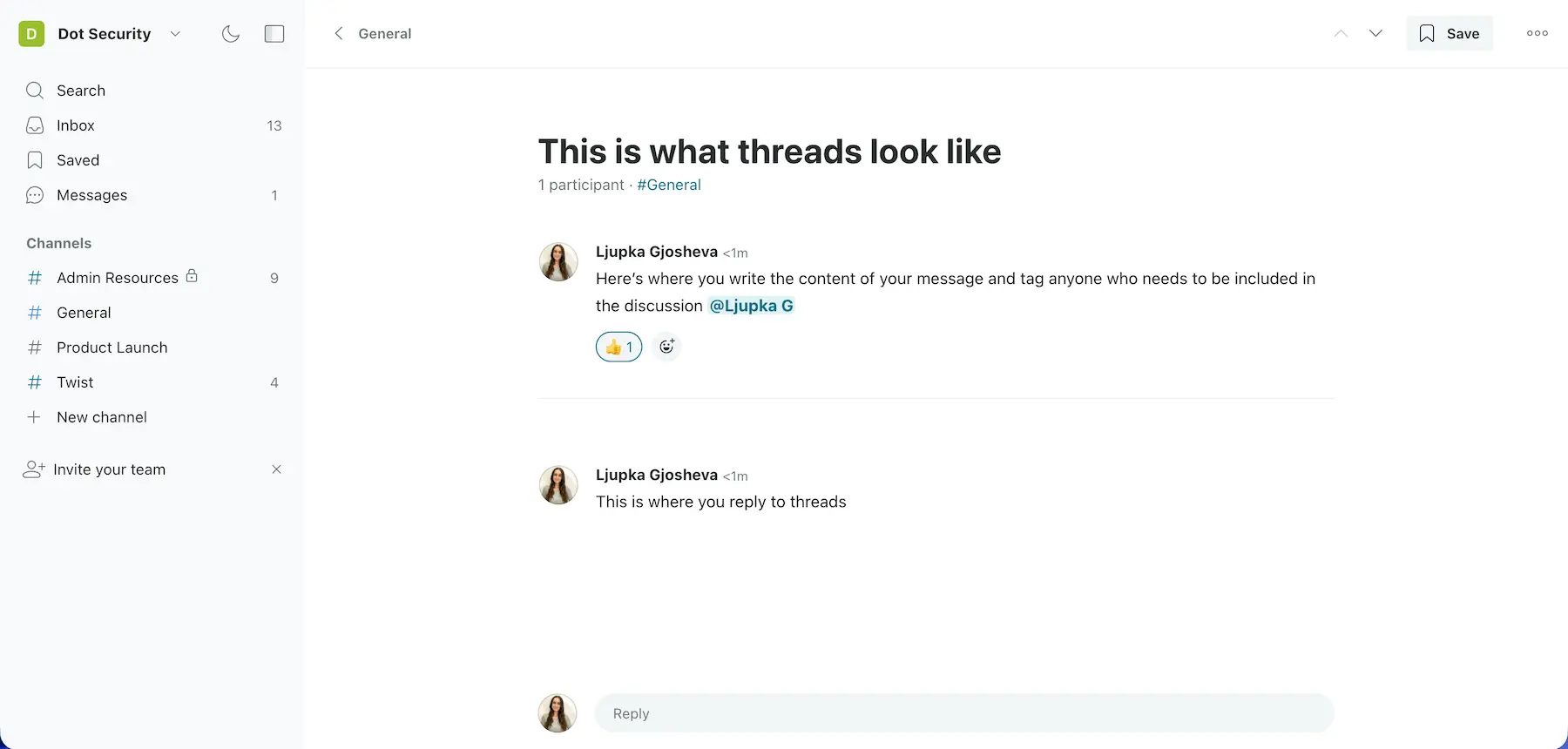
In any case, users must give their thread an appropriate subject line and explain what will be discussed in the replies below. As you talk, you can also easily assign certain messages as tasks through your Todoist account. And, once your team has reached the end of the discussion, you can close the thread and even write the conclusion of the conversation when you do.
At that point, the thread will disappear from the channel that hosted it (unless you make closed threads visible through the channel settings).
Of course, if the topic ever needs to be revisited, you’ll be able to find the thread through the search feature and reopen it by simply adding a reply.
This is only one of the ways in which Twist prioritizes asynchronous communication. To name another, I only need to mention that the app doesn’t even have built-in video conferencing capabilities — though that feature is still present thanks to the app’s Jitsi Meet integration.
A much more concerning con would be the fact that free plan users only have access to a month of their comments and messages.
Keep all your messages forever
| Twist’s pros | Twist’s cons |
|---|---|
| – Clean user interface – Prioritizes asynchronous communication – Organized discussions in threads – Unread messages shown in the Inbox tab – Plenty of useful integrations | – No built-in voice or video calls – Free plan limits access to messages |
What’s new in Twist?
According to Twist’s website, the developers are taking a hiatus from adding new features to Twist.
#9: Zoho Cliq — best for in-app productivity tools
If you’re on the hunt for collaboration tools for remote teams that combine team communication with productivity features, you may like Zoho Cliq.
Zoho Cliq has most of the features you’d need to communicate as a team, including:
- DMs and channels where you can send messages and files
- Voice and video calling features for 1-on-1 or group meetings
- Screen sharing during calls for presentations and demos
Available for: Web, Windows, Mac, Linux, Android, and iOS
| Zoho Cliq’s plans | Zoho Cliq’s pricing |
|---|---|
| Free | $0 user/month |
| Standard | $18 up to 25 users/month |
| Professional | $2 user/month |
| Enterprise | $4 user/month |
*billed annually
What makes Zoho Cliq one of the best team communication tools for business?
Apart from the basics, Zoho Cliq includes several useful productivity features:
- A built-in calendar for scheduling events
- Task management available on paid plans
- Reminders for keeping track of important tasks
- Notes for capturing information
It also includes a Remote Work module that lets you check in and check out to track your hours when working remotely.
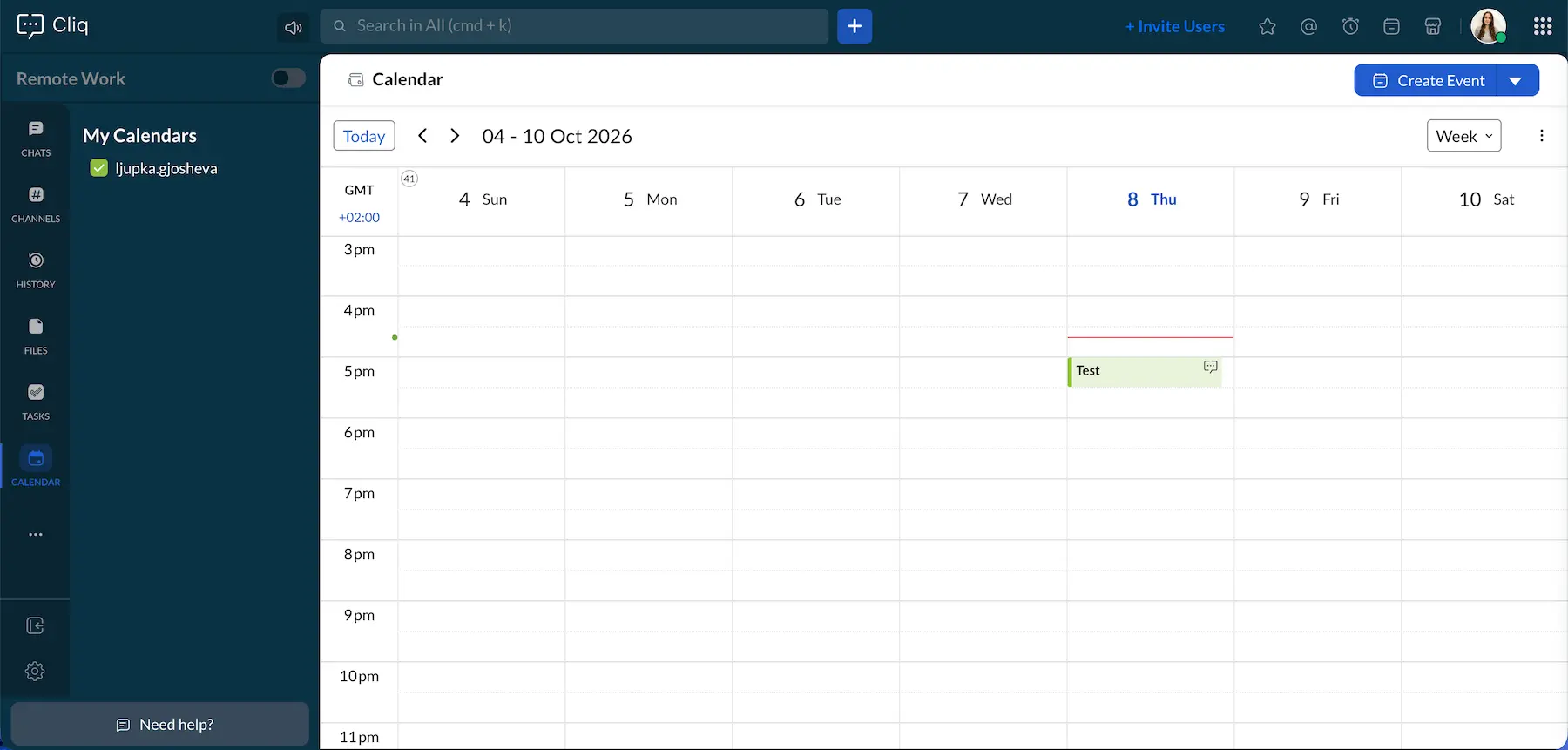
One feature I particularly appreciated was the organization view, which makes it easier to see how the company is structured and find people within it.
However, like many other apps, Zoho Cliq’s free plan comes with some limitations that could be an issue for larger teams. For example, group chats are limited to 100 participants, and users can only search the most recent 10,000 messages.
Access all your messages for free
| Zoho Cliq’s pros | Zoho Cliq’s cons |
|---|---|
| – Messaging in DMs and channels – Voice and video calls with screen sharing – Built-in productivity features | – Limited free plan |
What’s new in Zoho Cliq?
Zoho Cliq added a Poll extension that lets teams create chats for individual poll options, making it easier to discuss choices.

#10: Discord — best for voice communication
Discord markets itself as a group chat app that’s all fun and games — but that shouldn’t make you dismiss the platform as a potential collaboration tool for your team.
In fact, I know some people who use Discord to communicate with their coworkers. Granted, they work on pretty small teams, but they’re on call all day while they work — sometimes muted, sometimes in active communication.
Available for: Web, Windows, Mac, Linux, Android, and iOS
| Discord’s plans | Discord’s pricing |
|---|---|
| Free | $0 |
| Nitro Basic | $2.99 user/month or $29.99 user/year |
| Nitro | $9.99 user/month or $99.99 user/year |
🎓 PUMBLE PRO TIP
Is Discord the right fit for your team or should you go for an alternative instead? Check out these comparison articles to find out:
What makes Discord one of the best team communication tools for business?
Like the other team messaging apps we’ve discussed, Discord offers its users:
- An unlimited message history in direct chats, channels, and threads (which appear in the sidebar under the channel they belong to)
- The option to send voice and video messages, as well as screen recordings
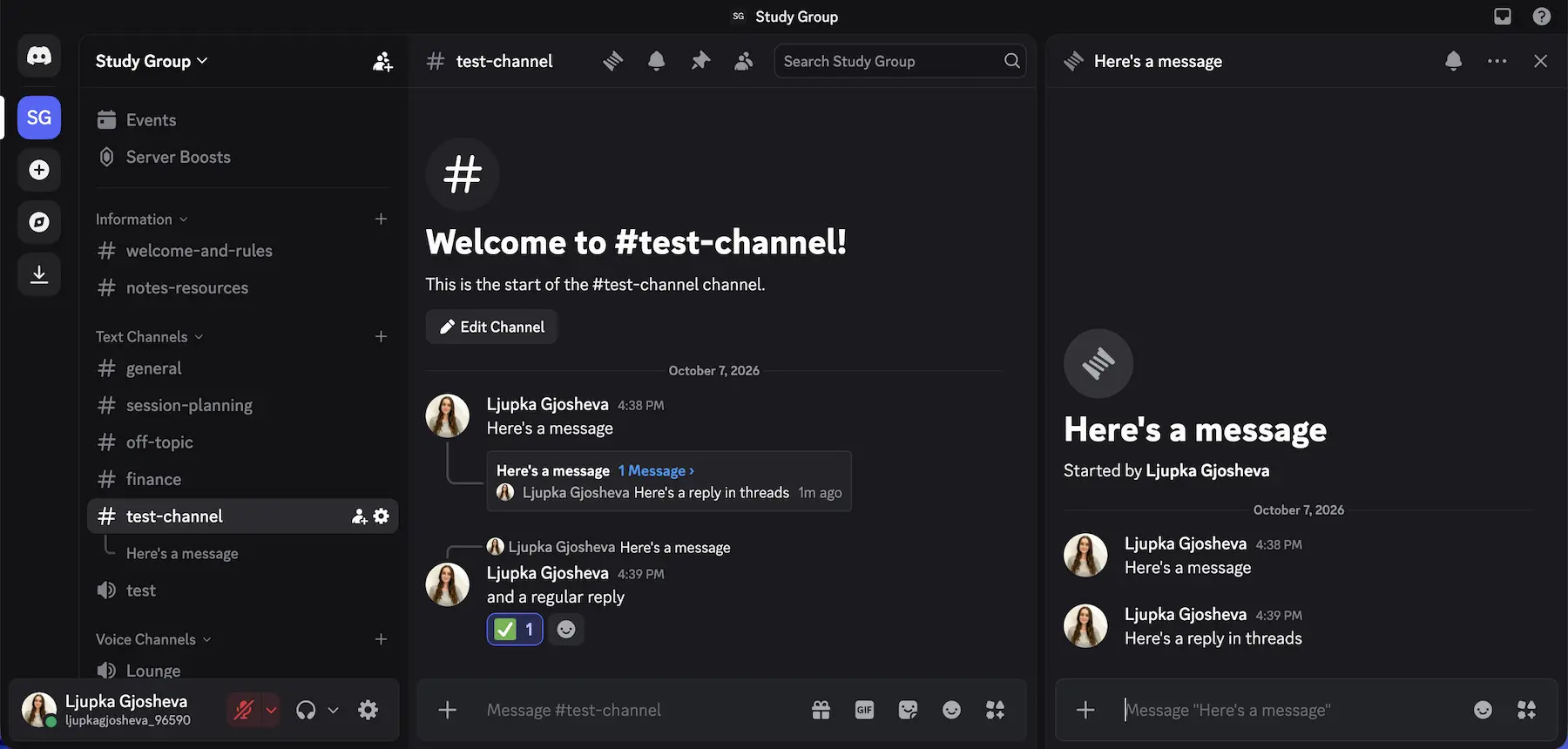
However, the app definitely prioritizes voice and video calls, and many people use it to stay on a call and coordinate with others while gaming.
Because of that, Discord has some pretty whimsical features (like the fact that its emoji picker icon changes to a different emoji every time you hover your cursor over it). Generally, the platform seems to embrace the chaotic nature of its original purpose, which is also reflected in its cluttered UI.
Still, Discord’s always-on calling feature might also make it a great solution for distributed teams that want to feel more connected or professionals who have to be available around the clock — like security teams.
Try a free Discord alternative
But, keep in mind that, while voice calls can be joined by any number of users, video calls can host up to 25 people in a standard voice channel.
Speaking of which, I found that Discord’s free plan had plenty of useful features — which is a good thing, because its paid plans certainly don’t add anything in terms of professional tools. Rather, they just add account personalization options, which reminded me that the platform is, ultimately, not made for professional use.
| Discord’s pros | Discord’s cons |
|---|---|
| – Emphasis on always-on voice channels – Unlimited message history and storage (though file size is limited to 20 MB on the free plan) – Decent text-based communication features (channels, DMs, threads) | – Somewhat cluttered interface – Not designed for professional use – Paid plans mostly expand your personalization options |
What’s new in Discord?
Discord has recently doubled its free file upload limit from 10 MB to 20 MB.
FAQ
These are some of the most common questions people ask when choosing a team communication tool for their business.
What are communication tools in the workplace?
Communication tools are software platforms that help employees communicate and collaborate through messaging, voice and video calls, files sharing, and other workplace features.
What are some good tools for team collaboration?
Some popular team collaboration tools include Pumble, Microsoft Teams, Google Chat, Slack, Zoom, and Zoho Cliq. The best option depends on your team’s communication needs and budget.
What are the best tools for team communication?
The best team communication tool depends on your team’s needs. Pumble is a strong option for teams looking for organized messaging and collaboration, while tools like Microsoft Teams, Google Chat, and Zoom may be a better fit for teams already using their respective ecosystems.
How to choose the best team communication tool for your business
When choosing a business messaging tool, focus on the value you’ll get from it.
Additionally, choose an app that won’t drain your resources. In my opinion, these are the exact benefits you’ll experience after choosing Pumble.
Of all the team communication tools I’ve tested, Pumble has the best features for professional communication even on the free plan. Moreover, its solid built-in features can be further expanded through integrations — especially with its sister apps, Clockify and Plaky.
So, if you’re interested in seeing what those 3 can do, check out the CAKE.com Productivity Suite to save 53% on Clockify, Pumble, and Plaky subscriptions.
Or, if you’d rather try a piece of CAKE.com before devouring the whole thing, you can start using Pumble for free.
Onboard as many users as you want, and enjoy an unlimited message history right from the start.
How we reviewed this post: Our writers & editors monitor the posts and update them when new information becomes available, to keep them fresh and relevant.